AEO search involves organizing content so AI-driven answer engines including ChatGPT, Google AI Overviews, Gemini, Perplexity, and other answer engines choose and cite it as the direct response to a buyer's question. It extends SEO instead of replacing it, yet measurement focuses on citations and mentions across a representative set of prompts rather than rankings. Sona AI Visibility connects those prompts and citations with pipeline and revenue, where most tracking ends.
What is AEO in search, and how does it differ from SEO, GEO and AIO?
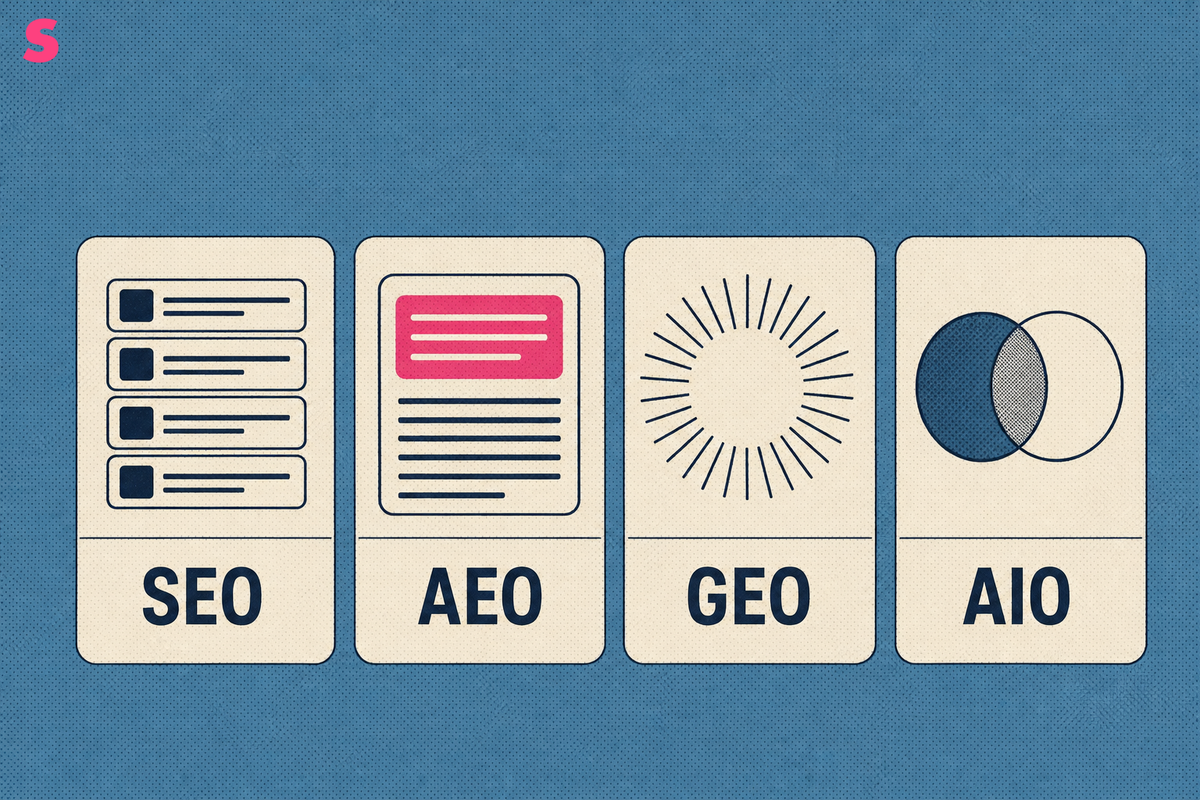
AEO search, or answer engine optimization, structures content so AI-powered search engines select it as a direct answer and cite it in a response. It focuses on usefulness within an answer, not only on ranking as a link on a results page.
SEO targets organic rankings and clicks from traditional search results. AEO targets selection, synthesis and citation in answers from ChatGPT, Perplexity, Gemini, Claude, Google AI Overviews and other answer engines. Both disciplines require crawlable, authoritative pages, but they produce different visible outcomes.
GEO, or generative engine optimization, is often used as a near synonym for AEO. Some teams use GEO for the broader work of influencing how generative systems describe a category, while AEO more specifically describes earning a direct answer or citation. Neither term replaces SEO.
AIO has two meanings that create confusion. It can mean AI optimization, the umbrella practice of adapting marketing for AI systems. It can also refer to Google AI Overviews, Google’s answer experience in search. AEO does not replace content strategy, digital PR or technical SEO. It measures and optimizes how those activities contribute to cited AI answers.
Why does AEO search matter for a B2B SaaS pipeline?
AEO search matters to B2B SaaS teams because buyers can research a category, compare vendors and form a shortlist before visiting a website. A citation in an AI answer can shape that evaluation even when the buyer never clicks a traditional organic result.
A demand generation leader needs more than a visibility score. The operational questions are whether the prompts that mention the company are commercial, which accounts engage after AI research and whether those accounts create pipeline. Mention tracking is the baseline. Revenue measurement determines whether the work deserves budget.
Sona AI Visibility connects citations to pipeline and revenue on one account timeline, and tracks which AI crawlers are reaching pages, so AI research can be measured alongside other marketing channels. The product tracks 11 AI engines, per Sona product documentation, October 2026.
Consider a buyer asking an answer engine for enterprise software that solves a defined workflow problem. A category page might earn a citation, but the more valuable outcome is a later demo request from an account that becomes a sales opportunity. AEO gives content, product marketing and demand teams a shared method for investigating that chain.
How do answer engines choose which sources to cite, and how do ChatGPT, Google AI Overviews and Perplexity differ?
Answer engines choose sources that help them construct a credible, direct response to a prompt. Clear answers, relevant evidence, accessible pages and recognizable entities make a source easier to retrieve, interpret and cite.
ChatGPT, Google AI Overviews and Perplexity all produce AI-generated answers, but they are distinct answer surfaces with different retrieval behavior and presentation. Google AI Overviews appear within Google Search. Perplexity foregrounds cited web sources in its response. ChatGPT can answer from model knowledge, web retrieval or both, depending on the product mode and prompt.
A B2B SaaS team should not assume that a page cited by one engine will appear in every engine. The practical unit of analysis is a prompt, an engine and the answer returned on a specific date. That unit makes a cited page observable without suggesting that one response represents the whole market.
Source selection changes as retrieval indexes, model behavior and competitor content change. Daily prompt tracking reveals persistent patterns that a weekly snapshot can obscure. Evaluate whether a change persists across repeated daily observations rather than treating an isolated result as a trend.
Which content formats should teams test for AEO search?
No approved dataset establishes which content formats answer engines cite most frequently across categories or engines. Teams should therefore treat format selection as a testable hypothesis, rather than as a universal ranking of page types.
Direct answers, structured explanatory pages and long-tail conversational queries of four or more words are supported AEO patterns, per Digital Marketing Institute and YouTube. Content format and prompt characteristics should remain separate in reporting. A comparison page, technical documentation page or editorial explainer is a format. A conversational phrase is a prompt pattern.
A useful format starts with the answer, then explains the conditions, mechanism and trade-offs. For example, a page answering “how do SaaS companies measure AI search attribution?” should define the attribution problem in its opening paragraph, explain how citations lead to visits or self-reported discovery, and identify the records needed to connect activity to an account and opportunity.
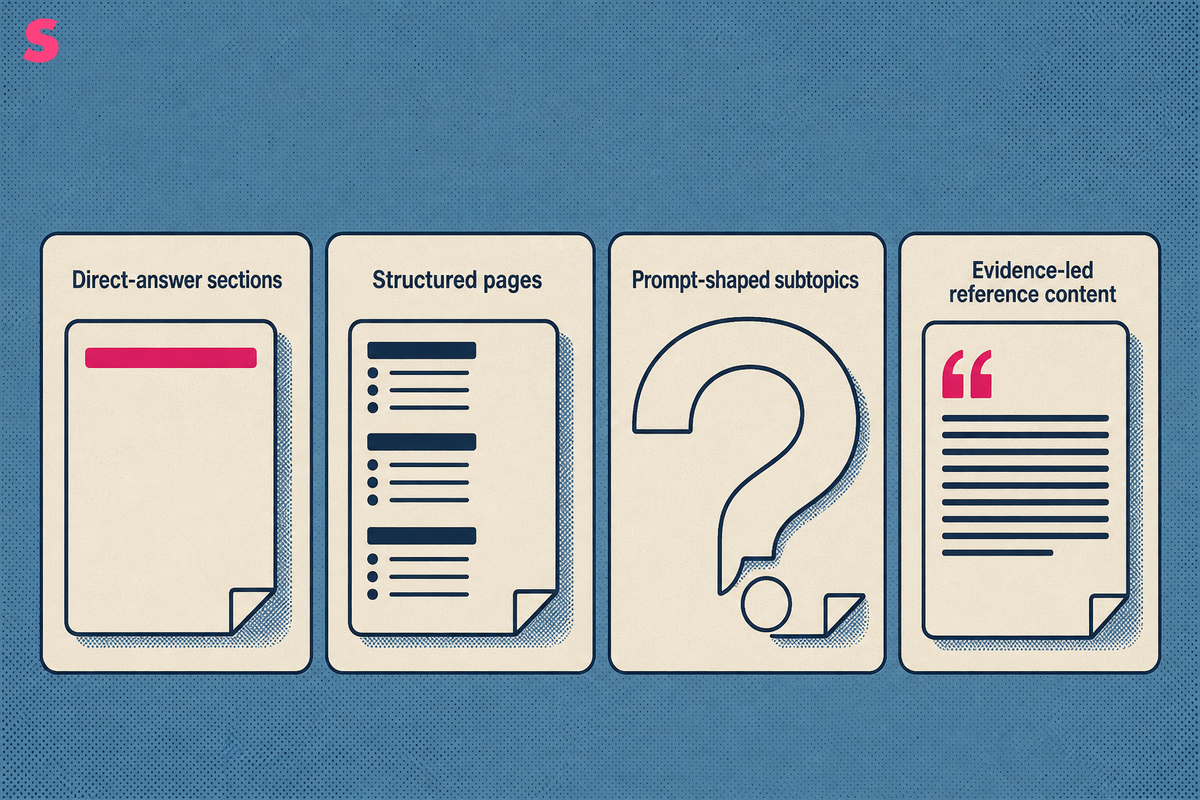
- Direct-answer sections: State the conclusion immediately, then provide supporting explanation.
- Structured pages: Use descriptive headings, short paragraphs and ordered steps where a process has a sequence.
- Prompt-shaped subtopics: Cover conversational questions, especially phrases of four or more words, per YouTube.
- Evidence-led reference content: Publish definitions, comparisons, implementation guidance and original expertise that a buyer can verify.
Teams can observe their own citation patterns without guessing. Build a representative prompt set, run each prompt across selected engines, record cited domains and URLs, then classify each cited source format. The result shows whether a category tends to cite comparison pages, technical documentation, editorial explainers or product pages.
Sona AI Visibility supports that analysis by showing prompts buyers ask, sources AI cites and how pages perform. Treat the output as a dated answer log, not a permanent verdict on content quality.
Which content, entity and technical signals make a page more likely to be cited?
A page becomes easier for answer engines to cite when its content is direct, its entity signals are consistent and its technical foundations support reliable retrieval. Clear structure helps buyers evaluate a claim and helps an engine locate the relevant passage.
A practical readiness review covers crawlability, JavaScript dependence, security, schema and content structure, content quality and freshness, and accessibility. Crawlability includes robots.txt, canonical tags and indexability. JavaScript dependence matters because answer engines need usable server-rendered HTML. Security headers and accessible markup improve technical hygiene.
Schema can clarify page meaning, but schema alone does not create a citation. A page also needs a distinct explanation, current evidence and a clear relationship to the company or expert behind it. Entity work includes consistent company descriptions, product terminology, author expertise and corroborating third-party references earned through digital PR.
The Free AI Readiness Checker evaluates page readiness across technical and content factors. The result is a dated snapshot. Periodic technical reviews can prioritize pages where a severity-ranked fix has the strongest practical value.
Which SEO tactics carry over to AEO search, and which need redesign?
AEO search is not a rebrand of SEO. SEO and answer optimization share technical quality, useful content and entity credibility, but SEO optimizes for rankings and clicks while AEO optimizes for selection and citation within a synthesized response.
| Practice | Traditional SEO objective | AEO objective | What carries over | What needs redesign |
|---|---|---|---|---|
| Keyword research | Find demand and ranking opportunities | Identify the buyer questions behind demand | Search volume and commercial intent | Rewrite priority themes as natural-language prompts |
| On-page content | Match search intent and earn rankings | Provide a passage suitable for direct citation | Topical depth and accurate terminology | Lead with a concise answer, then add conditions and evidence |
| Technical SEO | Support crawling, indexing and performance | Support retrieval and accurate parsing | Canonical tags, crawlability and server-rendered HTML | Audit AI crawler access and JavaScript dependence |
| Authority building | Build trust and referral signals | Establish credible, corroborated entities | Original research and reputable coverage | Align entity descriptions across owned and earned sources |
| Reporting | Rankings, traffic and conversions | Mentions, citations, source patterns and downstream outcomes | Conversion measurement | Measure prompts and engines separately from keyword rankings |
The SEO foundation remains essential. A technically inaccessible page cannot become a reliable AI source. The redesign changes the unit of optimization from a keyword and rank position to a prompt, answer, cited page and resulting buyer journey.
How do you build a prompt set and measure AEO search visibility?
AEO search visibility requires a prompt set that represents real buying questions across funnel stages, audiences and competitive situations. A narrow, hand-picked set can make a brand look stronger or weaker than the actual buyer experience.
- Collect high-value themes from customer calls, sales objections, site search, keyword research and product positioning.
- Group prompts by Awareness, Consideration, Decision and Purchase stages.
- Include informational, commercial, transactional and competitor-comparison questions.
- Run the same prompts daily across the selected answer engines.
- Score brand mentions and citations separately, then record cited URLs and competing sources.
A mention means the answer names a brand. A citation means the answer points to a source associated with that brand. The distinction matters because a brand can appear without receiving a source citation, and a page can be cited without a prominent brand mention.
Repeat runs are necessary because answers vary. Daily tracking reveals persistent patterns that weekly snapshots can obscure. Review prompt trends monthly, and conduct a broader positioning and competitive benchmark review quarterly.
Sona AI Visibility uses AI Search Insights to show buyer prompts, cited sources and page performance. A score is only a dated snapshot. A comparable sequence of daily observations lets a team distinguish a sustained citation change from answer variability.
Which tools measure AEO search visibility across AI engines, and what do they cost?
AEO measurement tools differ in engine coverage, prompt allowances, refresh cadence and whether they extend from citation reporting into attribution. The comparison below uses publicly available pricing and plan details as of October 2026. Prices and allowances change, so procurement teams should validate current terms before purchase.
| Tool | Starting price | Agency Plans? (Yes/No) | # of Answer Engines Tracked | Answer Engines | # of Daily Tracked Prompts (entry plan) | Cost per Daily Tracked Prompt | Differentiation |
|---|---|---|---|---|---|---|---|
| Sona AI Visibility | From $75/month billed annually | Yes | Up to 11 (3 on Starter) | ChatGPT, Gemini, Google AI Mode, Google AI Overviews, Perplexity, Claude, DeepSeek, Grok, Copilot, Qwen, Mistral | 5,000 credits/month, about 56 daily tracked prompts across three engines | $0.45 per daily tracked prompt | Connects AI citations and prompts to pipeline and revenue on one account timeline |
| Profound | Free Trial; Enterprise custom pricing | Yes | Up to 9 (3 on free Trial) | ChatGPT, Gemini, Google AI Overviews | 50 prompts daily for 7 days | Not calculable from custom pricing | AI visibility tracking with agency pitch workspaces |
| Peec AI | From $95/month | Yes | Up to 13 (3 of 6 on Starter, plus add-ons) | ChatGPT, Google AI Mode, Google AI Overviews | 50 prompts daily | $0.63 per daily tracked prompt | Prompt and brand visibility tracking across self-serve and agency plans |
| Otterly.ai | From $29/month | Yes | Up to 7 (4 on Lite, 3 as paid add-ons) | ChatGPT, Google AI Overviews, Perplexity, Microsoft Copilot | 15 prompts daily | $0.48 per daily tracked prompt | AI search monitoring with engine add-ons available |
| Scrunch AI | From $250/month | Yes | Up to 9 (4 on Core) | ChatGPT, Perplexity, Google AI Overviews, Copilot | 125 prompts, refresh frequency not published | No refresh cadence published | AI visibility monitoring across brand and agency plans |
| AthenaHQ | From $295/month | Not published | 11 | Not published | 3,600 credits/month; unlimited prompts; run frequency not stated | No refresh cadence published | Credit-based AI response monitoring with a free Essential tier |
| PromptWatch | From $95/month | Yes | Not published | All supported models | 50 prompts daily | $0.48 per daily tracked prompt | Prompt tracking with response-volume allowances and agency tiers |
Most tools report where a brand appears in answers. Sona AI Visibility also treats AI search as a measurable channel by connecting citations to pipeline and revenue. That distinction matters when the question is not merely whether a brand was mentioned, but whether the mention produced commercial value.
How do AEO findings turn into content, PR and revenue reporting?
AEO findings become operational when each prompt gap has an owner, a page and a next action. Content teams improve missing explanations, product marketing corrects positioning gaps, SEO teams resolve retrieval barriers, and PR teams pursue credible references that strengthen the relevant entity or claim.
- Prioritize prompts with commercial relevance and recurring citation gaps.
- Assign each gap to a content, product marketing, SEO or PR owner.
- Map the prompt to the page that should answer it, or create a new page when no suitable asset exists.
- Re-run the prompt list daily and review recurring patterns monthly.
- Use quarterly reviews to assess positioning, competitive source patterns and technical progress.
Monitoring which AI answers mention a brand is only half the job. The other half is connecting those mentions to accounts, pipeline and revenue. Sona AI Visibility connects AI citations and prompts to pipeline and revenue while tracking AI crawler and agent activity from server logs or a lightweight edge worker.
Reporting should separate leading and lagging indicators. Mentions, citations, cited pages and crawler activity are leading indicators. Qualified account engagement, opportunities and closed-won revenue are lagging indicators. This structure prevents a dashboard from treating higher visibility as proof of pipeline before the buyer journey supports that conclusion.
What are the frequently asked questions about AEO?
Is AEO search the same as SEO?
No. SEO earns rankings and clicks on a results page. AEO earns selection as a cited answer within an AI response. SEO and AEO share foundations such as crawlability, authoritative content and technical quality, but they serve complementary purposes and require different reporting units.
What is the difference between AEO and AIO?
AIO can mean AI optimization, or it can mean Google AI Overviews. AEO is the practice of making content suitable for direct selection and citation in AI answers. Google AI Overviews is one Google answer surface where that citation can occur.
What is an AEO search engine?
An AEO search engine, more accurately called an answer engine, returns a synthesized answer with cited sources instead of only a list of links. ChatGPT, Perplexity, Gemini, Claude, Google AI Overviews and other answer engines are common examples.
How many prompts should a SaaS company track for AEO?
A SaaS company should track enough prompts to cover each funnel stage, core audience, use case and competitor set across relevant engines. Plan limits vary by tool. A narrow or selectively chosen prompt set can distort visibility, so build a representative sample and run it daily.
Can AEO be tied to pipeline and revenue?
Yes, if citations and prompts are connected to the accounts and deals that follow rather than left as mention counts. Sona AI Visibility links AI citations and prompts to pipeline and revenue, allowing teams to evaluate AI research as a measurable acquisition channel.
Does AEO mean writing content for machines?
No. Direct answers, clear headings and structured explanations help buyers as much as answer engines. Generic, repetitive content serves neither audience. Strong AEO content retains original evidence, precise terminology and a distinct point of view while making the answer easy to retrieve.
Summarize this article with AI: ChatGPT · Claude · Perplexity · Google AI Mode
Last updated: October 2026