


An AEO grader queries AI answer engines about your brand, then measures how frequently and how effectively you appear in their answers. One run is only a snapshot, since answers vary by prompt, model, time and location, making repeated measurement more important than any individual score. Sona AI Visibility extends beyond grading by connecting prompts and citations to pipeline and revenue while monitoring AI crawler and agent activity. Use a score to identify pages needing improvement, not as a final judgment.
What is an AEO grader and what does it actually do?
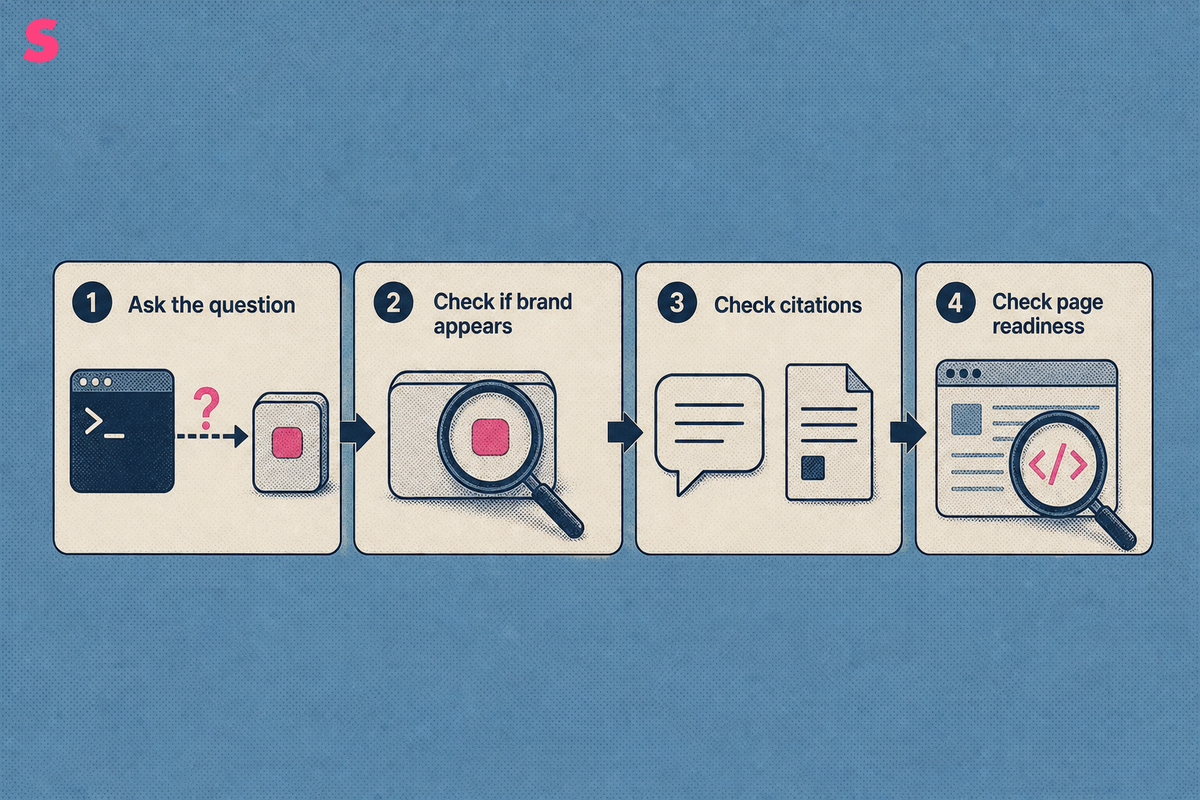
An AEO grader asks AI answer engines questions about your brand and category, then scores how visible, accurate, and well cited the business is in the answers. It turns AI search presence into a structured assessment rather than an anecdotal check.
An AI search grader can test whether an answer engine names your company, how prominently it appears, whether the description is accurate, and whether your pages or third-party sources support the answer. Some tools run preset category queries. Others inspect a single URL for citation readiness.
For example, a grader could ask an engine for the best B2B analytics platforms, inspect whether your brand appears, record the surrounding wording, and identify cited sources. A page-level grader evaluates a URL’s crawlability, semantic structure, canonical tag, content quality, and other signals that help an answer engine retrieve and cite the page.
An AEO assessment is not an SEO audit, a Google rank tracker, or a guarantee of future citations. Traditional search primarily ranks pages or links for a query. Answer engines can retrieve passages or facts from multiple sources, synthesize an answer, and cite only the sources selected as support. AEO grading therefore assesses what AI systems say now, whether evidence is clear and retrievable, and whether claims have sufficient corroboration for answer generation.
Why does an AEO grader score matter to someone responsible for pipeline?
An AEO grader score matters because buyers research vendors in ChatGPT, Perplexity, Gemini, Claude, and other answer engines before they submit a form or visit a site. A poor score can reveal that a brand is absent, inaccurately described, or unsupported in answers that shape early buying decisions.
For a demand generation leader, the immediate use is prioritisation. A low score on a commercial category prompt matters more than a low score on a broad educational prompt because the first query signals that a buyer is comparing options. The score identifies where to investigate, not whether pipeline has already changed.
Sona AI Visibility connects AI citations and AI-referred visits to pipeline and revenue on one account timeline, and tracks which AI crawlers reach pages. That measurement separates a visible mention from a cited answer that produces an identifiable account, an opportunity, or closed-won revenue.
A brand-level grade has a clear boundary. It can indicate whether AI search deserves attention, but it does not prove revenue impact alone. Attribution requires AI-referred visit data, identity resolution, account activity, and CRM outcomes.
What do the scoring dimensions of an AEO grader measure?
An AEO grader commonly combines brand visibility, answer accuracy, citations, competitive presence, and technical readiness into one score. The individual dimensions matter more than the blended number because each points to a different operational problem.
| Scoring dimension | What the grader evaluates | What a weak result can signal | Useful next action |
|---|---|---|---|
| Visibility | Whether the brand appears in relevant AI answers | The brand is absent from category or comparison prompts | Review prompt coverage and missing content topics |
| Accuracy | Whether the answer describes the brand correctly | Outdated positioning, product facts, or category associations | Correct key source pages and supporting evidence |
| Citations | Whether pages or other sources support the answer | Important claims lack retrievable evidence | Strengthen authoritative pages for cited claims |
| Competitive presence | Which alternatives appear beside the brand | Competitors own high-intent comparison prompts | Build pages that answer the missing comparison question |
| Technical readiness | Whether AI systems can crawl and parse the page | Access, rendering, metadata, or structure problems | Resolve crawlability and page-level findings |
A brand score is not a work item. Prompt-level evidence is the work item because it identifies the question that produced the result and the source an engine used. Sona AI Visibility uses AI Search Insights to show prompts buyers ask, cited sources, and how pages perform against competitors.
Some graders score five dimensions out of 100 and add a written interpretation. That format helps with an initial diagnosis, but a weighted total can conceal a serious issue, such as accurate answers with no citations or strong visibility only on low-intent prompts.
What does an AEO grader check on a page to judge whether AI engines can use it?
An AEO grader that evaluates a page checks whether an AI crawler can reach, render, parse, and understand the page well enough to use it as evidence. The review should cover technical access and content usefulness because a crawlable page with weak answers has little citation value.
Technical checks often include robots.txt access, canonical tag handling, indexability, server-rendered HTML, JavaScript dependency, metadata, structured data, page performance, and security headers. Content checks examine headings, semantic structure, factual specificity, update recency, FAQPage JSON-LD, accessibility, and whether the page answers a clear buyer question.
The Free AI Readiness Checker assesses whether AI engines can technically crawl and parse a site, not whether the brand appears in AI answers.
A page-level assessment differs from a prompt-based grader. The first asks whether a URL is ready to become a source. The second asks whether an answer engine already uses the brand or its pages in a response. Teams need both views when deciding whether to repair a page or create a missing resource.
How do you run an AEO grader analysis step by step?
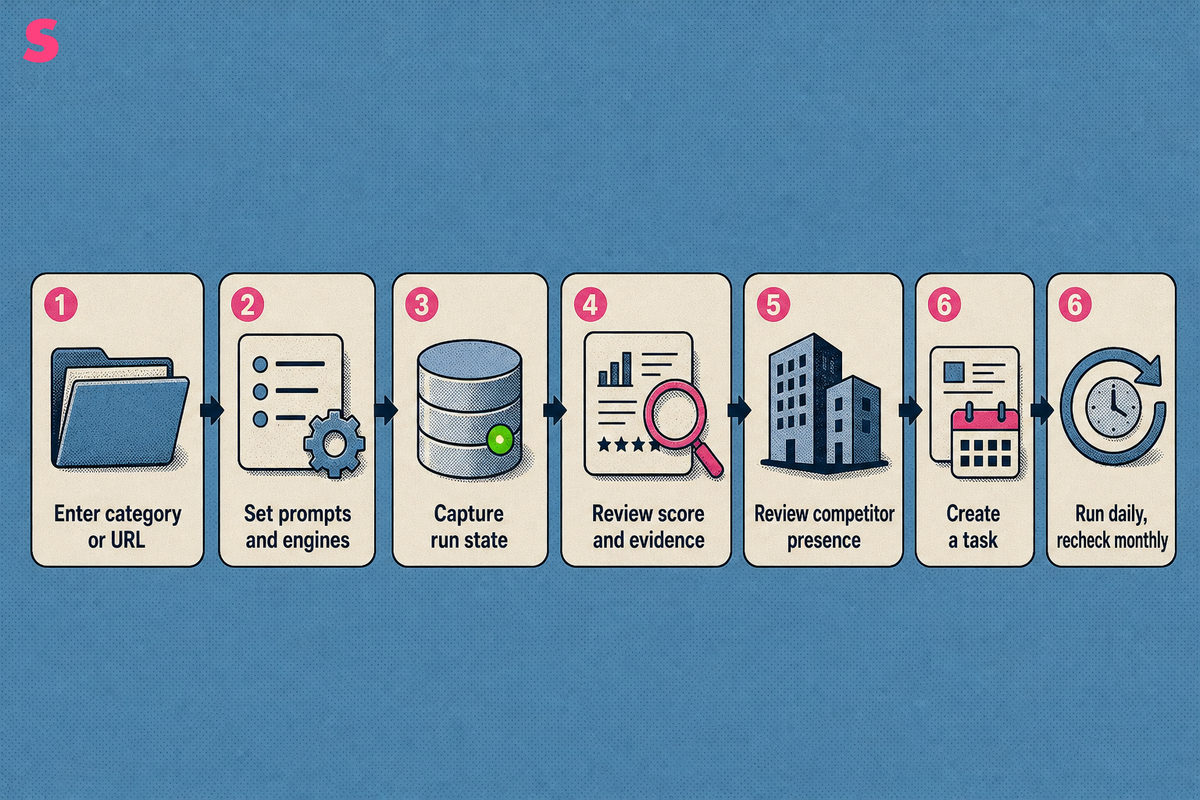
A completed AEO grader analysis should preserve the same category, prompt set, engines, settings, answers, citations, and competitor-presence evidence from input through task creation. Use one commercial category example throughout the review so each finding can be traced to a specific buyer question.
- Enter the category or URL. Record the category, customer segment, core problem, and any page that should support the answer. Preserve the submitted input with the analysis record.
- Set prompts and engines. Include educational, comparison, implementation, pricing, and alternative prompts. Record exact wording, country settings, and the answer engines selected.
- Capture the run state. Save the analysis status and settings so the result can be repeated under comparable conditions.
- Review the score and answer evidence. Record the overall result, dimension findings, full answer text, brand position, and sources cited in the answer.
- Review competitor presence. Record the companies named beside the brand and identify the prompt, answer wording, or cited evidence behind each appearance.
- Create a task from one finding. Assign a content, web, or product-marketing owner to a specific prompt, page, source, or factual claim, with a due date and recheck criteria.
Run the same prompt list daily. Review repeated runs and treat movement as meaningful only when it persists across multiple comparable observations, engines, or prompts. Keep exact prompt wording and settings constant so the team can distinguish changed answer output from changed test conditions.
Use a different clock for technical work. A full technical re-audit works monthly or quarterly, while daily prompt monitoring captures changing answer output. Sona AI Visibility tracks prompts daily and keeps prompt history, while page audits can be re-run on an ongoing schedule.
What does an AEO grader score of 40, 75 or 95 actually signal?
An AEO grader score of 40, 75, or 95 has no tool-independent meaning. Each grader can use different prompts, engines, scoring weights, and underlying answer evidence, so the number requires interpretation within that specific assessment.
For a score of 40, inspect the grader’s rubric, dimension scores, tested prompts, engines, and underlying answers. The review should identify whether the result reflects absent brand mentions, inaccurate descriptions, citation evidence, technical findings, or another graded condition.
For a score of 75, inspect the same evidence before assigning a priority. A blended score can combine different conditions, such as strong visibility on educational prompts and weak support on comparison prompts.
For a score of 95, preserve the dated prompt list, engine settings, rubric, answers, and citations. The result describes performance in that assessment, not a permanent rating or a universal benchmark.
How reliable is an AEO grader score when AI answers change between runs?
An AEO grader score from one run is directional, not conclusive, because AI answers vary by prompt wording, model, time, location, and retrieved sources. Reliability improves when a team runs a stable prompt set repeatedly and interprets a series rather than a single score.
One-time checks remain useful for an initial baseline. For example, one free grader provides a one-time review of what ChatGPT, Perplexity, and Gemini say about a brand, while another option offers an estimate from one engine in 60 seconds or four-engine results for $10, including answers, citations, and share-of-voice data, as of October 2026.
Consistency is the operating principle. Preserve exact prompt wording, country settings, brand names, and category terms. If a team changes all of those variables between runs, the score change cannot be assigned to a change in the engine’s answer.
Sona's own AI visibility data, September 2026, covers eight answer surfaces: ChatGPT, Google AI Overviews, Perplexity, Google AI Mode, Gemini, Mistral, Qwen, and Claude. Engine coverage matters because a brand can appear in one answer surface and remain absent in another.
Which AEO grader best measures visibility, citations and competitor presence?
The best tool depends on whether the business needs a one-time diagnostic, continuous prompt monitoring, page-level readiness analysis, or attribution to pipeline. For a B2B team responsible for revenue, the most complete measurement connects prompts and citations to accounts, pipeline, and revenue rather than stopping at visibility counts.
The comparison below uses publicly listed entry-plan details as of October 2026. Check pricing, prompt allowances, and engine coverage again before procurement because AI visibility plans change frequently.
| Tool | Starting price | Agency Plans? (Yes/No) | # of Answer Engines Tracked | Answer Engines | # of Daily Tracked Prompts (entry plan) | Cost per Daily Tracked Prompt | Differentiation |
|---|---|---|---|---|---|---|---|
| Sona AI Visibility | From $75/month, billed annually | Yes | 11 | ChatGPT, Gemini, Google AI Mode, Google AI Overviews, Perplexity, Claude, DeepSeek, Grok, Copilot, Qwen, Mistral | 5,000 credits/month, about 56 daily tracked prompts across three engines | $0.45 per daily tracked prompt | Connects AI citations and prompts to pipeline and revenue on one account timeline, with AI crawler activity from server logs. |
| Peec AI | From $95/month | Yes | 3 | Not published | 50 prompts daily | $0.63 per daily tracked prompt | AI visibility tracking for self-serve and agency plans. |
| Otterly.ai | From $29/month | Yes | 4 | ChatGPT, Google AI Overviews, Perplexity, Microsoft Copilot | 15 prompts daily | $0.48 per daily tracked prompt | AI search monitoring across four engines on the Lite plan. |
| PromptWatch | From $95/month | Yes | Not published | Not published | 50 prompts daily | $0.48 per daily tracked prompt | Prompt and response monitoring with agency plans. |
Choose a one-time grader when the immediate question is whether AI systems describe the brand accurately. Choose daily monitoring when the team needs prompt-level history. Choose revenue measurement when leadership needs to connect AI search activity to commercial outcomes. Most tools report mentions and citations; Sona AI Visibility connects those signals to pipeline and revenue.
How do you turn a low AEO grader score into a prioritised fix list?
A low AEO grader score becomes useful when every finding becomes a ranked task tied to a prompt, page, source, or factual claim. Start with problems that prevent AI engines from accessing key pages, then resolve inaccurate answers and high-intent prompt gaps.
- Fix access blockers. Resolve robots.txt, WAF, rendering, canonical, or indexability issues on pages that should support commercial questions.
- Correct factual gaps. Update product descriptions, category positioning, pricing context, and supporting evidence on core pages.
- Map missing prompts to pages. Identify whether an existing page should answer the question or whether the prompt needs a new resource.
- Prioritise commercial intent. Address comparison, alternative, integration, implementation, and pricing prompts before broad awareness questions.
- Re-run the same prompt set daily. Confirm whether the answer changed and whether the change persists.
Do not treat every finding as equal. A missing citation on a low-value informational prompt can wait behind a blocked product page or an inaccurate description on a decision-stage comparison query. The objective is a sequenced backlog, not a higher score for its own sake.
Assign each gap to a specific page and buyer question. Improve the page, then track whether answer engines begin to use it.
What are the frequently asked questions about AEO graders?
What is an AEO grader?
An AEO grader asks AI answer engines questions about a brand and its category, then scores how visible, accurate, and well cited the brand is in the answers. Some graders assess live answer output, while others grade whether a specific page is ready to be cited.
How is an AEO grader different from an SEO audit?
An SEO audit checks a site against traditional search ranking factors such as crawlability, metadata, performance, and indexation. An AEO assessment checks what AI engines say about the brand, whether they cite it, and whether pages that should support an answer are technically usable.
Can an AEO grader give me a reliable score from one run?
One run provides a baseline, not a reliable long-term reading. AI answers vary by prompt wording, model, time, location, and source retrieval. Repeated runs on a fixed prompt set provide a fairer reading because the team can distinguish sustained movement from a one-day fluctuation.
How much does it cost to grade AI search visibility?
One-time graders can be free, while ongoing monitoring tools list entry prices from $29 to $95 per month as of October 2026. Multi-engine, multi-seat configurations cost more. The comparison table shows published entry pricing and daily prompt allowances for several ongoing platforms.
What should I fix first after a low AEO grader score?
Start with crawl access and factual errors on key pages, then fill content gaps for high-intent prompts where competitors are cited and the brand is absent. Assign each finding to a page and prompt, rank the backlog by commercial intent, and verify changes through repeated daily prompt runs.
Does an AEO grader tell me whether AI visibility drives revenue?
No. A grader measures presence in answers, citations, readiness, or competitive visibility. Connecting citations to pipeline requires attribution for AI-referred visits, account identification, buyer journeys, and CRM outcomes. That is a measurement problem beyond a one-time visibility score.
Summarize this article with AI: ChatGPT · Claude · Perplexity · Google AI Mode
Last updated: October 2026







