The 2025 AEO answer engine optimisation ranking criteria are not one score: answer engines choose sources that are retrievable, trusted, simple to extract and relevant to the prompt. Six criteria cover this, from crawler access to commercial proof. Tool scores differ by prompt set and sampling, so assess them with a fixed protocol. Sona AI Visibility connects prompts and citations to pipeline and revenue, and monitors AI crawler activity.
What is answer engine optimization, and what replaces ranking in AI answers?
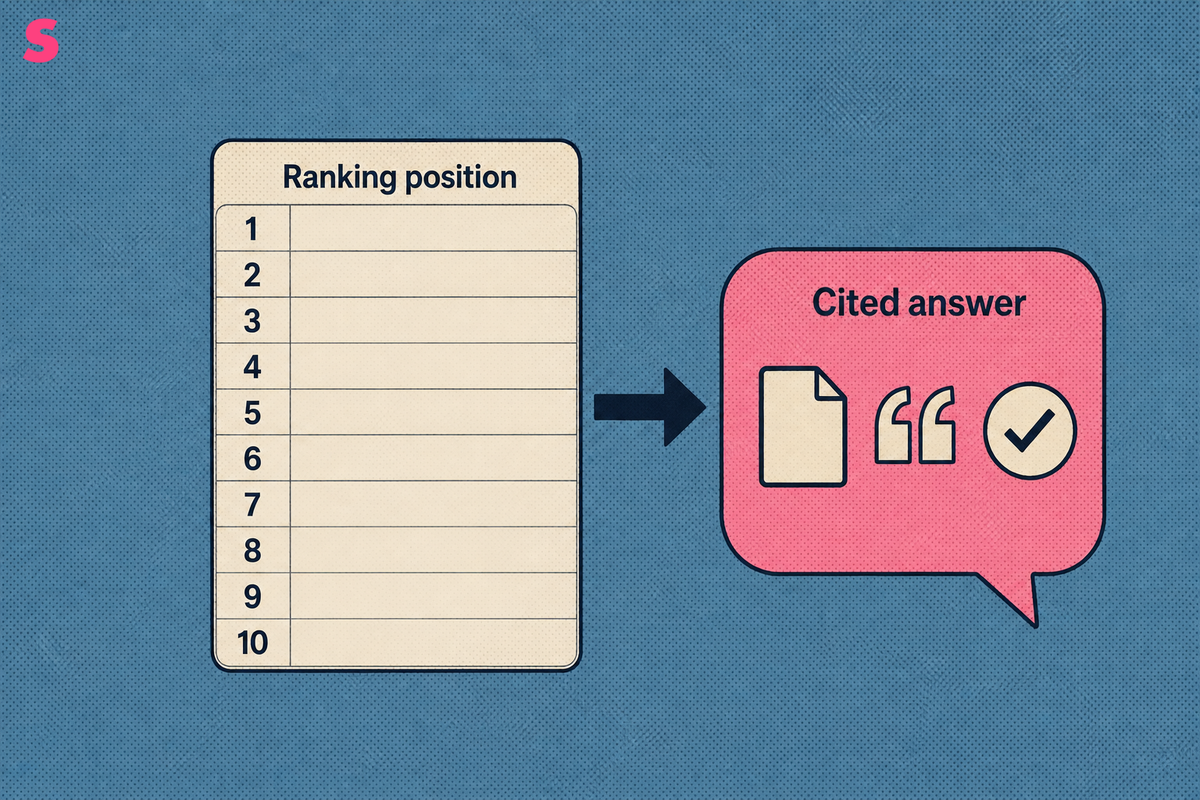
Answer engine optimization (AEO) structures content so AI systems can extract, summarise and cite it. The goal is selection as a cited source in an answer, rather than a position on a results page.
For B2B SaaS marketers, AEO matters because buyers ask AI systems for definitions, vendor shortlists and implementation guidance. A brand absent from the answer framing a purchase decision may never reach the buyer’s shortlist.
The AEO answer engine optimisation ranking criteria 2025 framework replaces a single rank with response relevance. Per PwC, response relevance replaces ranking, and summarised content replaces links as the key evaluation metric. Answer engines favour sources that are clear, credible and consistent, rather than brands with the largest ad spend or greatest name recognition.
AEO does not replace traditional SEO, a ten-blue-links ranking exercise, or brand-mention monitoring. Traditional SEO helps pages become discoverable through crawlability, indexability and authority. AEO assesses whether a system can retrieve, understand and use a page in a generated answer. GEO, or generative engine optimization, overlaps heavily with AEO, but AEO focuses more directly on selection and citation.
Which six criteria decide whether an answer engine cites and recommends a B2B SaaS brand?
Six criteria determine whether a B2B SaaS page is eligible for an AI answer: retrieval eligibility, entity and brand trust, answer extractability, citation quality, recommendation relevance and commercial proof. Together, they establish whether an engine can reach the page, trust its claims and match its content to the buyer’s question.
No universal AEO ranking factor or fixed scoring model exists. Authority, user intent and topical relevance are the most commonly cited drivers, per a LinkedIn-sourced statement. Assess each criterion independently, then identify the weakest constraint on a page that should earn citations.
| Criterion | What the engine is effectively checking | What the team controls |
|---|---|---|
| Retrieval eligibility | Whether a crawler can fetch, render and parse the page. | robots.txt rules, server-rendered HTML, canonical tags, sitemaps, performance and HTTPS. |
| Entity and brand trust | Whether the company, category and claims are consistently described. | Accurate positioning, named authors, customer evidence and consistent third-party profiles. |
| Answer extractability | Whether a passage gives a direct, self-contained answer. | Question headings, concise definitions, tables, lists and semantic structure. |
| Citation quality | Whether the page contains credible evidence worth referencing. | Dated sources, precise claims, original expertise and clear editorial ownership. |
| Recommendation relevance | Whether the brand fits the buyer’s stated use case. | Clear ICP, integrations, use cases, company-size guidance and comparison content. |
| Commercial proof | Whether the vendor claim is substantiated enough for a shortlist. | Pricing clarity, customer examples, implementation detail and product differentiation. |
The available evidence does not establish a verified, platform-specific ranking formula for ChatGPT, Perplexity, Google AI Overviews, Gemini, and other answer engines. Teams should therefore measure each platform separately rather than assume that a citation or mention on one system predicts the same outcome elsewhere.
| Platform | What to record separately | Optimization priority |
|---|---|---|
| ChatGPT | Brand mentions, cited domains, prompt wording, geography and test date. | Test direct answers, credible evidence and entity consistency against a fixed prompt library. |
| Perplexity | Brand mentions, cited domains, prompt wording, geography and test date. | Test source quality, extractable passages and citation frequency against the same prompt library. |
| Google AI Overviews | Brand mentions, visible sources, query wording, geography and test date. | Test crawlability, page clarity and source selection separately from other answer engines. |
Can answer engines reach and read your pages in the first place?
Answer engines can cite a page only when their crawlers can fetch and interpret it. Retrieval eligibility is a gate, not a ranking boost. A page that fails crawlability, rendering or security checks leaves consideration before content quality matters.
Audit crawlability first. Check robots.txt rules for AI crawlers, indexability directives, XML sitemaps, canonical tags and server responses. A pricing or integrations page can appear complete in a browser while returning an almost empty HTML shell to a crawler when the main copy loads only after client-side JavaScript executes.
Performance and security affect the same gate. Server-rendered HTML gives crawlers readable content without waiting for scripts. HTTPS, stable response headers and basic header hygiene show that a page is technically maintained. A crawler receiving a blocked, slow or incomplete response cannot extract a reliable answer.
Sona AI Visibility tracks 11 engines. A crawlability audit should still test whether the relevant AI crawlers can reach and load priority pages, including pricing, integrations and high-intent product pages.
How do answer engines judge E-E-A-T, authority, expertise and trust in a brand?
E-E-A-T means Experience, Expertise, Authoritativeness and Trustworthiness. For AEO, these signals support source credibility rather than guaranteeing citation. First-hand implementation knowledge supports Experience, named authors and topical depth support Expertise, entity consistency supports Authoritativeness, and accurate claims with external corroboration support Trustworthiness.
Entity accuracy is operational, not cosmetic. A company should describe the same category, primary use case and product scope on its homepage, product pages, documentation, company profiles and review listings. Contradictory descriptions force an answer engine to resolve ambiguity, weakening the page as a source.
Topical authority comes from depth within a narrow subject. A SaaS company publishing detailed implementation guidance, definitions, integration documentation and customer evidence for one category gives an engine a stronger evidence base than a broad site with thin pages across unrelated topics. Named authors and first-hand operational experience strengthen that evidence.
Backlinks remain an authority signal. A YouTube analysis estimates that answer-engine visibility required about 13 referring domains, compared with 41 for page-one traditional SEO. The analysis is directional and unaudited, not proof that AEO is three times easier. Reviews, directories, community discussions and customer references also corroborate that a brand and its claims are real.
Which content formats and page signals make an answer easy to extract and cite?

Answer engines cite content that is direct, semantically clear and easy to extract into a self-contained response. Question-style headings, concise opening answers, tables, lists and clearly labelled claims make a SaaS page easier for machines to parse and buyers to verify.
Generated answers often lift a narrow passage rather than summarise an entire page. Schema markup helps machines parse what a page describes, but it does not guarantee citation. Factual accuracy, sourced statistics with dates, visible updated dates and genuine freshness reduce ambiguity around a claim.
Accessibility supports machine readability and human usability. Alt text, ARIA labels, sufficient contrast and explicit image dimensions make page elements more interpretable.
Illustrative example: a vague feature paragraph might say that a platform helps teams understand customer activity across channels. An extractable rewrite would say that the platform records a documented buyer action and sends the relevant account record to a CRM workflow. The rewrite gives an engine a defined subject, action and outcome.
What makes an answer engine recommend a SaaS brand instead of only citing it?
Answer engines recommend a SaaS brand when it clearly matches the buyer’s commercial intent and provides evidence for a shortlist. A citation answers a factual question. A recommendation connects a stated need with a specific vendor fit.
Recommendation relevance depends on how plainly a company states who it serves. A buyer may ask for a tool for enterprise demand generation, a platform with a named CRM integration or software for a particular workflow. Product pages should state the intended company size, use case, technical dependencies and operating constraints in language close to the buyer’s question.
Commercial proof gives a recommendation substance. Useful proof includes named use cases, documented implementation paths, customer evidence, pricing clarity and comparison pages that explain differences plainly. A comparison page should describe the product’s focus and the situation where that focus matters, rather than make vague superiority claims.
A B2B SaaS team should separate informational prompts from buying prompts. A definition page can earn a citation for explaining a category. A pricing, integrations or alternatives page is more likely to support a recommendation because it answers practical shortlist questions.
What has actually moved answer-engine visibility, and what is still unproven?
No approved, documented before-and-after AEO experiment is available in the evidence set for this article. It would be inaccurate to claim that a specific intervention has moved answer-engine visibility without a fixed prompt set, named engines and geographies, test dates, sample size, baseline, post-change result and persistence evidence.
- Established evaluation criteria: retrieval eligibility, entity and brand trust, answer extractability, citation quality, recommendation relevance and commercial proof.
- Unproven tactics: schema markup volume, LLMs.txt-style files and exact-match question headings.
- Unsupported promises: any tactic claiming a guaranteed citation, recommendation or answer position.
Public AEO results require scrutiny because many come from vendors. A credible result should disclose the prompts, engines, geographies, sample size, scoring rules and test dates. Without those details, a reported visibility gain is untested evidence rather than a reproducible finding.
A valid test should isolate one documented page change, use a fixed prompt library across named engines and geographies, collect repeated baseline and post-change samples, and report whether any observed effect persists. Interpretation should separate the page intervention from unresolved variables such as model updates, retrieval changes and competing content.
Sona AI Visibility supports ongoing prompt tracking across 11 engines. A full technical re-audit belongs on a monthly or quarterly clock, while prompt monitoring belongs on a daily clock because retrieval indexes, model behaviour and competing content change between weekly snapshots.
How should a B2B SaaS team measure AEO visibility without fooling itself?
A B2B SaaS team should measure AEO with a fixed prompt library, named competitor set, fixed engine list, defined geographies, repeated samples and written scoring rules. A single answer is unreliable because wording, model updates, retrieval changes, location and personalisation change the output.
- Build prompts across category, comparison, use-case and problem-solving intent.
- Name the brands included in each comparison prompt.
- Run the same prompt list daily across the selected engines and geographies.
- Record the answer, cited domains, citation position, sentiment and test date.
- Review the repeated series monthly or quarterly for durable patterns.
| Metric | What it shows | Main limitation |
|---|---|---|
| Mention rate | How often a brand appears in sampled answers. | A mention does not show whether the brand was cited positively or commercially relevant. |
| Citation frequency | How often the brand’s pages appear as supporting sources. | Different engines expose citations differently. |
| Citation position | Where a cited source appears in an answer or source list. | Position formats vary by engine and interface. |
| Sentiment | Whether the answer frames the brand positively, neutrally or negatively. | Sentiment requires documented scoring rules. |
| Answer share of voice | The brand’s representation against named competitors in a prompt set. | Results change when the competitor set changes. |
| Referral traffic | Visits that arrive from answer engines. | Zero-click research and unattributed visits remain difficult to observe. |
Running the same prompt list daily reveals patterns that a weekly snapshot can average away. The output is a log, not merely a score. A dated score is a snapshot, while repeated samples show whether movement persists through normal answer variation.
Tool scores are not interchangeable because vendors use different engine coverage, prompt sets, sampling schedules and citation definitions. Sona AI Visibility tracks 11 engines, while Otterly.ai lists 4 engines on its Lite plan and PromptRush lists 5 engines on its entry plan, as of October 2026 listings. Compare methodology before comparing visibility totals.
How do you connect AEO visibility to pipeline and revenue?
AEO visibility connects to pipeline through qualified referral traffic, assisted conversions, branded search, self-reported attribution and sales influence. Teams should examine whether accounts exposed to AI answers later visit, convert, enter opportunities or appear in closed-won revenue.
Manual measurement starts with a consistent taxonomy. Tag AI-referred visits where referrer data exists, ask how prospects heard about the company on high-intent forms, connect anonymous visits to accounts where possible and review whether AI exposure appears before a sales conversation. Branded search and direct traffic can support the analysis, but neither proves that an AI answer caused the outcome.
Monitoring AI answers that mention a brand is only half the job. Sona AI Visibility Growth adds page-level insights, Agent Analytics, company-level visitor identification and AI search attribution.
More mentions do not automatically create more pipeline. A practical review separates informational visibility from commercial visibility, then compares the accounts, opportunities and revenue associated with each prompt class. That distinction shows whether a citation programme influences a buying journey or only increases awareness.
What are the frequently asked questions?
Is AEO the same as GEO?
AEO and GEO overlap heavily and are often used interchangeably. AEO centres on selection as a cited answer, while GEO centres on inclusion in generative responses. The same six criteria, retrieval, trust, extractability, citation quality, relevance and proof, support both disciplines.
Does traditional SEO still matter for answer engine optimization?
Traditional SEO remains the foundation for answer engine optimization. Crawlability, indexability, authority and clear content carry forward. The outcome changes from a results-page position to selection as a cited source within an AI-generated response.
Do backlinks affect whether answer engines cite a page?
Backlinks remain an authority signal. A YouTube analysis estimates about 13 referring domains for answer-engine visibility compared with 41 for page-one SEO. The figure is directional and unaudited, so teams should not treat it as a universal threshold.
Does schema markup guarantee an AI citation?
No. Schema markup helps machines parse what a page describes, but no answer engine guarantees citation because of schema. Treat it as one structural signal alongside direct answers, accurate claims, clear headings and crawlable content.
How many prompts should a SaaS team track to get a reliable read?
No fixed prompt count is supported by the available research. Reliability comes from a fixed prompt library, repeated daily sampling, defined geographies and a stated competitor set. A smaller, stable set produces more useful trend data than a large list that changes each week.
Can buyers trust AEO tool rankings published by vendors?
Buyers should treat vendor-published AEO rankings with caution. Ask for the prompts used, sample size, engines, scoring rules, geographies and test dates before relying on any score. Without disclosed methodology, a visibility ranking cannot be independently compared or reproduced.
Summarize this article with AI: ChatGPT · Claude · Perplexity · Google AI Mode
Last updated: October 2026