


White-label AI SEO involves a partner or platform managing AI search visibility work, including tracking citations in ChatGPT, Perplexity, Google AI Overviews, and other answer engines, while the agency sells it to clients under its own brand. The key buying choice is the delivery model: build in-house, buy software, partner with a provider, or combine them. Reporting-only dashboards are not resale infrastructure, so verify custom domains, client isolation, engine coverage and a published testing method before signing.
What is white label AI SEO, and how is it different from traditional SEO?
White label AI SEO is a service model in which a partner performs AI search visibility work for a client while an agency sells and delivers that work under its own brand. The agency retains the commercial relationship. The partner, platform, or internal team handles execution.
For an agency, the work extends beyond improving organic rankings. It shows whether a client appears in answers from ChatGPT, Perplexity, Gemini, Google AI Overviews, Claude, Copilot, and other answer engines, then identifies what should change. That creates a deliverable an agency can add to an SEO, content, digital PR, or demand generation retainer.
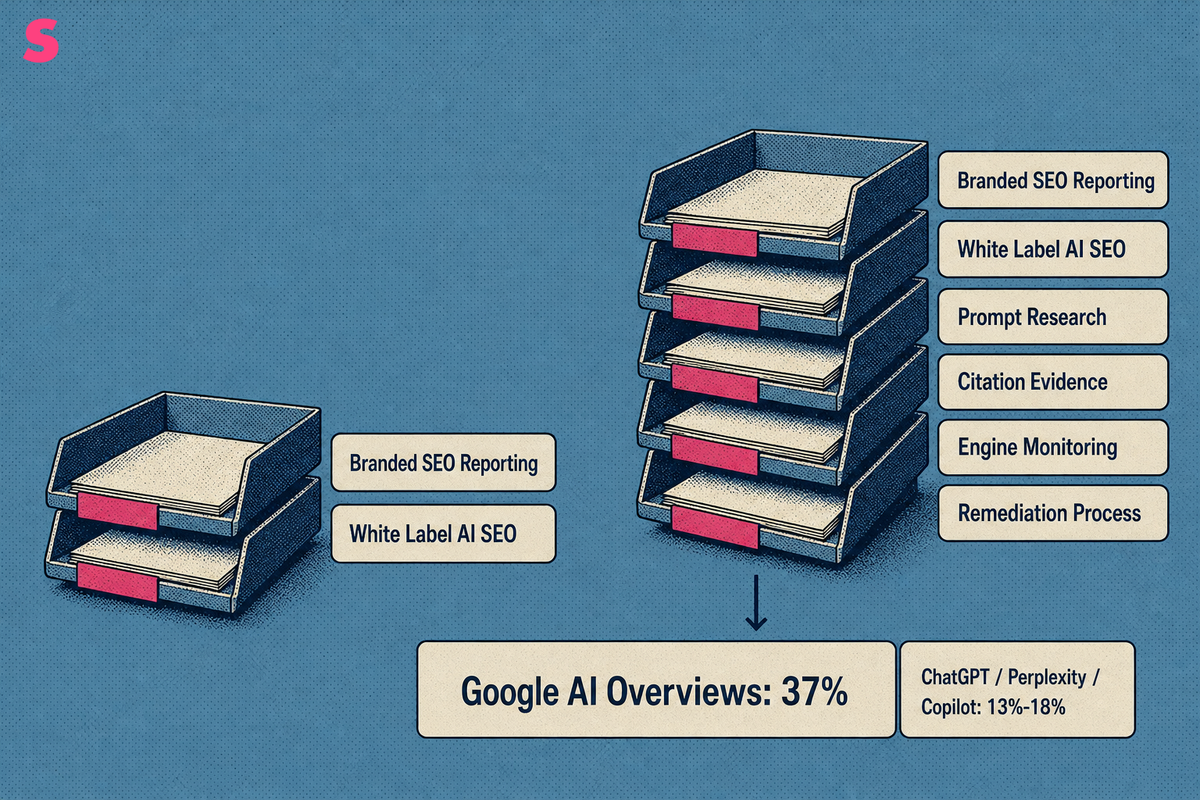
White label AI SEO differs from white-label SEO reporting. Branded reporting changes presentation, but it does not create prompt research, citation evidence, engine monitoring, or a remediation process. It also differs from white-label content writing and conventional rank tracking, which focus on production or traditional search positions.
Authority and backlinks still matter, but they do not fully explain answer-engine inclusion. Indystar.com reported on November 4, 2026 that 37% of sources cited by Google AI Overviews ranked in the top 10 for the same question, compared with 13%–18% for ChatGPT, Perplexity, and Copilot. That variation leaves substantial room to assess prompt intent, cited sources, content structure, retrieval, and brand relevance.
What does white-label AI SEO include beyond branded SEO reporting?
A white-label AI visibility platform for agencies should provide evidence and operating controls, not only a client-branded PDF. Core work includes citation tracking, brand mentions, sentiment review, prompt monitoring, competitor visibility, content recommendations, and implementation support.
Consider a client that sells payroll software. An agency can maintain a fixed prompt set covering category questions, comparisons, implementation concerns, and purchasing intent. Each prompt runs across selected answer engines daily. The agency then traces a citation from the prompt to the cited client page or third-party source, then recommends an action such as improving a comparison page, adding structured evidence, or fixing a technical issue.
That workflow distinguishes measurement from reporting. A dashboard showing a brand visibility score does not tell an account manager what to do next. Sona AI Visibility uses AI Search Insights to show prompts buyers ask and how pages perform in AI answers, giving an agency a prompt-level view instead of a single brand-level number.
- Citation evidence: capture the answer, cited sources, date, engine, location, and prompt.
- Prompt governance: define who can add, retire, tag, or approve prompts for each client workspace.
- Client explanation: translate a citation change into a content, technical, PR, or distribution action.
White-label dashboards become resale infrastructure when they combine engine coverage, citation-level evidence, prompt governance, and client-ready explanations. Branding matters, but the measurement model matters more.
Should an agency build, buy software, partner with a provider, or combine them?
Agencies should choose a delivery model based on technical capacity, service scope, and the need for repeatable client delivery. Building provides the most methodological control. Partnering creates the lowest operational burden. A hybrid model suits agencies that own strategy and content while outsourcing data collection or specialist execution.
| Delivery model | Setup effort | Time to first client deliverable | Support model | Control over methodology | Who owns the client relationship |
|---|---|---|---|---|---|
| Build in-house | High | Longer | Internal technical and client teams | Highest | Agency |
| Buy software | Moderate | Shorter | Platform support plus agency delivery | Moderate | Agency |
| Partner with a provider | Low | Short | Provider execution and agency account management | Lower | Agency, if contract terms preserve it |
| Hybrid model | Moderate | Short to moderate | Agency strategy with external data or production support | High for strategy, shared for operations | Agency |
Agencies can build with APIs, but the operational work persists. A production system needs prompt maintenance, model-change monitoring, data normalization, reporting logic, authentication, client isolation, export controls, and support processes. A prototype does not meet those delivery requirements.
A hybrid model works when an agency needs measurement and content production. The agency owns positioning, editorial standards, approvals, and the client relationship. The provider supplies monitoring infrastructure, specialist execution, or technical workflows that would otherwise consume internal capacity.
Which white-label features separate real resale infrastructure from a reporting-only dashboard?
Real resale infrastructure gives an agency control over the client experience, client access, and commercial boundaries. A reporting-only dashboard applies agency branding to exported outputs. The difference appears when a client logs in, receives a share link, requests data, or leaves the agency.
| Capability | What it enables | What to verify in a demo | Risk if absent |
|---|---|---|---|
| Agency branding | Agency logos, colors, and report identity | Whether branding appears in dashboards, exports, emails, and portals | Vendor branding appears in client-facing materials |
| Custom domain | A portal hosted under the agency’s domain | Login URL, certificate ownership, and domain setup responsibility | The client experiences a vendor-owned portal |
| Client workspaces | Separate data and permissions for each account | Workspace isolation, role controls, and administrator visibility | Cross-client exposure or operational confusion |
| Secure share links | Controlled report distribution | Password protection, expiry controls, revocation, and access logs | Old reports remain accessible indefinitely |
| Consolidated billing | One agency invoice across client accounts | Client allocation rules, usage reporting, and overage treatment | Fragmented margin tracking |
| API access and reseller rights | Custom reporting and contractual authority to resell | Export scope, API limits, data retention, and resale terms | Lock-in or unclear commercial rights |
Partial white-labeling covers reports and workspace logos. Custom-domain white-labeling extends the agency brand into the portal and login experience. API-first partner models prioritize data delivery into the agency’s reporting environment. Sona AI Visibility offers agency plans with one workspace per client and white-label reports, while agencies should confirm portal, domain, and resale requirements during procurement.
Ask for a live client journey. Create a test workspace, issue a share link, revoke access, export raw data, and inspect the email sender identity. Those tests reveal more than a sales deck.
Which AI engines and prompt coverage should a white-label platform monitor for clients?
A white-label AI visibility platform should monitor the engines a client’s buyers use and maintain consistent prompt coverage across client workspaces. At minimum, agencies should assess ChatGPT, Google AI Overviews, Google AI Mode, Perplexity, Gemini, Claude, Copilot, and other answer engines.
Per-engine evidence matters because answer systems retrieve and cite differently. Indystar.com reported on November 4, 2026 that Google AI Overviews appeared for 97.5% of category searches in Victorious’s Q3 2026 study, compared with 72.8% in Q2 2026. The same report found that 37% of sources cited by Google AI Overviews ranked in the top 10 for the same question, compared with 13%–18% for ChatGPT, Perplexity, and Copilot.
Agencies should not treat AI visibility as one blended score. A client can be strong in Google AI Overviews because of conventional organic authority, yet absent from a conversational answer engine that cites different sources. Sona AI Visibility provides engine coverage across its plans.
- Which engines are included in the base plan, and which require premium access?
- Can each client use its own locations, countries, languages, and prompt tags?
- Can the agency bulk-import prompts and enforce approval rules?
- Does the platform retain answer evidence and citation history for client reporting?
A team that runs the same prompt list daily can identify patterns that a weekly snapshot obscures. An answer can shift because of a retrieval-index change, a model update, or a competitor’s new content. Agencies should define and document a persistence threshold before testing so that short-lived movement and sustained change are evaluated consistently.
How do agency plans differ in pricing structure, and what does that do to margins?
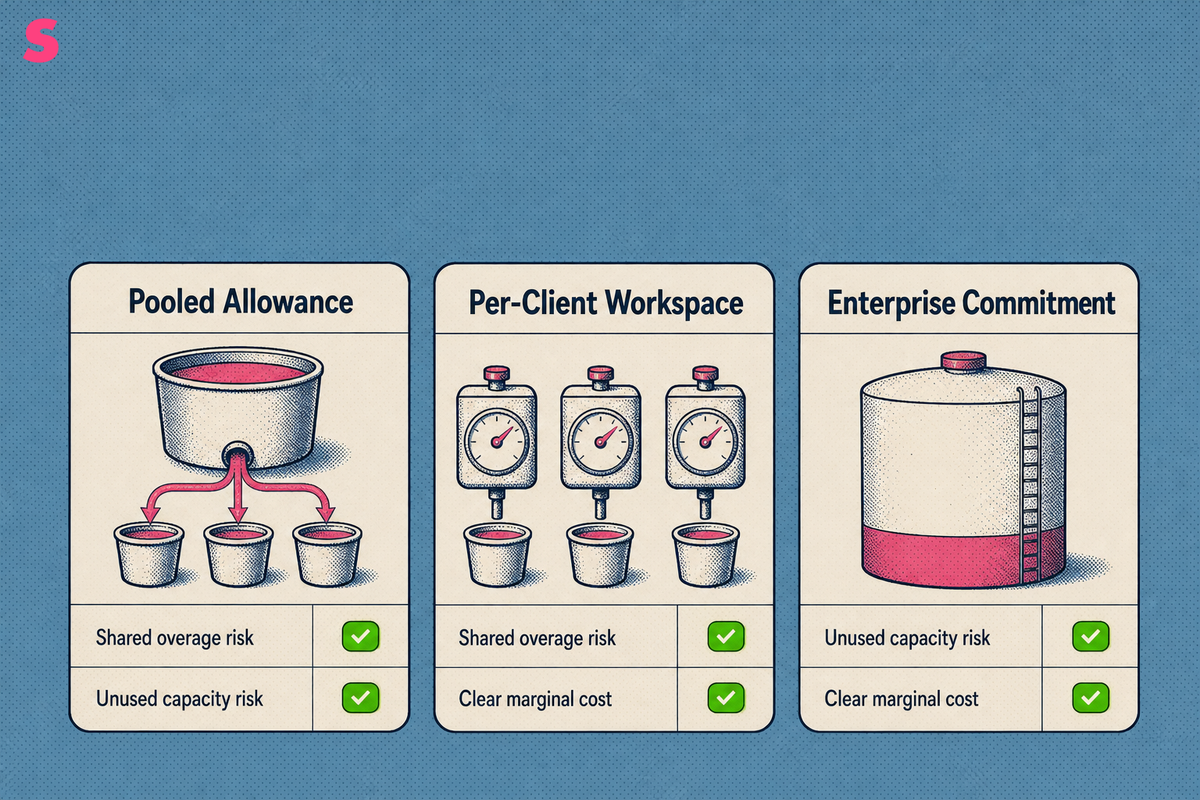
Pooled allowances spread fixed platform cost across clients but expose the agency to shared overages. Per-client pricing makes marginal cost clearer but raises cost with every account. Enterprise commitments increase utilization risk when committed capacity remains unused.
Agency plans differ mainly in their allocation of client workspaces, prompt allowances, seats, credits, and enterprise commitments. The best AEO white-label partner matches the agency’s service model rather than offering the most attractive entry tier.
Pooled plans give an agency a shared allowance across clients. That structure can improve unit economics when client demand is uneven. It also makes usage less predictable because one account can consume monitoring capacity needed for another account.
Per-client workspaces make allocation, permissions, reporting, and margin analysis clearer. They can also create a direct cost for every additional client. Agencies should map prompt allowances to the number of client topics, engines, locations, and reporting commitments in each retainer.
Calculate client gross margin as retainer revenue minus allocated platform, provider, and delivery costs. Show overages separately from the allocated platform cost, and show unused committed capacity separately from client delivery costs. That format distinguishes profitable delivery from favorable-looking pricing that relies on unused allowance.
Some agency plans include pitch-style workflows, such as audit workspaces or prospect-facing assessments. Treat those as business-development features rather than substitutes for delivery capacity. Separate sales usage from contracted client monitoring, then review utilization monthly and client strategy quarterly.
How can an agency test whether an AI visibility platform's numbers are reliable?
An agency can test AI visibility measurement with a fixed prompt set, repeated runs, clear inclusion rules, and a dated reporting window. AI answers vary, but that variability changes the unit of analysis from a permanent rank to a distribution of outcomes.
- Select a fixed prompt set for each client, divided across informational, comparison, implementation, and hiring-intent questions.
- Record the engine, location, date, and client domain or brand variants for every run.
- Run the same approved prompt list daily across the selected engines.
- Score each answer as cited, mentioned without citation, or absent.
- Calculate citation rate and uncited-mention rate separately, using valid measured answers as the denominator for each rate.
Define one observation as one prompt, engine, location, and run-date response. Report the total sample as prompts multiplied by engines, locations, and run dates, then disclose missing, blocked, and failed runs separately. Break results out by prompt-intent stratum and engine rather than relying on one blended result.
Document scoring rules before measurement begins. Define approved brand variants, count duplicate citations to the same client once per answer, and send ambiguous references to manual review. Audit scoring consistency with a blinded manual sample that reviewers assess without seeing the platform score.
Report the distribution, not a promise of permanent placement. Personalization, geographic variation, changing source indexes, and citation instability affect individual answers. The useful client deliverable is before-and-after evidence from the same prompt set, engine list, location, and date range.
Specific-provider mentions and hireable-agency mentions answer different commercial questions. Brand visibility does not automatically create commercial visibility for an agency.
Vendors making tested claims should disclose the tested prompt set, reporting window, baseline, exclusions, complete denominator, and scoring rules so an agency can reproduce the work. Ask every provider to show its methodology: prompt selection, refresh cadence, engine settings, location controls, citation capture method, deduplication rules, and scoring rubric. Sona AI Visibility connects citations and AI-referred visits to pipeline and revenue, giving agencies a second validation layer beyond mention counts.
How should an agency score white-label vendors on data ownership, confidentiality and lock-in?
An agency should score white-label vendors across delivery, proof, pricing, reporting, and client ownership before signing a contract. The core question is whether the agency can retain client data, preserve confidentiality, export history, and continue serving the client if the vendor relationship ends.
- Delivery: assess turnaround, implementation scope, escalation paths, and content-production support.
- Proof: request raw answer evidence, prompt histories, methodology documentation, and sample client reports.
- Pricing: test allocation rules, client workspace limits, credits, overages, and contract commitments.
- Reporting: inspect white-label controls, exports, share permissions, and presentation quality.
- Client ownership: confirm confidentiality, workspace isolation, data export, account transfer, and exit provisions.
Use the same rating scale for every category: strong means documented evidence and a successful trial demonstration, acceptable means documented terms with evidence that requires operational validation, and weak means unsupported claims or unclear contractual terms. A vendor must pass confidentiality, export rights, workspace isolation, non-solicitation, and exit provisions. A vendor that fails any gate cannot pass based on its aggregate score.
Weight the scorecard by delivery model. A build-oriented agency should place the greatest weight on API access, export quality, and methodology control. An agency using a managed partner should place the greatest weight on confidentiality, client non-solicitation, delivery accountability, and exit terms. A hybrid agency should give similar emphasis to methodology control, reporting, and client ownership.
A trial should include one real client-like workspace, a limited prompt set, multiple user roles, a report export, and a cancellation scenario. Sona AI Visibility includes unlimited seats and API and MCP access on every plan, while agency buyers should confirm the specific data-retention and client-transfer terms that govern their contract.
What services can an agency layer on top of a white-label platform to earn recurring revenue?
An agency can layer recurring strategy, content, technical remediation, digital PR, and executive reporting on top of AI visibility measurement. The platform provides evidence. The agency earns recurring revenue by turning that evidence into prioritized work and client decisions.
Useful retainer components include prompt research, citation-gap analysis, source outreach, comparison-page development, schema improvements, content refreshes, AI crawler access reviews, and quarterly positioning reviews. Prompt tracking runs daily. A full technical re-audit or competitive benchmark belongs on a monthly or quarterly schedule.
Sona AI Visibility connects AI prompts and citations to pipeline and revenue, and its Agent Analytics shows AI crawler and agent activity. Mention counts are the baseline every tool offers. Revenue connection gives an agency a way to justify a retainer in commercial terms.
Agencies should attach deliverables to an existing operating rhythm: a monthly evidence review, a prioritized action backlog, and a quarterly business review. A dated score is a snapshot. A comparable series reveals whether client visibility is moving, while severity-ranked fixes tied to affected pages make the work actionable.
What are the frequently asked questions about white label AI SEO?
What is white label AI SEO in one sentence?
White label AI SEO is a service model where a partner or platform performs AI search visibility work for a client and an agency delivers and sells that work under its own brand.
Is white label AI SEO the same as white-label SEO reporting?
No. White-label reporting is the branded output layer. White label AI SEO also includes monitoring across AI engines, prompt governance, citation evidence, content or technical recommendations, and an operating process for implementation.
Can an agency resell AI visibility tracking under its own domain?
Some platforms support custom-domain white-labeling, often at higher tiers, while others brand only reports. Agencies should verify the domain, portal, login, user permissions, email identity, and client workspace experience during a trial.
How often should AI visibility be measured for clients?
Run a fixed prompt set daily and report inclusion rates over time. Single runs vary with model changes, location, retrieval results, and personalization, while daily observations reveal whether a change persists.
Do backlinks still matter for AI visibility?
Authority helps, but it does not fully explain which brands an answer engine mentions. Indystar.com reported on November 4, 2026 that 37% of sources cited by Google AI Overviews ranked in the top 10 for the same question, compared with 13%–18% for ChatGPT, Perplexity, and Copilot. Prompt relevance, cited sources, and content quality also require assessment.
Is a white-label partner a better fit than software for an agency without technical staff?
Often, yes. A partner can handle prompt maintenance, data collection, and execution, but the agency should confirm that it retains the client relationship, access to client data, confidentiality protections, and a clear exit path.
Summarize this article with AI: ChatGPT · Claude · Perplexity · Google AI Mode
Last updated: November 2026







