A search engine for AI agents is a service or API that provides machine-readable outputs, including ranked URLs, excerpts or complete page content, allowing an LLM-powered application to access current web information without a person reviewing a results page. Selection depends on four layers: retrieval quality, usable context, operational performance and total cost per completed task, rather than per-query pricing alone. Because vendor benchmarks vary by dataset and scoring, the safest approach is to test your own documented prompt set with two or three candidates.
What is a search engine for AI agents, and how does it differ from web search?
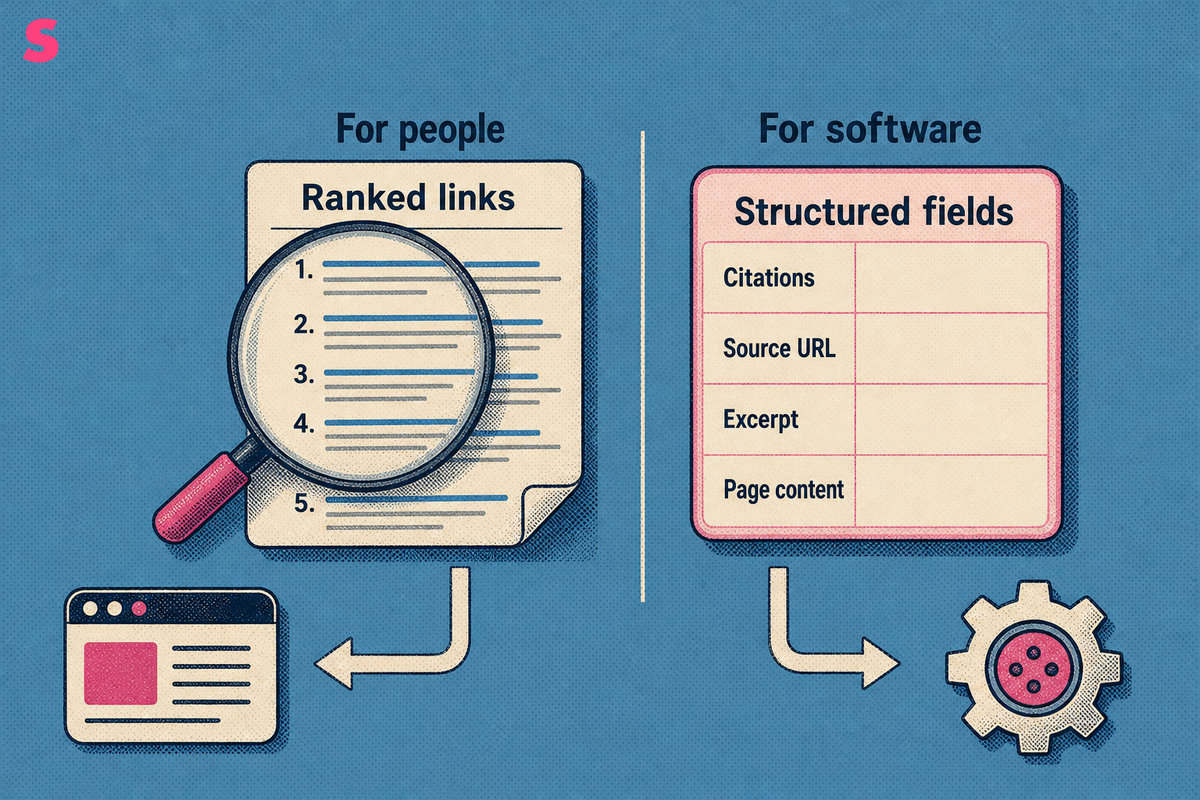
A search engine for AI agents is a search tool or API that returns structured, machine-readable results to an LLM, rather than a page of links for human review. It can provide ranked URLs, metadata, excerpts, page content, or a cited answer for the agent’s reasoning workflow.
Traditional web search optimizes a results page for people. Agent search optimizes the response for software: predictable fields, citations, source URLs, extraction options, and content an LLM can use without scraping a browser interface. The key distinction is whether the returned material works in an automated system.
An agent might identify a competitor’s current pricing, find recent regulatory guidance, or collect sources for a market brief. It needs current material, source metadata, and content that fits its context window.
A purpose-built retrieval API can return page content and search metadata in one request. Each extra fetch, parser, and ranking step adds engineering work. Select a tool based on whether it returns machine-readable metadata or page-level content in the same request, per you.com.
Why do teams building AI agents need a dedicated search tool?
Teams building AI agents need a dedicated search tool because an LLM’s training data is not a live source of record. Research agents, monitoring agents, and retrieval-augmented generation workflows need fresh public-web retrieval they can parse, rank, cite, and retain as evidence.
Without retrieval, an agent can produce stale answers about changing product specifications, executive roles, market events, or documentation. Without structured retrieval, teams often scrape consumer search pages. That creates brittle browser automation, inconsistent markup handling, duplicate results, and weak citation trails.
A system that cannot retrieve and validate sources cannot reliably explain its answers. A dedicated search API separates web retrieval from answer generation, allowing teams to inspect sources before an LLM writes the final response.
What does a single agent search request look like from query to cited answer?
A single agent search request moves through task interpretation, query construction, API retrieval, optional page extraction, evidence selection, and answer generation with citations. Each stage can add latency, token use, infrastructure cost, or all three.
- Interpret the task. The agent identifies the factual question, date range, domains, and required output format.
- Rewrite the query. The agent turns a broad instruction into one or more searchable queries, often adding constraints such as a company name, geography, or recent date.
- Call the search API. The API returns ranked URLs, titles, excerpts, metadata, or an initial synthesized response.
- Fetch or extract source pages. The agent retrieves full content when snippets are insufficient. This step adds network latency and can consume extraction credits.
- Rank evidence and compose an answer. The LLM selects supportable claims, formats citations, and produces the response. This stage consumes model tokens.
| Test request | Response record to inspect |
|---|---|
F01: What is Microsoft’s current chief executive officer? Cite an official source. |
Ranked URL, page title, excerpt or extracted text, canonical URL, retrieval timestamp, source date, citation identifier, request latency, and request cost. |
Consider an agent asked to summarize a software category for a procurement team. Search results may identify relevant pages quickly, but the agent still needs enough source text to distinguish a current price page from an outdated review. When the first response includes usable excerpts, canonical URLs, dates, and page content, the workflow needs fewer follow-up calls.
What types of search tools exist for AI agents, and what does each return?
Search tools for AI agents fall into three practical categories: search-only APIs, AI-answer APIs, and crawl or extraction platforms. The right category depends on whether the agent needs raw retrieval control, a synthesized answer, or dependable access to page-level content from selected domains.
Some providers maintain an independent web index, while others draw from third-party search results or crawl pages supplied by the customer. Brave Search API was described as using an independent index with more than 30 billion indexed pages in an October 2026 listing. Index ownership affects where ranking, freshness, and coverage originate.
| Tool category | Typical output | Own index or third-party results | Agent workflow fit | Typical pricing basis |
|---|---|---|---|---|
| Search-only API | Ranked URLs, titles, excerpts, metadata, and source links | Independent index or third-party search results | Query fan-out, source discovery, domain filtering, and agent-controlled reasoning | Per search request or usage credits |
| AI-answer API | Synthesized answer with citations and supporting sources | Provider retrieval layer, sometimes backed by a web index | Fast factual responses when the buyer accepts less control over the final answer prompt | Per answer, per search, model tokens, or combined usage |
| Crawl and extraction platform | Full-page text, structured fields, rendered content, and crawl output | Customer-specified URLs or domains | Site monitoring, domain-restricted research, extraction, and document pipelines | Per page, crawl credit, extraction request, or compute usage |
| Enterprise search service | Indexed documents, retrieval results, filters, and governance controls | Customer-managed private index | Private-data retrieval with permissions and document governance | Monthly search unit, storage, and query usage |
Exa offers a SERP API, website crawler tools, and a deep research API for web search and web crawling in applications. Tavily is positioned as a search engine and API for AI agents and LLM-powered applications. The category label matters less than the response the agent receives.
What is a search engine for AI agents not, and what is it commonly confused with?
A search engine for AI agents is not a private knowledge base, a vector database, a consumer AI answer engine, or an SEO rank tracker. It retrieves fresh public-web material for an automated workflow. Each adjacent category addresses a different information problem.
A private knowledge base manages enterprise documents, permissions, governance, indexing, and access control. A vector database stores and retrieves embeddings. An agent-search API can add public-web evidence to those systems, but it does not replace their security model or document controls.
A consumer answer engine gives a person a completed response. An agent-facing API gives software reusable retrieval output or an answer component. SEO and AI visibility platforms work in the opposite direction: they measure whether a site appears in answers and search experiences rather than helping an agent find information.
Sona AI Visibility connects AI citations and prompts to pipeline and revenue, while Agent Analytics tracks AI crawler and agent activity on a site through server logs or a lightweight edge worker without a JavaScript tag. Mention and competitor tracking is the baseline. The distinct question is whether AI discovery produced measurable commercial outcomes.
Which criteria separate a strong agent search API from a weak one?
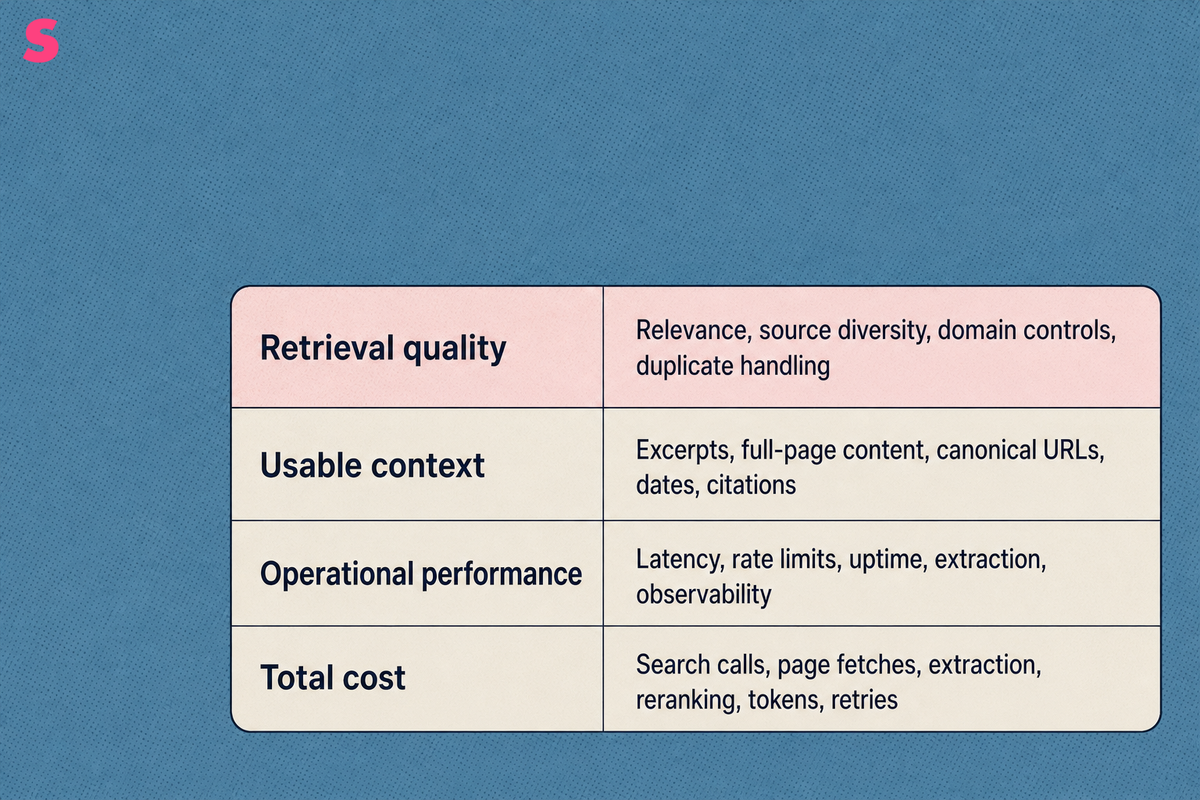
A strong agent search API delivers relevant retrieval, usable context, dependable operations, and an acceptable total cost per completed task. The right service performs across all four layers for the buyer’s real prompt set, not merely at the lowest listed query price.
- Retrieval quality: inspect relevance, source diversity, domain controls, duplicate handling, and support for complex or recent queries.
- Usable context: check whether the response includes excerpts, full-page content, canonical URLs, dates, structured metadata, and citations.
- Operational performance: evaluate latency, rate limits, uptime expectations, extraction support, crawling, filters, and observability.
- Total cost: include search calls, page fetches, extraction, reranking, model tokens, retries, and human debugging time.
Context quality often determines engineering effort. Ranked URLs alone can work, but the agent must fetch and parse pages before answering. Full text, source metadata, and citations reduce downstream work, though they can increase request cost and response size.
How much do search APIs for AI agents cost, and what does the per-query price leave out?
Search API pricing ranges from low-cost request tiers to recurring search infrastructure charges, but per-query price is not cost per completed task. Compare the full workflow cost, including every search, fetch, extraction call, model response, retry, and failed task.
As of October 2026 listings, Parallel listed Turbo and Fast at $1 per 1,000 searches, Exa listed an entry tier at $4 per 1,000 requests, and Brave Search API was listed at $5 per 1,000 requests. Google Search Enterprise Edition with Core Generative Answers in AI Mode costs $4.00 per 1,000 queries, per Google Cloud pricing. Azure AI Search Basic was listed at $73.73 per search unit per month in an October 2026 listing.
Free allowances can support prototypes. Tavily and Firecrawl each listed 1,000 credits per month, while Parallel listed up to 5,000 free requests per month, in October 2026 listings. Search built into major model APIs costs $10 to $14 per 1,000 searches before token charges, while specialized tools cost up to $35 per 1,000 searches, per digitalapplied.com.
Use this calculation from production logs: cost per completed task = total search, fetch, extraction, reranking, model, and retry spend ÷ successfully completed tasks. A cheaper search endpoint can cost more when it requires custom crawling, deduplication, citation handling, relevance tuning, and observability work.
How should you test search tools for AI agents, and what method makes the results trustworthy?
Test agent-search tools with a documented prompt set, five runs per prompt, fixed model settings, and a scoring rubric for completed tasks. Freeze the UTC testing window before execution, record it in every run file, and change one retrieval system at a time.
| Prompt IDs | Verbatim representative prompt | Task class |
|---|---|---|
| F01–F10 | F01: What is Microsoft’s current chief executive officer? Cite an official source. |
Factual lookup |
| M01–M10 | M01: Compare the current public pricing pages for two named software vendors and identify the lower entry price. |
Multi-hop research |
| R01–R10 | R01: Identify an official announcement published between 1 October 2026 and 31 October 2026 and summarize the change. |
Recent-event query |
| D01–D10 | D01: Using only the named company’s documentation, explain its current authentication requirements and cite the relevant page. |
Domain-restricted research |
Publish all 40 prompt records before testing, including named entities, permitted domains, expected evidence type, output format, and the fixed UTC testing window. Run F01–D10 five times each, for 200 recorded runs per tool. Keep the agent model, system prompt, context limit, answer format, citation rules, location, and rate-limit settings constant.
Score relevance, correctness, and citation validity on a 0–2 scale. A score of 0 means the result fails the requirement, 1 means it is partially sufficient, and 2 means it fully satisfies the predeclared requirement. Citation validity is 2 only when each material claim maps to a returned source that supports it. A completed task requires a score of 2 on all three dimensions and compliance with the required answer format.
Use two independent reviewers for every run. Reviewers score without seeing the tool name. A third reviewer resolves any disagreement, and the final record retains both original scores and the adjudicated decision. Report p50 and p95 latency across all five runs for each prompt, and calculate cost per completed task from total spend across successful and failed runs divided by completed tasks.
Public benchmarks are useful signals, not universal verdicts. Perplexity Search led the Artificial Analysis Search Index with a score of 80, per artificialanalysis.ai, October 2026. Two providers tied at 74% on BrowseComp in a September 2026 listing, while three providers tied at 94% on SimpleQA Verified in an October 2026 listing.
No benchmark can crown a universal winner because results change with the agent model, query rewriting, context window, and answer prompt. Vendor-published evaluations also require scrutiny. Check the dataset, prompt design, scoring method, and reproducibility before treating a benchmark as procurement evidence.
How should a B2B buyer choose between a search API, an AI-answer API, and a crawl platform?
A B2B buyer should choose a search API for source control, an AI-answer API for synthesized cited responses, and a crawl platform for page-level extraction from selected domains. The decision turns on the required output, control over the final answer prompt, operational limits, and cost per completed task.
Choose a search API when the agent needs ranked sources, metadata, domain filtering, and control over reasoning. Choose an AI-answer API when a cited response is the main deliverable and the team accepts less control over synthesis. Choose a crawl platform when the workflow needs rendered content, structured extraction, or recurring collection from known domains.
Public-web retrieval does not replace governance for private enterprise information. A company knowledge base still needs permissions, document indexing, retention rules, and access control. Search APIs add fresh external evidence to that controlled environment.
Shortlist two or three candidates, then run the same documented prompt set through each service. Track retrieval relevance, citation validity, p95 latency, and cost per completed task. For ongoing visibility monitoring, run the same prompt list daily because a pattern that holds four days differs from a one-day spike that a weekly snapshot would average away.
What are the frequently asked questions about search engine for ai agents?
What is the difference between a search API and an AI answer API?
A search API returns ranked results, excerpts, metadata, or page content for the agent’s own model to reason over. An AI answer API returns a synthesized response with citations. The answer API saves a generation step, while the search API gives the buyer more control over the final prompt, evidence selection, and answer format.
Is there a free search API for AI agents?
Yes. Tavily and Firecrawl each listed free allowances of 1,000 credits per month, while Parallel listed up to 5,000 free requests per month, in October 2026 listings. Free allowances suit prototypes and evaluation work. Production volume needs a separate cost model because allowances, credit definitions, and rate limits change.
Do search tools built into model APIs cost less than dedicated ones?
Not necessarily. Search built into major model APIs costs $10 to $14 per 1,000 searches before token charges, while specialized tools cost up to $35 per 1,000 searches, per digitalapplied.com. Price per search is not cost per completed task because extraction, retries, token use, and engineering work can dominate total spend.
Why can't one benchmark name a universal winner?
Search results shift with the agent model, query rewriting, context window, and answer prompt. A benchmark also reflects its own dataset and scoring rules. Vendor-run benchmarks can favor the vendor’s product, so a buyer should test candidates with a documented prompt set drawn from real work.
Can a search API replace a company knowledge base?
No. A search API retrieves fresh public-web content, while a company knowledge base manages private documents, permissions, governance, indexing, and access control. An agent can use both systems in one workflow, but they solve different retrieval problems.
What does cost per completed task mean for agent search?
Cost per completed task is the full spend required to finish one successful agent task. Add search requests, fetches, extraction, reranking, model tokens, and retries from your logs, then divide that total by tasks that met the acceptance criteria. This measure exposes workflows that look cheap per query but fail often or require expensive recovery steps.
Summarize this article with AI: ChatGPT · Claude · Perplexity · Google AI Mode
Last updated: October 2026