


SEO for agents involves two areas: deploying AI agents to research, plan and complete SEO work, and making a website accessible to web-browsing AI agents. Unlike standard SEO software, an agent plans, executes, checks and reports on its own work, making the key purchasing question how much it can alter on a live site without approval. Safe use requires least-privilege access, staging, approval gates and rollback, while success should be measured through qualified traffic and conversions rather than page counts.
What is an SEO agent, and how is it different from SEO software, an AI assistant or an agency?

An SEO agent is software that researches, decides, executes, verifies and reports on SEO work with limited supervision. Agentic SEO uses proactive AI agents to improve digital content for discoverability across traditional and emerging channels.
The defining feature is an autonomy loop: research a problem, choose a response, perform or propose the work, verify the result, then report what changed. A tactical SEO tool produces a report. A chat assistant answers after a person asks. A human agency supplies strategy, specialist judgment and accountable delivery.
- Monitoring agents watch rankings, SERPs, crawl errors, reviews and competitor changes.
- Content agents cluster keywords, create outlines, identify missing subtopics and draft optimization recommendations.
- Execution agents create CMS tickets, suggest internal links, update structured data or prepare page changes for approval.
Many products marketed as SEO agents remain read-only recommendation engines. That software can be useful, but it does not execute autonomously. Buyers should determine whether a product moves from analysis to a documented plan, controlled execution, verification and learning, or stops at a dashboard.
SEO agents can automate keyword research, content optimization, backlink outreach and SERP monitoring. Their value is reducing repetitive work so SEO teams can act on higher-value opportunities.
Which SEO tasks can AI agents automate, and which still need a person?
AI agents can automate recurring SEO research, monitoring and structured optimization work. People should retain control of strategy, factual accuracy, brand judgment and sensitive site changes. An SEO agent can audit websites, track rankings and identify optimization opportunities continuously.
Tasks suited to automation include keyword research, topic clustering, site audits, rank and SERP monitoring, internal-link suggestions, backlink prospecting, recurring reports and local review monitoring with drafted replies. Local SEO agents can monitor reviews across Google, Yelp, Facebook and other review platforms, then prepare responses for review.
- Automate: crawl monitoring, duplicate detection, keyword clustering, reporting and issue prioritization.
- Automate with approval: metadata changes, internal links, review replies, content briefs, schema markup and outreach drafts.
- Keep human: positioning, original research, subject-matter claims, final editorial decisions and high-risk technical changes.
A controlled workflow is straightforward. An agent audits a site on a schedule, ranks findings by severity, drafts a fix and waits for approval. A technical team can accept, revise or reject the proposed change before production deployment.
AI content is not inherently low quality, but unreviewed output is unreliable. Agents accelerate research and optimization. They cannot supply proprietary evidence, lived customer knowledge or editorial judgment. A useful agent reduces manual preparation and gives a qualified person better material for a decision.
How do you build an AI agent SEO strategy around business goals?
An AI agent SEO strategy starts with business goals, search intent, topical authority and conversions, then assigns repetitive SEO work to an agent. The agent should support revenue priorities rather than create more pages without a clear audience or commercial purpose.
A small team could begin with a goal such as increasing qualified demo traffic for a product category. The agent clusters relevant keywords, identifies commercial and informational intent, proposes a content plan with headings, subtopics and questions, and maps each page to a conversion path. A subject-matter expert then corrects the positioning, adds original evidence and approves the publishing plan.
- List every SEO task the team performs, including research, audits, content planning, reporting and implementation.
- Mark which tasks can be automated safely and which require review.
- Pick an agent platform that supports the required data sources, approvals and change logs.
- Deploy one workflow, measure its output and expand only after the workflow proves reliable.
SEO agents can build a content plan with keywords, headings, subtopics and key questions. The human editor should decide whether the plan reflects buyer language, product differentiation and credible evidence. That editorial work turns a keyword map into topical authority.
ROI comes from avoided research labor, faster technical triage, reduced publishing backlog and incremental qualified conversions. Pages generated is a production metric. Pipeline quality is the business metric.
How do you make a site visible to AI agents and answer engines like Google AI Overviews and ChatGPT?
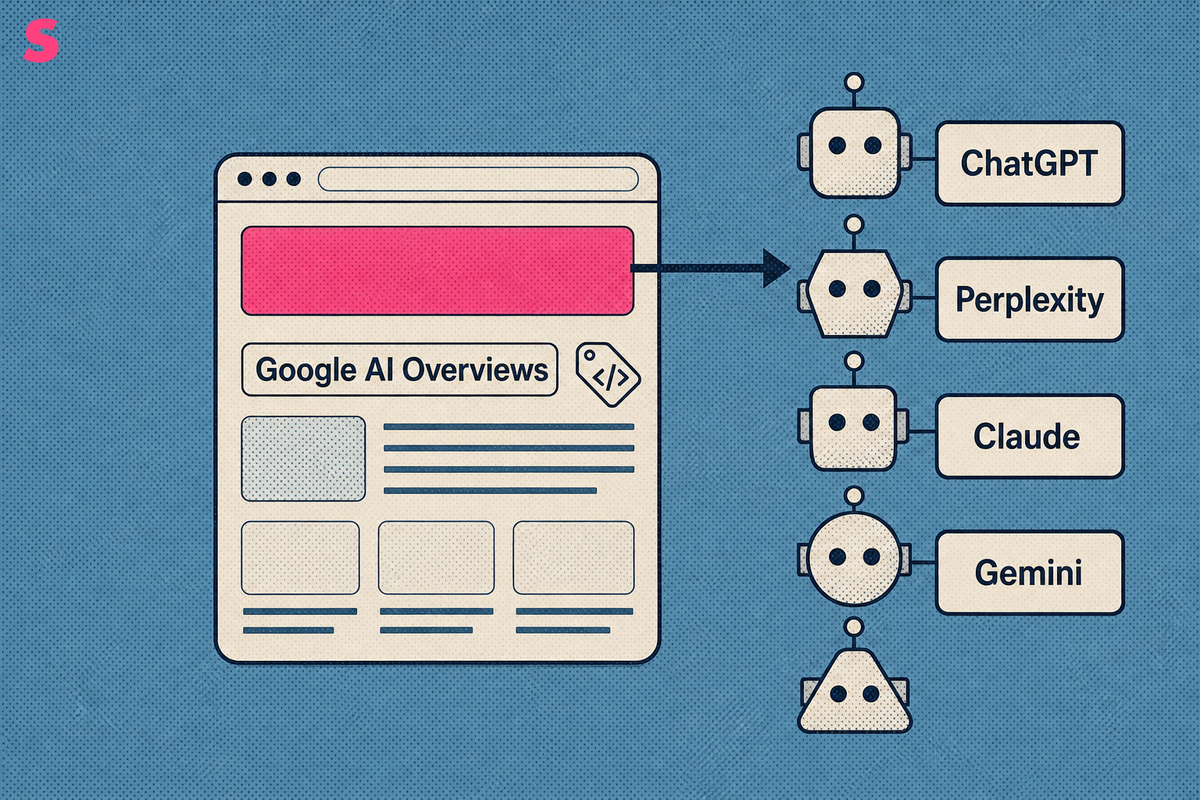
SEO for agents means making pages easy for browsing systems to fetch, parse and cite. Sites need crawlable pages, clear structure, direct answers near the top and facts that a retrieval system can verify against reliable sources.
Google AI Overviews, ChatGPT, Perplexity, Claude, Gemini, and other answer engines each produce AI answers, but Google AI Overviews is a Google feature. These systems retrieve and summarize web pages differently from a human browser. A page that renders poorly, blocks crawlers or buries its answer under generic copy creates a discoverability problem.
- Use server-rendered HTML where possible and avoid critical content that depends entirely on JavaScript.
- Put the direct answer, definitions and supporting evidence near the beginning of the page.
- Use descriptive headings, coherent internal links, canonical tags and machine-readable structured data where relevant.
- Check robots.txt, CDN rules and web application firewall settings for crawler access.
An SEO agent can audit crawl access, identify pages with weak structure and prepare remediation tasks. It cannot guarantee a citation in an AI answer. Citation decisions remain controlled by each engine’s retrieval, ranking and answer-generation systems.
Sona AI Visibility connects citations to pipeline and revenue on one account timeline, and tracks which AI crawlers reach pages. Agent Analytics reads crawler activity from server logs or a lightweight edge worker, showing which pages AI crawlers read and how often without relying on a JavaScript tag.
What controls should an SEO agent have before it edits a live website?
An SEO agent should have least-privilege access, a staging environment, approval gates, change logs, QA checks and a tested rollback procedure before it edits a live website. Broad publishing permissions without controls can damage a site.
- Grant read-only access first, then add narrowly scoped permissions after reliable performance.
- Require approval for CMS publishing, code changes, JavaScript changes, redirects, robots.txt and canonical tags.
- Test changes on staging before production deployment.
- Record the prompt, proposed action, approver, affected URLs and deployment time in a change log.
- Define a rollback owner and test the reversal procedure before a major batch ships.
Consider an agent that proposes title-tag changes across 200 pages. A reviewer approves a representative sample in staging, the team checks rendered titles and analytics instrumentation, then releases the changes in batches. The change log records each batch, making reversal an operational step rather than an emergency investigation.
Approval gates should reflect risk. A draft internal link is low risk. A robots.txt update can affect crawlability across an entire site. The permissions model should recognize that difference.
How can you test and score an SEO agent before you buy it?
Test an SEO agent with fixed prompts, a staging copy and a repeatable scoring rubric before purchase. A vendor demo shows a prepared workflow. A buyer-run protocol shows how the agent handles the buyer’s site, content standards and operational controls.
Use one production site and its staging copy, then run each prompt three times. Test five task types: audit, keyword clustering, content outline, internal linking and reporting. Keep the same pages, inputs and evaluation criteria across each run.
- Audit prompt: “Audit this staging domain for crawlability, canonical tag conflicts, broken internal links and missing title tags. Rank findings by severity, cite the affected URLs and propose reversible fixes.”
- Keyword prompt: “Cluster this keyword list by search intent, identify commercial themes and recommend one priority page for each cluster.”
- Content prompt: “Create a content outline for this target query, including headings, subtopics, evidence requirements and conversion intent.”
- Internal-linking prompt: “Recommend contextual internal links from these source pages to this target page. Show anchor text, placement and rationale.”
- Reporting prompt: “Summarize ranking, crawl and conversion changes for this page group, distinguish verified data from assumptions and list the next actions.”
| Criterion | Weight | How each criterion is scored |
|---|---|---|
| Accuracy | 1 | 0 = material errors, 1 = partly correct, 2 = correct and relevant |
| Evidence cited | 1 | 0 = unsupported, 1 = partial evidence, 2 = URLs, data or findings clearly identified |
| Execution depth | 1 | 0 = generic advice, 1 = actionable recommendation, 2 = complete implementation plan |
| Verification step | 1 | 0 = absent, 1 = basic check, 2 = explicit post-change validation |
| Approval support | 1 | 0 = uncontrolled action, 1 = approval mentioned, 2 = clear approval gate and owner |
| Reversibility | 1 | 0 = no rollback path, 1 = partial rollback, 2 = documented reversal method |
Each agent produces 15 evaluated outputs: five task types run three times. Score each output by adding the six criterion scores for a maximum of 12, then calculate the agent score as the mean across all 15 outputs. Record the range for repeated runs of each task, and use two independent reviewers to score outputs, reconciling any disagreement against the rubric. Set an acceptance threshold before testing, including a minimum mean score and no material safety failure. This is a proposed buyer-run protocol, not an executed benchmark.
This protocol supplements vendor demos rather than replacing them. Ask vendors to run the same disclosed prompts against a controlled environment, then compare outputs against the rubric rather than relying on polished examples.
How do leading AI SEO tools compare on engines, prompt limits and pricing?
AI SEO tools differ in monitoring coverage, prompt allowances, pricing structure and execution support. The comparison below uses published entry-plan information as of October 2026. Prices and limits change, so confirm current terms before purchase.
| Tool | Starting price | Agency Plans? (Yes/No) | # of Answer Engines Tracked | Answer Engines | # of Daily Tracked Prompts (entry plan) | Cost per Daily Tracked Prompt | Differentiation |
|---|---|---|---|---|---|---|---|
| Sona AI Visibility | From $75/month, billed annually | Yes | Up to 11 (3 on Starter) | Not published | 5,000 credits/month, about 56 prompts tracked daily across 3 engines | $0.45 per daily tracked prompt | Connects AI citations and prompts to pipeline and revenue on one account timeline, and tracks AI crawler activity from server logs or a lightweight edge worker without a JavaScript tag |
| Profound | Custom pricing | Yes | Up to 9 (3 on free Trial) | ChatGPT, Gemini, Google AI Overviews | 50 prompts daily for the trial | Custom pricing; unit cost not calculable | AI answer monitoring and agency workspaces |
| Peec AI | From $95/month | Yes | Up to 13 (3 of 6 on Starter, plus add-ons) | ChatGPT, Google AI Mode, Google AI Overviews | 50 prompts daily | $0.63 per daily tracked prompt | AI search visibility monitoring across self-serve and agency plans |
| Scrunch AI | From $250/month | Yes | Up to 9 (4 on Core) | ChatGPT, Perplexity, Google AI Overviews, Copilot | 125 prompts | No refresh cadence published | AI search monitoring for brands and agencies |
| AthenaHQ | From $295/month | Yes | 11 | Not published | 3,600 credits/month, unlimited prompts | No refresh cadence published | Multi-model AI visibility analysis |
As of October 2026, Sona AI Visibility tracks 11 answer engines, starts from $75/month billed annually, and includes unlimited seats, API access and MCP access on every plan. The table does not rank products. It identifies the operating model a buyer should evaluate.
How should you measure an SEO agent beyond rankings, and does the price pay back?
Measure an SEO agent through qualified traffic, conversions, citations, crawlability, time saved and incremental pipeline, not rankings alone. Rankings remain useful, but they do not show whether an agent reduced a technical backlog or influenced a commercial outcome.
Track a prompt list daily when measuring AI-search visibility. A team that runs the same prompt list daily can detect changes that a weekly snapshot obscures, including shifts caused by retrieval-index changes, model updates and competitor publishing. Set a persistence threshold before testing. For example, a team may require a change to persist across several daily observations before treating it as a trend.
A brand-level visibility score is a dated snapshot, not a work item. Teams need to know which prompts produce the score, which sources appear in answers and which pages need attention. Sona AI Visibility connects prompts and citations to pipeline and revenue, while AI crawler and agent activity shows whether relevant pages are being reached.
AI SEO agents were listed from $20/month to enterprise contracts, with full-platform agents commonly around $80–$900/month, per the August 2026 listing. SEO agency fees range from $2,000 to $20,000 monthly, per Clutch.
The payback case should compare avoided labor, publishing velocity, technical backlog reduction and incremental qualified pipeline against subscription or service cost. Review prompt-level work daily, then conduct a fuller technical re-audit and positioning review monthly or quarterly.
What are the risks of automated SEO with AI agents?
Automated SEO with AI agents creates risks when output is treated as verified work rather than a proposal. The major risks are hallucinated facts, duplicate content, brand inconsistency, search-policy violations, technical errors and diminishing returns from mass publishing.
- Hallucinated facts: require fact review and source validation before publication.
- Duplicate or thin content: run canonical-tag, similarity and duplicate-content checks before release.
- Brand inconsistency: provide approved style rules, positioning documents and prohibited claims.
- Search-policy violations: require human sign-off for content, links and scaled publishing programs.
- Technical errors: use staging, approval gates, QA checks, change logs and tested rollback procedures.
- Diminishing returns: track marginal return through qualified traffic, conversions and pipeline rather than publishing volume.
AI-generated content becomes low quality when it substitutes generic synthesis for editorial judgment and original evidence. A strong operating model assigns agents to research, prioritization and first drafts, then assigns people to expertise, proof, brand voice and final accountability.
Automation should narrow uncertainty, not distribute it faster. The right agent workflow makes every proposed change reviewable, reversible and measurable.
What are the frequently asked questions about SEO agents?
What is an SEO agent in simple terms?
An SEO agent is software that researches, plans, executes, checks and reports on SEO tasks with limited supervision. Unlike a chat assistant that waits for a prompt each time, an SEO agent can follow a defined workflow and monitor recurring work.
Can an AI agent replace an SEO agency?
An AI agent can take over research, monitoring and reporting that agencies often bill by the hour. Strategy, subject-matter expertise and editorial judgment still need a person. SEO agencies charge $2,000 to $20,000 monthly, per Clutch.
How much does an AI SEO agent cost?
AI SEO agents were listed from $20/month to enterprise contracts, with full-platform agents commonly around $80–$900/month, per the August 2026 listing. Prices change, so confirm current pricing and usage limits with each vendor.
Is it safe to let an AI agent publish or change pages on its own?
Publishing is safe only with least-privilege access, a staging environment, approval gates, a change log and a tested rollback procedure. Start with read-only analysis, then widen permissions after the agent demonstrates accurate and reversible work.
Do I need to optimize differently for AI agents that browse the web?
Yes, with a different emphasis. Make pages crawlable, place direct answers near the top, keep structure clear, make facts verifiable and inspect server logs to identify which agents fetch the pages.
How do I build my own SEO AI agent?
List every SEO task, mark which tasks can be automated, pick an AI agent platform and deploy one workflow with human approval before adding more. Start with a controlled audit or reporting workflow, then expand into content or implementation work.
Summarize this article with AI: ChatGPT · Claude · Perplexity · Google AI Mode
Last updated: October 2026







