


A technical GEO guide opens with one definition: technical GEO is the engineering effort that helps AI engines crawl, recognize, extract, validate and summarize a page, distinct from content and PR. According to Google’s Search documentation from August 2026, a page must be indexed and eligible for snippets to appear in generative features within Google Search. Sona AI Visibility connects AI citations and prompts with pipeline and revenue, meaning the work is measured by demos instead of mention totals.
What is technical GEO, and how does it differ from content GEO and technical SEO?
Technical GEO is the technical and editorial practice of making a useful page easy for answer engines to crawl, identify, extract, verify, and summarize without manual intervention. A technical GEO guide focuses on eligibility and machine readability, while content GEO focuses on what the page says and why it merits citation.
For a B2B SaaS team, the distinction matters because a strong page can fail before an engine evaluates its expertise. A crawler may reach and index a product page yet struggle to isolate the definition, proof, entity relationships, or answer required by a buyer’s prompt.
Consider two pricing integration pages. Both are crawlable and indexed. The first renders its core explanation through client-side JavaScript, uses vague headings, and buries product details in comparison widgets. The second exposes its main explanation in server-rendered HTML, uses descriptive headings, names the integration consistently, and places a direct answer near the top. The second page is easier to extract into an answer.
| Category | Technical GEO | Content GEO | Technical SEO |
|---|---|---|---|
| Primary question | Can an answer engine access and interpret this page? | Does the page answer a buyer question clearly and credibly? | Can a search engine crawl, index, and rank this page? |
| Main inputs | Crawling, rendering, indexing, structure, accessibility | Prompts, evidence, entities, authorship, topical coverage | Canonicals, internal links, sitemaps, performance, crawl control |
| Primary output | Pages that can be extracted and cited | Answers worth selecting and citing | Pages eligible for search visibility |
| Measurement | Crawl access, extraction readiness, technical findings | Prompt coverage, citations, source references, entity presence | Index status, rankings, traffic, crawl activity |
Technical GEO is not technical SEO under a new label, although the foundations overlap. Crawlability, indexability, relevance, and authority remain foundational. Broader GEO practices add answer-level prompts, citation monitoring, entity coverage, and multi-engine measurement across ChatGPT, Perplexity, Gemini, Claude, and other answer engines to guide and measure the technical work.
GEO also draws on content strategy, PR, and data analysis. A widely repeated framing puts GEO at roughly 80% strategic and 20% technical. Technical work establishes eligibility, but prompt intent and external authority influence which eligible source receives a citation.
Which technical requirements decide whether an AI engine can cite a page at all?
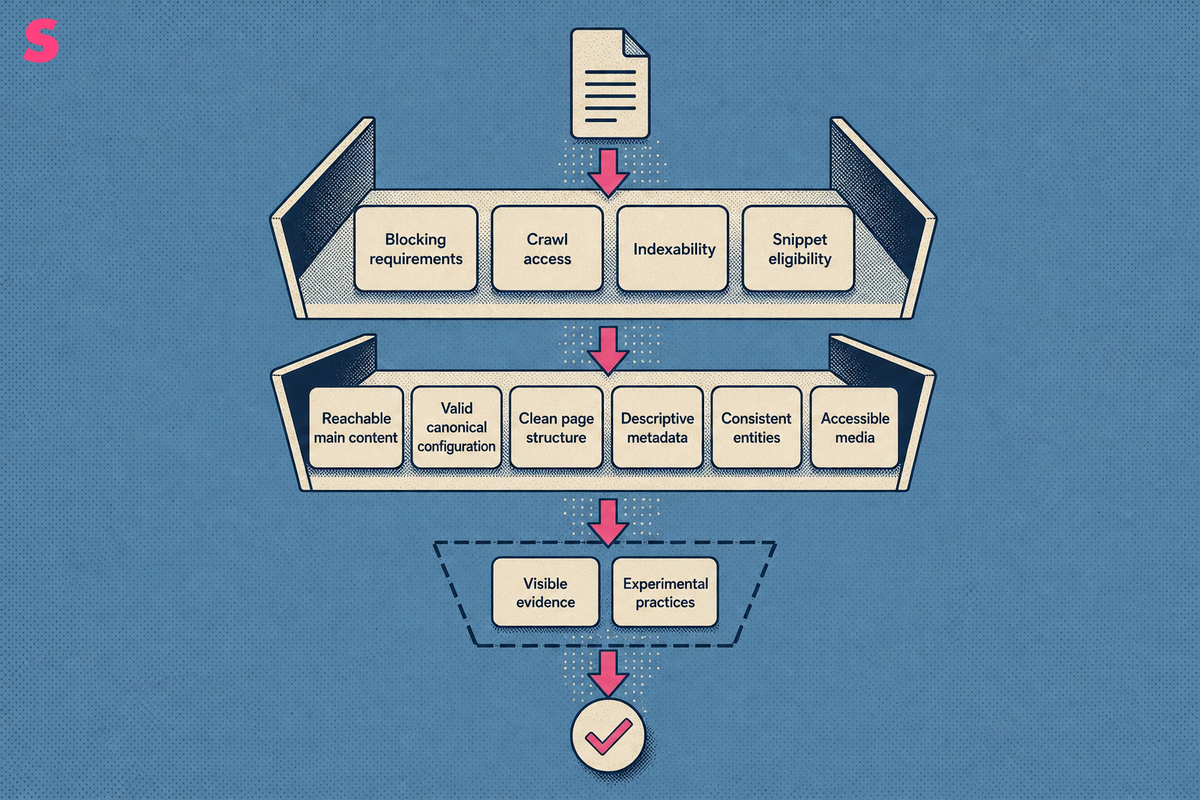
Technical GEO begins with access and eligibility. Per developers.google.com, August 7, 2026, a page must be indexed and eligible to appear with a search snippet to qualify for generative AI features in Google Search, including Google AI Overviews.
A noindex directive, nosnippet directive, or crawler block can remove a page from eligibility regardless of content quality. Original research and strong copy cannot appear in a Google generative result if Google cannot index the page or display a snippet.
- Blocking requirements: crawl access, indexability, snippet eligibility, and reachable main content. Without these, the engine cannot reliably retrieve or present the page.
- Amplifying requirements: valid canonical configuration, clean page structure, descriptive metadata, consistent entities, accessible media, and visible evidence. These improve interpretability but do not guarantee citation.
- Experimental practices: engine-specific markup patterns and claims about preferred schema types. Treat these as hypotheses to test, not established rules.
No proven universal playbook exists because answer engines retrieve, summarize, and cite differently. Google provides an established eligibility baseline. Many other recommendations are correlation studies, vendor claims, or implementation hypotheses. Technical documentation should distinguish among those evidence levels.
The Free AI Readiness Checker provides a starting technical review by checking whether AI engines can crawl and parse a site.
How should engineers configure crawling, rendering, and indexing for generative search?
Engineers should configure generative-search access around reachable URLs, crawl rules, server-rendered content, and verifiable index signals. Technical GEO implementation means making priority pages discoverable, ensuring their main content remains readable without fragile rendering dependencies, and verifying what bots fetch.
- Review robots.txt rules for search crawlers and AI crawlers, then confirm that priority pages are not blocked unintentionally.
- Include canonical URLs in XML sitemaps and support them with internal links from relevant product, solution, and resource pages.
- Validate canonical tags, indexability directives, and duplicate-page handling so the preferred page is clear.
- Inspect rendered HTML to determine whether the page’s definition, evidence, tables, and core copy exist without client-side JavaScript execution.
- Use server logs to confirm which AI crawlers fetch priority pages, rather than assuming access from robots.txt alone.
Performance matters when it affects retrieval or rendering. A page whose main content appears only after JavaScript errors, delayed API calls, or personalization logic creates extraction risk. Server-rendered HTML gives crawlers a stable document to parse.
HTTPS and response-header hygiene are baseline requirements, not citation tactics. They establish secure, consistent access for users and bots. A technical review should inspect redirects, response status, security headers, crawl responses, and rendered content together.
Sona AI Visibility tracks AI crawler activity from server logs or a lightweight edge worker, without a JavaScript tag. This evidence helps engineering teams distinguish theoretical crawler access from observed visits to priority pages.
How do structured data, page structure, and accessibility help answer engines extract a page?
Structured data, semantic page structure, and accessibility help answer engines identify a page’s meaning and locate its evidence. They support extraction. They do not guarantee that ChatGPT, Google AI Overviews, Perplexity, Gemini, Claude, Microsoft Copilot, or other answer engines will cite the page.
Start with visible structure. Use descriptive headings, answer-first paragraphs, consistent product and company names, and sections that separate a specific question from its supporting explanation. Schema markup should describe visible content already present on the page, not introduce claims readers cannot verify.
Accessibility improves machine readability and human usability. Alt text describes images, ARIA labels clarify controls, contrast supports legibility, and explicit image dimensions reduce layout ambiguity. These are interpretability signals, not direct ranking guarantees.
A visibility score shows that a page is absent from an answer. A technical audit identifies page-level findings that may hinder access, extraction, or citation eligibility. Sona AI Visibility uses AI Search Insights to score a page out of 100 across six categories, rank findings as critical or medium with a fix attached, and re-run the audit on an ongoing basis so teams can verify whether the fix landed.
Schema recommendations beyond content matching remain experimental unless an engine documents them. Do not rank schema types or HTML patterns by supposed engine preference. Document the page’s meaning accurately, then measure whether the page appears for the prompts it should answer.
How should keyword research become an intent and prompt strategy for AI search?
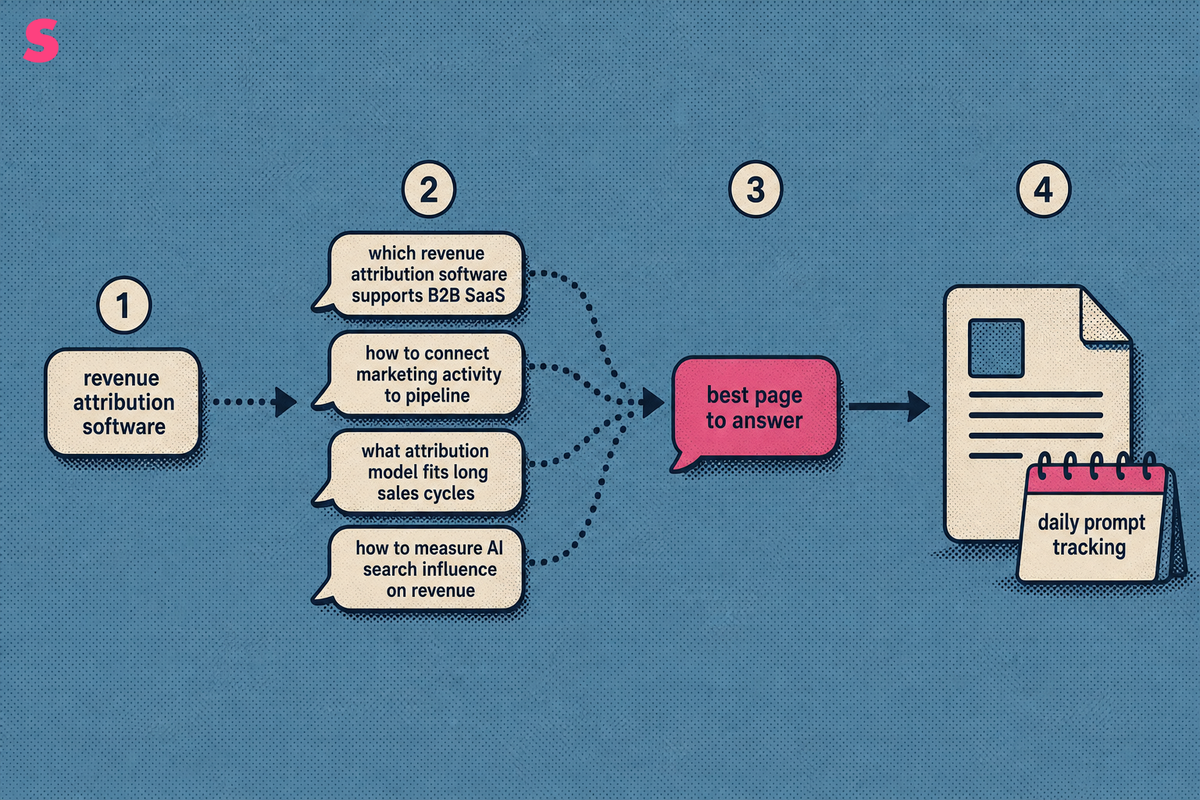
Keyword research should become a prompt strategy by translating short category terms into the full questions buyers ask before evaluating vendors. Per reply.com, GEO content should start from prompts rather than keywords, use an LLM-friendly structure, and adopt a conversational, direct tone.
Take the category keyword revenue attribution software. It can become distinct buyer prompts: which revenue attribution software supports B2B SaaS, how to connect marketing activity to pipeline, what attribution model fits long sales cycles, and how to measure AI search influence on revenue. Each prompt reflects a different need.
- Cluster related keywords by buyer intent and buying stage.
- Rewrite each high-value cluster into one to three natural-language prompts.
- Map every prompt to the page that should provide the best answer.
- Create or revise pages where no credible answer exists.
- Run the same prompt list daily and record the cited pages, sources, and answer position.
Daily prompt tracking exposes patterns that a weekly snapshot can obscure. Retrieval indexes change, models change, and competitors publish. Treat isolated changes as inconclusive until repeated sampling confirms a pattern.
Sona AI Visibility supports the chain from keywords to prompts to pages, then to accounts and revenue. The goal is not to track every possible question. It is to identify buyer prompts that connect category demand to a page your company can credibly own.
Which content formats and authority signals make answer engines cite a page?
Answer engines cite pages that provide a direct answer, clear evidence, identifiable expertise, and corroborating signals beyond the company website. Strong B2B SaaS pages combine concise definitions, original evidence, named authors, visible update dates, and claims another source can verify.
E-E-A-T and topical authority remain useful operating concepts. A buyer-facing page should show experience through concrete mechanisms, expertise through accurate terminology, authority through sustained topic coverage, and trust through attributable evidence. A generic thought-leadership article rarely contains enough substance for a high-intent prompt.
Off-site entity coverage belongs in a GEO programme because answer engines synthesize across sources. A vendor-published directional statistic from marketsplash.com, September 15, 2026, reports that mentions on third-party pages correlate with AI visibility at 0.664, compared with 0.218 for backlinks. That figure is not an industry benchmark, but it supports treating PR, reviews, analyst coverage, and expert references as part of the work.
Build content formats around the evidence a buyer needs: implementation guides, technical comparisons, documented use cases, product definitions, and research pages with clear methods. Publish only claims a named author or supporting source can stand behind. Ensure outside sources use consistent company, product, and category terminology.
How do you measure GEO performance when AI answers change from run to run?
Measure GEO with fixed prompts, repeated sampling, documented scoring rules, engine-level segmentation, and commercial outcomes. A single answer observation is unstable. A measurement system needs a repeatable prompt set across ChatGPT, Google AI Overviews, Perplexity, Gemini, Claude, Microsoft Copilot, and other relevant answer engines.
Sona’s own AI visibility data, September 2026, covers eight answer surfaces: ChatGPT, Google AI Overviews, Perplexity, Google AI Mode, Gemini, Mistral, Qwen, and Claude. Engine segmentation matters because a page can appear in one answer surface and remain absent in another.
Document whether a measurement counts a brand mention, a linked citation, a cited domain, an answer position, or a competitor reference. Sample each prompt repeatedly, retain the raw answers, and report confidence intervals or ranges rather than treating one run as conclusive.
Sona AI Visibility connects AI citations and prompts to pipeline and revenue on one account timeline, and tracks AI crawler activity from server logs or a lightweight edge worker. Mention tracking is the baseline. The business question is whether cited pages contribute to qualified organic visits, branded demand, demo starts, assisted conversions, sales influence, pipeline, and closed-won revenue.
Start with Search Console and analytics. In 2026, self-serve GEO trackers generally start at $20–$100 per month, mid-market platforms commonly cost $250–$800 per month, and published enterprise pricing floors run from $1,000 to $6,000 per month. Move to enterprise tooling after identifying the markets, prompts, and engines that matter.
What should a 30, 60, and 90-day technical GEO roadmap contain?
A 90-day technical GEO roadmap should establish eligibility first, improve extraction readiness second, and connect citation change to commercial reporting third. Each phase needs an owner, a tangible output, and a pass condition.
| Phase | Primary owner | Work | Output | Pass condition |
|---|---|---|---|---|
| Days 1–30 | SEO and engineering | Eligibility audit, crawl and index fixes, baseline prompt set | Priority URL inventory and documented crawl findings | Priority pages are reachable, indexable, and snippet-eligible |
| Days 31–60 | SEO, content, and engineering | Page structure, accurate schema, prompt-to-page mapping, first sampling cycles | Mapped prompt set and revised priority pages | Every priority prompt has an intended page owner |
| Days 61–90 | Content, PR, analytics, and product marketing | Authority work, reporting, pipeline review, and technical re-audit | Trend report with page-level actions | Reporting links prompt movement to commercial measures |
Run prompt tracking daily. Run a full technical re-audit monthly or quarterly because the two cadences answer different questions. Daily prompt data reveals answer volatility, while periodic audits verify whether technical fixes landed and whether releases created regressions.
The useful output is not just a score, which is a dated snapshot. It is the severity-ranked fix attached to each page that moved, giving SEO and engineering teams a specific work item.
Who should own technical GEO across SEO, content, engineering, analytics, and legal?
Technical GEO needs one accountable programme owner, usually an SEO or growth leader, with defined responsibilities across engineering, content, analytics, product marketing, and legal. Per medium.com, GEO involves technical coding, content strategy, PR, and data analysis rather than a single discipline.
| Task | SEO | Content | Product marketing | Engineering | Analytics | Legal |
|---|---|---|---|---|---|---|
| Crawl access and indexing | A | I | I | R | I | I |
| Schema and page structure | A | R | C | R | I | I |
| Prompt set and page mapping | A | R | R | I | C | I |
| Reporting and pipeline measurement | C | I | C | I | A/R | I |
| Claims and evidence review | C | R | A | I | I | C |
In this RACI model, A means accountable, R means responsible, C means consulted, and I means informed. One accountable owner prevents crawl fixes, content rewrites, PR activity, and attribution reporting from becoming disconnected projects.
Sona AI Visibility gives the accountable owner a shared view of prompts, citations, pages, crawler activity, and revenue outcomes. Engineering owns implementation, content owns clarity, analytics owns measurement integrity, and legal reviews substantiated claims.
What are the frequently asked questions about technical GEO?
Is technical GEO just technical SEO with a new name?
Technical GEO shares most technical SEO foundations: crawlability, indexability, canonical tags, internal linking, rendering, and authority. Broader GEO adds prompt-level tracking, citation monitoring, entity coverage, and multi-engine measurement because answer engines select sources for full questions rather than ranking pages only for keyword searches.
Does schema markup guarantee citations in ChatGPT or Google AI Overviews?
No. Schema markup helps a page describe visible content clearly, but it does not guarantee citation. Per developers.google.com, August 7, 2026, eligibility for Google generative features starts with indexing and search-snippet eligibility. Treat schema as supporting infrastructure, not a decisive citation mechanism.
Is GEO mostly a technical task or a strategic one?
A commonly cited framing puts GEO at roughly 80% strategic and 20% technical. Technical work establishes access and extraction eligibility. Content quality, prompt selection, entity consistency, original evidence, and third-party authority influence whether an answer engine selects the page.
How do you measure GEO when AI answers change every time?
Use a fixed prompt set, sample every prompt repeatedly, segment results by engine, document scoring rules, and report ranges instead of single observations. Run the prompt list daily. This operating rhythm separates sustained change from a temporary retrieval or model shift.
How much should an early-stage SaaS company spend on GEO tracking?
Start with Search Console and analytics. Add low-cost prompt monitoring once the team has a defined prompt list. In 2026, self-serve GEO trackers generally start at $20–$100 per month. Move to an enterprise platform after the company identifies its priority markets, buyer prompts, and answer engines.
Do more AI citations mean more pipeline?
No. Citation volume is a visibility measure, not a commercial result. Tie citations to qualified visits, branded demand, demo starts, assisted conversions, sales influence, pipeline, and closed-won revenue. That reporting shows whether AI visibility contributes to business outcomes rather than creating an isolated marketing metric.
Summarize this article with AI: ChatGPT · Claude · Perplexity · Google AI Mode
Last updated: October 2026







