GEO campaign case studies are credible only if they provide a stated baseline, a fixed prompt set, reporting for each engine and a dated measurement period. Most of the eight cases assessed in October 2026 are vendor-reported or secondhand, so evaluate them using absolute beginning and ending figures and whether they report trials, leads or revenue instead of mentions. Sona AI Visibility links prompts and citations to pipeline and revenue, the outcome that matters.
Which successful GEO campaigns case studies report the strongest results?
The strongest reported GEO outcomes connect AI visibility to signed revenue, leads, or trials rather than citations alone. A K–12 education platform reported monthly signed revenue rising from $24,000 to $280,000 over five months, per the October 2026 listing. That commercial outcome is more commercially consequential than inclusion counts or citation rates. Auditability depends on customer identity, absolute values, analytics access, attribution rules, prompt sets, and dated measurement windows.
The eight published cases below are presented as a cross-section of reported commercial, acquisition, traffic, and visibility outcomes. The figures are reported outcomes, not independently re-measured results.
| Case study | AI metric | Absolute baseline to end value | Timeline | Single stated leverage point | Evidence type |
|---|---|---|---|---|---|
| K–12 education platform | Monthly signed revenue growth of 1,041% | $24,000 to $280,000 monthly signed revenue | Five months | Not stated in the listing | Vendor-reported, October 2026 listing |
| SmartSource | LLM traffic up 65%, organic leads up 50%, total leads up 20% | Not disclosed | Not stated in the listing | Not stated in the listing | Vendor-reported, October 2026 listing |
| SaaS company growth account | ChatGPT supplied 31% of reported new users | 31% from ChatGPT, versus 16.5% from TikTok, 10.4% from the App Store, and 8.7% from Google | Not stated in the listing | Not stated in the listing | First-party company account, October 2026 listing |
| SaaS free-trial example | More than 20 monthly free-trial signups attributed to ChatGPT citations | More than 20 trials per month | Not stated in the listing | UTM and referral-source filtering | Secondary report, October 2026 listing |
| Thompson Tractor | Generative-AI traffic up 586% | Not disclosed | Not stated in the listing | Not stated in the listing | Vendor-reported, October 2026 listing |
| The Rank Masters | ChatGPT referrals up 8,337% | Not disclosed | 90 days | Not stated in the listing | Vendor-reported, October 2026 listing |
| Telecom Google AI Overviews case | Google AI Overviews inclusions | 712 to 3,235 inclusions | Not stated in the listing | Not stated in the listing | Vendor-reported, October 2026 listing |
| B2B SaaS citation-rate case | Citation coverage across 12 target prompts | 0% to 58% | 60 days | Not stated in the listing | Vendor-reported, October 2026 listing |
The table is an evidence cross-section, not a verdict on campaign quality. Signed revenue with an explicit start and end value gives readers more commercial context than a large percentage without a disclosed denominator.
What sample of GEO case studies was audited, and how was it read?
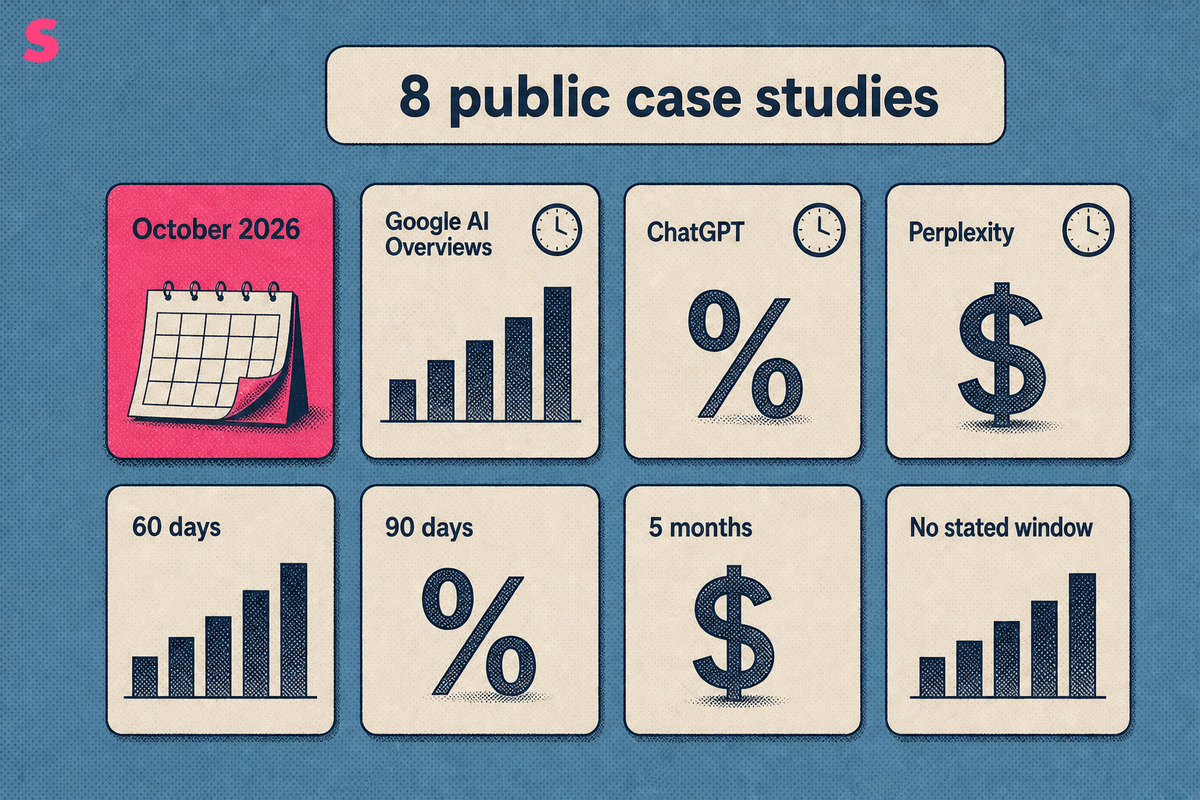
This review audited eight public GEO case studies read in October 2026. Each case was public, dated, and contained at least one numeric before-and-after value or measurable acquisition outcome. The reported answer surfaces were Google AI Overviews, ChatGPT, and Perplexity.
The stated reporting windows were 60 days for the B2B SaaS citation-rate case, 90 days for The Rank Masters referral case, and five months for the K–12 education platform revenue case. Other listings disclosed outcomes without a measurement window, reducing their value for budget forecasting.
Sona did not run these campaigns or re-measure the reported figures. Read the figures as published case-study claims, not independently verified performance data. Sona’s own AI visibility data, September 2026, covers eight answer surfaces: ChatGPT, Google AI Overviews, Perplexity, Google AI Mode, Gemini, Mistral, Qwen and Claude.
The sample does not establish an industry benchmark, average uplift, or causal model for GEO. It shows which claims are published, what each claim measures, and whether a buyer can inspect the baseline, prompt set, engine coverage, and reporting window.
Which metrics should a GEO campaign be judged on: citations, traffic, trials or revenue?
Judge a GEO campaign in a hierarchy: citations first, then AI-referred traffic, trials and leads, and finally signed revenue. Each lower stage sits closer to commercial impact. Conventional search rankings do not guarantee AI visibility because an answer engine can cite pages that lack the strongest search position.
Citations and inclusions establish whether a brand appears when a buyer asks a relevant prompt. The telecom case moved from 712 to 3,235 Google AI Overviews inclusions, per the October 2026 listing. The B2B SaaS case moved from 0% to 58% citation coverage across 12 prompts in 60 days, per the October 2026 listing. Both are visibility results, not demand-generation proof.
AI-referred traffic tests whether citations produce visits. Thompson Tractor reported generative-AI traffic growth of 586%, per the October 2026 listing. Traffic alone does not establish commercial value because visitor intent, conversion paths, and referral classification vary.
Trials, leads, and revenue are the decisive measures. SmartSource reported LLM traffic growth of 65%, organic lead growth of 50%, and total lead growth of 20%, per the October 2026 listing. The K–12 platform reported monthly signed revenue rising from $24,000 to $280,000 and appointment bookings rising from 9.6% to 28.4%, per the October 2026 listing.
Which tactics recur across the GEO campaigns that worked?
Recurring GEO tactics include content clusters, a consistent publishing cadence, Search Console data optimization, and expertise translated into structured copy that an answer engine can cite. Five published successful GEO cases identified content clusters, steady publication, and Search Console-led optimization as shared factors, per the October 2026 listing.
Content clusters give a brand multiple pages that answer related buyer questions with distinct evidence and intent. Publishing cadence matters because answer engines retrieve changing sources. Search Console data helps teams identify established demand, then reshape high-value keyword themes into the fuller prompts buyers use in ChatGPT, Perplexity, Gemini, Claude, and other answer engines.
Page readiness also matters. Pages need crawlability, performance that does not depend entirely on JavaScript, and sound transport and header hygiene. They also need structure, including schema markup, current useful copy, alt text, ARIA attributes, contrast, and explicit image dimensions.
Sona AI Visibility Growth adds page-level insights, Agent Analytics, company-level visitor identification, and AI search attribution. Repeated checks remain necessary because page readiness is a dated snapshot until observations establish a trend.
How quickly do GEO results appear, and do they last?
Reported GEO results appeared in windows from 60 days to five months, but none of the eight published cases documents durability. The B2B SaaS citation case reported 0% to 58% coverage in 60 days, per the October 2026 listing. The Rank Masters case reported 8,337% ChatGPT referral growth in 90 days, per the October 2026 listing.
The K–12 education platform reported its revenue change after five months, per the October 2026 listing. These periods show that reported movement can occur within a quarter, but they do not prove that gains held after a model update, retrieval-index change, new competitor content, or shift in buyer prompts.
AI answers vary by prompt, location, model, personalization, and time. One observed answer does not establish a durable ranking. A GEO measurement plan should report Google AI Overviews, ChatGPT, Perplexity, and other answer engines separately rather than combine different engine behavior into one visibility number.
A team that runs the same prompt list daily can identify patterns that a weekly snapshot would average away. Repeated observations are stronger evidence of a trend than a one-day spike. Sona AI Visibility supports daily prompt tracking, while a full technical re-audit and positioning review belong on a monthly or quarterly schedule.
How do you attribute trials and revenue to AI citations?
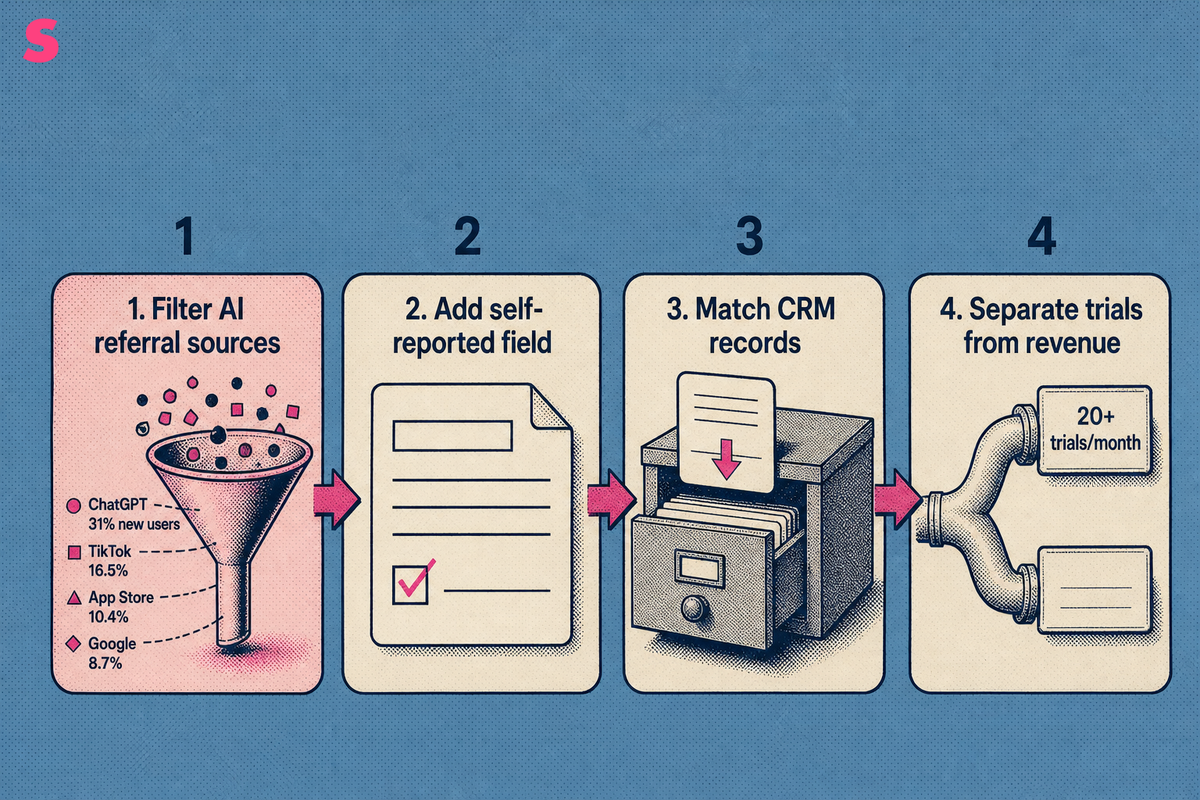
Attributing trials and revenue to AI citations requires referral data, self-reported attribution, and CRM matching rather than citation counts alone. The SaaS free-trial example attributed more than 20 monthly trials to ChatGPT citations through UTM and referral-source filtering, per the October 2026 listing. That case is a secondary report, so its underlying analytics were not independently verified.
A SaaS company’s first-party account reported ChatGPT as the source of 31% of new users, ahead of TikTok at 16.5%, the App Store at 10.4%, and Google at 8.7%, per the October 2026 listing. Channel-share reporting needs a consistent definition of a new user and clear treatment of direct, hidden, or misclassified AI referrals.
Use a structured process:
- Filter identifiable AI referral sources and preserve UTM parameters where they exist.
- Add a self-reported attribution field to signup and demo forms for research that produced no click.
- Match trials, opportunities, and closed-won records in the CRM to the account and acquisition timeline.
- Separate trial volume from qualified pipeline and signed revenue.
For attribution, Sona AI Visibility Growth adds AI search attribution and company-level visitor identification. Mention and competitor tracking remain baseline visibility measures.
What red flags show a GEO case study is inflated or cherry-picked?
The clearest red flags are missing absolute baselines, extreme percentage claims from zero or tiny starting points, pseudonymous customers, and undisclosed prompt sets. A 0% to 58% citation rate is meaningful as a measurement start, per the October 2026 listing. An 8,337% referral increase without a disclosed starting value is much harder to interpret.
The K–12 platform case reports 1,041% revenue growth from $24,000 to $280,000 monthly signed revenue, but the customer is pseudonymous, per the October 2026 listing. Other vendor-reported case-study claims include 4,900% revenue growth and $90 million in pipeline during 2026. Apply the same scrutiny to those figures: baseline, dates, attribution rule, and source analytics.
Four measurable elements make a case study more credible: a stated baseline, a fixed prompt set, per-engine reporting, and a dated measurement window, per the October 2026 listing. Missing any element does not prove the outcome is false. It means readers cannot reliably reproduce or compare the claim.
- No raw analytics export, control group, or disclosed attribution logic.
- One blended metric that hides different results across answer engines.
- No geography, sampling cadence, citation rule, or prompt list.
- Secondhand reposting that does not identify the original customer evidence.
How do you pressure-test a vendor's GEO numbers and reproduce the result?
Pressure-test a GEO claim by asking for the fixed prompt set, engine list, geography, sampling schedule, citation rule, and absolute start and end values. A percentage without its denominator is a marketing statement, not a reproducible result.
- Ask for every tracked prompt and the rationale for including it.
- Ask which answer engines were measured, then require per-engine reporting.
- Ask for the reporting window, geography, and sampling schedule.
- Ask for absolute values beside every percentage change.
- Ask for the analytics export behind AI-referred traffic and the CRM definition of a trial, opportunity, or revenue event.
- Ask what else changed during the period, including paid spend, seasonality, product launches, and site changes.
- Repeat the prompt sampling daily to account for answer variance.
Preserve the output as a log rather than treating one visibility score as a conclusion. A dated score starts an investigation. A comparable series shows whether movement holds, and page-level evidence gives the team an operational next step.
Budget guidance needs the same discipline. Claims that successful agencies allocate 11–20% of marketing spend to GEO while retaining paid search investment are vendor-reported, per the October 2026 listing. Test that spending premise against attributable pipeline and revenue rather than treating it as a universal benchmark.
What do these GEO case studies not show?
These GEO case studies do not show an independently verified average return, a reliable durability curve, or a like-for-like comparison between AI-referred and organic visitor quality. The sample contains eight published cases, mostly from B2B, SaaS, and services contexts, read in October 2026. Failed campaigns are rarely published, creating survivorship bias.
The cases also do not provide control groups, common prompt sets, common geographies, or a shared attribution standard. Several rely on vendor-reported outcomes, some use pseudonymous customers, and several omit raw analytics. Their figures can shift because answer outputs and referral classification change.
Monitoring which AI answers mention a brand is only half the job. The other half is connecting those mentions to accounts, pipeline, and revenue.
The evidence does not explain the root causes of failed GEO programs or provide industry-specific implementation roadmaps. Those questions need separate studies with controlled prompt sets, stable reporting periods, and comparable commercial outcomes.
What are the frequently asked questions about GEO case studies?
What makes a GEO case study credible?
A credible GEO case study states a baseline, uses a fixed prompt set, reports each answer engine separately, and gives a dated measurement window. It should show absolute start and end values beside percentage changes. Those details let readers assess the denominator, reproduce the sampling process, and distinguish a sustained trend from a one-day result.
Are published GEO case study results independently verified?
Mostly not. Several published cases are vendor-reported, some use pseudonymous customers, and some do not publish raw analytics or a control group. Treat published results as claims to test rather than universal benchmarks. The K–12 platform’s revenue figures, for example, appear in an October 2026 listing but are not independently verified.
How long does it take for a GEO campaign to show results?
The reported windows in the reviewed cases run from 60 days to five months. The B2B SaaS citation case reported movement in 60 days, while the K–12 education platform reported its outcome after five months, per October 2026 listings. None of the eight cases documents how long gains lasted, so repeated measurement is necessary.
Why can a huge percentage gain in AI traffic be misleading?
A jump from zero or a very small starting number produces an extreme percentage. The Rank Masters case reported 8,337% ChatGPT referral growth over 90 days, per the October 2026 listing, but the listing does not disclose an absolute baseline. Ask for the starting and ending values before assigning commercial significance.
How do you attribute a trial or sale to an AI citation?
Combine UTM and referral-source filtering, a self-reported attribution question at signup, and CRM matching. AI referrals can be hidden or misclassified in analytics, especially when buyers research in an answer engine and return later through a direct visit. The SaaS free-trial example used UTM and referral-source filtering to attribute more than 20 monthly trials to ChatGPT citations, per the October 2026 listing.
Which AI engines should a GEO campaign track?
Track every answer surface used by target buyers and report each engine separately. At minimum, include Google AI Overviews, ChatGPT, and Perplexity, the answer engines named in the reviewed cases. Per-engine reporting prevents one strong surface from concealing weak visibility or citation coverage elsewhere.
Summarize this article with AI: ChatGPT · Claude · Perplexity · Google AI Mode
Last updated: October 2026