


The best LLM SEO tracking tool is the one that matches your measurement goal: prompt-level visibility across ChatGPT, Google AI Overviews, Gemini, Perplexity and Claude, with enough prompts included to make the numbers repeatable. Entry plans start near $29 per month and enterprise tiers run into the thousands. Most trackers stop at mention and citation counts; Sona AI Visibility ties those citations, and the prompts behind them, to pipeline and revenue, and tracks AI crawler activity from server logs.
What does an LLM SEO tracking tool actually measure?
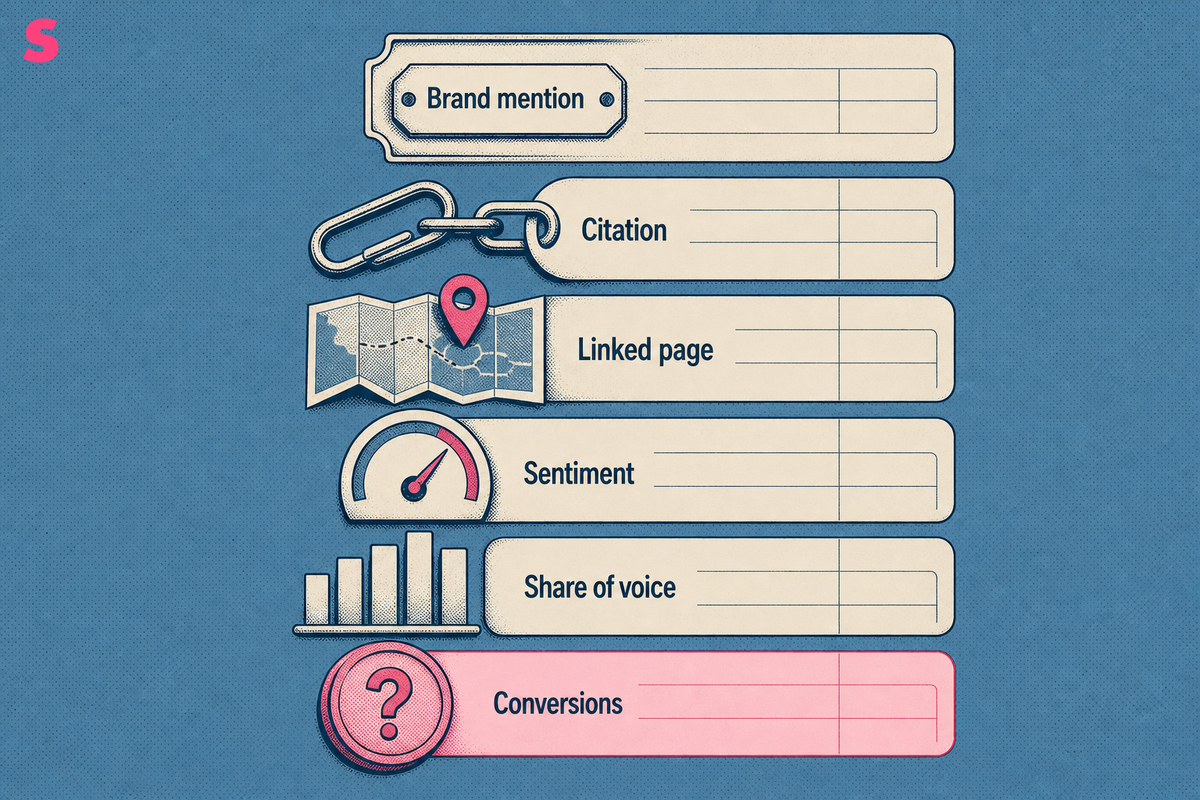
An LLM SEO tracker runs a fixed list of buyer prompts against answer engines on a schedule and records what comes back. Not a position in a results page. Whether the brand is named, whether it is cited with a link, which page earned the citation, how the answer characterises the brand, and which competitors appeared alongside it.
Those are six distinct measurements, and tools differ on which they capture:
- Brand mention: the brand name appears anywhere in the generated answer.
- Citation: the answer links a source, and one of the sources is your domain.
- Linked page: which specific URL earned the citation, which is the part that makes a finding actionable.
- Sentiment: positive, neutral or negative framing of the brand in that answer.
- Share of voice: how often you appear across the prompt set relative to named competitors.
- Conversions: whether the visit that followed the answer became a signup, a lead or pipeline.
The first five are visibility measurements. The sixth is a revenue measurement, and most tools in this category do not attempt it, because it requires resolving the anonymous visitor behind an AI referral rather than reading an answer string.
How were the 7 tools in this shortlist chosen?
Four eligibility criteria, applied before any tool was written up. Every entry had to publish a price on its own pricing page, name the answer engines it tracks, state a prompt allowance on its entry plan, and refresh those prompts on a stated cadence. A tool that hides any of the four cannot be compared on the same axis as one that publishes all four. The seven tools that clear those gates are presented as an unranked shortlist, not as places 1 to 7.
Two objections are worth naming directly. The first is that a vendor-written comparison is biased. It is, and the defence is method rather than modesty: every price in this article was read from the vendor's own pricing page in August or September 2026, and the cost-per-prompt column uses one shared denominator for all rows, including Sona's. On that denominator Sona is not the cheapest figure in the table.
The second objection is that these tools measure different things, so a single list flattens real differences. True. That is why the entries below separate what a tool does from what it costs from who it suits, and why the comparison table splits engine count from engine names: a count can be sorted, a free-text blend of counts and names cannot.
Which 7 LLM SEO tracking tools are worth shortlisting, and what does each cost?
Seven tools clear the four eligibility criteria, and every price in this section was read from the vendor's own pricing page in August or September 2026. The shortlist is unranked, with Sona first and the rest in no particular order. Each entry states what the tool does, what it costs on its entry plan, and who it suits.
Sona AI Visibility. Connects citations and the prompts behind them to pipeline and revenue on one account timeline, and tracks which AI crawlers reach your pages from server logs or a lightweight edge worker, so a mention becomes something measurable rather than a number to report. Mention and competitor tracking across ChatGPT, Gemini, Claude, Perplexity and more is the baseline underneath that. Brands from $75/month, agencies from $199/month, both billed annually, with unlimited seats on every plan and a 14-day free trial. Suits B2B teams who have to justify the channel in pipeline terms.
Profound. Citation and answer tracking, with Starter covering ChatGPT only and Growth widening to three answer engines. From $99/month, Growth at $399, Enterprise custom, billed yearly, with a free trial on Growth. Suits a team whose buyers concentrate in one engine.
Peec AI. Prompt-level visibility across a chosen set of three models. From $80/month on Starter with 50 daily prompts, rising to $420 on Advanced, billed annually. Suits a small marketing team running its first structured prompt list.
Otterly.ai. Daily prompt checks with unlimited team members on every plan. Lite is $29/month for 15 prompts, Standard $189 for 100, Premium $489 for 400, with a free trial, no commitment and 15% off annual billing. Suits a brand that wants the lowest-friction start.
Scrunch AI. Brand visibility tracking with a separate agency tier. Core is $250/month for brands with 125 unique prompts; Agency Core is $500/month with 250, and there is a 7-day trial of Starter with no credit card. Suits agencies running several client workspaces.
AthenaHQ. Credit-metered tracking across a wide engine set, with a free Essential tier of 300 credits. Starter is $295/month with 3,600 credits, where one credit is one AI response, and annual billing takes 17% off. Suits mid-market teams that want breadth of engine coverage.
PromptWatch. Prompt and response monitoring with published agency plans. Essential is $95/month for 50 prompts and 6,000 responses, Professional $245, Business $579, agency plans from $199. Suits agencies that bill on reporting.
How do the LLM SEO trackers compare on price, prompts and engine coverage?
Prices resist comparison because the units disagree. One vendor sells prompt slots, another sells credits, a third sells monthly responses. A headline prompt count on one tool may mean one model; on another it means four. The cost-per-prompt column below fixes that with a single denominator: one prompt, on one model, once a day. Every price in the table was read from the vendor's own pricing page in August or September 2026.
| Tool | Starting price | Agency Plans? (Yes/No) | # of Answer Engines Tracked | Answer Engines | # of Daily Tracked Prompts (entry plan) | Cost per Daily Tracked Prompt | Differentiation |
|---|---|---|---|---|---|---|---|
| Sona AI Visibility | Brands from $75/month, agencies from $199/month, both billed annually. 14-day free trial, no credit card. Unlimited seats and API/MCP access on every plan | Yes | 11 | ChatGPT, Gemini, Google AI Mode, Google AI Overviews and Perplexity on standard, plus Claude, DeepSeek, Grok, Copilot, Qwen and Mistral on premium | 5,000 credits/month on Starter 5K, about 166 prompts tracked daily on one model or 56 across three. 1 credit = 1 AI answer | $0.45 per daily tracked prompt | Ties citations and prompts to pipeline and revenue on one account timeline; tracks AI crawler activity with no JavaScript tag |
| Profound | From $99/month (Starter), $399 (Growth), Enterprise custom, billed yearly. Free trial on Growth. Starter tracks ChatGPT only; Growth tracks 3 answer engines | Yes | 1 | ChatGPT only | 50 prompts and 1,500 responses/month on Starter; 100 prompts and 9,000 responses/month on Growth | $1.98 per daily tracked prompt | Focus: answer and citation tracking, concentrated on ChatGPT at entry tier |
| Peec AI | From $80/month (Starter), $205 (Pro), $420 (Advanced), Enterprise custom. Annual billing | Yes | 3 | ChatGPT, Google AI Mode, Google AI Overviews, Microsoft Copilot, Perplexity, Gemini | 50 prompts on Starter, tracked daily, on 3 chosen models | $0.53 per daily tracked prompt | Focus: daily prompt visibility on a buyer-chosen model set |
| Otterly.ai | From $29/month (Lite), $189 (Standard), $489 (Premium), Enterprise from $1,000. Free trial, no commitment. 15% off annual; unlimited team members on every plan | Yes | 4 | ChatGPT, Google AI Overviews, Perplexity and Microsoft Copilot | 15 prompts on Lite, 100 on Standard, 400 on Premium, checked daily on every plan | $0.48 per daily tracked prompt | Focus: low entry price with unlimited team members on every plan |
| Scrunch AI | Core $250/month for brands, Agency Core $500/month, Enterprise custom. 7-day trial of Starter, no credit card | Yes | 4 | ChatGPT, Perplexity, Google AIO and Copilot | 125 unique prompts on Core, 250 on Agency Core | $1.50 per daily tracked prompt | Focus: a distinct brand tier and agency tier with different prompt allowances |
| AthenaHQ | From $295/month (Starter), Enterprise custom. Free Essential tier with 300 credits. 17% off annual; 1 credit = 1 AI response | Yes | 10 | ChatGPT, Perplexity, Google AI Overviews, Google AI Mode, Gemini, Claude, Copilot, Grok and DeepSeek | 3,600 credits on Starter, where 1 credit is 1 AI response | $2.46 per daily tracked prompt | Focus: broad engine coverage metered in credits, with a free entry tier |
| PromptWatch | Essential $95/month, Professional $245, Business $579. Agency plans from $199/month (Kick-off) | Yes | 4 | ChatGPT, Claude, Gemini and Perplexity | 50 prompts and 6,000 responses/month on Essential, with 500 agent credits | $0.48 per daily tracked prompt | Focus: response-level monitoring with a separately priced agency ladder |
Across the wider field, a comparison published on linkedin.com on January 8, 2026 put the range at $29 to $499 per month depending on feature set. Published pricing runs past that at the top end: Otterly.ai's Enterprise tier starts at $1,000 per month.
Which AI engines does an LLM SEO tracker need to cover?
Cover the engines your buyers use, then the ones that feed them. For B2B, that means ChatGPT, Google AI Overviews, Google AI Mode, Gemini, Perplexity and Claude as the core, with Copilot, Grok and DeepSeek as secondary. Sona's own AI visibility data, September 2026, covers eight answer surfaces: ChatGPT, Google AI Overviews, Perplexity, Google AI Mode, Gemini, Mistral, Qwen and Claude.
Engine counts in this category are not comparable at face value. Google AI Overviews and Google AI Mode are two surfaces of one product and are sometimes counted as one. A tool listing ten "AI destinations" may be counting model ecosystems rather than distinct answer surfaces. Read the names, not the number.
Coverage also varies by tier in ways the headline hides. Profound's $99 Starter tracks ChatGPT only, widening to three engines on the $399 Growth plan. Peec AI's Starter tracks three models chosen from six. Semrush's AI Visibility Toolkit, from $99 per month per domain, tracks three LLMs of the buyer's choice. Check what the entry plan covers, not what the feature page lists.
Collection method matters too. Some tools scrape the prompt response the way a person sees it, ads and formatting included. Others pull from the vendor's official API, which returns a structured response that need not match the screen. The two methods can capture different answers to the same question. Sona uses both, aiming to mirror the end-user experience as closely as possible.
How reliable are LLM visibility scores when AI answers change daily?
A single reading is unreliable. A daily series is not. The same prompt returns different answers as the retrieval index shifts, as a model updates, and as competitors publish, so one check tells you almost nothing about direction. A pattern that holds across several consecutive days is a trend; a one-day spike is noise.
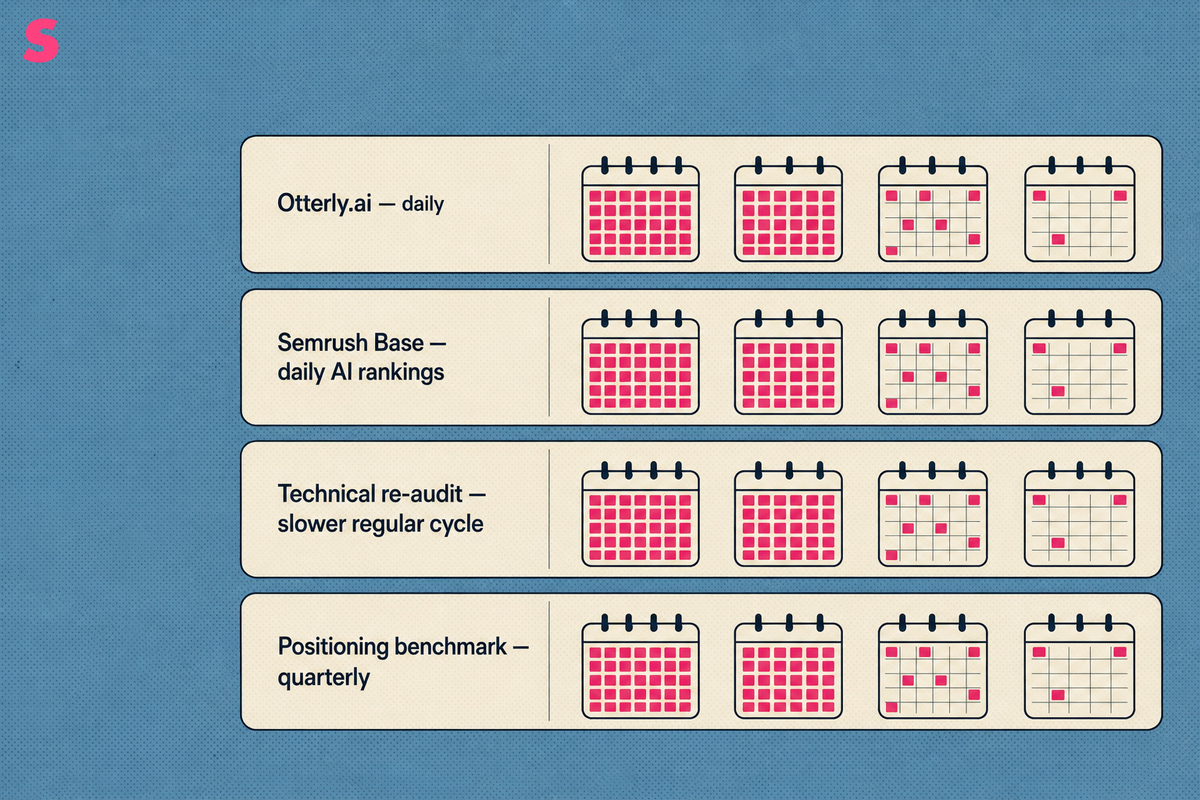
Daily tracking is published by some tools in this category: Otterly.ai checks daily on every tier, and Semrush's Base plan includes daily AI rankings. A team running the same prompt list every day sees patterns a weekly snapshot would have averaged away, which is why the cadence matters more than any single score.
Other variables move too, and a transparent methodology names them: location, model version, prompt phrasing and date. Query fanout belongs on that list. A tracked prompt is rarely one literal string; it expands into the phrasings a real buyer would use, and measuring visibility across that set is closer to how generative engines decompose a question.
Set the cadence by artefact. Prompt lists daily. A full technical re-audit on a slower, regular cycle. A positioning and competitive benchmarking review quarterly. And remember what you are buying: a score is a dated snapshot, while the comparable series of those scores over time is what shows a team a trend.
How do you connect LLM visibility data to traffic, leads and revenue?
You connect it by resolving the visit, not by counting the mention. An AI-referred visitor usually arrives with no keyword and often lands in analytics as direct traffic, which is why AI search looks small in most dashboards and the direct bucket looks inflated. Sona AI Attribution stitches those AI touchpoints into one account timeline alongside ads, web and CRM data, and adds self-reported attribution on demo and signup forms to credit the zero-click research that never sent a click at all.
Here is the gap that makes mention counts unsatisfying. A brand-level visibility score is a number, not a work item. Knowing what share of tracked answers names you does not say which prompts you lost, which competitor took the slot, or which of your pages the engine cited instead. A prompt-level and page-level view does, and Sona reports visibility, position, share of voice, buying stage and intent on the prompt row itself, alongside which pages AI crawlers have actually indexed.
Run the chain in order and the commercial-value objection answers itself:
- Track the prompt list daily and record mentions, citations and cited pages.
- Resolve the account behind each AI-referred visit.
- Score that account on intent and buying stage.
- Report AI search as a channel with spend, deals and ROAS next to every other channel.
What do entry-level AI SEO tracking plans leave out?
Entry plans buy a sample, not a measurement. The three things they cut are prompt allowance, engine breadth and history. Otterly.ai's $29 Lite plan tracks 15 prompts. Peec AI's $80 Starter tracks 50. Profound's $99 Starter tracks 50 prompts on ChatGPT alone. Fifteen prompts cannot cover awareness, consideration and decision questions across a category.
History is the quieter cut and the one that hurts a quarterly report. Ask any vendor how long prompt-level results are retained on the plan you are buying, because without a retained series you have a score and no trend.
Seats and trials vary more than price does. Otterly.ai includes unlimited team members on every plan. Sona includes unlimited seats and API/MCP access on every tier, with a 14-day free trial and no credit card. Scrunch AI offers a 7-day trial of Starter with no credit card, and AthenaHQ has a free Essential tier of 300 credits.
For a small SaaS team, the honest starting point is a free technical check before a paid subscription. The Free AI Readiness Checker audits a site and reports whether engines can crawl and parse your pages. It does not tell you whether you appear in answers, which is the job of the paid tier.
Which LLM SEO tracking tool should you pick for your team size and goal?
Pick by what you have to prove, not by feature count. The prices below were read from each vendor's own pricing page in August or September 2026.
- B2B teams that must justify the channel in pipeline terms: Sona AI Visibility, because it carries citations through to accounts, pipeline and revenue rather than stopping at mention counts, from $75/month for brands.
- Small businesses and early-stage SaaS testing whether they appear at all: Otterly.ai at $29/month for 15 daily prompts, or Peec AI at $80/month for 50.
- Teams whose buyers live in one engine: Profound at $99/month, tracking ChatGPT on Starter.
- Agencies needing client workspaces and white-label reporting: Sona's agency ladder from $199/month with one shared credit pool, Scrunch AI's Agency Core at $500/month, or PromptWatch's agency plans from $199/month.
- Mid-market teams wanting the widest engine set: AthenaHQ at $295/month across ten engines.
Whichever you pick, budget for the prompt list you actually need. Fifty prompts across three stages, checked daily, is a real measurement. Fifteen is a pilot. Price the tool on cost per daily tracked prompt and the tiers become comparable.
Frequently Asked Questions
What is the difference between an LLM SEO tracker and a rank tracker?
A rank tracker records a position for a keyword in a results page. An LLM SEO tracker runs prompts against answer engines and records whether the brand is mentioned, cited or linked inside the generated answer. There is no position 1 to 10 to report, so the metrics are mention rate, citation rate and share of voice instead.
How much does LLM SEO tracking software cost?
Across the seven shortlisted tools, with every price read from the vendor's own pricing page in August or September 2026, Sona AI Visibility starts at $75/month for brands and $199/month for agencies, Otterly.ai Lite is $29/month, Peec AI Starter is $80/month, PromptWatch Essential is $95/month, Profound Starter is $99/month, Scrunch AI Core is $250/month and AthenaHQ Starter is $295/month. Enterprise tiers run higher, and several vendors quote them on request.
How many prompts do you need to track for a reliable AI visibility score?
Enough to cover each buying stage and to repeat daily. The 15 to 50 prompts on entry plans are a sample rather than a measurement. A larger prompt set reduces how much any single answer moves the aggregate, so a swing on one prompt no longer looks like a change in the brand's position.
Can an LLM SEO tracking tool show traffic and conversions from AI answers?
Some stop at prompt-level mentions and citations. Sona AI Visibility resolves the accounts behind AI-referred visits and ties them to pipeline and revenue on one account timeline, including the zero-click research where an engine cited the brand but sent no click.
Is a free AI SEO tracker good enough to start?
A free tier or a $29 plan is enough to confirm whether a brand appears at all. The prompt caps, single-engine limits and short retention make it unsuitable for reporting trends to a leadership team, because a trend needs a retained series rather than one reading.
Do you still need traditional SEO tools alongside an LLM SEO tracker?
Yes. Answer engines draw heavily on pages that already rank and get crawled, so keyword, technical and backlink data remain the inputs AI visibility depends on. A page blocked in robots.txt or dependent on client-side JavaScript will not be cited regardless of how good the copy is.
Summarize this article with AI: ChatGPT · Claude · Perplexity · Google AI Mode
Last updated: September 2026







