


An AI Overview tracker is software that runs a fixed set of queries against Google, then records whether your brand appears in the Google AI Overviews answer, which URLs Google cites, and which competitors show up beside you. Self-serve plans run from roughly $29 to $699 per month, and the real separator is whether a tool counts unlinked mentions, linked citations, or both. Most stop at those counts; Sona AI Visibility ties the citations, and the prompts behind them, to pipeline and revenue.
What does an AI Overview tracker actually do?
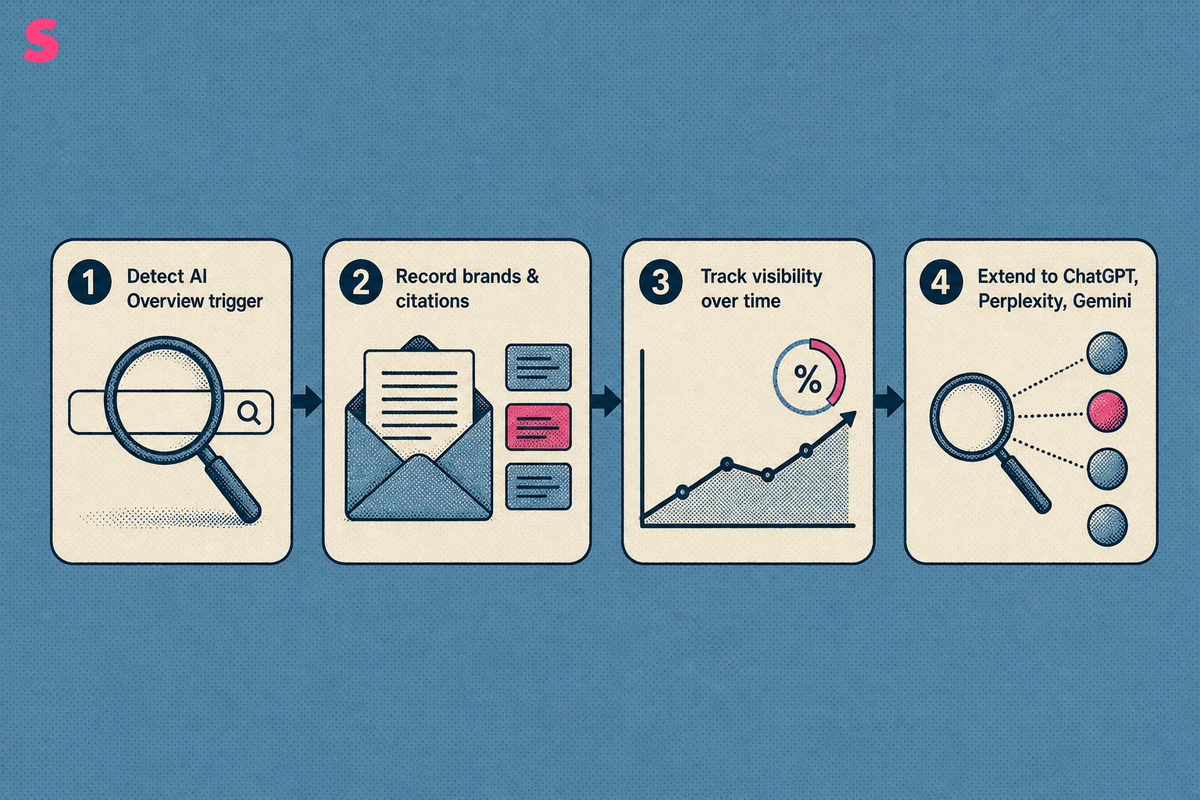
An AI Overview tracker runs a fixed list of queries against Google on a schedule, records whether Google AI Overviews appeared for each one, and logs what the generated answer said: which brands it named, which URLs it cited as source cards, and where your domain sat among them. It is rank tracking for a surface that has no ranks.
Teams buy one because coverage keeps growing. An almcorp.com analysis put Google AI Overviews on roughly 31% of tracked queries in February 2025 and 48% in February 2026, meaning incidence across that tracked query set rose sharply in a single year.
Most tools in this category do four things:
- Detect whether Google AI Overviews triggered for a query, and store the answer text
- Record brand mentions and linked citations, yours and your competitors'
- Track a share-of-voice or visibility percentage over time
- Extend the same method to other answer engines such as ChatGPT, Perplexity and Gemini
What they do not all do is connect any of it to a session, a lead, or a closed deal. That gap is where the real purchasing decision sits.
Which capabilities actually differ between AI Overview tracking tools?
Dedicated Google AI Overview trackers generally measure the same core things: whether an AI Overview triggered for a query, which brands and URLs the generated answer named, and how that changes over time. The capabilities that separate one product from another are narrower: how the answer is sampled, which engines the entry plan actually covers, how often prompts refresh, whether prompt-level intent is classified, and whether anything downstream of the citation is measured.
Use this as a checklist when you demo:
- Sampling method. Scraped answer versus vendor API response, and whether the method is disclosed at all
- Locale and device controls. Country, language and device profile per query run
- Prompt-level intent. Whether each tracked prompt is classified as commercial, informational, transactional or navigational, and tagged to a buying stage
- Page-level resolution. Which of your URLs is being cited, rather than a domain-level score
- Crawler visibility. Whether AI bots can reach the pages you want cited
- Revenue connection. Whether an AI-referred visit resolves to an account
A single brand visibility percentage is a dated snapshot, not a work item, and it tells a team nothing about what to write next. Sona AI Visibility reports at the prompt and page level instead, showing which prompts surface the brand, which sources get cited in those answers, and which of your own pages no AI crawler has ever indexed.
How do the leading AI Overview trackers compare on price, prompts and engines?
Entry prices on published self-serve plans run from $29 to $399 per month. The spread tracks prompt allowances, engine counts and refresh cadence rather than quality. The figures below were read from each vendor's own pricing page between August and September 2026.
Cost per daily tracked prompt is normalised on one shared denominator: one prompt, on one model, once per day. Dividing each price by whatever a vendor calls a prompt produces a fourfold error, because some vendors count per model and some count across all models.
| Tool | Starting price | Agency Plans? (Yes/No) | # of Answer Engines Tracked | Answer Engines | # of Daily Tracked Prompts (entry plan) | Cost per Daily Tracked Prompt | Differentiation |
|---|---|---|---|---|---|---|---|
| Sona AI Visibility | Brands from $75/month, agencies from $199/month, both billed annually. 14-day free trial, no credit card. Unlimited seats and API/MCP access on every plan | Yes | 11 | ChatGPT, Gemini, Google AI Mode, Google AI Overviews and Perplexity on standard, plus Claude, DeepSeek, Grok, Copilot, Qwen and Mistral on premium | 5,000 credits/month on Starter 5K, about 166 prompts tracked daily on one model or 56 across three | $0.45 per daily tracked prompt | Connects citations and prompts to pipeline and revenue on one account timeline, and reads AI crawler activity from server logs with no JavaScript tag |
| Otterly.ai | From $29/month (Lite), $189 (Standard), $489 (Premium), Enterprise from $1,000. Free trial, no commitment. 15% off annual; unlimited team members on every plan | Yes | 4 | ChatGPT, Google AI Overviews, Perplexity and Microsoft Copilot | 15 prompts on Lite, checked daily on every plan | $0.48 per daily tracked prompt | Focus: daily prompt checks, with unlimited team members on every plan |
| Peec AI | From $80/month (Starter), $205 (Pro), $420 (Advanced), Enterprise custom. Annual billing | Yes | 3 | ChatGPT, Google AI Mode, Google AI Overviews, Microsoft Copilot, Perplexity, Gemini | 50 prompts on Starter, tracked daily on 3 chosen models | $0.53 per daily tracked prompt | Focus: daily prompt visibility across a buyer-chosen set of models |
| Profound | From $99/month (Starter), $399 (Growth), Enterprise custom, billed yearly. Free trial on Growth. Starter tracks ChatGPT only; Growth tracks 3 answer engines | Yes | 1 | ChatGPT only on Starter | 50 prompts and 1,500 responses/month on Starter | $1.98 per daily tracked prompt | Focus: citation and mention tracking, with three engines on Growth |
| Scrunch AI | Core $250/month for brands, Agency Core $500/month, Enterprise custom. 7-day trial of Starter, no credit card | Yes | 4 | ChatGPT, Perplexity, Google AIO and Copilot | 125 unique prompts on Core, 250 on Agency Core | $1.50 per daily tracked prompt | Focus: separate brand and agency workspaces with fixed unique-prompt allowances |
| AthenaHQ | From $295/month (Starter), Enterprise custom. Free Essential tier with 300 credits. 17% off annual; 1 credit = 1 AI response | Yes | 10 | ChatGPT, Perplexity, Google AI Overviews, Google AI Mode, Gemini, Claude, Copilot, Grok and DeepSeek | 3,600 credits on Starter, where 1 credit is 1 AI response | $2.46 per daily tracked prompt | Focus: credit-metered response tracking across a wide engine list |
| Goodie | From $399/month (Explorer), Pro and Enterprise custom. 7-day free trial. 20% discount on annual billing; Explorer tracks 3 AI models | Yes | 3 | ChatGPT, Google AI Overviews and Perplexity | 100 prompts and 3,000 AI responses/month on Explorer | $3.99 per daily tracked prompt | Focus: prompt and response tracking on three models, with a 7-day trial |
Does your tracker need to cover engines beyond Google AI Overviews?
Yes, if your buyers research in chat. Google AI Overviews is one surface among several that generate an answer and cite sources, and a tool scoped to Google alone will miss the prompts where a shortlist gets built. Sona AI Visibility keeps an archive of 8 answer surfaces: ChatGPT, Google AI Overviews, Perplexity, Google AI Mode, Gemini, Mistral, Qwen and Claude (Sona's own AI visibility data, September 2026).
Engine coverage on entry plans varies more than headline marketing suggests. Profound's Starter tier tracks ChatGPT only, at $99/month. Goodie's Explorer tier at $399/month covers three models including Google AI Overviews. AthenaHQ's Starter at $295/month lists nine named engines.
Pick coverage by where your category is discussed, not by the largest number on a pricing page. A local services brand can reasonably scope to Google. A B2B software vendor whose buyers ask for vendor shortlists needs the chat engines, because that is where the comparison happens and where the citation decides whether you make the list.
How often should AI Overview tracking data refresh, and what does that cadence cost?
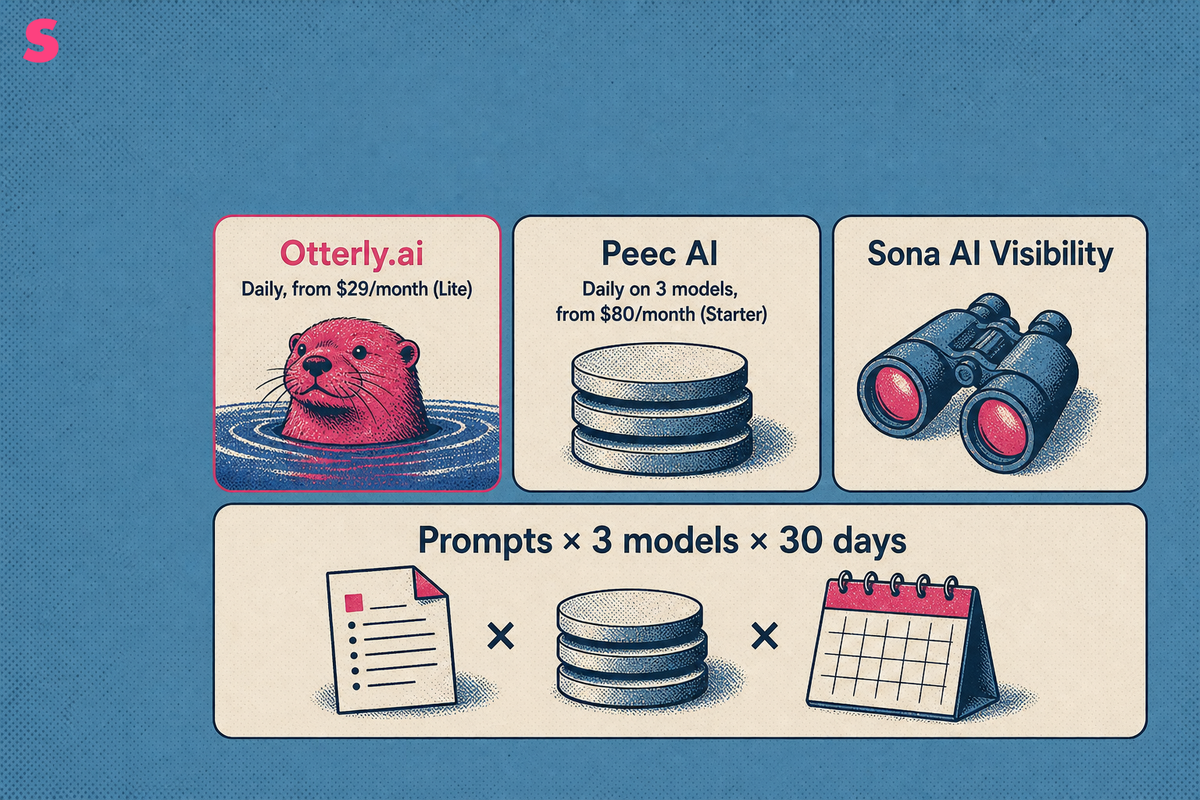
Track your priority prompt list daily. That is this article's recommendation rather than a rule the market has settled, and the reason is resolution rather than diligence. An engine's answer to the same query shifts with the retrieval index, with a model update, and with whatever a competitor published last week. A weekly sample makes it harder to separate a real move from noise. As an internal working rule, treat a change that holds four days running as a trend and a one-day spike as nothing yet.
Daily tracking is published on the named Otterly.ai and Peec AI plans, though cadence varies by product. Otterly.ai checks daily on every plan including the $29/month Lite tier, and Peec AI tracks daily on its $80/month Starter tier across three chosen models. Sona AI Visibility meters prompts as prompts multiplied by three models multiplied by 30 days, which is the same daily assumption expressed in credits.
Two things belong on a slower clock:
- Full technical re-audit: monthly, or on a 7-day watch for pages you are actively fixing
- Competitive benchmark and narrative review: quarterly
Run the same prompt list every day and patterns emerge that a weekly snapshot would have averaged away.
How can you tell whether an AI Overview tracker's measurement method is reproducible?
Ask how the answer was collected, and whether the vendor will tell you at all. Some tools scrape the response the way a person sees it, ads, formatting and all. Others pull from the vendor's official API, which returns a structured response that need not match the on-screen answer.
The two methods do not just collect data differently. They can capture different answers. Sona AI Visibility aims to mirror the end-user experience as closely as possible, and uses both methods to do it.
Beyond collection method, four sampling variables decide whether two runs are comparable at all:
- Location and language set per query run, and held constant between runs
- Logged-in state, since a personalised session returns a different answer
- Sample count, meaning how many responses per prompt per day are averaged
- Query wording, including whether the tool expands one prompt into its phrasing variations
If a vendor will not disclose those four, treat its visibility percentage as directional. Nobody can reproduce it, and nobody can defend it in a board deck.
How do you connect AI Overview visibility to traffic, pipeline and revenue?
Connect them by resolving the visit, not by counting the mention. A citation in Google AI Overviews can end three different ways, and each lands differently. A no-click exposure, where the reader takes the answer and moves on, creates no web session at all, so nothing reaches analytics. A click that arrives carrying a recognised AI engine referrer can be isolated as its own channel. A click whose referrer is stripped, or a later direct visit from someone who read the answer and typed your domain a day afterwards, stays unattributed unless something recovers it. That third group is why teams report inflated direct numbers and cannot price the channel.
Three mechanisms close that gap, in order of how much work each takes:
- Referral-source segmentation: isolate known AI engine referrers in analytics as their own channel
- Self-reported attribution: a "how did you hear about us" field on demo and signup forms, categorised and reconciled against click data
- Identity resolution: match the anonymous session to a real account so the touch joins a buyer journey
Sona AI Visibility handles this with AI Attribution, which places every AI touchpoint on one account timeline alongside ads, web and CRM data and credits AI search rather than last click. The result is a channel line with spend, deals and ROAS next to it, which is what a budget conversation needs.
How does AI Overview tracking fit alongside rank tracking and SEO reporting?
It sits beside rank tracking, not on top of it. A rank tracker answers where a URL sits for a keyword. An AI Overview tracker answers whether the generated answer above those results names you and links to you, a different question with a different failure mode: you can hold position three organically and be absent from the answer entirely.
| Question | Rank tracking answers it | AI Overview tracking answers it |
|---|---|---|
| Where does this URL rank? | Yes, position per keyword | No |
| Did a generated answer cite us? | No | Yes, per query and per source card |
| Which competitor was named instead? | Indirectly, by position | Yes, from the answer text |
| Can AI crawlers reach the page? | No | Only in tools that read crawler activity |
Run both against the same query set, and keep the technical layer in view. Sona's Free AI Readiness Checker scores a single URL on how readable it is to AI crawlers. One score is a dated snapshot. The series of those scores over weeks, with a severity-ranked fix attached to each page that moved, is what a team can act on.
Which teams need an AI Overview tracker, and who should skip one?
Buy one if a meaningful share of your commercial queries already trigger Google AI Overviews and you have someone who will act on the findings. Skip one if neither is true. The tool produces a work queue, and a work queue nobody owns is a subscription with a dashboard attached.
Worth the spend:
- B2B software and services teams whose buyers build vendor shortlists inside chat engines before they ever fill in a form
- Brands in comparison-heavy categories, where "best X for Y" queries carry real pipeline
- Agencies reporting to multiple clients, which is why agency tiers exist at $199/month with Sona AI Visibility and $500/month with Scrunch AI's Agency Core
- Enterprise SEO teams already reporting on organic and now asked about answer engines
Not worth it yet:
- Sites whose traffic is navigational or branded, where the answer rarely changes the outcome
- Teams with fewer than 20 commercial queries worth monitoring, who can log results manually
- Pre-product companies with no page worth citing, where writing the page comes first
- Anyone who wants a number for a slide rather than a change in what gets published
Frequently Asked Questions
Can you track Google AI Overviews without paying for a tool?
Yes. Run a fixed query list from a logged-out browser on a set schedule, record whether Google AI Overviews appeared, and log the cited URLs in a spreadsheet. It works for a couple of dozen queries. Past that it stops scaling, and it gives you no chartable history, no locale control and no competitor benchmark.
What is the difference between a brand mention and a citation in a Google AI Overview?
A mention is your brand named in the answer text with no link. A citation is a linked source card pointing at a page you own. Only the citation can send a session, which makes it the one to track for traffic. Mentions still matter, because they shape the shortlist a buyer carries into the next query.
How many prompts or keywords should you track to start?
Start with the 20 to 50 commercial queries that already drive pipeline. Run them daily for two weeks and confirm the tracker returns stable, reproducible results. Then widen. Buying the largest prompt allowance on day one buys volume before you know whether the measurement holds.
How much does AI Overview tracking software cost?
Among the tools in the comparison table on this page, published entry plans run from $29 to $399 per month. Prompt allowances, refresh cadence, seat counts and the number of answer engines included drive the spread. On a normalised basis of one prompt, one model, once per day, those same entry plans work out between $0.45 and $3.99 per daily tracked prompt.
Why do two AI Overview trackers report different results for the same query?
They sample under different conditions. Location, device profile, language, logged-in state, query wording and the number of samples per run all change what Google returns. Collection method matters too: a scraped response and an API response are not always the same answer. Two tools are comparable only when both disclose how they sample.
Does AI Overview visibility show up in Google Search Console?
Not separately. Search Console reports clicks and impressions from search overall rather than isolating appearances in Google AI Overviews, so the channel cannot be split there. The practical route is a dedicated tracker for citations plus referral-source segmentation in analytics, with self-reported attribution on forms to catch the zero-click research that never sends a session.
Summarize this article with AI: ChatGPT · Claude · Perplexity · Google AI Mode
Last updated: September 2026







