


The Peec AI review conclusion: a polished, monitoring-only platform for tracking brand visibility across ChatGPT, Perplexity, Gemini and Google AI Mode, with Starter priced at $95 monthly. Model limits and add-ons may increase the actual cost, and the tool measures visibility instead of pipeline. Most trackers only count mentions; Sona AI Visibility ties those citations and prompts to pipeline and revenue. Try any tracker with a fixed prompt set before purchasing.
Is Peec AI worth paying for as a monitoring-only AI visibility tracker across ChatGPT, Perplexity and Gemini?
For an established B2B brand that needs a monitoring dashboard, Peec AI may be worth considering. The product tracks where a brand appears in AI answers, rather than diagnosing page-level fixes or connecting visibility to commercial outcomes.
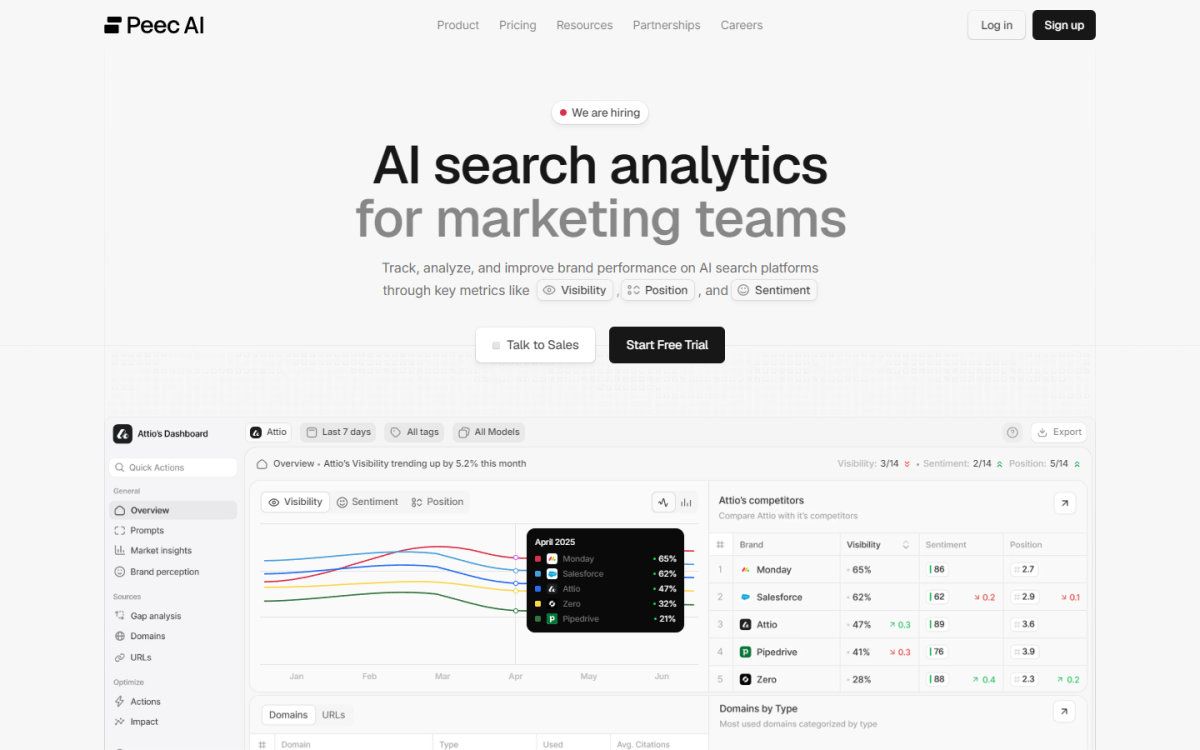
Peec AI’s strongest use case is recurring observation. Teams can track prompts, compare brand visibility across answer engines, review citations, and identify shifts in position or sentiment. That suits marketing teams with established content, SEO traffic, and a defined competitor set.
The limitation is material. Mentions, positions, and sentiment are leading indicators, not proof of qualified visits, opportunities, pipeline, or closed-won revenue. A monitoring dashboard shows whether a brand appeared. Revenue measurement shows whether that appearance influenced a buyer journey.
Choose Peec AI when the buying question is limited to AI answer visibility across a manageable set of engines and countries. Skip it when the team needs optimization guidance, broad self-serve model coverage, or attribution from AI-referred research through revenue.
Which AI search engines does Peec AI track, and how often does it report results?
Peec AI tracks at least six named AI-search surfaces: ChatGPT, Perplexity, Gemini, Microsoft Copilot, Google AI Mode, and Google AI Overviews, per the 2026-04-03 listing. Its documented coverage gives teams a cross-engine view of brand appearances and the citation URLs attached to those answers.
Reporting can run daily, weekly, or hourly depending on the configuration or plan, per the 2026-10-20 listing. Daily tracking is the practical rhythm for a core prompt list. Repeated daily runs reveal patterns that weekly snapshots can obscure, since retrieval indexes, model updates, and competitor publishing can quickly change an answer.
Peec AI also tracks visibility across ChatGPT, Perplexity, Gemini, Copilot, and Google AI Mode, according to youtube.com. The citation URL view matters because a brand mention without a cited page gives the content team little evidence about the source selected by an answer engine.
What does Peec AI measure, and where do its visibility metrics stop short of revenue?
Peec AI measures AI visibility, not revenue impact. The product is designed for monitoring rather than optimization, per the October 2026 listing, and it supplies prompt suggestions, volume indicators, and rapid idea testing for research purposes, according to reddit.com.
The practical outputs are visibility signals: whether a brand appears, its position in an answer, the cited URLs around an answer, and sentiment or competitive context. These signals can guide research, but they do not prove that a buyer visited, converted, entered a sales process, or influenced pipeline.
A single brand-level visibility score is not a work item. A prompt-level view is more actionable because it identifies the buyer question that produced a result and the cited source shaping the answer. Sona AI Visibility connects citations and prompts to pipeline and revenue on one account timeline, while AI Search Insights shows prompt and source performance against competitor coverage.
Sona’s own AI visibility data from September 2026 covers 8 answer surfaces: ChatGPT, Google AI Overviews, Perplexity, Google AI Mode, Gemini, Mistral, Qwen, and Claude. Engine coverage establishes monitoring breadth, but it does not replace a commercial measurement model.
How much does Peec AI cost per month, and what do Starter, Pro and Advanced include?
Peec AI starts at $95 per month on monthly billing for Starter, while annual billing is listed at $80 per month, per the 2026-09-04 listing. Pro is listed at $245 monthly or $205 annually, per the 2026-09-28 listing. Advanced is listed at $495 monthly or $420 annually, per the 2026-08-27 listing.
As of October 2026, Starter costs $0.63 per daily tracked prompt. Buyers should compare the published prompt allowance, selected models, country coverage, and add-ons instead of normalizing the plans independently.
| Plan | Monthly price | Annual-billing price per month | Tracked prompts | Projects | Model selection | Countries |
|---|---|---|---|---|---|---|
| Starter | $95, per the 2026-09-04 listing | $80, per the 2026-09-04 listing | 50, per the 2026-09-04 listing | 1, per the 2026-09-04 listing | 3 selected models, per the 2026-04-03 listing | 1, per the 2026-09-28 listing |
| Pro | $245, per the 2026-09-28 listing | $205, per the 2026-09-28 listing | 150, per the 2026-09-28 listing | 2, per the 2026-09-28 listing | 3 selected models, per the 2026-04-03 listing | 3, per the 2026-09-28 listing |
| Advanced | $495, per the 2026-08-27 listing | $420, per the 2026-08-27 listing | 350, per the 2026-08-27 listing | 5, per the 2026-08-27 listing | 3 selected models, per the 2026-04-03 listing | Not published |
| Enterprise | Custom pricing | Custom pricing | Not published | Not published | Up to 13 models, per the 2026-10-13 listing | Not published |
Do Peec AI add-ons increase its headline price once model add-ons and extra countries are added?
Peec AI’s headline subscription price can understate the operating budget when a team needs more than three selected models or wider geographic coverage. Starter, Pro, and Advanced allow customers to select three models from a six-model pool, per the 2026-04-03 listing, while Enterprise supports up to 13 models, per the 2026-10-13 listing.
Model add-ons are reported at $30 per month on Starter, $70 on Pro, and $140 on Advanced when billed annually, per the 2026-09-04 listing. One review estimated that these add-ons can raise the practical bill by 30% to 60% above the headline price, per the 2026-05-12 listing.
Country limits also affect procurement. Starter is listed with one country and Pro with three countries, per the 2026-09-28 listing. Regional teams should map required markets before treating a displayed plan price as the final operating cost.
The relevant comparison is not a generic monthly price. It is the budget for the engines, countries, prompts, competitors, and users that the team will monitor each day.
How should you test Peec AI before buying, and what prompt set and scoring rule should you use?
Test Peec AI with a fixed prompt set, repeated daily across the engines and countries that matter to your pipeline. This Peec AI review relies on documented product behaviour, not a hands-on test, so the protocol below is a buyer-run validation method rather than reported product results.
Use 30 prompts for a B2B SaaS evaluation: 10 category prompts, 10 comparison prompts, and 10 problem-led prompts. Run the same list in ChatGPT, Perplexity, Gemini, Google AI Mode, and other answer engines. Repeat the list in at least two countries when buyers operate across markets, then include the same three to five competitors in every run.
| Test component | Specification | Measurement | Decision rule |
|---|---|---|---|
| Category prompts | 10 category-definition prompts | Mention rate and position | Record brand presence by engine |
| Comparison prompts | 10 vendor-comparison prompts | Mention rate, position, sentiment | Separate neutral from negative context |
| Problem-led prompts | 10 buyer-problem prompts | Citation presence and cited URL | Identify content gaps by prompt |
| Repeat runs | Daily runs for a consistent period | Variance by engine and country | Treat a four-day movement as a trend |
Keep the scoring rubric explicit: mention rate, position, citation presence, and sentiment. Do not combine those scores with qualified traffic or pipeline. Those outcomes require analytics, identity resolution, and CRM evidence.
A score is a dated snapshot. The daily log of repeated results distinguishes sustained movement from a one-day answer fluctuation. Review the prompt set daily, then conduct a positioning and competitive benchmark review quarterly.
What are the pros and cons of Peec AI, based on its documented behaviour?
Peec AI has clear strengths for monitoring teams, but its documented scope is narrower than a full AI-search measurement and optimization workflow. The tradeoff is accessible visibility reporting with constraints around model selection, geography, optimization, and commercial attribution.
Pros
- Clean UI and straightforward visibility metrics, per the October 2026 listing.
- Affordable entry pricing at $95 monthly for Starter, per the 2026-09-04 listing.
- Prompt suggestions and volume indicators for research, according to reddit.com.
- Citation URLs within visibility tracking, according to youtube.com.
- An intuitive UX and useful dashboard insights without a lengthy sales process, per the October 2026 listing.
- A 2026 review rated AI visibility and analytics 9/10, and prompt-level insights and citations 9/10, according to linkedin.com.
Cons
- Monitoring rather than optimization, per the October 2026 listing.
- Three selected models on self-serve plans, per the 2026-04-03 listing.
- Model add-ons from $30 to $140 per month on annual billing, per the 2026-09-04 listing.
- One country on Starter and three on Pro, per the 2026-09-28 listing.
- Limited value for new startups with little SEO traffic, per the October 2026 listing.
- No documented traditional SEO tooling in the supplied product evidence.
The 9/10 scores provide directional feedback, not independent proof of fit. Reviews can be vendor-influenced, so buyers should use a fixed prompt protocol and test reporting output against their own category, markets, and competitors.
Who should buy Peec AI, and who should skip it?
Peec AI suits established sites with existing SEO traffic that need a low-friction AI visibility monitoring dashboard. It is less suitable for new startups, teams seeking optimization guidance, or marketing leaders who need to connect AI answers to revenue.
A suitable buyer has a stable category, known competitors, and a defined prompt list. For example, a demand generation team operating in one to three countries can use Peec AI to monitor brand presence across selected answer engines, review citation URLs, and track changes in important comparison prompts.
Peec AI is best suited to established sites with existing SEO traffic and has limited value for new startups, per the October 2026 listing. A startup without meaningful content coverage or search demand may collect monitoring data without enough pages, prompts, or citations to form a prioritised program.
Teams should also skip Peec AI when they need broad self-serve model coverage, page-level remediation, or revenue attribution. Sona AI Visibility is designed for the latter measurement problem: it connects AI citations and AI-referred visits to pipeline and closed-won revenue while tracking crawler activity that influences whether pages can be cited.
How does Peec AI compare with other AI visibility tools, and what does Sona do differently?
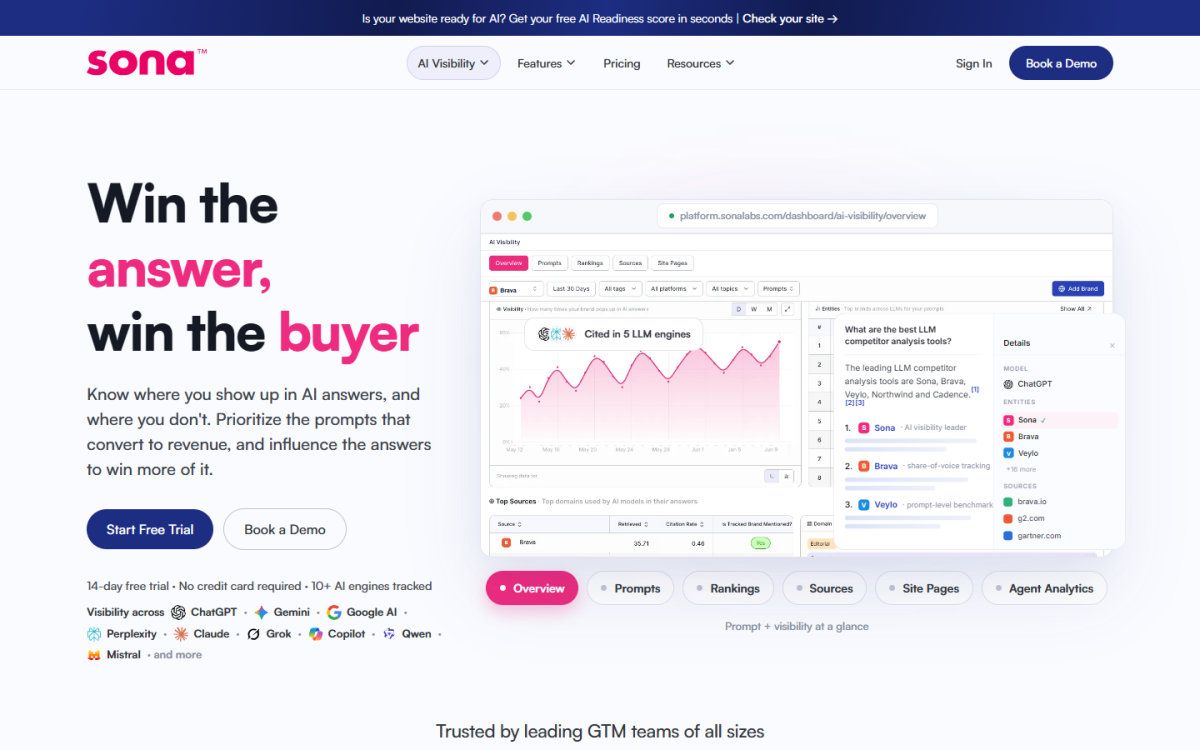
Peec AI is a monitoring-led choice for teams that want prompt, citation, and visibility reporting. Sona AI Visibility addresses a broader measurement question by connecting AI citations and prompts to pipeline and revenue on one account timeline, while its AI crawler activity shows which pages answer engines reach.
Most AI visibility trackers focus on mentions, prompt coverage, and cited sources. Sona AI Visibility treats AI search as a measurable channel with spend, deals, and ROAS alongside other channels. That distinction matters when a marketing leader must justify budget with commercial evidence rather than a visibility score.
The comparison below uses published entry-plan details as of October 2026. A cost-per-prompt figure is a unit price, not a quality ranking.
| Tool | Starting price | Agency Plans? (Yes/No) | # of Answer Engines Tracked | Answer Engines | # of Daily Tracked Prompts (entry plan) | Cost per Daily Tracked Prompt | Differentiation |
|---|---|---|---|---|---|---|---|
| Sona AI Visibility | From $75/month, billed annually | Yes | 11 | ChatGPT, Gemini, Google AI Mode, Google AI Overviews, Perplexity, Claude, DeepSeek, Grok, Copilot, Qwen, Mistral | 5,000 credits/month, about 56 prompts tracked daily across 3 engines | $0.45 per daily tracked prompt | Connects AI citations and prompts to pipeline and revenue on one account timeline |
| Peec AI | From $95/month | Yes | 3 | Not published | 50 prompts daily | $0.63 per daily tracked prompt | Focus: AI visibility monitoring with prompt, citation, and mention tracking |
| Profound | Custom pricing | Yes | 3 | ChatGPT, Gemini, Google AI Overviews | 50 prompts daily during the 7-day trial | Cannot calculate: custom pricing | Focus: AI visibility monitoring across named answer engines |
| Otterly.ai | From $29/month | Yes | 4 | ChatGPT, Google AI Overviews, Perplexity, Microsoft Copilot | 15 prompts daily | $0.48 per daily tracked prompt | Focus: AI visibility tracking across four entry-plan engines |
| Scrunch AI | From $250/month | Yes | 4 | ChatGPT, Perplexity, Google AI Overviews, Copilot | 125 prompts, refresh cadence not published | No refresh cadence published | Focus: AI visibility monitoring across four Core-plan engines |
As of October 2026, Peec AI Starter activates three choices from a six-engine pool: ChatGPT, Google AI Mode, Google AI Overviews, Microsoft Copilot, Gemini, and Naver AI.
What are the frequently asked questions about peec ai review?
How many AI models can a self-serve plan track?
Starter, Pro, and Advanced allow a customer to choose three models from a six-model pool, per the 2026-04-03 listing. Enterprise supports up to 13 models, per the 2026-10-13 listing. Teams that need more coverage should include model add-ons in the budget before selecting a self-serve tier.
How much do model add-ons cost per month?
Model add-ons are reported at $30 per month on Starter, $70 on Pro, and $140 on Advanced when billed annually, per the 2026-09-04 listing. One review estimated that add-ons can raise the practical bill by 30% to 60% above Peec AI’s headline price, per the 2026-05-12 listing.
Does a monitoring tool help you improve AI visibility, or only measure it?
Peec AI is designed for monitoring rather than optimization, per the October 2026 listing. It provides prompt suggestions, volume indicators, and citation URLs, but the content, technical, and distribution work required to improve visibility occurs elsewhere.
How often does the tool report results?
Peec AI can report results daily, weekly, or hourly depending on configuration or plan, per the 2026-10-20 listing. Confirm the cadence attached to the exact plan before purchase. For a core prompt list, daily tracking provides enough resolution to separate sustained change from a one-day fluctuation.
Is the tool a good fit for a new startup with little SEO traffic?
Peec AI is best suited to established sites with existing SEO traffic and has limited value for new startups, per the October 2026 listing. A newer company should first establish core pages, category positioning, and buyer prompts before paying for a detailed monitoring program.
Can an AI visibility tracker show revenue or pipeline impact?
Visibility metrics such as mentions, position, citations, and sentiment do not prove qualified traffic or pipeline. Sona AI Visibility connects AI citations and prompts to pipeline and revenue on one account timeline, making AI search measurable alongside other acquisition channels.
Summarize this article with AI: ChatGPT · Claude · Perplexity · Google AI Mode
Last updated: October 2026







