


Use NLP for SEO by analyzing a query’s search intent, identifying the entities and subtopics covered by top-ranking pages, and creating content that addresses those questions with first-hand expertise. NLP tools detect patterns in search results, so their scores are proxies rather than ranking requirements. Use them for decision support, then validate results in Google Search Console by comparing impressions, clicks and average position for updated pages over matched periods.
How does NLP work in SEO, and how is it different from keyword density?
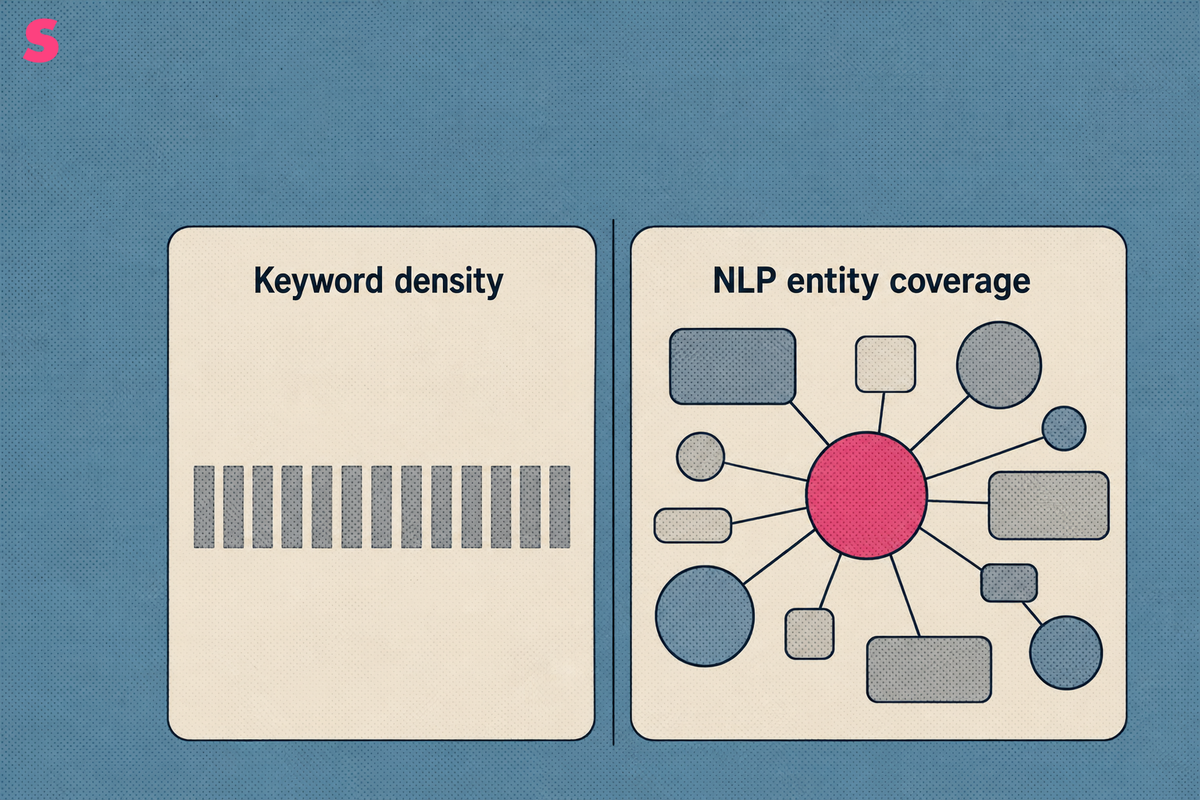
Natural language processing, or NLP, uses machine learning to identify the structure and meaning of text, including people, places and entities. Modern search engines such as Google use advanced NLP to interpret searches, match queries to content and rank results, per Search Engine Land.
Keyword density counts repeated terms. NLP-informed SEO checks whether a page addresses the entities, subtopics and questions that define search intent. A B2B SaaS page about attribution software, for example, should explain attribution models, buyer journeys, CRM data and pipeline rather than repeat one target phrase.
Search engines interpret a query as a contextual request. Help them connect the query with an answer by using a descriptive heading, defining the subject early and organizing supporting details into logical sections. Clear writing, entity coverage and direct answers are recommended NLP techniques for SEO, per Medium.
Conversational and voice searches make this discipline more visible. People ask complete questions with constraints and use cases. State the concise answer first, then explain the conditions, terminology and evidence that make the answer useful.
What do you need in place before you start using NLP on a page?
Before using NLP for SEO, assemble a controlled page-level baseline. The prerequisite is not a larger content toolset. It is enough evidence to identify what changed after an edit.
- Google Search Console access: Use verified access for the target domain to record impressions, clicks, average position and ranking queries.
- A short page list: Select pages tied to one buyer-journey stage, such as awareness guides, comparison pages or decision-stage product pages. Mixed intent makes results difficult to interpret.
- Audience research: Gather sales-call notes, support tickets and reviews. These materials reveal the language buyers use to describe a problem.
- A baseline snapshot: Export impressions, clicks, average position and ranking queries before editing. Use matched date ranges after publication.
- One NLP tool or API: Choose a content editor, topic model or API-based entity extractor. The method matters more than the interface.
Technical readiness belongs in the prerequisite. Verify that AI engines can crawl and parse the site before evaluating content performance. That technical review does not measure brand mentions or organic rankings.
What are the six steps to use NLP in SEO on a B2B SaaS page?
The practical answer to how to use NLP in SEO is to apply entity and intent analysis to one page at a time, then measure that page against a recorded baseline. The following six-step workflow turns an abstract content score into an editorial decision.
- Define intent for one query. Read the results page and identify whether searchers want a definition, process, comparison or vendor evaluation. Output: a one-sentence search-intent statement. Done: the page format matches the task implied by the query.
- Extract entities and subtopics. Sample credible ranking pages and record recurring concepts, named entities, questions and qualifiers. Output: a raw coverage list. Done: the list separates core concepts from incidental references.
- Map gaps to the buyer journey. Mark each missing concept as awareness, consideration, decision or purchase content. Output: a prioritized editorial brief. Done: each addition supports the page’s intended stage.
- Draft with product-specific expertise. Explain implementation details, constraints, trade-offs and examples your team can substantiate. Output: a revised page. Done: the copy answers the query without relying on generic definitions.
- Validate coverage against the entity list. Review whether essential concepts appear naturally in headings, body copy, examples and internal links. Output: a final coverage review. Done: every included entity improves the answer.
- Measure in Search Console. Compare matched periods after the page has been recrawled and indexed. Output: a page-level performance record. Done: the team can identify changes in impressions, clicks, position and query breadth.
Keep the unit of work narrow. One query cluster, one primary page and one buyer task make it possible to determine whether an NLP-based edit improved relevance or merely added length.
How do you find entities, related terms and topical gaps in top-ranking content?
Find entities and topical gaps by sampling results that already satisfy the query, extracting repeated concepts, then filtering those concepts through buyer intent and your own expertise. The goal is not to copy competing pages. The goal is to identify what a credible answer must explain.
- Search the target query and sample several organic results that represent different page types, such as guides, product pages and comparison pages.
- Run each page through an NLP extractor. Google’s Natural Language API provides entity, syntax, sentiment and classification analysis for text, per G2.
- Record recurring entities, related terms, user questions, definitions, implementation steps and qualifiers. Keep the source page beside each record.
- Classify the results page intent. A result set dominated by templates signals a different task from a result set dominated by vendor comparisons.
- Sort concepts into must-have entities, supporting subtopics and noise. A must-have entity appears across credible results and is necessary to answer the query. Noise is a brand reference, a one-off example or an unrelated tangent.
Reviews and comments provide a second data source. NLP can analyze sentiment in customer comments and reviews, helping teams identify pain points and repeated language without relying on a keyword tool as the sole source of audience vocabulary. Use those phrases to improve explanations, not to manufacture objections.
A semantic gap matters when the page lacks a concept a buyer needs to make progress. If a B2B SaaS comparison explains features but omits implementation, data requirements or ownership, the gap is substantive. An isolated missing synonym may be noise.
What should a documented before-and-after NLP edit include?
A documented before-and-after NLP edit requires the actual page copy, the entity or intent gaps that motivated each change, and matched Google Search Console evidence. Generic tactics can guide an editorial workflow, but they do not demonstrate that a specific edit improved rankings.
| Evidence element | What to record | Why it matters | Search Console evidence |
|---|---|---|---|
| Pre-edit passage | Save the exact copy, heading structure and publication date before revision. | Shows the starting answer and its substantive gaps. | Record impressions, clicks, average position and ranking queries for a matched pre-edit period. |
| Entity and intent gaps | List missing concepts, buyer questions and qualifiers, with the evidence behind each addition. | Separates a relevance edit from arbitrary expansion. | Identify the category, comparison, question-led or task-led queries expected to change. |
| Revised passage | Save the precise revised copy and the date it was published. | Allows reviewers to connect performance changes with specific editorial decisions. | Compare the updated URL across an equivalent post-edit period after recrawling and indexing. |
| Ranking result | Document whether the page gained, lost or maintained relevant visibility. | Prevents an editorial example from implying an unverified outcome. | Report changes in impressions, clicks, average position and query breadth across matched periods. |
A product-category page that says a platform helps teams measure marketing performance may need a clearer definition of attribution, relevant data sources, the buyer journey the product supports and the teams that use the workflow. Record those specific edits before reviewing Search Console impressions and average position for the category query and closely related queries.
A comparison page that repeats product names but offers no decision criteria may need a structured evaluation framework covering use case, implementation, reporting requirements and commercial stage. The relevant evidence is whether Search Console reports a broader set of comparison queries and stronger clicks for those queries after the documented revision.
Which kinds of NLP SEO tools handle briefs, scoring and semantic analysis?
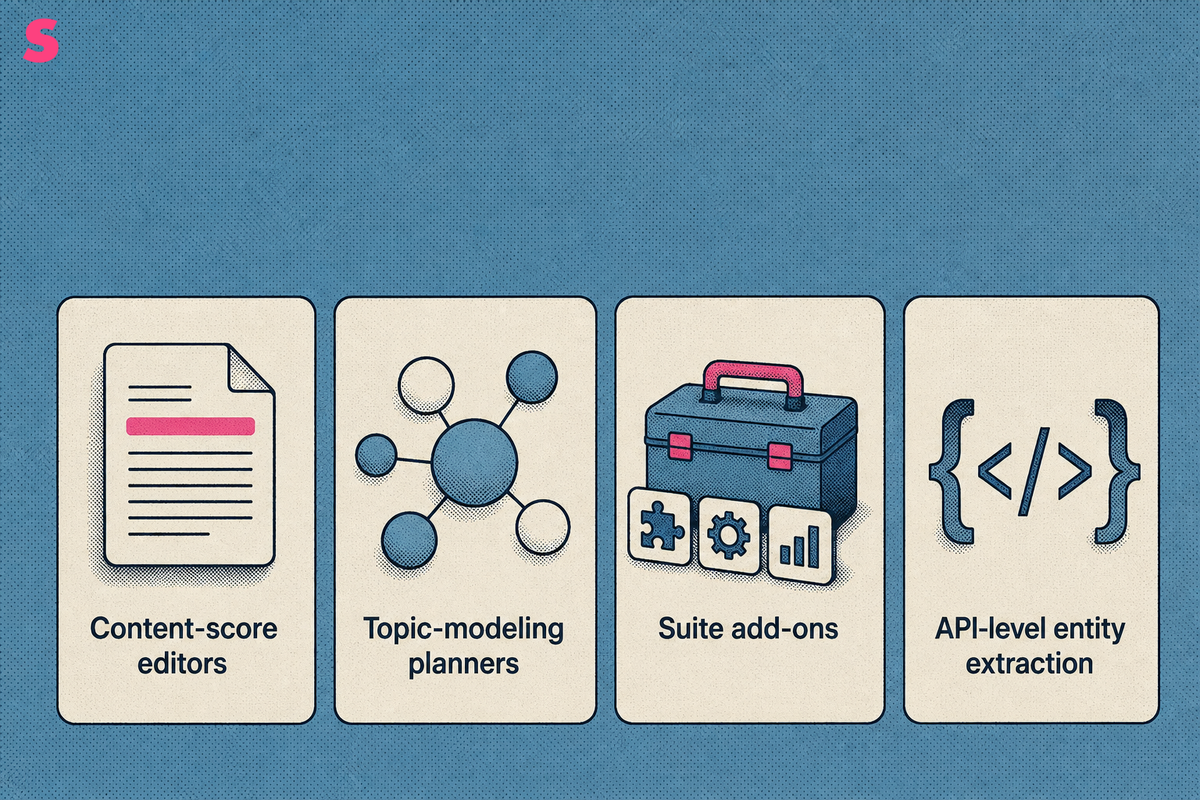
NLP SEO tools fall into four useful categories: content-score editors, topic-modeling planners, suite add-ons and API-level entity extraction. Choose the category that solves the immediate editorial problem rather than buying a broad platform for a single page rewrite.
- Content-score editors: Compare draft coverage with patterns in ranking content. They suit content teams producing briefs and revising articles at scale.
- Topic-modeling planners: Group concepts into clusters and reveal adjacent subjects. They suit SEO leads planning topic coverage across a site.
- Suite add-ons: Combine traditional SEO research and reporting. They suit teams that already use a broader search platform.
- API-level entity extraction: Returns structured entity, syntax, sentiment and classification data. It suits technical SEO teams that need a repeatable analysis workflow.
Downstream AI visibility and attribution systems measure citations and AI-referred traffic after publication. Sona AI Visibility connects citations and AI-referred visits to pipeline and revenue while reporting AI crawler activity from server logs or a lightweight edge worker. Surfer SEO, Frase, MarketMuse, Semrush and Scalenut are commonly categorized as NLP SEO content-optimization tools. A March 11, 2026 comparison placed AI content-optimization tools between $19 and $599 per month, with substantial differences in article limits and functionality.
Use a content tool to improve the page, then use measurement systems to understand the audiences and channels the page reaches.
What goes wrong when you use NLP in SEO, and how do you recover?
The most common NLP SEO failure is mechanical term insertion. The page becomes longer, less precise and harder to read because the writer treats every recommended entity as a mandatory keyword. That is keyword stuffing with a more technical label.
Spot the problem by reading each paragraph aloud and asking whether the entity changes the reader’s understanding. Remove terms that do not answer a question, define a concept or support a decision. Then rewrite around the buyer’s task, not the extraction list.
Content scores do not equal rankings. A page can cover relevant entities and still lack original evidence, technical quality, useful internal links or external authority. Google does not publish an NLP score for optimization, so third-party scores are proxies inferred from ranking patterns rather than ranking requirements.
Formulaic output creates another problem. Copying competitor headings produces pages that resemble existing results without adding product-specific expertise. Recover with a four-part sequence: stop adding terms, restore the original answer, add first-hand detail, then re-check search intent against the results page.
A score is only a dated snapshot. Keep the audit record with the page, its edits and the Search Console baseline so the team can distinguish a coverage improvement from unsupported content expansion.
How can you tell whether NLP-driven optimization worked?
NLP-driven optimization worked when an updated page earns stronger relevant visibility in Google Search Console across matched periods. Compare impressions, clicks, average position and the number of ranking queries for the updated URL against the pre-edit baseline.
Query breadth is an early signal. If an updated B2B SaaS page begins appearing for new, closely related questions, the page may cover the topic more completely. Do not treat that signal as proof of causation, because indexing changes, competitors, internal links and demand also affect performance.
Review one page cohort at a time. Group pages by intent and publication date, record the edit date and compare equivalent periods after Google has processed the revision. Search Console does not show what ChatGPT, Perplexity, Gemini, Claude and other answer engines say about a brand.
Sona AI Visibility connects AI citations and the prompts behind them to pipeline and revenue on one account timeline, and tracks AI crawler activity from server logs or a lightweight edge worker. AI Search Insights shows the prompts buyers ask, cited sources and page-level performance, helping teams examine AI search alongside Search Console without confusing the two datasets.
For prompt monitoring, run the same prompt list daily. Daily tracking reveals changes that a weekly snapshot can average away because answers change with retrieval indexes, model updates and competitor publishing. Review positioning and competitive benchmarks quarterly instead.
How should NLP fit alongside technical SEO, original expertise and internal linking?
NLP should function as a decision-support layer within SEO, not as a shortcut around technical quality or subject-matter expertise. Use it to identify missing concepts and audience language, then validate every addition against the page’s search intent and buyer-journey role.
- Confirm crawlability, indexability, canonical tags and server-rendered HTML.
- Choose one search intent and one page to own that intent.
- Use audience research and entity analysis to identify substantive coverage gaps.
- Add original product expertise, evidence and implementation detail.
- Build internal links between the revised page and related pages in the same topic cluster.
- Measure the page in Search Console before changing the next cohort.
NLP cannot replace backlinks, first-hand expertise or internal linking. A technically inaccessible page cannot gain visibility from better entity coverage, and a generic page cannot become authoritative by copying the vocabulary of stronger results.
Monitoring which AI answers mention a brand is only half the job. Sona AI Visibility connects those mentions to accounts, pipeline and revenue, so teams can assess whether AI search activity contributed to commercial outcomes.
What are the frequently asked questions about using NLP in SEO?
Is NLP in SEO just keyword stuffing with a new name?
No. Keyword stuffing repeats a phrase to influence relevance signals. NLP-informed SEO covers the entities, subtopics and questions a searcher expects from a complete answer. Done badly, NLP becomes mechanical term insertion. Every term should clarify the topic or advance the buyer’s task.
Does Google publish an NLP score that you can optimize for?
No. Google uses NLP to understand queries and content, but it does not publish an NLP score that functions as a ranking requirement. Third-party content scores are proxies inferred from ranking results. Use them to identify coverage questions, then rely on Search Console and editorial judgment to assess the page.
Can you use Google’s Natural Language API for SEO?
Yes. Google provides NLP capabilities through the Natural Language API for SEO analysis, per G2. Teams can run entity, syntax, sentiment and classification analysis on their own pages and sampled competing pages to identify the concepts each text emphasizes.
How do you measure whether NLP optimization improved rankings?
Record a Google Search Console baseline, then compare impressions, clicks, average position and the number of ranking queries for updated pages across matched periods. Results do not isolate NLP from technical fixes, link changes, demand shifts or competitor activity, so document every material page change.
Are NLP SEO tools too expensive for small teams?
Prices vary widely. A March 11, 2026 comparison lists AI content-optimization tools from $19 to $599 per month. Small teams can start with one editor or an API workflow, apply it to a limited page set and expand only after the process produces usable editorial decisions.
Does NLP help with voice and conversational search?
Yes, indirectly. Clear, direct answers to full-sentence questions and complete coverage of relevant entities match how conversational queries are phrased. Voice optimization does not require a separate content formula. It requires content that answers a specific question without ambiguity.
Summarize this article with AI: ChatGPT · Claude · Perplexity · Google AI Mode
Last updated: October 2026







