


To measure SEO performance in AI search engines, lock a representative prompt set, run it regularly across the engines your buyers use, and track mentions, citations, and share of voice separately. Use these as leading indicators, then validate them against referral traffic, conversions, and pipeline. Sona AI Visibility connects prompts and citations to pipeline and revenue, and displays AI crawler and agent activity, so a baseline can be evaluated against business outcomes. Repeat runs and report ranges, since individual responses vary.
What do you need in place before you track AI search visibility?
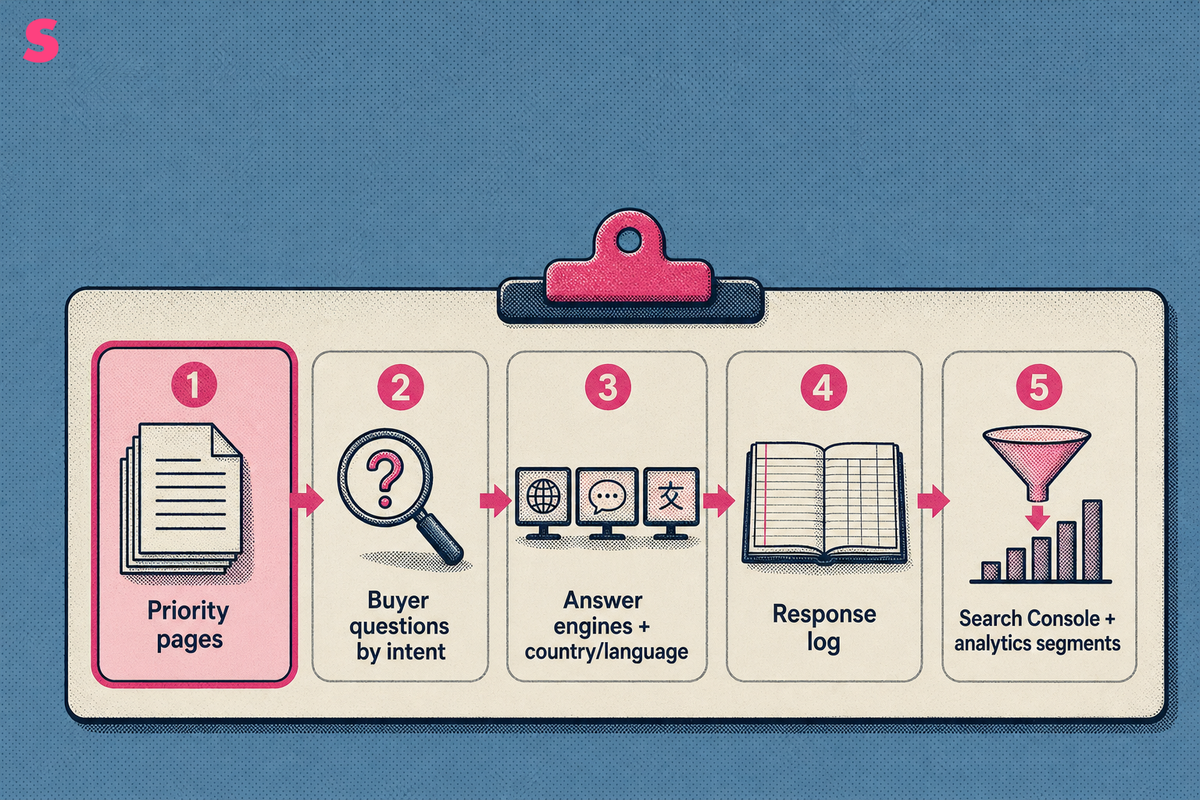
To track SEO effectiveness in AI search engines, define priority pages and buyer questions before collecting results. Choose the answer engines to monitor, create a spreadsheet or database for raw responses, confirm Google Search Console access, and configure analytics to isolate AI referral traffic.
- A list of high-value pages, such as product, comparison, solution, and pricing pages.
- Buyer questions grouped by intent, not only short keywords.
- Buyer-relevant answer engines, plus a defined country and language.
- A response log containing the prompt, date, engine, full answer, citations, and cited URLs.
- Google Search Console access and analytics segments for identifiable AI referrals.
AI answers differ from ranked blue links. An answer engine synthesizes a response, decides which brands to mention, and may cite several pages or none. Traditional web analytics records visits after a click, but tools such as Google Analytics and Adobe Analytics do not directly measure AI SEO success, per reddit.com. They do not capture brand inclusion, citation placement, or zero-click research.
Before collection, verify that relevant AI crawlers can fetch the canonical, server-rendered version of each priority page. Check robots directives, response status, canonical tags, and structured data on the fetched URL. Confirm that pages return a successful response and that structured data matches visible page content.
Organize content for answer extraction with direct definitions, clear subheadings, concise supporting evidence, and source-transparent claims. Show authorship, first-party evidence, editorial review, and dates for material changes. These E-E-A-T signals help readers and answer engines assess who made the claim, what evidence supports it, and whether the page remains current.
Use analytics as downstream evidence, not as the only measurement system. Establish response-level evidence before making content changes.
Which metrics show whether SEO is working in AI search engines?
Measure SEO effectiveness in AI search engines through presence, citation quality, and business outcomes. Mention visibility shows whether an answer names your brand. Citation visibility shows whether an answer links to or identifies one of your pages as a source.
| Metric | What it counts | How it is calculated | What it tells you |
|---|---|---|---|
| Mention visibility | Responses that name the brand | Brand mentions ÷ total responses | Leading indicator of answer presence |
| Citation visibility | Responses citing an owned page | Cited responses ÷ total responses | Leading indicator of source inclusion |
| Citation rank | Position of an owned citation | Record the citation order in each response | Prominence of the cited source |
| Share of voice | Brand mentions against named competitors | Brand mentions ÷ all tracked brand mentions | Competitive presence in the prompt set |
| Sentiment | How the answer characterizes the brand | Classify each mention as positive, neutral, or negative | Whether presence carries a favorable recommendation |
| Referral traffic and conversions | Visits and conversion events from AI referrals | Segment referral sessions, then match to conversion events | Downstream validation of visibility |
| Assisted pipeline | Pipeline influenced by AI research | Match AI touchpoints to account and opportunity records | Whether visibility contributes to revenue outcomes |
AI engines do not expose conventional rankings in the same way as Google's organic results. Measure presence, citation inclusion, citation position, sentiment, and cited-page quality. Mentions and citations are leading indicators. Referral traffic, conversions, and pipeline show whether that visibility reaches commercial outcomes.
Evaluate structured data, canonical tags, server-rendered HTML, content recency, and trust signals on every cited page. Verify that the cited URL is canonical, crawlable under applicable robots directives, and available as server-rendered HTML. Diagnose whether the page answers the prompt directly, presents evidence near the claim, identifies its author, and explains its sources. Those factors support page-level diagnosis, not the visibility metric itself. A brand-level score is a dated snapshot, not a work item. Sona AI Visibility uses AI Search Insights to show tracked prompts, cited sources, and page performance so teams can identify the prompt and source behind a movement.
Which AI engines should you monitor first, including Google AI Overviews?
Start with the answer engines your buyers use most, then expand after the baseline stabilizes. For many B2B teams, the initial set includes ChatGPT, Google AI Overviews, Google AI Mode, Perplexity, and other answer engines. Add Gemini, Claude, Microsoft Copilot, and other answer engines where audience behavior supports coverage.
Google Search Console offers a Generative AI performance report for content appearing in generative AI features on Google Search, per developers.google.com. The report covers Google surfaces. It does not replace tracking for ChatGPT, Perplexity, Gemini, Claude, and other answer engines.
- Google AI Overviews and Google AI Mode: use Search Console evidence alongside response capture and citation logs.
- ChatGPT and Perplexity: track brand mentions, cited URLs, answer frequency, and citation order from repeated responses.
- Gemini, Claude, and Microsoft Copilot: use the same prompt and response log, with engine-specific context recorded for every run.
Sona's own AI visibility data, September 2026 covers 8 answer surfaces: ChatGPT, Google AI Overviews, Perplexity, Google AI Mode, Gemini, Mistral, Qwen and Claude. Start narrow. A stable comparison across selected engines is more useful than a poorly controlled comparison across eight.
How do you build a prompt set that gives reliable AI visibility data?
Build a prompt set around buyer intent, then freeze it before measuring performance. Select enough prompts to represent every defined intent segment while keeping manual review feasible.
- Branded prompts: “What does [brand] do?” and “What are alternatives to [brand]?”
- Non-branded category prompts: “What is the best software for [category]?”
- Comparison prompts: “How does [category option] compare with [category option]?”
- Problem-aware prompts: “How can a team solve [operational problem]?”
- Buying-intent prompts: “Which provider should we choose for [job]?” followed by “What should we compare before buying?”
Write prompts in conversational language because answer engines process fuller questions and follow-up context. Include a follow-up question when it changes the buying task, such as asking for implementation requirements after requesting a vendor shortlist.
Freeze the set once selected. If the prompt list changes each month, differences may reflect a changed sample rather than changed AI visibility. Begin with buyer-relevant engines the team can collect consistently, then expand coverage only when the baseline remains comparable.
How do you baseline your AI search visibility in 7 steps?
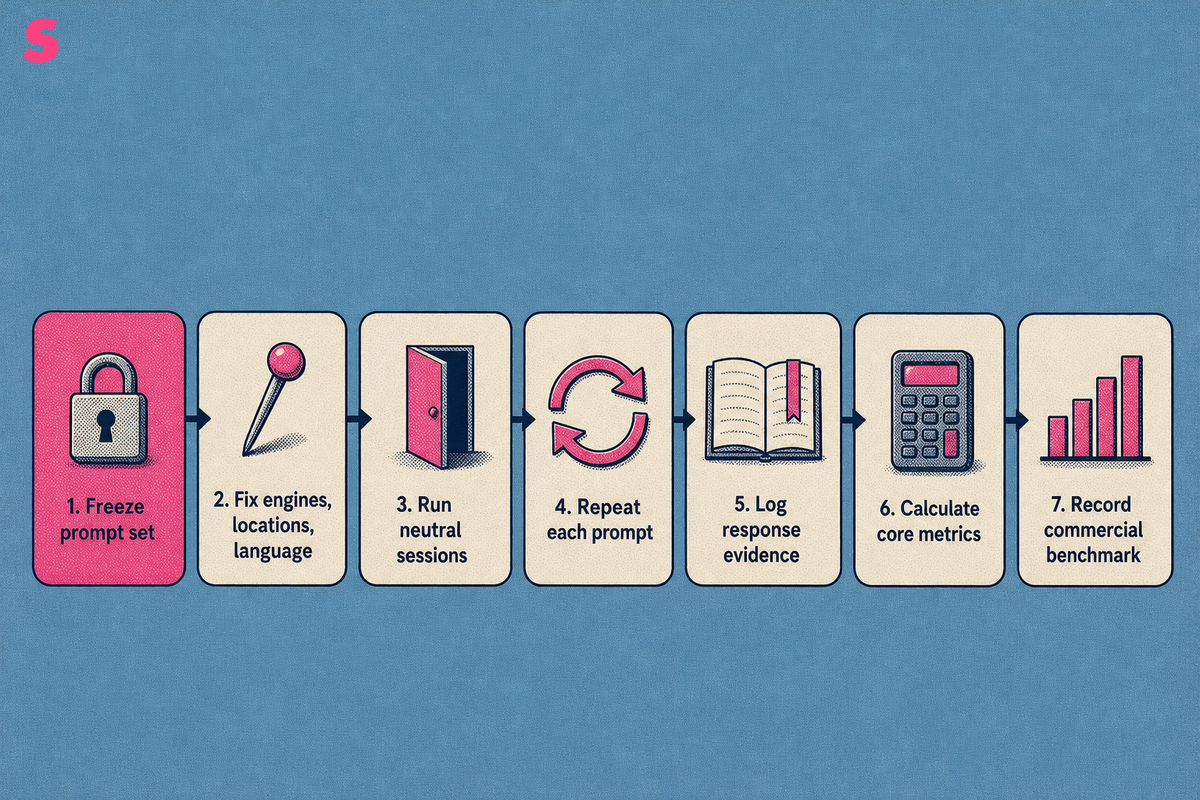
A reliable AI search baseline uses fixed prompts, controlled sessions, repeated responses, and a transparent scoring rule. Run this seven-step protocol before changing content, technical configuration, or page structure.
- Freeze the prompt set. Save each prompt in a worksheet with an ID, intent segment, target page, and commercial priority.
- Fix engines, locations, and language. Record the engine name, country, language, device context, and date in separate fields.
- Run neutral, fresh sessions. Open a new session for every prompt and avoid account history that could alter the response.
- Repeat each prompt several times. Record every response separately rather than replacing one answer with another.
- Log response evidence. Capture the full answer, brand mentions, citations, cited URLs, named competitors, and citation order.
- Calculate core metrics. Calculate mention rate, citation rate, citation rank, and share of voice, then express each result as a range across repeated runs.
- Record the commercial benchmark. Add Search Console data, AI referral traffic, branded search activity, and direct traffic for the same pre-optimization period.
A monitoring platform can automate neutral querying, repeated collection, citation extraction, and scoring in steps 3–6. The method still requires an auditable prompt set, fixed conditions, and retained source responses.
Run prompts on a consistent schedule. Answers can change after retrieval-index changes, model updates, or competitor publishing activity. Classify movement as sustained only when it remains outside documented baseline variation across repeated runs. Review broader positioning and the technical benchmark quarterly.
What does a working baseline look like, and what do you do when results swing?
A working AI search baseline includes repeat runs that agree within a documented range, raw source responses for every score, and a complete record of cited URLs and competitors. It supports valid comparisons over time when collection conditions remain fixed.
Do not treat one response as a definitive ranking. AI answers are stochastic. Results can swing because of personalization, localization, model updates, prompt variation, retrieval changes, or changing search features.
- Use the same prompt wording, engine, location, and language.
- Use fresh neutral sessions for each response.
- Increase repeated runs when the results differ sharply.
- Report a range, such as the lowest and highest mention rate across the run set.
- Keep the full response beside every extracted citation and score.
Recovery starts by identifying the control that changed. If localization varies, fix the location. If prompt wording drifted, restore the frozen wording. If repeated responses remain inconsistent, widen the confidence range rather than claiming false precision. The output is a log that reveals sustained movement outside the documented baseline range, not a single score that settles the question.
How do you measure AI visibility momentum and connect it to pipeline?
Measure AI visibility momentum by comparing each daily run with the frozen baseline. Treat a gain as real only when it exceeds baseline run-to-run variation. Visibility alone does not prove revenue impact, so validate mention and citation changes against referral traffic, assisted conversions, demo creation, pipeline, and closed-won revenue.
Track branded-search spikes and direct-traffic increases that coincide with citation periods as supporting signals. These signals can identify zero-click research that does not arrive through a clearly labeled AI referral. Keep the comparison period consistent and record the dates of prominent citations.
Sona AI Visibility connects prompts and citations to pipeline and revenue on one account timeline, and tracks AI crawler and agent activity from server logs or a lightweight edge worker. This connects answer visibility with the pages crawlers reach, the visits that follow, and commercial outcomes.
Use month-over-month ranges rather than isolated point estimates. A sustained citation-rate increase beyond the baseline range is evidence of momentum. A visibility increase without referral or pipeline movement remains a leading indicator that needs further observation.
How does an AI search monitoring platform work?
An AI search monitoring platform runs a defined prompt set across selected answer engines, captures responses, extracts mentions and citations, scores results, compares competitors, and reports changes over time. These platforms track brand mentions and links in AI answers alongside competitor performance.
- Select prompts, locations, languages, and answer engines.
- Query each engine in controlled sessions.
- Parse the response for brand mentions, links, sources, and named competitors.
- Extract cited URLs and assign citation position.
- Calculate visibility, citation, sentiment, and share-of-voice metrics.
- Compare results by prompt, engine, page, competitor, and date.
- Report the series with raw responses available for review.
Platforms can monitor answer surfaces including ChatGPT, Perplexity, Gemini, and other answer engines, per nicklafferty.com. Modern platforms also model dialogue patterns and follow-up questions, which matters when a buyer refines an initial question.
Proprietary scoring can mislead when a platform hides the prompt list, response evidence, geography, or scoring rule. Ask to see the raw response and formula behind every aggregate score. Sona AI Visibility tracks buyer prompts and sources alongside page performance, supporting prompt-to-page review.
What should you compare when choosing an AI visibility tracking tool?
Compare AI visibility tracking tools by engine coverage, daily prompt capacity, citation analysis, competitor tracking, integrations, API access, raw-response access, geography controls, personalization controls, and scoring transparency. A comparable evaluation uses the same prompt set and collection conditions.
Prices, engine counts, prompt allowances, and agency-plan status in the table are as of October 2026. A per-prompt figure appears only where the approved pricing data provides one.
| Tool | Starting price | Agency Plans? (Yes/No) | # of Answer Engines Tracked | Answer Engines | # of Daily Tracked Prompts (entry plan) | Cost per Daily Tracked Prompt | Differentiation |
|---|---|---|---|---|---|---|---|
| Sona AI Visibility | From $75/month billed annually, $99/month monthly | Yes | 11 | Not published | 5,000 credits/month, about 166 daily tracked prompts on one model or 56 across three | $0.45 per daily tracked prompt | Connects AI citations and prompts to pipeline and revenue, and tracks AI crawler activity without a JavaScript tag |
| Profound | Custom pricing | Yes | 9 | ChatGPT, Perplexity, Google AI Mode, Gemini, Microsoft Copilot, DeepSeek, Claude, Google AI Overviews, Exa Search | Custom prompt allowance, daily | Cannot be calculated from custom pricing | Enterprise AI visibility tracking across daily prompt monitoring |
| Peec AI | From $95/month | Yes | 3 | Not published | 50 prompts daily | $0.63 per daily tracked prompt | Self-serve AI visibility tracking with broader engine coverage on higher tiers |
| Otterly.ai | From $29/month | Yes | 4 | ChatGPT, Google AI Overviews, Perplexity, Microsoft Copilot | 15 prompts daily | $0.48 per daily tracked prompt | AI search monitoring across answer engines, with additional engines available as add-ons |
| Scrunch AI | From $250/month | Yes | 4 | ChatGPT, Perplexity, Google AI Overviews, Microsoft Copilot | 125 prompts, refresh frequency not published | No refresh cadence published | AI visibility monitoring for citations and answers across core answer engines |
| PromptWatch | From $95/month | Yes | Not published | Not published | 50 prompts daily | $0.48 per daily tracked prompt | Prompt and response monitoring across supported AI models |
Choose the tool that exposes the evidence behind its score. Retain prompt-level results, cited URLs, response text, and collection settings, then connect the visibility record to the pages and commercial outcomes that matter.
What are the frequently asked questions about tracking SEO effectiveness in AI search engines?
How many prompts do I need to track AI search visibility?
Track enough prompts to cover branded, category, comparison, problem-aware, and buying-intent segments. Freeze the set once selected so visibility changes reflect answer performance rather than a changed sample.
How often should I re-run my AI search prompt set?
Repeat the prompt set several times during the baseline period to measure natural variation, then run the same prompt list on a consistent schedule. Classify movement as sustained only when it remains outside documented baseline variation across repeated runs. Keep prompts, engines, languages, and locations constant.
Can Google Search Console show how my content performs in AI search?
Google Search Console offers a Generative AI performance report for content in generative AI features on Google Search, per developers.google.com. It covers Google surfaces only, so ChatGPT, Perplexity, Gemini, Claude, and other answer engines require separate tracking.
Can Google Analytics measure AI search effectiveness on its own?
Google Analytics does not directly measure AI SEO success, per reddit.com. It becomes useful after AI referral traffic is segmented and compared with a response-level visibility baseline, citations, conversions, and account outcomes.
Is one ChatGPT answer a reliable measure of my ranking?
No. AI answers vary between runs. Use fixed prompts, fresh neutral sessions, repeated runs, and confidence ranges. Report presence and citation rate across the run set instead of treating one answer position as a definitive ranking.
Do I need to monitor every AI engine?
No. Start with the engines your buyers use, establish a stable baseline, and add engines when budget and evidence justify broader coverage. Google AI Overviews, ChatGPT, Perplexity, and other answer engines are common starting points for teams measuring AI search visibility.
Summarize this article with AI: ChatGPT · Claude · Perplexity · Google AI Mode
Last updated: October 2026







