To rank on voice assistants, provide a clear, speakable response to every question buyers raise, back it with standard search authority, and test it with different assistants. Assistants generally draw on existing search indexes, snippets, maps, and AI retrieval, so traditional SEO remains the base. Suggested answer lengths vary, so regard any word count as a hypothesis. Analytics seldom distinguish spoken searches from typed ones, making a fixed question set the reliable way to track progress.
What does ranking in voice assistants actually mean, and what do you need before starting?
Ranking in voice assistants means becoming the source an assistant reads aloud, names, or cites in response to a question. Voice assistants do not use a separate ranking system. They draw from search indexes, snippets, maps, knowledge graphs, and AI retrieval, so conventional SEO remains the foundation.
Traditional rankings matter because a page must be discoverable and competitive before it can surface in an assistant response. Featured snippets and concise answer blocks help because they package a direct response an assistant can restate. Google AI Overviews provide another answer format to test, particularly for queries with commercial research intent.
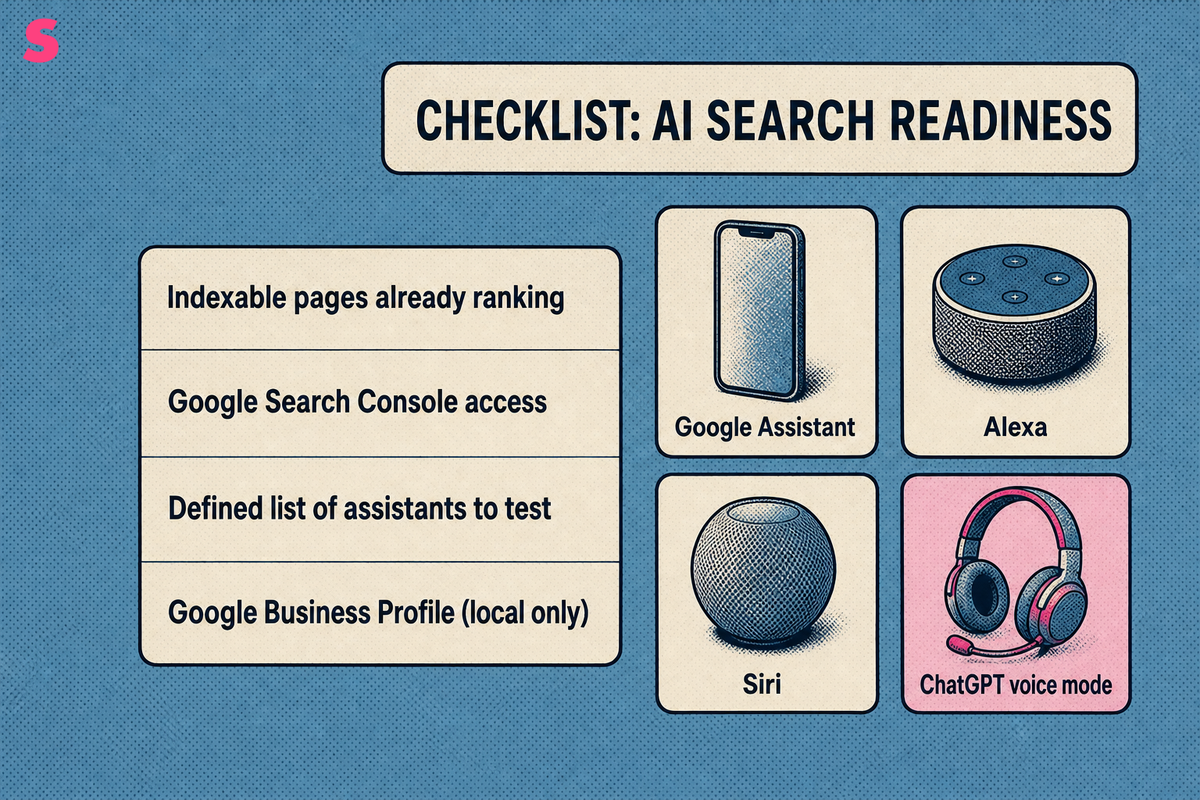
Do not treat Google Assistant, Alexa, Siri, and ChatGPT voice mode as one channel. Each assistant can return different wording, sources, and entity references for the same query. An unverified claim updated in October 2026 says approximately 75% of voice results overlap with top-three desktop rankings, but its methodology requires review before it informs planning.
Set the prerequisites before step one: indexable pages that already rank or sit near the first page, Google Search Console access, a defined list of assistants to test, and a Google Business Profile only for businesses that serve local customers. Sona AI Visibility can show the prompts buyers ask across answer engines, but it does not measure whether a buyer spoke a query aloud.
How do you test whether your brand appears in voice assistant answers?
Test voice visibility with a fixed set of commercially important questions, then score each assistant response. The result is a baseline rather than a conventional rank position. It records brand presence, cited sources, and answer accuracy.
- Choose 20–50 questions tied to revenue, category evaluation, implementation, integrations, and vendor selection. A practitioner recommendation updated October 10, 2026, specifies a fixed set of 20–50 commercially important queries.
- Record the assistant, test location, device language, date, and exact wording. Keep those conditions consistent for comparable results.
- Run every query daily. Daily testing reveals changes in retrieval indexes, model updates, and competing content that a weekly snapshot can conceal.
- Review the log weekly, then decide which pages, entity records, or third-party sources require work.
| Test field | What to record | Scoring rule | Example outcome | What the result tells you |
|---|---|---|---|---|
| Brand presence | Mentioned, cited, or absent | 2 = cited, 1 = mentioned, 0 = absent | Brand named with a source | Whether the assistant recognizes the brand |
| Cited source type | Own site, review site, directory, community thread, competitor | Classify, do not score | Review profile cited | Where the assistant found its evidence |
| Answer accuracy | Accurate, partly accurate, inaccurate | 2 = accurate, 1 = partly accurate, 0 = inaccurate | Correct integration detail | Whether entity facts need correction |
| Commercial usefulness | Whether the answer addresses the buyer question | 2 = direct, 1 = partial, 0 = irrelevant | Explains the right use case | Whether the query belongs in the set |
| Page or profile action | The page, listing, or third-party source to improve | Assign an owner and due date | Rewrite comparison page | What the team should change next |
Brand presence, answer accuracy, and commercial usefulness produce 0–6 points per response. Calculate the test-set percentage as total earned points divided by the maximum possible points across all queries and assistants. Cited source type and page or profile action are unscored diagnostic fields. Record an unavailable or failed assistant response as unavailable, assign no points, and exclude it from the denominator until a valid response is available.
Sona AI Visibility can track prompts, citations, and AI-referred visits across 11 answer engines, but voice-assistant testing should remain a manual, controlled check. A dated score is a snapshot. A daily series provides the evidence needed to distinguish a durable change from a one-day result.
How do you find the conversational questions B2B buyers actually ask?
Start with question-style impressions and clicks in Google Search Console, then expand them into language a buyer would say aloud. Voice queries mirror natural speech rather than stripped keyword strings such as “CRM SaaS integration.”
Build the initial list from existing queries containing who, what, when, where, why, how, best, compare, pricing, alternatives, and integration language. Expand each useful topic through People Also Ask. A guide published July 10, 2026, says one expansion can yield approximately 2–4 related questions, making it a practical source of variants rather than a final keyword list.
- Category: What is the best platform for this problem?
- Use case: How does this software solve a specific workflow?
- Integration: Does this platform work with a named system?
- Compliance need: Does this product support a buyer requirement?
- Vendor comparison: Which provider is better for a defined use case?
Prioritize questions with commercial intent, clear ownership by an existing page, and a buyer action behind them. Trim the list to the fixed test set instead of tracking every variation. Sona AI Visibility can group prompts into topics and classify prompt intent, helping teams distinguish informational questions from commercial comparisons.
How should you write and format an answer so an assistant can read it aloud?
Write a direct answer immediately below a question-style heading, then add supporting detail, examples, and qualification. The first answer block should stand alone when read aloud. The surrounding page can remain technical and written for a professional reader.
Use plain wording in the answer block, lead with the conclusion, and avoid burying the answer beneath background context. One guide recommends a 9th-grade reading level for voice-oriented answer blocks, while the rest of a B2B page can use the precise language needed for implementation and evaluation.
For a featured-snippet opportunity, inspect the current result for the target question and identify whether it uses a paragraph, list, or table. Place a direct answer beneath a matching question heading, then use the corresponding format on the page. Winning a snippet is not guaranteed, so publish the change and re-run the fixed assistant test set to measure whether the answer appears.
Answer length is a testing hypothesis, not a ranking rule. Published recommendations range from 25–35 words, updated October 17, 2026, to approximately 40–60 words, published July 10, 2026, and 40–100 words, updated October 26, 2026. Test two or three lengths against the same voice question set and retain the version that produces accurate, complete answers.
Add a visible FAQ block to key pages when the page supports several related questions. A practitioner recommendation updated October 17, 2026, suggests 5–8 questions. Use real buyer questions, concise answer-first paragraphs, and headings that match the language in the test log.
Which schema types help voice visibility, and does schema guarantee inclusion?
Schema helps machines interpret page content, but it does not guarantee inclusion in a voice assistant answer. The reviewed evidence does not show that structured data directly produces voice visibility. Treat schema as a clarity layer, validate the markup, and measure its effect through the same fixed question set.
| Schema type | What it describes | Best page type | Implementation pattern |
|---|---|---|---|
| FAQPage | Question-and-answer content | Support, product, and explanatory pages | @context, @type, mainEntity, Question, acceptedAnswer |
| HowTo | Ordered instructions | Implementation and process guides | @context, @type, step, name, text |
| Article | Editorial or educational content | Guides, research, and explainers | @context, @type, headline, author, datePublished |
| Organization | Business identity and entity facts | Homepage and company pages | @context, @type, name, logo, sameAs |
| Speakable | Sections intended for spoken presentation | Pages with concise answer blocks | @context, @type, cssSelector or xpath |
A visibility score shows that a page is not being cited. It does not identify the page element blocking inclusion. Sona AI Visibility includes AI Search Insights, which scores a page out of 100 across crawlability, performance, security, content structure, content quality, and accessibility; it ranks findings as critical or medium with a fix attached, then re-runs the audit so a team can confirm the fix landed.
How do reviews, third-party mentions, and community discussion affect which brand an assistant names?
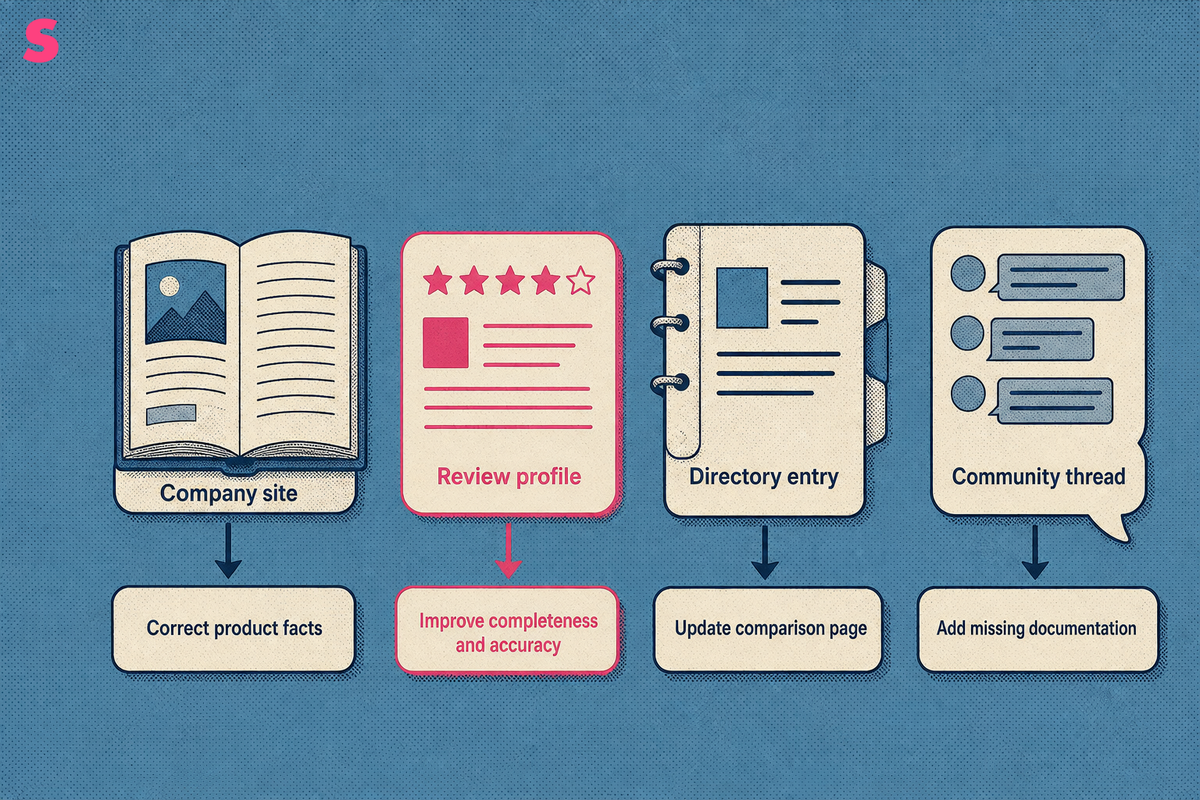
Reviews, directories, comparison pages, and community threads can shape the sources a voice assistant cites, so record the cited source type for every test result. Restaurant.org states that encouraging customers to rate and review a specific location improves the chance that a voice assistant recommends that business to nearby users.
For B2B SaaS, treat third-party references as testable evidence rather than assumed ranking factors. A review profile, directory entry, or community discussion may surface because it directly answers the buyer question, contains stronger entity information, or frames the category more clearly than the company page.
Act on the cited source, not only the company site. If an answer cites a comparison page, correct product facts and positioning there. If it cites a review profile, improve completeness and accuracy. If it cites a community thread, determine whether the missing information belongs in documentation, an integration page, or a direct answer block.
Which speed, mobile, and local factors matter, and do software companies need local SEO?
Mobile usability and page speed matter because a voice answer depends on a page that can be fetched and understood quickly. One guide updated October 17, 2026, recommends Largest Contentful Paint at or below 2 seconds. Another claim that slower pages are routinely excluded from voice results is not independently substantiated, so use the 2-second figure as an operating target rather than a guarantee.
Local optimization matters most for restaurants, services, retailers, and location-based buyers. Maintain accurate Google Business Profile, Apple Business Connect, and Bing Places records for those businesses. B2B SaaS is rarely local, so software companies can skip local-listing work unless offices, service areas, or location-specific buyer needs affect demand.
Which assistant should you optimise for first: Google, Alexa, Siri, or ChatGPT voice mode?
Prioritize the assistant with the largest gap in your own scored test, not the assistant with the broadest reputation. Test Google Assistant, Alexa, Siri, and ChatGPT voice mode with the same questions, then fix the listing or content asset associated with the weakest commercially important results.
| Business type | Assistant to test first | First asset to fix | Question set emphasis |
|---|---|---|---|
| Local service business | Google Assistant and Siri | Location profile and service pages | Nearby, open now, service availability |
| Retailer | Google Assistant, Alexa, and Siri | Store, product, and inventory pages | Product availability and local options |
| B2B SaaS company | ChatGPT voice mode and Google Assistant | Category, use-case, and comparison pages | Capabilities, integrations, and alternatives |
| Multi-location brand | Google Assistant, Alexa, and Siri | Location records and location landing pages | Nearest location and local service details |
Re-run the fixed prompt list daily after a meaningful content or entity change. A weekly review can summarize the trend, but the daily record shows whether the change held across consecutive runs. The assistant with the largest sustained gap deserves the first implementation cycle.
How do you know the work succeeded, and what do you fix when assistants still skip your brand?
Voice optimization has succeeded when the same fixed question set produces a higher score across consecutive daily runs, the brand is mentioned or cited more often, answers are accurate, and cited sources shift toward pages the company controls. Success is a trend in a controlled log, not one favorable answer.
Diagnose failures through the cited source type. If the brand is absent, improve the page that should answer the query and verify crawlability, entity facts, and answer structure. If a competitor or third-party source is cited, improve the cited comparison, review, directory, or community source. If the answer is inaccurate, correct entity facts wherever the test identifies the error.
Search Console and analytics cannot cleanly identify whether a query was spoken, typed, answered by an assistant, or followed by a conversion after an AI-generated answer. Use the controlled test set alongside referral and conversion data. Sona AI Visibility connects prompts and citations to pipeline and revenue, while showing AI crawler and agent activity as the front of that measurement path. Mention tracking remains the baseline that tools in this category provide.
Maintain a clear operating rhythm: run prompts daily, review the narrative weekly, and conduct a broader technical audit monthly or quarterly. A severity-ranked fix attached to each page that moved turns a historical series into work a team can prioritize.
What are the frequently asked questions about voice assistant rankings?
Is voice search a separate ranking system from regular SEO?
Mostly no. Voice assistants reuse search indexes, snippets, maps, knowledge graphs, and AI retrieval, so conventional SEO is the foundation. Voice-specific work adds conversational question research, concise answers, structured content, entity accuracy, and controlled testing.
How long should an answer be for a voice assistant to read it aloud?
No validated standard exists. Published advice ranges from 25–35 words to 40–100 words, with recommendations updated in October 2026. Test two or three answer lengths against the same question set, then retain the format that produces the most accurate and complete spoken answer.
Does FAQ or Speakable schema guarantee voice assistant visibility?
No. The reviewed sources do not show that FAQPage or Speakable schema directly causes voice assistant inclusion. Structured data clarifies page content and entity meaning, so validate markup and measure any visibility change through a fixed test set.
Do B2B SaaS companies need local SEO for voice assistants?
Usually not. B2B SaaS buyers search by category, use case, integration, compliance need, or vendor comparison. Local listings matter when offices, service areas, or location-based buyer requirements influence the purchase.
Can Google Search Console show which queries were spoken?
Google Search Console cannot show that distinction cleanly. It can reveal question-style queries, impressions, and clicks, but it does not identify whether a user spoke the query or whether an assistant answered it. Use Search Console for question research, then validate answers with a controlled test.
How often should you re-run a voice assistant test?
A weekly review is a common practitioner recommendation for a fixed set of 20–50 commercially important queries. Run the same prompt list daily because a daily record separates a sustained trend from a one-day answer change. Review the weekly pattern and assign the next fixes from the evidence.
Summarize this article with AI: ChatGPT · Claude · Perplexity · Google AI Mode
Last updated: October 2026