Ranking in an LLM means appearing, and being recommended or cited, in answers the model gives to buyer prompts, measured by the share of repeated responses rather than a single one-through-ten position. Mention rate, citation rate and competitor share of voice are the core measures, and they matter most when tied to pipeline. Sona AI Visibility connects prompts and citations to pipeline and revenue and tracks AI crawler activity at the front of that path. Model leaderboards measure something different.
What does it mean to rank in an LLM, and how is it different from a Google rank?
To rank an LLM usually means comparing AI models on leaderboards for capability, price, speed or real-world use. The phrase can also mean measuring a brand’s visibility inside generated AI answers, but that is a separate marketing measurement problem.
An LLM leaderboard evaluates models against a defined methodology. A Google rank tracker records a page at a fixed position in a search-results list. Brand visibility measurement records whether an AI assistant mentions, recommends or cites a company across repeated answers.
That distinction changes the operational question. A technical buyer asks which model performs best for reasoning, coding, math, agentic work or a given API budget. A marketing team asks how often a brand appears for a buying prompt, whether the answer recommends it, and whether the answer cites a page that supports the claim.
- LLM leaderboard ranking: a model’s comparative result on a defined benchmark, usage dataset or evaluation methodology.
- Google rank: a page’s position in a defined search-results list.
- AI search ranking: a brand’s repeated presence, placement and supporting citations within generated answers.
- LLM brand performance: the pattern of visibility across prompts, models, locations and time.
LLM model rankings are not universal because benchmark design changes the result. Brands likewise do not receive permanently fixed positions in generated answers. The measurement unit for brand visibility is a repeated prompt run, and the useful result is a rate across a defined set of runs.
Why does the same prompt return different brands from different AI models?
The same buyer prompt can return different brands because AI models interpret requests, retrieve information and weigh sources differently. Wording, model choice, retrieval date, location and personalization can change the answer.
A buyer asking for a project-management platform for a distributed software team may trigger multiple hidden research tasks. Perplexity research reports that 88.6% of queries expand into exactly two sub-queries in the target fan-out model. One sub-query could concern collaboration features, while another could concern integrations or security.
Each answer engine retrieves a different source set, applies its own relevance logic, and generates a response in its own style. One assistant could foreground a familiar enterprise vendor. Another could cite a specialist product because a recent comparison page better matches the prompt.
AI assistants recommend an average of 6–11 brands per prompt across categories, per the 2026-05-20 listing. That is a cross-category average, not a prediction for a particular market. A narrow B2B category can produce a smaller, more repetitive vendor set.
An illustrative four-run test makes the variation concrete. If one brand appears in three answers, another in two, and a third in one, the first brand has stronger visibility in that test. The result records an observed distribution under stated conditions, not a permanent preference.
Is ranking in an LLM the same as an LLM leaderboard ranking?
No. LLM leaderboards rank AI models, while brand visibility measurement tracks websites and brands inside a model’s generated answers. A model leaderboard helps a technical buyer compare capability, cost and task fit. It does not show whether an AI assistant recommends a company.
Leaderboards compare more than 250 models on dimensions including intelligence, price, performance and speed, per artificialanalysis.ai. Other leaderboards cover more than 300 models, including GPT, Claude, Gemini, Llama, DeepSeek, Qwen, Mistral and GLM, per llm-stats.com. Model comparisons also assess reasoning, coding, math, agentic behavior and software engineering capabilities, per the October 2026 listing.
| Ranking approach | What it measures | Useful decision | Current example |
|---|---|---|---|
| Overall benchmark score | Aggregate capability under one benchmark methodology | Shortlisting frontier models for broad capability requirements | Claude Opus 5.5 ranked first at 86.62 as of October 2026, followed by GPT-6 Astra at 84.34 and GPT-6.1 Sol at 84.3, per benchlm.ai |
| Real-prompt preference | Model performance on real prompts | Checking how models perform under user-facing interactions | Text Arena ranks models using real prompts, per arena.ai |
| Contamination-free task testing | Research reports, bug fixes, decks and long-running applications | Evaluating practical work beyond short benchmark questions | LiveBench 2.0 evaluates real work with contamination-free tasks, per livebench.ai |
| API usage ranking | Tokens processed through an API | Understanding which models developers use in production | Usage rankings reflect real-world developer adoption, per the October 2026 listing |
| Frontier-tier price | Input and output token cost for models scoring 80 or higher | Comparing capable models against an API budget | GPT-6.1 Sol was the lowest listed score-80-plus option at $2.00/$10.00 per input/output million tokens as of October 2026, per benchlm.ai |
| Production-grade price | Input and output token cost for models scoring 70 or higher | Finding a lower-cost model for production workloads | MiMo-V2.6-Pro was the lowest listed score-70-plus option at $0.43/$0.87 per input/output million tokens as of October 2026, per benchlm.ai |
Methodology drives the outcome. Rankings differ because leaderboards use different datasets, benchmark methodologies and evaluation criteria, per genai.stackexchange.com. MIT research found that LLM ranking platforms can be skewed by a few data points, per news.mit.edu. Choose a model by the relevant task, cost tier and enterprise fit rather than assuming one universal winner, per benchlm.ai.
Brand measurement serves a separate purpose: tracking whether a market-facing prompt produces a mention, recommendation or citation for a company.
How do LLMO, GEO, AEO and SEO relate to each other?
LLM optimization (LLMO) aims to increase the chance that language models mention, recommend or cite a brand. Generative engine optimization (GEO) focuses on visibility in generative answers. Answer engine optimization (AEO) focuses on answers returned by AI-driven search and assistant interfaces. SEO focuses on visibility in conventional search results.
All four disciplines overlap around useful content, technical access and authoritative sources. A well-structured page that answers a buyer’s question can support traditional search and AI-generated answers, but the mechanisms and measurement standards differ.
- SEO: optimizes pages for crawlability, indexing, rankings and clicks from search-results pages.
- AEO: optimizes information for direct answer retrieval and answer presentation.
- GEO: optimizes a brand’s presence in generative search responses.
- LLMO: optimizes content and source signals for language-model answers across AI assistants.
LLMO is more than writing content for a chatbot. GEO is more than conventional SEO under a new label. AEO is more than featured-snippet optimization. Each term addresses whether an answer engine can retrieve, trust and use information in a response.
SEO remains relevant because pages, entities and source credibility shape what answer engines can retrieve. AI visibility creates a different outcome: a brand can appear in an answer without receiving a click, and a click can arrive without a conventional keyword ranking.
Which metrics show how a brand performs in AI-generated answers?
Brand performance in AI-generated answers is measured through repeated prompt outcomes: mention rate, citation rate, competitor share of voice, average position within an answer, sentiment and source visibility. Each metric answers a distinct question.
- Mention rate: the percentage of runs where the brand appears.
- Citation rate: the percentage of runs where an answer cites the brand’s owned pages.
- Competitor share of voice: the brand’s share of all observed mentions across a defined competitor group.
- Average position: the brand’s mean order of appearance where answer order can be recorded.
- Sentiment: whether the surrounding treatment is favorable, neutral or unfavorable under a written scoring rule.
- Source visibility: the frequency with which owned pages or third-party sources appear as citations.
Consider a hypothetical test of 10 buyer prompts, each run 5 times. That produces 50 answer records. If Brand A appears in 18 answers, its mention rate is 18 divided by 50, or 36%. If 9 of those answers cite an owned page, its citation rate is 18% across all runs.
Mention and competitor tracking is the baseline every tracker offers. The operational question is which prompts generated the result and which sources supplied it. A brand-level score does not identify a next action. Sona AI Visibility provides prompt-level and page-level views, including the sources AI cites, so a team can identify the question and page behind a visibility gap.
How do you test your rank in an LLM so the result can be trusted?
A trusted LLM visibility test requires a fixed prompt set, defined competitors, repeated runs, fixed engine and region settings, and written scoring rules. This article does not publish a proprietary prompt test or a brand ranking derived from answer records, so its examples illustrate measurement design rather than report tested market results.
A reproducible protocol records the complete answer text, brands named, cited pages, citation domains, answer order, sentiment label and date for every run. Mention rate equals answers naming the brand divided by total answer records. Citation rate equals answers citing an owned page divided by total answer records. Share of voice equals a brand’s observed mentions divided by all observed competitor mentions. Average position equals the sum of recorded appearance positions divided by the number of answers naming the brand.
Before collection, define a mention as an explicit brand name, define a citation as a linked or attributed owned page, and define sentiment criteria for favorable, neutral and unfavorable treatment. Record tied appearances at the same answer position when the answer structure does not establish an order. Those decision rules prevent reviewers from changing the scoring standard after seeing the answers.
A broad dataset cannot replace a company’s measurement design. A 2026-08-02 listing describes 126 million real U.S. AI-search prompts across 22 industries and 4 AI platforms. Broad patterns can frame a category, but they cannot define the buyer questions, competitors or sales motion of one B2B SaaS company.
- Build an industry-specific prompt set from commercial, informational, comparison and implementation questions that buyers ask before purchase.
- Define the competitor group in writing, including direct alternatives, category leaders and adjacent providers that appear in buying conversations.
- Fix the engines, regions, language and device context for each test. Record every setting with the result.
- Run the same prompt list on a documented schedule and retain every answer record.
- Log the complete answer text, brands named, cited pages, citation domains, answer order, sentiment label and date for every run.
- Apply one written rule for mentions, citations, position and sentiment before reviewing results.
Responses can shift with a retrieval-index change, a model update or new competitor content. A documented cadence and a retained answer log make it possible to distinguish recurring movement from an isolated result. Run a full technical re-audit or competitive benchmark quarterly because those reviews answer a different question.
Sona AI Visibility captures prompt history and source-level performance across tracked answers. AI Search Insights shows the prompts buyers ask and how a brand ranks against competitors, giving a team a repeatable record rather than an anecdotal screenshot.
Which signals are linked to stronger visibility in LLM answers?
Stronger LLM visibility is associated with crawlable, clearly structured pages that answer buyer prompts directly, technical access for AI crawlers, credible third-party mentions and consistent descriptions across the sources an engine reads. These signals are associated with visibility, not guaranteed levers.
Technical access comes first. A page that an AI crawler cannot fetch cannot become a retrieval source. Server-rendered HTML, clean canonical tags, accessible content structure and current information make pages easier for crawlers and answer engines to interpret.
Content structure also matters. Pages that state the product category, intended buyer, use case, limits and comparison criteria in direct language give an answer engine material it can retrieve. Digital PR, reviews and third-party references create corroborating sources beyond a company’s own site.
Sona AI Visibility shows, page by page, the prompts a site should appear in but does not through Site Pages gap prompts. Repeated observations help a team distinguish a durable issue from a brief shift.
How do LLM rank-tracking tools compare on price, engines and prompts?
LLM rank-tracking plans are not directly interchangeable because they package prompts, engines, refresh cadence, countries and data collection differently. Compare a plan against the prompt set and decision process it must support, not a headline price alone.
| Tool | Starting price | Agency Plans? | # of Answer Engines Tracked | Answer Engines | # of Daily Tracked Prompts (entry plan) | Cost per Daily Tracked Prompt | Differentiation |
|---|---|---|---|---|---|---|---|
| Sona AI Visibility | From $75/month, billed annually, as of October 2026 | Yes | Up to 11 (3 on Starter) | ChatGPT, Gemini, Google AI Mode, Google AI Overviews, Perplexity, Claude, DeepSeek, Grok, Copilot, Qwen, Mistral | 5,000 credits/month, about 56 prompts tracked daily on 3 engines | $0.45 per daily tracked prompt | Connects AI citations and prompts to pipeline and revenue on one account timeline, and tracks AI crawler activity without a JavaScript tag |
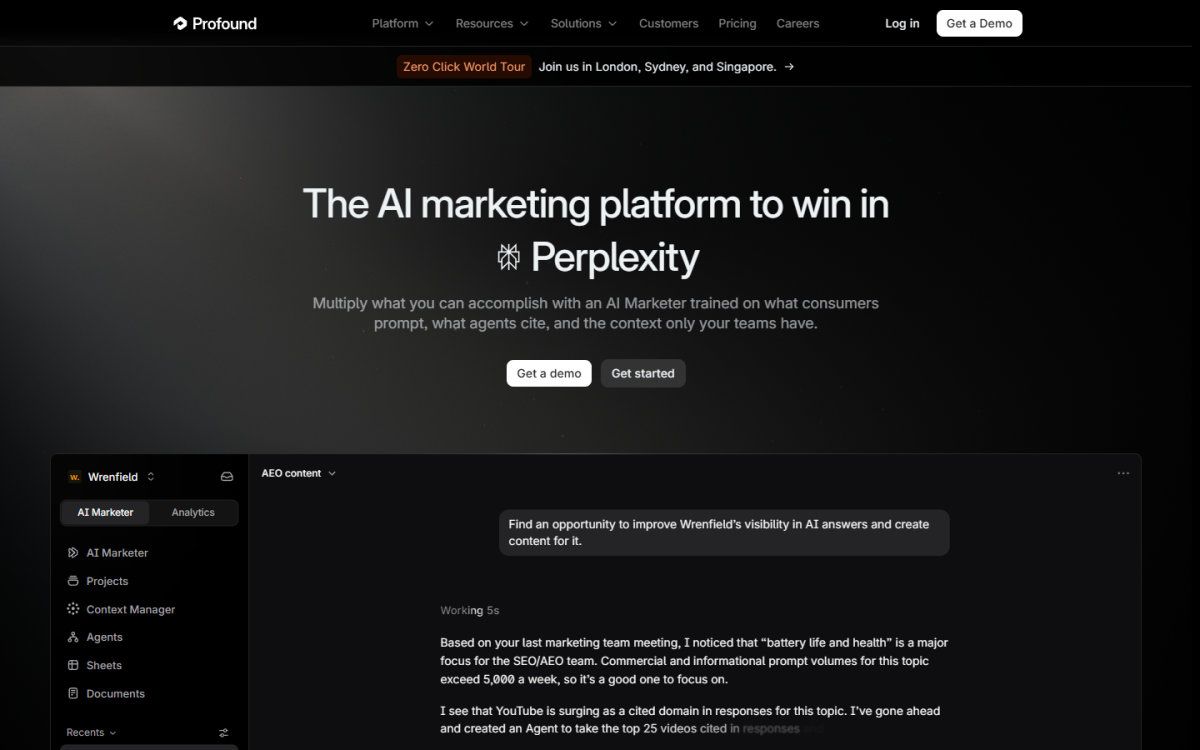
| Profound | Custom pricing, as of October 2026 | Yes | Up to 9 (3 on free Trial) | ChatGPT, Perplexity, Google AI Mode, Gemini, Microsoft Copilot, DeepSeek, Claude, Google AI Overviews, Exa Search | Custom prompt plan, daily | Cannot be calculated because pricing is custom | Custom Enterprise plans across up to nine engines |
| Otterly.ai | From $29/month, as of October 2026 | Yes | Up to 7 (4 on Lite, 3 as paid add-ons) | ChatGPT, Google AI Overviews, Perplexity, Microsoft Copilot | 15 prompts daily | $0.48 per daily tracked prompt | Daily tracking across four engines on the Lite plan |
| AthenaHQ | From $295/month, as of October 2026 | Yes | 11 | Not published | 3,600 credits/month, unlimited prompts on Starter | No refresh cadence published | Model coverage and credit-based response tracking on Starter |
The table uses entry-plan terms as of October 2026. Profound agency plans start from $99 per month, while its brand offering uses a free Trial and custom Enterprise pricing. Otterly.ai uses daily prompt limits, while AthenaHQ uses credits and unlimited prompts on Starter. Those units describe different purchasing models.
What can LLM visibility data not tell you about demand and revenue?
LLM visibility data cannot prove demand, buyer preference, clicks, pipeline or revenue by itself. A mention or citation is exposure. Generated answers vary, reproducibility is limited, and scoring rules can differ across tools and models.
A high mention rate can reflect broad category awareness without commercial intent. A cited article can inform a buyer without sending a visit. A recommendation can influence a deal without creating a measurable referral. Connecting an answer to a closed deal requires attribution evidence.
Sona AI Visibility connects prompts and citations to pipeline and revenue on one account timeline, resolves anonymous accounts behind AI-referred visits without cookies, and tracks AI crawler activity from server logs or a lightweight edge worker. Mention-count tracking remains the baseline, not the reason to choose a measurement system.
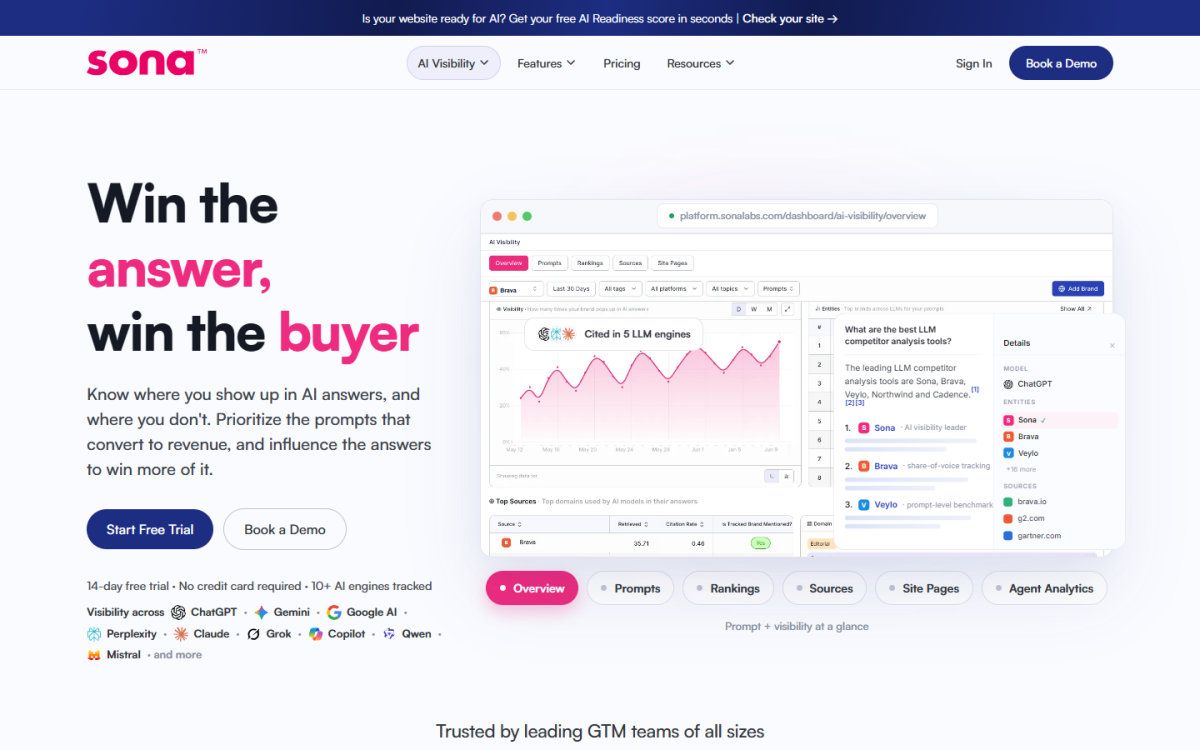
Use visibility data to prioritize investigation. Combine prompt-level appearance, cited-page evidence, account activity and CRM outcomes before assigning commercial value. That preserves the distinction between a brand appearing in an answer and a buyer taking a revenue-producing action.
Frequently Asked Questions
Can you see your exact rank in ChatGPT?
No. ChatGPT has no fixed position list for brands. Visibility appears as how often a brand is mentioned or cited across repeated runs of the same prompt, so report the outcome as a rate rather than a single rank.
Is LLM optimization the same as SEO?
LLM optimization and SEO overlap, but they differ. SEO targets rankings on a results page, while LLM optimization targets whether a model mentions, recommends or cites a brand in its answer. Good SEO content can support both outcomes.
How many brands does an AI assistant recommend per prompt?
AI assistants recommend an average of 6–11 brands per prompt across categories, per the 2026-05-20 listing. A specific market can produce a different number of recommendations.
How many prompts should a company track?
A company should track enough prompts to cover the buying questions in its market. Define the prompt set first, then select a plan that supports the required coverage.
Which model is ranked first on LLM leaderboards?
As of October 2026, benchlm.ai ranks Claude Opus 5.5 first with a score of 86.62. Other leaderboards can order models differently because they use different benchmarks and criteria. None of those leaderboards measure brand visibility inside AI answers.
Does appearing in AI answers lead to revenue?
Not on its own. A mention or citation is exposure. Revenue impact requires connecting AI-referred visits and the prompts behind them to accounts, pipeline and closed deals through an attribution process.
Summarize this article with AI: ChatGPT · Claude · Perplexity · Google AI Mode
Last updated: October 2026