


ChatGPT product search discovery lets shoppers see product cards with images, prices and links within a ChatGPT response, using merchant feeds and public product data instead of blue-link lists. OpenAI cites availability, price, quality and primary-seller status as merchant-ranking factors (October 2026). Search Engine Land reported in July 2026 that feed-based offers consistently provided brand, image and merchant information in one analysis, making a feed the initial requirement. Purchases still finish on the merchant’s website.
What is ChatGPT product search discovery and how does it differ from web search and shopping ads?
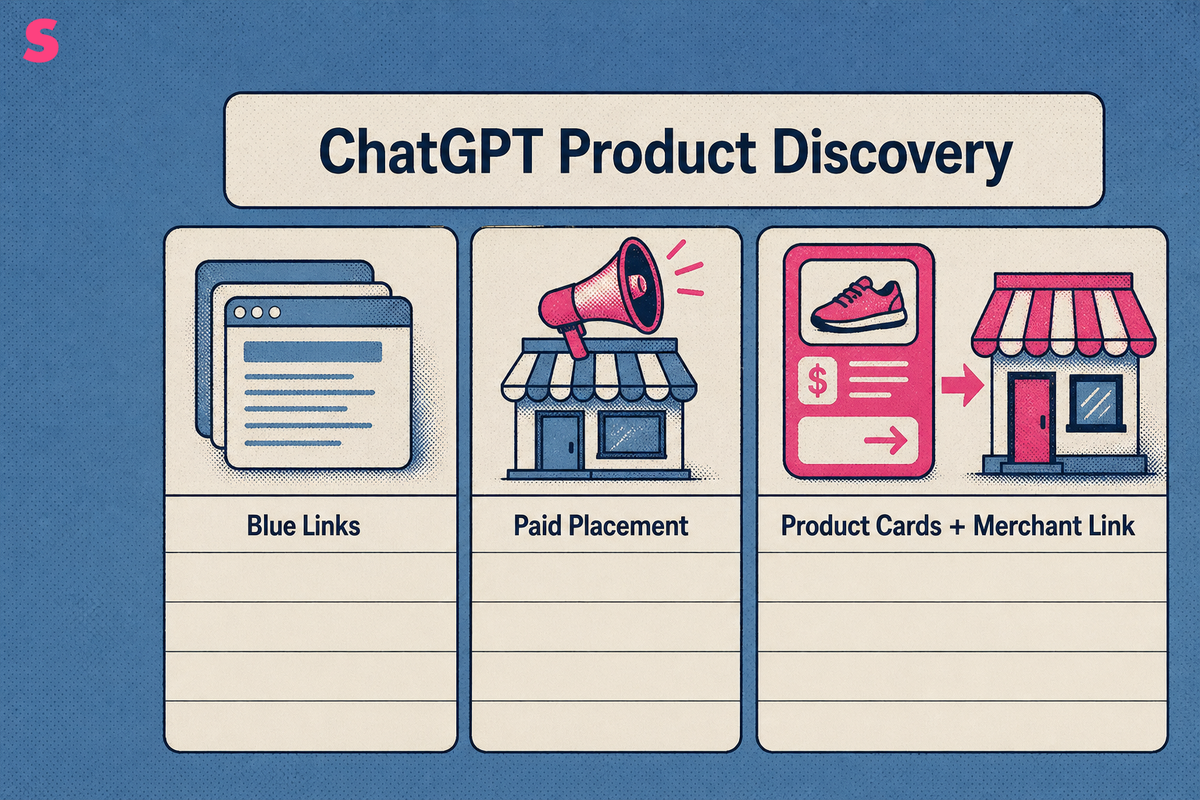
ChatGPT product search discovery is how products become eligible to appear when a shopper asks ChatGPT for recommendations, comparisons, or product research. ChatGPT can display visual product options, details, and merchant links when a question signals shopping intent, per help.openai.com.
For an ecommerce team, the job is to keep product data accurate, accessible, and specific enough for ChatGPT to match a shopper’s request with a product page. A shopper asking for waterproof hiking boots under a stated budget expresses a defined product need, not a short keyword query.
ChatGPT product discovery differs from conventional web search because it synthesizes options in a conversational response. It differs from shopping ads because merchants do not buy placement inside the answer. ChatGPT presents products for browsing and comparison, including imagery, product details, and merchant links, per openai.com.
For example, a shopper could ask ChatGPT to find a compact espresso machine for a small apartment. The response can compare products by price, reviews, and features, then direct the shopper to a merchant-owned site to continue the purchase journey.
How does ChatGPT decide which products and merchants to show?
ChatGPT shopping results consider product availability, price, quality, and whether the merchant is the maker or primary seller, per help.openai.com, October 15, 2026. Stores should treat product discovery as a catalog-quality and merchant-quality issue, not merely a copywriting exercise.
These factors determine whether an offer can credibly answer a shopper’s request. A product with a current price, available inventory, complete specifications, clear imagery, and direct merchant fulfillment gives ChatGPT more material for matching and comparison.
Product relevance remains essential. A request for a carry-on suitcase with an integrated laptop compartment should lead to a page that identifies its size, compartment design, materials, price, availability, and fulfillment conditions. Vague category pages provide little evidence for that match.
Sona AI Visibility connects citations and AI-referred visits to pipeline and revenue, while also showing the buyer prompts behind AI traffic. For ecommerce teams, that distinction separates broad product research visibility from visibility around commercial, decision-stage product comparisons.
- Keep pricing and availability current.
- Use consistent product titles, variants, and identifiers.
- State factual attributes in product-page copy, not only inside images.
- Clarify whether the store is the brand, manufacturer, or primary seller.
Where does ChatGPT get its product data: merchant feeds, crawling, or both?
ChatGPT can use both merchant-provided product data and publicly available product information, per help.openai.com, October 26, 2026. A merchant feed provides structured catalog input, while crawlable public pages offer another source of product information.
The two routes serve different operational needs. A feed supports catalog completeness and current commerce attributes. Public product pages provide shopper-facing context, including specifications, use cases, category relationships, and merchant policies.
| Product-data route | How ChatGPT receives the information | What the store should manage | Best operational use |
|---|---|---|---|
| Merchant-provided feed | Structured catalog data supplied through supported integrations | Identifiers, descriptions, pricing, inventory, media, and fulfillment options | Keeping commerce attributes complete and current |
| Public product pages | Publicly available product information indexed from the web | Accessible product pages, structured data, server-rendered product details, and canonical tags | Providing detailed product context and merchant information |
| OAI-SearchBot access | Website crawling for ChatGPT shopping and search experiences | robots.txt access and pages that load without crawler blocks | Helping public product pages become discoverable |
OpenAI supports product-feed integrations through SFTP, APIs, leading commerce platforms, and feed providers, per openai.com, October 18, 2026. Stores should use feeds to strengthen catalog coverage while preserving crawlable product pages, because feeds do not replace merchant sites.
Sona AI Visibility tracks which AI crawlers reach pages from server logs or a lightweight edge worker. That evidence shows whether AI crawler access exists at the product-page level rather than assuming a robots.txt change reached every important URL.
How do you submit a product feed to OpenAI, step by step?
To submit a product feed to OpenAI, prepare a complete catalog file, validate an initial sample, and maintain daily snapshots. OpenAI documents CSV and JSON feed formats, plus an initial sample feed for validation followed by daily snapshots, per developers.openai.com, September 1, 2026.
OpenAI supports SFTP, API, commerce-platform, and feed-provider integrations, per openai.com, October 18, 2026. The approved documentation does not specify a self-service onboarding screen, required credentials, delivery endpoint, or the format of a validation response. Confirm those route-specific details with OpenAI or the supported platform or feed provider before scheduling production delivery.
- Audit the product catalog for stable identifiers, titles, descriptions, price, inventory, images, and fulfillment details.
- Create the feed in CSV or JSON format using the required commerce fields documented by OpenAI.
- Choose the integration path that fits the store’s infrastructure, such as SFTP, an API, a commerce platform, or a feed provider, then complete that route’s onboarding and access requirements.
- Transfer one representative sample feed through the approved route for validation before publishing the full catalog.
- Resolve validation issues against the source catalog, then activate daily snapshots through the same integration route so price, inventory, variants, and fulfillment changes reach the product-data pipeline.
- Check the merchant site separately for accessible product URLs, consistent structured data, and valid canonical tags.
Validation matters because an incomplete feed can create mismatches between a product card and the merchant landing page. Reconcile each identifier with its destination URL, product variant, image, and current price before maintaining daily snapshots.
Submitting a feed is not a paid-ad campaign and does not guarantee inclusion in ChatGPT shopping results. It provides a controlled catalog-data source that ChatGPT can use alongside public product information.
Which product data fields should an online store fix first?
Online stores should fix product identifiers, titles, descriptions, price, inventory, images, and fulfillment options first because OpenAI lists those fields in its product-feed documentation, per developers.openai.com, September 1, 2026. These fields determine whether a product can be identified, compared, and purchased from the correct merchant.
Start with identifiers. A stable product ID distinguishes a parent product from size, color, bundle, or regional variants. The title should identify the actual product rather than rely on internal naming conventions that shoppers would never use.
Descriptions should answer comparison questions directly. Product dimensions, compatibility, material, capacity, intended use, included accessories, warranty context, and variant differences belong in crawlable text. Product images support discovery, but cannot carry the full burden of product explanation.
- Price and inventory: prevent stale offers and unavailable recommendations.
- Media: associate the correct image with the correct product variant.
- Fulfillment options: clarify shipping, delivery, pickup, and merchant conditions.
- Structured data: reinforce semantic relevance for product pages and catalog entities.
Implement Product and Offer markup on each canonical product page. The markup should identify the product, its variant, image, price, currency, availability, merchant, and destination URL. Keep every marked-up value consistent with the merchant feed and visible page content.
{
  "@type": "Product",
  "name": "PRODUCT_TITLE",
  "sku": "VARIANT_IDENTIFIER",
  "image": "PRODUCT_IMAGE",
  "brand": { "@type": "Brand", "name": "BRAND_NAME" },
  "offers": {
    "@type": "Offer",
    "price": "CURRENT_PRICE",
    "priceCurrency": "CURRENCY_CODE",
    "availability": "CURRENT_AVAILABILITY",
    "seller": { "@type": "Organization", "name": "MERCHANT_NAME" },
    "url": "PRODUCT_DESTINATION"
  }
}
A product page should match its feed. A shopper who reaches a page with a different price, unavailable variant, or unrelated image encounters friction immediately. The catalog, page template, inventory system, and checkout experience need one consistent product record.
How can you help ChatGPT find your products without feed access?
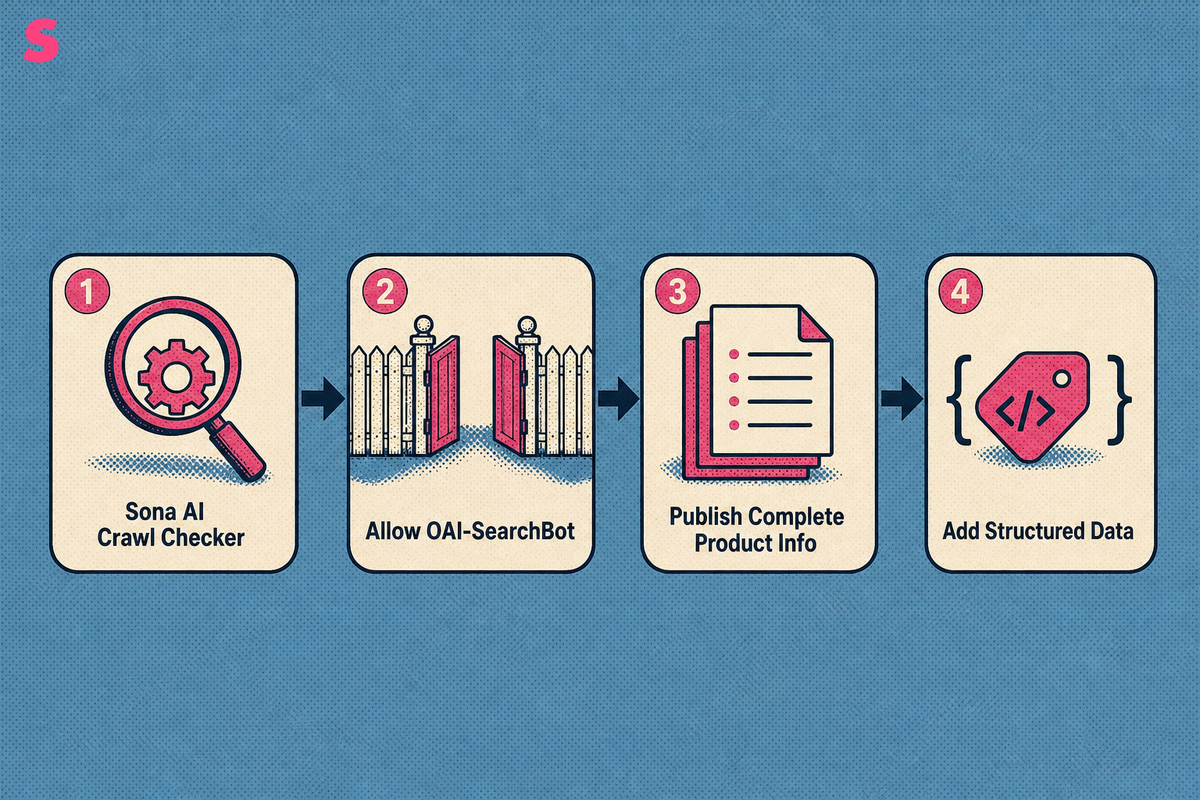
Without feed access, an online store can help ChatGPT find products by allowing OAI-SearchBot to crawl public product pages, publishing complete product information, and implementing structured data. These steps improve the availability and interpretability of public product information without replacing a merchant feed.
OAI-SearchBot is the crawler ChatGPT uses to index websites for shopping and search experiences. Blocking OAI-SearchBot in robots.txt removes a path through which public product pages can be found. Ecommerce teams should review robots.txt, CDN rules, WAF policies, authentication barriers, and rate limits.
Product pages need server-rendered HTML containing the details shoppers need. That includes title, price, availability, product description, specifications, variant information, images, merchant identity, and a canonical tag. Attributes hidden behind client-side rendering or blocked resources are harder to interpret.
The Sona AI Crawl Checker tests AI crawlers, including retrieval, agent-triggered, training, and stealth crawlers. It identifies access failures such as robots.txt disallow rules, WAF responses, rate limiting, and cloaking, then returns a specific configuration fix.
Use a repeatable technical checklist rather than one-off troubleshooting. Run a full product-template audit monthly, and check crawler access after platform migrations, CDN changes, security-rule updates, or major template releases.
What results have analysts measured for products in ChatGPT shopping so far?
Early analysis suggests that product feeds influence the completeness and placement of offers in ChatGPT shopping results. Search Engine Land reported on July 31, 2026 that approximately 99.9% of product-feed citations in an analysis of more than 1 million ChatGPT shopping offers appeared as the top product offer.
The same July 31, 2026 analysis reported that feed-sourced offers supplied brand, product-image, and merchant details 100% of the time, compared with 0% for page-scraped offers. The finding does not establish a ranking guarantee, but it shows why complete merchant data affects product presentation.
Google Shopping performance also appears relevant. Search Engine Land reported on July 31, 2026 that 60% of strong product matches in its analysis came from the top 10 Google Shopping results. That correlation does not mean Google Shopping rank automatically determines ChatGPT inclusion.
One shopping-query fan-out can populate an 8-product carousel from a single page of Google Shopping results, per Search Engine Land, July 31, 2026. Ecommerce teams should preserve conventional product SEO, maintain strong merchant feeds, and test conversational shopping prompts as separate discovery work.
No verified merchant before-and-after implementation outcome, including traffic, conversion, revenue, or product-visibility change, is included in the approved evidence for this page. These findings are aggregate market analyses, not merchant implementation results.
How do you check whether your products appear in ChatGPT and bring in traffic?
Check ChatGPT shopping visibility by running a defined prompt list, recording the products and merchants that appear, then matching referred visits to product-page and conversion data. The useful output is a repeatable log, not a one-time screenshot.
Build the prompt list from commercial product questions: category comparisons, use-case requests, budget constraints, compatibility questions, and alternatives to a named product. Run the same prompt list daily. Daily tracking reveals changes that a weekly snapshot can obscure when retrieval indexes, model updates, and competitor changes shift answers.
For each prompt, capture the date, product position, merchant link, product attributes shown, cited destination page, and whether the item was absent. Then compare ChatGPT-referred sessions with landing pages, add-to-cart events, checkout starts, and completed orders in the merchant’s analytics environment.
Sona AI Visibility includes AI Search Insights, which shows prompts buyers ask and how a brand’s pages perform in AI answers. For a catalog team, prompt-level evidence can identify product pages that should answer a commercial question but do not appear.
A visibility score is a dated snapshot. The operational value comes from a comparable series that identifies sustained movement, followed by severity-ranked page fixes that give merchandising, SEO, and engineering teams a defined work queue.
What are the limits of ChatGPT product discovery, and does SEO still matter?
ChatGPT product discovery is a shopping research and referral layer, not a replacement for ecommerce SEO, product feeds, merchant operations, or conversion optimization. ChatGPT shopping is currently live for users in the United States, with broader merchant and regional availability planned over time, per openai.com, October 18, 2026.
Merchants do not fully control product selection. A complete feed, accessible product pages, structured data, current inventory, and strong Google Shopping performance improve the evidence available for matching, but none guarantees placement for a particular prompt or shopper.
SEO still matters because product pages remain the destination for product details, merchant trust, checkout, organic search traffic, and conversion measurement. ChatGPT users can discover and evaluate products in ChatGPT, but purchases are completed on merchant-owned websites or apps, per chatgpt.com.
Sona AI Visibility can track AI crawler activity alongside citations, helping teams verify whether important product pages are reached by AI systems. That evidence supports technical prioritization, but product discovery still depends on accurate catalog operations and a merchant site that converts qualified visitors.
Monitoring brand mentions in AI answers covers only visibility. Sona AI Visibility connects AI citations and AI-referred visits to accounts, pipeline, and revenue on one account timeline, helping teams distinguish visible product research from commercial impact.
Frequently Asked Questions
Can customers buy products inside ChatGPT?
No. Users can discover and compare products in ChatGPT, but purchases are completed on merchant-owned websites or apps, per chatgpt.com. The merchant remains responsible for landing-page performance, cart events, checkout measurement, order confirmation, and revenue attribution after the referral leaves ChatGPT.
Do I need a product feed to appear in ChatGPT shopping results?
Not strictly. OpenAI says product data can come from merchant-provided data or publicly available product information, per help.openai.com, October 2026. A feed improves catalog completeness and freshness, but does not guarantee inclusion in ChatGPT shopping results.
What file format and refresh schedule does OpenAI's product feed use?
OpenAI documents CSV or JSON feeds containing identifiers, descriptions, pricing, inventory, media, and fulfillment options, per developers.openai.com, September 1, 2026. The documented process starts with one sample feed for validation and continues through daily snapshots.
What is OAI-SearchBot and should I allow it?
OAI-SearchBot is the crawler ChatGPT uses to index websites for shopping and search experiences. Allowing it gives public product pages a path into ChatGPT discovery, while blocking it in robots.txt removes that path. Ecommerce teams should review crawler access alongside WAF and CDN policies.
Is ChatGPT shopping available outside the United States?
ChatGPT shopping is currently live for users in the United States, and broader merchant and regional availability is planned, per openai.com, October 18, 2026.
Does ranking well in Google Shopping help in ChatGPT?
Strong Google Shopping performance appears to correlate with ChatGPT product matching. Search Engine Land reported in July 2026 that 60% of strong product matches in its analysis came from the top 10 Google Shopping results, but the finding does not guarantee ChatGPT placement.
Summarize this article with AI: ChatGPT · Claude · Perplexity · Google AI Mode
Last updated: October 2026







