


AI SEO keyword research uses language models to create, organize and rank search queries, then validates each against actual search volume, difficulty and your conversion data. AI accelerates discovery and clustering, but it cannot provide reliable demand figures. Consider every AI-generated phrase a hypothesis until a trusted keyword database and first-party data verify it. Teams that follow this process create clusters tied to pages and buying stages instead of simply collecting plausible phrases.
What is AI SEO keyword research and how does it differ from traditional keyword research?
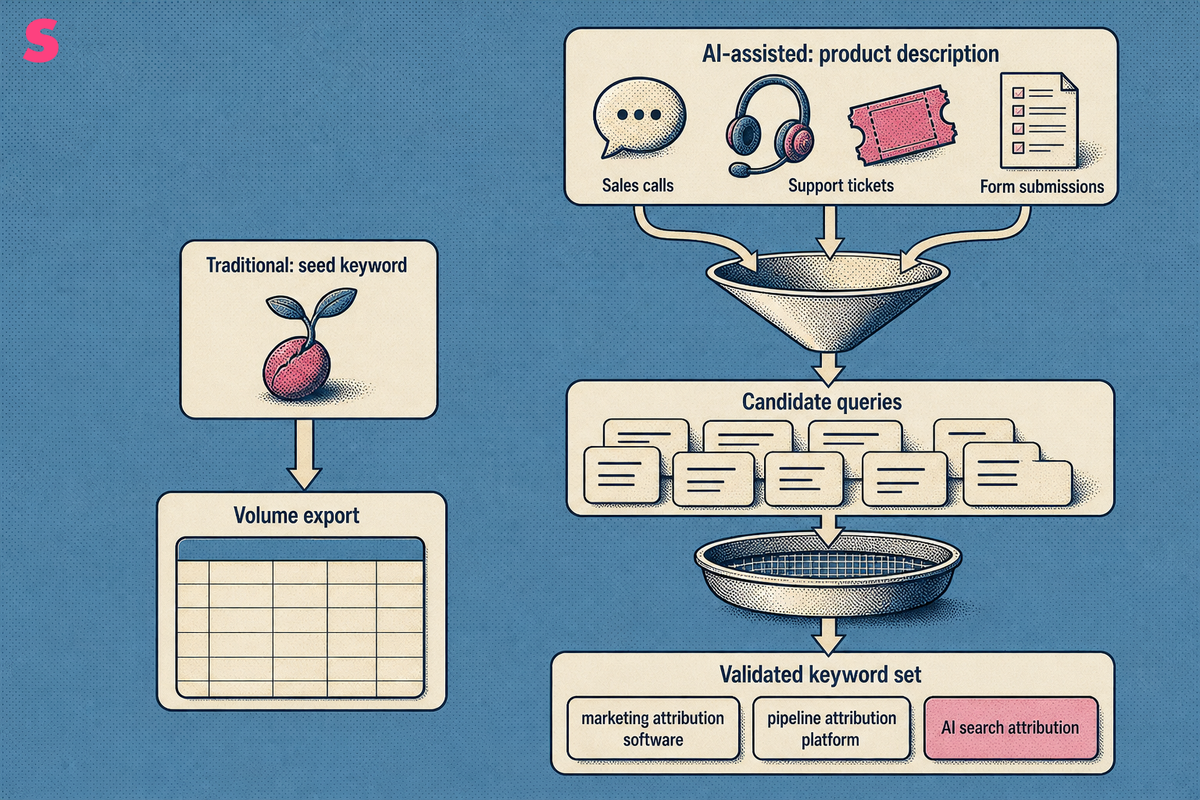
AI SEO keyword research uses language models to generate, group, and prioritize search queries, while a keyword database supplies demand data. It turns business context and customer language into a validated keyword set for search planning.
Traditional keyword research often begins with a seed term and a volume export. AI-assisted research begins with a product description, sales-call language, support tickets, and form submissions, then expands those themes into candidate queries. The database remains essential because search volume, keyword difficulty, current position, and SERP features come from collected search data.
For example, a B2B SaaS company might describe its product as software for attributing pipeline across paid, organic, and AI search. An AI workflow can generate phrases such as marketing attribution software, pipeline attribution platform, and AI search attribution. A keyword database then removes phrases with no measurable demand or commercial relevance.
AI SEO keyword research is not a list of phrases invented by a chatbot. It is distinct from prompt research for answer engines. Keywords are search queries with measurable Google demand. Prompts are fuller conversational requests that require separate tracking and analysis.
How do you run AI SEO keyword research step by step for a B2B SaaS product?
A repeatable B2B SaaS keyword workflow begins with customer language, validates each suggestion against search data, and ends with assigned pages and measured outcomes. The result is a working content plan rather than a spreadsheet of loosely related phrases.
- Extract recurring language from sales calls, support tickets, CRM notes, demo forms, and onboarding questions.
- Turn each theme into a short business description, then ask AI to expand it into problem, solution, comparison, implementation, and pricing queries.
- Validate every candidate in a keyword database for volume, difficulty, intent, current ranking URL, and SERP features.
- Cluster validated terms by topic, search intent, and buying stage.
- Map each cluster to an existing page or a new content brief, then track rankings, conversions, and AI-search visibility.
For a pipeline attribution product, customer language such as “we cannot tell which campaigns create revenue” can produce terms around attribution models, campaign measurement, buyer journeys, and revenue reporting. AI tools accept a short business description as input, making expansion faster than starting with one broad seed keyword.
Long-tail discovery belongs in the same workflow. Expand a validated head term into implementation questions, industry variants, comparison modifiers, and objection-driven queries. A phrase such as marketing attribution software can produce candidates around B2B SaaS reporting, multi-touch measurement, and proving campaign influence. Validate each variation before assigning content work.
Sona AI Visibility supports the keyword-to-prompt-to-page chain by organizing keywords into prompts and showing the pages that should surface for those questions. The keyword identifies demand, the prompt captures the buyer’s fuller request, and the page gives the team a specific asset to improve.
Which AI workflows are worth using for discovery, clustering, intent classification, content gaps, or prioritization?
AI works well for discovery, clustering, intent labeling, and grouping content gaps. It is not the final authority for search volume, difficulty, or business value, because those judgments require keyword databases, SERP review, and product knowledge.
Use AI to turn a raw export into usable structures. It can consolidate near-duplicates, separate informational questions from commercial comparisons, and identify recurring subtopics across hundreds of candidate terms. That work reduces manual sorting and exposes gaps hidden by a flat keyword list.
Competitor keyword lists can be compared with a company’s current keyword set, then grouped into topic clusters, per DigitalApplied.com. The useful output is not a competitor copy list. It is a set of systematic opportunities, such as missing integration pages, comparison pages, or implementation guidance.
- Discovery: Generate synonyms, jobs-to-be-done language, questions, and modifiers.
- Clustering: Group related queries around one search intent and one likely page.
- Intent classification: Label terms as informational, commercial, transactional, or navigational.
- Gap grouping: Compare existing coverage with competitors and sort gaps by topic.
- Prioritization: Use AI for first-pass ranking, then use volume, difficulty, conversion evidence, and product relevance for final decisions.
Human review matters when a term looks attractive but does not match the product’s buying motion. A high-volume informational phrase can deserve lower priority than a smaller comparison query from an account near a purchase decision.
How do you validate AI-generated keywords against search volume, difficulty, and business value?
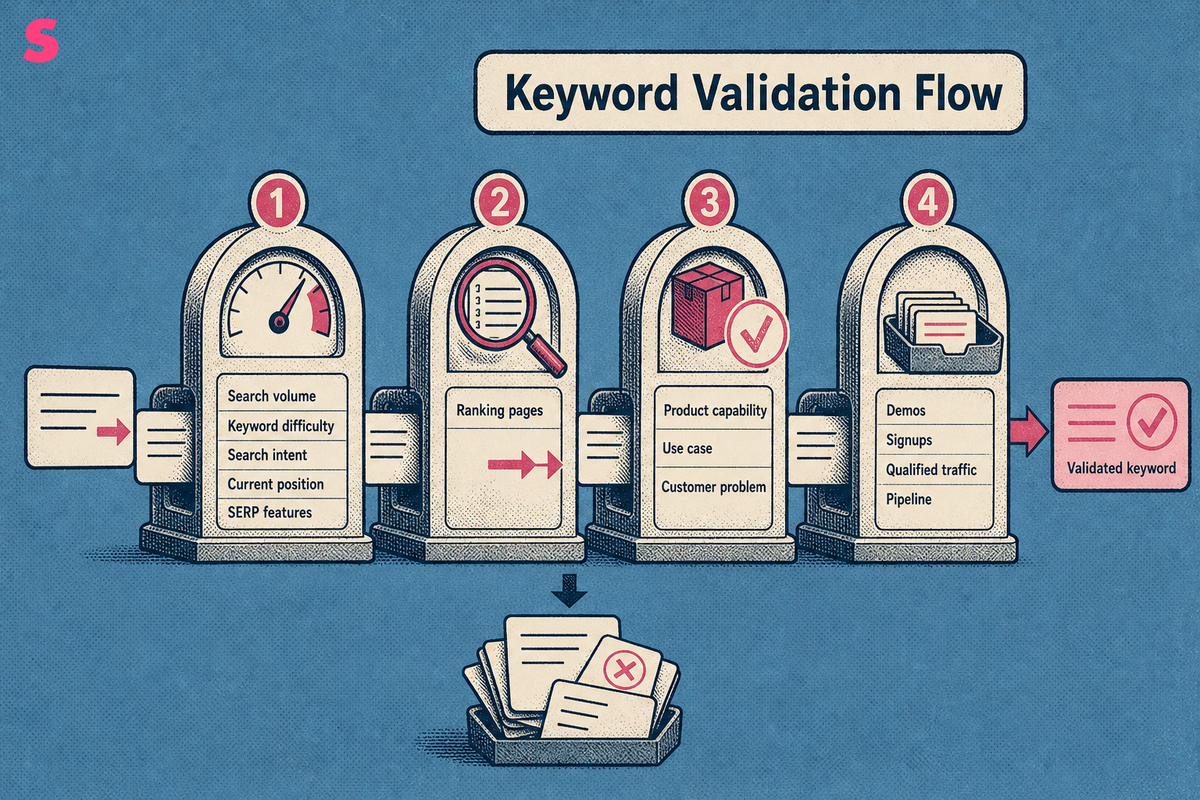
Validate every AI-generated keyword in a database, against the product, and against first-party conversion evidence. AI can produce plausible phrases with no demand, inaccurate volume estimates, generic recommendations, or language buyers never use.
Start with a database check for search volume, keyword difficulty, search intent, current position, and SERP features. These metrics show whether a term has measurable demand, whether the ranking environment matches the proposed page, and whether the query triggers product pages, editorial content, video, local results, or other formats.
- Check whether the phrase has measurable volume and a stable intent classification.
- Review the ranking pages and SERP features to identify the format Google rewards.
- Confirm that the phrase maps to a real product capability, use case, or customer problem.
- Check first-party data for related queries that already drive demos, signups, qualified traffic, or pipeline.
- Discard generic phrases that attract attention but do not connect to a commercial outcome.
Volume estimates demand, not priority. Difficulty describes competitive pressure, not business value. A practical selection balances demand and competition against company goals, existing authority, product fit, and conversion history. A lower-volume query with clear purchase intent can outrank a broad term that attracts the wrong audience.
A technical readiness checker evaluates whether AI systems can crawl and parse a site. It does not validate keyword demand or measure brand mentions.
How do you cluster AI keywords by search intent and buying stage without creating cannibalization?
Cluster validated keywords by topic and intent, assign one primary page to each cluster, and build a brief around that page’s job. Cannibalization occurs when two pages target the same intent and compete for the same ranking opportunity.
Start with a topic such as attribution software. Separate educational queries about attribution models from commercial queries about choosing software, comparison queries about alternatives, and transactional queries about pricing or demos. Each group needs a distinct page purpose, internal-linking role, and conversion path.
- Awareness: Definitions, frameworks, and problem education.
- Consideration: Methods, implementation guides, and use-case pages.
- Decision: Comparisons, alternatives, integrations, and vendor evaluation pages.
- Purchase: Pricing, demo, and product-led conversion pages.
Review the existing ranking URL for every candidate before commissioning a new page. If one URL already ranks for the primary query and serves the same intent, improve that page instead. Create a new page only when the query represents a distinct problem, audience, format, or buying stage.
Sona AI Visibility can connect a prompt to its implied buying stage and commercial intent. Intent Signals reconstruct the likely question behind an AI-referred visit and attach a buying stage to the account journey, helping teams distinguish broad visibility from demand that deserves follow-up.
How should you test an AI keyword research tool before you trust it?
Use a proposed test protocol with fixed prompts, a fixed keyword sample, and a published scoring rule. This protocol has not been run as a completed tool comparison, so it does not claim comparative results.
For every tool, run the five prompts below. Use this template: Based only on this business description, return 20 keyword suggestions. For each suggestion, provide the keyword, search intent, buyer stage, topic cluster, and one-sentence rationale. Include problem, solution, comparison, implementation, and pricing queries.
- B2B SaaS software that attributes pipeline and revenue across paid, organic, and AI search.
- Cloud cost-management software for finance and engineering teams at mid-market SaaS companies.
- Identity-resolution software that connects anonymous website activity to B2B accounts.
- Security-awareness training for distributed enterprises with compliance requirements.
- Customer-support software for SaaS teams that need AI-assisted ticket routing.
Deduplicate exact-match suggestions across the five outputs, then retain the first four unique suggestions from each prompt for a 20-keyword sample. Score each sample against one reference database and a documented relevance rubric. Keep the evaluator blind to the tool name during scoring.
| Criterion | What to check | Maximum points | Scoring rule | Pass threshold | Evidence retained |
|---|---|---|---|---|---|
| Relevance | Connection to the product and buyer problem | 20 | One point per relevant keyword | 15 | Keyword list and reviewer notes |
| Coverage | Problem, solution, comparison, implementation, and pricing breadth | 20 | Four points per covered theme | 15 | Theme map |
| Demand accuracy | Match against a reference keyword database | 20 | One point per keyword with validated demand | 15 | Database export |
| Intent label accuracy | Agreement with SERP and reviewer assessment | 20 | One point per correct label | 18 | SERP notes |
| Speed | Time from input to usable export | 20 | Points awarded against the agreed time target | 7 | Timestamped run log |
Set an overall pass mark of 75 points out of 100, while requiring the demand and intent thresholds. A hypothetical batch with 18 relevance points, 16 coverage points, 20 demand-accuracy points, 17 intent points, and 9 speed points totals 80 points but fails because it misses the mandatory intent threshold.
Repeat the same test when product positioning changes. A tool that generates strong ideas for one category can produce generic output for another category with a more complex buying motion.
When is a general-purpose AI assistant enough, and when do you need a dedicated SEO platform?
A general-purpose AI assistant is enough for early discovery, clustering, and drafting hypotheses. A dedicated SEO platform becomes necessary when a team needs live search data, repeatable rank tracking, documented decisions, and an audit trail across a large keyword program.
| Category | Best use | Live SERP and volume data | Rank or prompt tracking | Audit trail |
|---|---|---|---|---|
| General-purpose AI assistant | Idea expansion, clustering, intent labels, and brief outlines | External database required for validation | Manual process or separate tracking workflow | Prompt history and exported working files |
| Dedicated keyword research platform | Demand validation, competitor analysis, SERP review, and rank monitoring | Keyword database and SERP metrics | Keyword rankings and scheduled reporting | Saved lists, exports, and team reporting |
| AI visibility tracker | Prompt research, citations, AI-referred visits, and answer-engine monitoring | Prompt and citation coverage rather than keyword demand alone | Prompt visibility and answer-engine monitoring | Prompt history, citation records, and account activity |
Use an AI assistant when a small team needs to shape a manageable list before buying data. Use a dedicated platform when the team manages enough keywords, markets, or stakeholders that manual exports create inconsistencies. Use an AI visibility tracker when the plan includes prompts and citations across answer engines.
Run keyword validation when the content plan changes. Run the same prompt list daily when monitoring AI answers, because daily monitoring reveals patterns that a weekly snapshot averages away. A change that holds for four days is a trend. A one-day spike is noise.
Which tools combine keyword data with AI search tracking, and what limits should you compare?
Compare AI search tracking tools on the limits that determine operating scale: answer engines, daily tracked prompts, domains, history, reporting, API access, and MCP access. Sona AI Visibility connects prompts and citations to pipeline and revenue while tracking AI crawler activity. Semrush One Pro+ costs $299 per month with 100 prompts per day as of October 2026.
| Tool | Starting price | Agency Plans? (Yes/No) | # of Answer Engines Tracked | Answer Engines | # of Daily Tracked Prompts (entry plan) | Cost per Daily Tracked Prompt | Differentiation |
|---|---|---|---|---|---|---|---|
| Sona AI Visibility | from $75/month | Yes | Up to 11 (3 on Starter) | Not published | 5,000 credits/month, about 56 daily tracked prompts on 3 engines | about $0.45 per daily tracked prompt | Connects AI citations and prompts to pipeline and revenue on one account timeline, and tracks AI crawler activity without a JavaScript tag. |
| Peec AI | from $95/month | Yes | Up to 13 (3 of 6 on Starter, plus add-ons) | Not published | 50 prompts daily | about $0.63 per daily tracked prompt | AI answer tracking across active Starter engines. |
| Otterly.ai | from $29/month | Yes | Up to 7 (4 on Lite, 3 as paid add-ons) | ChatGPT, Google AI Overviews, Perplexity, Microsoft Copilot | 15 prompts daily | about $0.48 per daily tracked prompt | AI answer tracking across four entry-plan engines. |
| PromptWatch | from $95/month | Yes | Not published | Not published | 50 prompts | about $0.48 per daily tracked prompt | Tracking across all supported models on every plan. |
Prices and allowances are as of October 2026. Compare unit limits before headline price, especially when a platform sells credits, prompt responses, tracked keywords, or domains as separate allowances.
How do you measure whether AI keyword research produces pipeline and not just rankings?
Measure keyword research against rankings, AI citations, conversions, qualified accounts, pipeline, and closed-won revenue. Rankings show whether a page earns visibility. Revenue measurement shows whether the selected topic reached buyers who became customers.
Build reporting around the path from query to page to conversion. For Google, track the keyword, ranking URL, organic sessions, conversion events, and CRM outcomes. For answer engines, track the prompt, cited page, AI-referred visit, account, and deal progression. Keep informational traffic separate from commercial evaluation traffic.
Monitoring which AI answers mention a brand is only half the job. Sona AI Visibility connects the prompts and citations behind AI-referred visits to accounts, pipeline, and revenue, while AI crawler and agent activity show the start of that path. Basic mention tracking remains the baseline, but attribution determines whether visibility affected commercial results.
Review keyword outcomes by cluster rather than pageviews alone. A comparison cluster that produces fewer visits but more qualified opportunities can deserve more investment than a broad educational cluster with stronger traffic and weaker conversion evidence. Reporting decisions should follow the buying motion.
Use a quarterly review for positioning, competitive coverage, and content investment decisions. The output should record which clusters produced commercial movement, which pages earned citations, and which topics need a revised brief or stronger product alignment.
What are the frequently asked questions about AI keyword research?
Can a general-purpose AI assistant replace a keyword research tool?
A general-purpose AI assistant can generate ideas, cluster terms, and label intent. It cannot provide dependable volume or difficulty data by itself, so every candidate still needs a keyword database check before it earns a place in the content plan.
Does AI keyword research give accurate search volume?
AI keyword research does not produce accurate search volume by itself. Volume and difficulty figures come from proprietary keyword databases, and an AI interface does not make the underlying data more accurate.
What is the difference between a keyword and a prompt?
A keyword is a short query typed into a search engine such as Google. A prompt is a longer, conversational request entered into an AI assistant. The two overlap in topic, but they require separate research, validation, and tracking methods.
How do you avoid hallucinated keywords in an AI-generated list?
Treat every suggestion as a hypothesis. Check each phrase against a keyword database for demand, intent, and ranking context, then discard terms with no measurable volume or no clear connection to the product, audience, or commercial objective.
Are there free AI keyword research tools?
Yes. A 2026 AI SEO tool comparison, updated October 8, 2026, found six tools with a free tier rather than only a trial. Free plans often cap tracked keywords, prompts, domains, exports, or reporting depth.
How often should AI keyword research be repeated?
Repeat keyword research when the product, audience, competitive landscape, or ranking pages change. Re-validate volume and intent during each planning cycle because search results and buyer language shift over time. Run prompt monitoring daily when AI-answer visibility is part of the program.
Summarize this article with AI: ChatGPT · Claude · Perplexity · Google AI Mode
Last updated: October 2026







