


When adapting your SEO budget for AI search optimization, retain 70-80% for core SEO that generates qualified demand and allocate 20-30% to AI search, beginning with measurement ahead of content. Use this split as an initial benchmark because the numbers are based on vendor surveys and guidance from October 2026. Make subsequent funding changes only once controlled prompt tests demonstrate improvements. Sona AI Visibility connects the prompts and citations underlying AI answers with pipeline and revenue.
What do you need in place before you change an SEO budget for AI search?
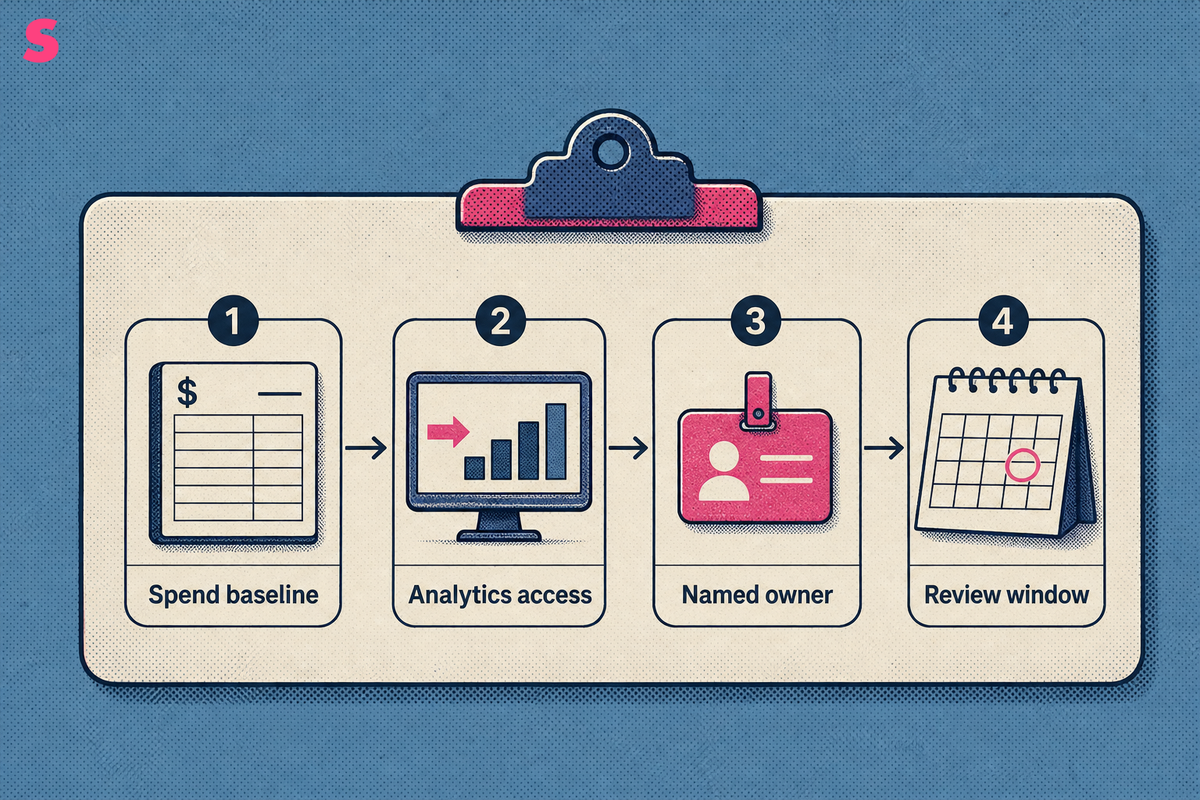
Before adapting an SEO budget for AI search, establish a spend baseline, analytics access for AI referrals, a named owner, and a fixed review window. Without those prerequisites, a budget shift becomes disconnected activity rather than an accountable test.
List every current SEO line item, including technical work, content production, content refresh, digital PR, link building, rank tracking, agency retainers, and tools. Record its monthly cost, owner, intended outcome, and performance evidence. This baseline informs every later decision.
Assign one person to own the AI-search budget line. The SEO lead often owns execution, while analytics or revenue operations owns measurement access. A survey published on August 14, 2026 found that SEO teams led AI-search optimization for 77% of respondents, up from 75% the previous year.
- Spend baseline: a line-item view of current SEO commitments.
- Analytics access: visibility into AI referrals, conversions, CRM stages, and revenue.
- Named owner: one person who can approve reallocation and report outcomes.
- Review window: a defined test period with a start date, prompt set, and decision date.
Set the review window before moving money. Prompt monitoring runs daily, while technical re-audits and budget reviews can run monthly or quarterly. Each cadence supports a different decision.
How do you audit your current SEO spend to find what to protect, trim or pause?
Audit SEO spend by assigning every line item one of three labels: protect, trim, or pause. Protect work that improves crawlability, extractability, authority, and qualified demand because those foundations support Google search and AI answers.
- Protect: retain technical SEO, high-performing content refreshes, conversion-critical pages, and measurement work.
- Trim: reduce repetitive keyword research, low-yield content production, and broad link-building programs without a clear commercial purpose.
- Pause: stop work with no defined audience, no owner, no measurable outcome, or clear duplication with another vendor.
Legacy SEO budgets concentrated on rank tracking, keyword-led production, technical remediation, and link acquisition. Current budgets retain technical remediation, commercially important content, and measurement, while reducing repetitive research, excess content volume, and broad link acquisition. Incremental AI-search costs come from recurring answer-engine monitoring, citation analysis, AI crawler telemetry, content extraction work, and AI-to-pipeline attribution.
Traditional SEO already covers much of the work that supports AI search. Clean internal linking, server-rendered HTML, canonical tags, structured content, accessible pages, and credible source material help search engines and answer engines understand a site. The new budget line covers measurement of AI answers, citations, crawler access, and AI-referred demand.
Check for double payment before adding an AI-search service. A technical SEO agency may already audit robots.txt, schema markup, page rendering, and content structure. Sona AI Visibility can show AI crawler activity from server logs or a lightweight edge worker, helping teams distinguish a missing technical signal from a reporting gap.
The Free AI Readiness Checker provides a dated snapshot of page readiness. A score establishes a baseline, but it does not replace ongoing measurement or prove that a page generated demand.
How much of an SEO budget should move to AI search optimization?
Move a controlled share of the existing SEO budget first, not the entire program. A 70/30 framework, cited in an October 2026 listing, places 70% on core SEO and 30% on AI-search initiatives, while arthurdosik.com describes a 70/20/10 framework for core SEO, AI-search work, and experimentation.
For established teams, an October 2026 listing recommends retaining 70–80% for core SEO and allocating 20–30% to AI-search initiatives. Another October 2026 listing suggests redirecting 15–25% of an existing digital marketing budget over 12 months. These frameworks are starting points, not universal benchmarks.
Survey findings explain why teams are creating a dedicated line. A survey of 300 enterprise leaders, published March 31, 2026, found that 65% were dedicating at least 25% of their 2026 marketing budget to AI-search optimization, while 28% allocated more than half. Because the respondents were enterprise leaders, smaller B2B SaaS companies should not treat those figures as required targets.
Start with the smallest allocation that funds measurement and one focused experiment. Increase the share only after the team can connect a fixed prompt set, AI referral activity, and commercial outcomes within the agreed review window.
Which SEO tasks should you cut or pause to fund AI search, and what do the numbers look like before and after?
Fund AI-search work by trimming low-return production and duplicative research, not by cutting crawlability, high-intent content, or analytics. The right reallocation protects SEO assets that earn qualified demand while creating room for citation analysis, crawler accessibility, structured content, and content refresh.
| Scenario | Before allocation | After allocation | Funds released | AI-search use |
|---|---|---|---|---|
| Small B2B SaaS validation | Existing SEO work includes broad link building, content production, technical SEO, and tools | 10–15% allocated to AI-search initiatives, with core SEO protected | Trim broad link building without a clear commercial purpose | Prompt monitoring, crawler checks, and refreshes for high-intent pages |
| Mid-market content-heavy team | Existing SEO work includes keyword research, new content, technical SEO, and reporting | 70–80% retained for core SEO, with 20–30% allocated to AI-search initiatives | Reduce repetitive research and low-yield content production | Schema, extractable content sections, and citation analysis |
| Agency-led program | Existing spend includes an agency retainer, internal content, and tools | 70% for core SEO, 20% for AI-search work, and 10% for experimentation | Reduce undifferentiated retainer work | Named AI-search deliverables, prompt baselines, and referral reporting |
| Enterprise demand program | Existing SEO work includes technical SEO, content, authority, and analytics | 70% for core SEO and 30% for AI-search initiatives | Reduce content volume and broad authority work | Account-level analysis, assisted conversion reporting, and controlled page tests |
Do not cut core crawlability, conversion measurement, high-intent product content, or proven technical remediation to create an AI-search budget. A survey published March 31, 2026 found that 62% of surveyed leaders identified crawlability for AI-powered search tools as a top optimization tactic, and 60% identified tracking AI-driven traffic.
Pause content designed only to fill a publishing calendar. Keep content that answers a specific commercial question, supports a sales motion, or already earns qualified visits. Put the savings into a measurable test, not another untracked content queue.
How should startup, mid-market and enterprise B2B SaaS budgets differ?
Startup, mid-market, and enterprise B2B SaaS teams need different AI-search allocations because their measurement capacity and content inventory differ. Startups need lean validation, mid-market teams need a repeatable operating model, and enterprises need a dedicated measurement line tied to pipeline.
| B2B SaaS stage | AI-search allocation | Primary budget use | In-house versus agency split | Review cadence |
|---|---|---|---|---|
| Startup | 10–15% of SEO budget | Fixed prompt set, crawler access, and high-intent page refreshes | Internal labor and tracking tools, with occasional specialist technical support | Daily prompt log, monthly budget review |
| Scale-up | 15–25% of SEO budget | Content testing, structured page templates, and referral measurement | Internal strategy and analytics, with agency spend assigned to defined work packages | Daily prompt log, quarterly positioning review |
| Mid-market | 20–30% of SEO budget | Prompt monitoring, citation analysis, page refreshes, and assisted conversion reporting | Internal SEO and analytics support, agency execution for scoped deliverables and reporting | Daily prompt log, monthly operating review |
| Enterprise | Dedicated measurement line within a broader AI-search program | Account-level attribution, technical governance, and multi-market testing | In-house governance and tooling, with agencies assigned to scoped execution and reporting | Daily prompt log, quarterly investment review |
An in-house model allocates spend to internal labor, tracking tools, analytics support, and occasional specialists. An agency model allocates spend to scoped deliverables, reporting, and any separate tool or attribution line. A hybrid model separates internal governance and measurement from external execution.
Before approving incremental spend, review every retainer statement of work. Confirm whether crawler audits, content refreshes, prompt monitoring, and reporting are already included. Fund only the work, tooling, or attribution support that is not already covered.
An October 2026 listing suggests that small businesses begin with 10–15% for AI-search initiatives. That range funds learning without disrupting proven SEO work. Enterprise allocations can be larger, but the March 31, 2026 survey of 300 enterprise leaders should not become a default for smaller teams.
For B2B SaaS, spend the first dollars on commercial prompts and pages that already influence demos, trials, pricing research, or category comparisons. Broad informational experimentation belongs later, after the team can measure whether AI visibility assists qualified demand.
Which new costs does AI search optimization add to an SEO budget?
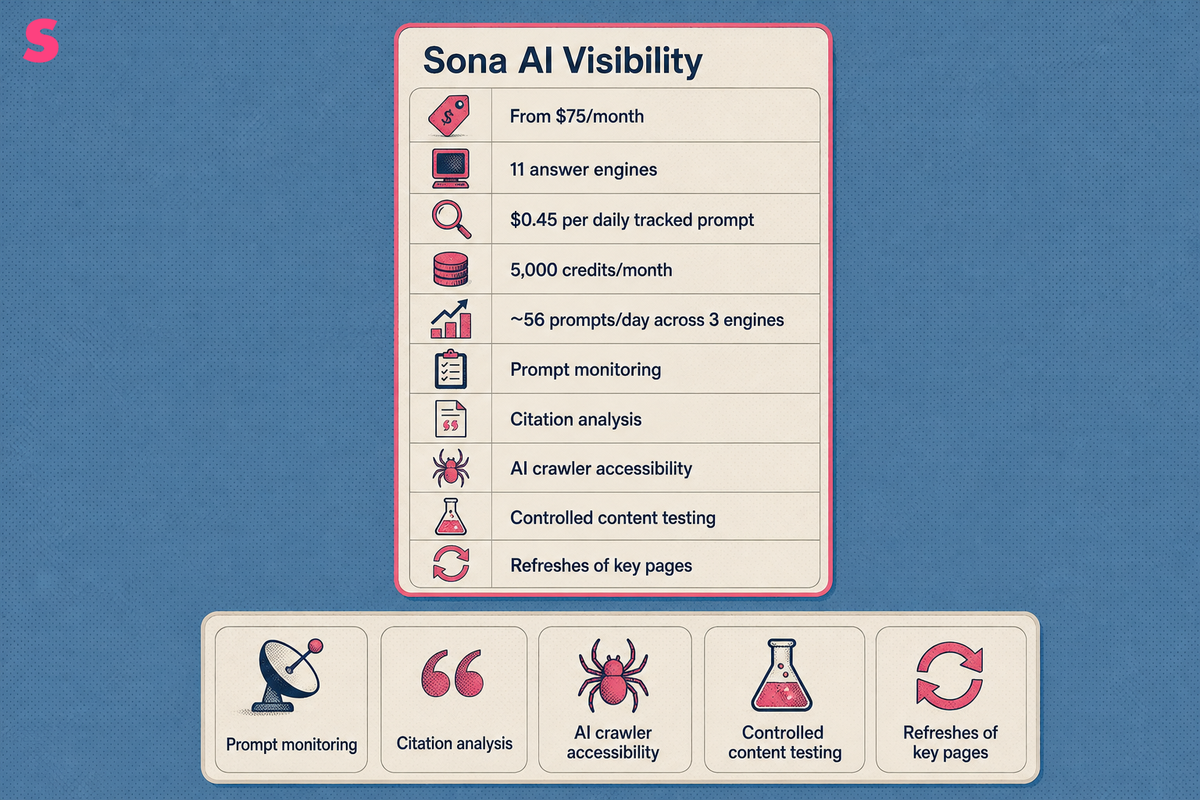
AI search optimization adds a measurement line before a content line. Budget for prompt monitoring, citation analysis, AI crawler accessibility, controlled content testing, and refreshes of commercially important pages.
Evaluate tracking tools by the same criteria: engine coverage, prompt limits, refresh frequency, citations, competitor context, and price. Tool data is not directly comparable when prompt sets, answer engines, collection methods, and sampling schedules differ. Use one fixed prompt set, then compare whether each tool supports the required operating rhythm.
Sona AI Visibility connects citations and AI-referred visits to pipeline and revenue on one account timeline, while also tracking AI crawler activity reaching site pages. Mention and competitor tracking across answer engines is the baseline. The budget question is whether reporting can support revenue decisions.
Sona AI Visibility pricing in October 2026 starts from $75/month and tracks 11 answer engines, at $0.45 per daily tracked prompt. The entry plan uses 5,000 credits per month, supporting about 56 prompts tracked daily across three engines. Treat pricing as one input, then test whether the plan supports the required prompt coverage and review process.
A survey published March 31, 2026 found that 58% of surveyed leaders prioritized LLM-friendly formats such as FAQ and Q&A content, while 56% prioritized refreshing existing content for AI summaries. Those activities should follow measurement because teams need evidence about which pages and prompts deserve investment.
What experiments should you run before committing a larger AI search budget?
Run a capped prompt-and-page experiment before committing a larger AI-search budget. Use a fixed prompt set, capture a baseline, change one variable at a time, and review results on a pre-agreed date.
- Select a limited set of commercial prompts connected to product pages, comparison pages, pricing pages, or category pages.
- Record baseline citations, mentions, answer position, AI referral traffic, and assisted conversions.
- Change one page element, such as a missing FAQ section, structured content, a dated refresh, or crawler access.
- Run the same prompt list daily and record results in a comparable log.
- Review the experiment against the fixed commercial metric, then either expand, revise, or stop it.
Daily tracking reveals changes that a weekly snapshot can obscure. An answer can shift because of a retrieval-index change, model update, or new competitor content. A persistent change warrants investigation, while a one-day spike does not.
AI search volatility calls for staged spending. Cap the experiment, preserve core SEO investment, and increase the budget only when the test produces a repeatable signal.
Which metrics show whether your AI search spending is working?
Measure AI-search spending with a chain of evidence: citation and mention share on a fixed prompt set, AI referral traffic, assisted conversions, branded demand, and sales-qualified opportunities. Visibility is an intermediate metric, not the final business result.
Keep the prompt set stable during the review period. Separate informational prompts from commercial and transactional prompts, then report citation share by intent. A rising citation count on low-value questions does not justify the same budget decision as stronger presence on prompts that precede demos or product evaluation.
Use Sona AI Visibility where the team needs to connect AI-referred visits to accounts, pipeline, and closed-won revenue. AI Attribution connects AI search activity to account timelines and captures self-reported attribution that click-level analytics can miss.
- Leading indicators: citation share, mention share, source inclusion, crawler access, and AI referrals.
- Commercial indicators: assisted conversions, branded search demand, demo requests, and sales-qualified opportunities.
- Decision metric: pipeline contribution relative to the cost of the AI-search test.
Set ROI expectations around evidence quality first. Establish whether a defined AI-search activity changes commercial signals, then decide whether the budget merits expansion.
What does a successful budget shift look like, and how do you recover if it stalls?
A successful SEO budget shift preserves core search performance while producing a repeatable AI-search signal within the review window. The team should have a daily prompt log, a clear page-level work queue, measurable AI referrals, and a commercial metric for the next budget decision.
Monitoring which AI answers mention a brand is only half the job. Connecting those mentions to accounts, pipeline, and revenue completes the analysis, and Sona AI Visibility does so through AI-referred visit attribution and account timelines.
The common failure is cutting proven SEO work too early or funding content before measurement exists. Recover by rolling back the unproven allocation, restoring the protected SEO line, re-establishing the original baseline, and restarting with a smaller fixed prompt set.
Do not interpret a one-time score as proof of progress. A score is a dated snapshot. The useful operating record is a comparable series over time, paired with a severity-ranked fix for the page that moved. That record gives the team a concrete next action without promising a ranking outcome.
End the review window with one of three decisions: expand the test because commercial signals improved, revise the hypothesis because the signal was incomplete, or stop the work because it did not justify further spend. A disciplined stop decision protects the wider SEO budget.
What are the frequently asked questions about AI search budgets?
Should you cut your SEO budget to pay for AI search?
No. Start by trimming or pausing low-return SEO lines and protect work that earns qualified demand. Crawlability, authority, extractable content, and conversion measurement support Google search and AI answer engines, so removing them creates unnecessary risk.
Is AI search too volatile to justify a dedicated budget?
No. Volatility supports a small, capped, staged budget with a fixed prompt set and review window. Daily tracking shows whether a change persists, while a limited test prevents a short-lived answer fluctuation from driving a large spend commitment.
Does traditional SEO already cover AI search optimization?
Partly. Accessibility, crawlability, structured content, canonical tags, internal linking, and authority work carry into AI search. Measurement of AI answers, citations, crawler activity, AI referral traffic, and assisted conversions is the new cost line that prevents teams from paying twice for overlapping work.
How do you connect AI visibility to revenue?
Track AI referral traffic, assisted conversions, branded demand, and sales-qualified opportunities alongside citation share. This measurement chain judges a mention by pipeline contribution rather than its number of appearances in AI answers.
How reliable are the budget benchmarks published in vendor surveys?
Treat budget benchmarks as survey findings, not universal targets. Check the sample size, respondent profile, and publication date before applying a percentage. The March 31, 2026 survey cited here covered 300 enterprise leaders, which makes it useful context but not a default allocation for every business.
Who should own the AI search budget?
The SEO team should own AI-search execution, with analytics or revenue operations sharing responsibility for measurement. A survey published August 14, 2026 found that SEO teams led AI-search optimization for 77% of respondents. Shared measurement responsibility connects citation reporting to conversion and pipeline data.
Summarize this article with AI: ChatGPT · Claude · Perplexity · Google AI Mode
Last updated: October 2026







