


Buying intent signals are visible actions, including repeat pricing-page visits, comparison searches and demo requests, indicating an account is seriously evaluating a purchase, not merely browsing. One action can be misleading, so dependable scoring blends recurring, recent, multi-person activity with a confident account match. Timing is critical: signals decline in value as they age, meaning every type requires an owner, an action and a response window defined before it triggers.
What are buying intent signals, and how do they differ from intent data and general engagement?
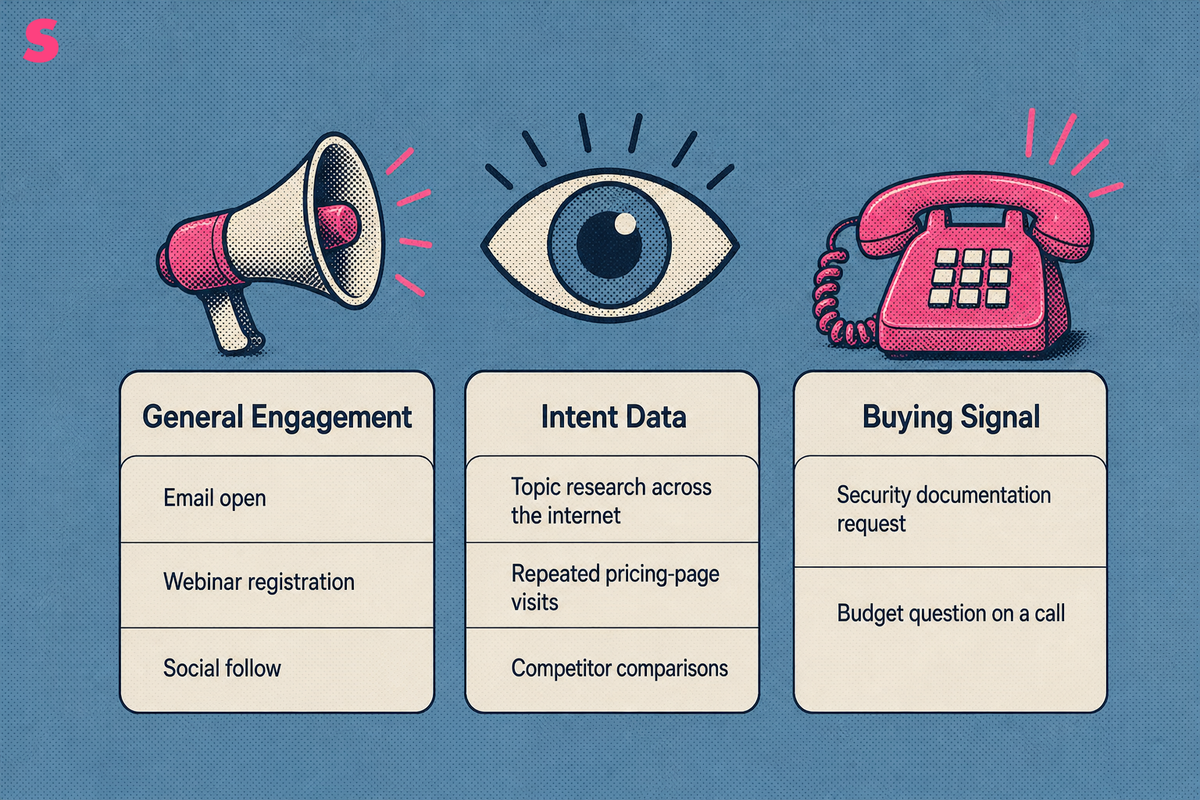
Buying intent signals are observable actions or statements that indicate an account may be moving toward a purchase. They help revenue teams separate broad interest from active evaluation and decide which accounts need attention now.
Intent data shows that people at an account are researching a topic across the internet. A buying signal sits closer to a purchase decision, such as repeated pricing-page visits, competitor comparisons, a request for security documentation, or a budget question during a call.
General engagement is different. An email open, webinar registration, social follow, or single ebook download can indicate awareness. Those actions become more meaningful when they recur, involve several people at one account, or appear alongside evaluation behavior. Verbal signals provide direct evidence when a buyer asks about pricing, implementation, contract terms, or a required feature.
Why do buying intent signals matter to a B2B sales or marketing team?
Buying intent signals matter because sales and marketing teams have finite rep time, ad budget, and account coverage. The practical question is not whether an account knows your category. It is whether the account merits a tailored message, sales outreach, retargeting budget, or executive attention.
An unnamed industry source updated in October 2026 reported that 91% of B2B marketers use intent data to prioritize accounts, while only 24% report exceptional ROI. The gap is execution: collecting activity is straightforward, but turning it into timely, relevant action is harder.
The buyer-intent data and signal-capture market reached an estimated $15.2 billion in 2026, up from $9.4 billion in 2023, per an unnamed industry estimate published in August 2026. For go-to-market teams, the baseline outcome is a defensible order of operations: contact accounts showing active evaluation before accounts showing only broad category interest.
What are first-party, second-party and third-party intent signals, and how reliable is each?
First-party activity is the most direct evidence near a purchase because it occurs on your properties or in your sales process. Second-party activity comes from a known external property, such as a review site or publisher. Third-party topic research helps with earlier discovery, but it can reflect general education rather than an active vendor search.
| Signal type | Source | Reliability near purchase | Identity confidence | Time to act |
|---|---|---|---|---|
| First-party | Website, product, forms, sales calls, events | High when actions repeat or involve evaluation pages | High for known contacts, mixed for anonymous visits | Immediate for high-intent activity |
| Second-party | Review sites, publisher properties, partner activity | Moderate to high when activity concerns comparisons or pricing | Moderate, based on the provider’s matching method | Prompt action after corroboration |
| Third-party | Topic-consumption networks and research behavior | Moderate for category discovery | Account-level confidence varies by match quality | Use for account selection and nurture |
| Verbal | Calls, emails, meetings, chat | High when the buyer discusses budget, timing, or requirements | High because the speaker is known | Immediate owner follow-up |
Third-party research can identify accounts entering a category. Near purchase, first-party behavior should carry more weight because it shows engagement with your product, pricing, proof, and implementation requirements.
Which early signals appear before a prospect contacts sales?
Early purchase signals appear across channels before a prospect submits a demo form. The strongest patterns combine repeated evaluation behavior, account change, and content consumption rather than relying on one anonymous page view.
- Website behavior: A visitor returns to pricing, product, integration, security, comparison, or customer-story pages across several sessions.
- Search and content: An account reads a category guide, then a vendor-comparison page, then implementation material.
- Review activity: A buyer views category pages, product profiles, competitor comparisons, or pricing information on a review property.
- Email and events: Several contacts from the same company engage with a webinar, follow-up resource, product email, or event meeting.
- Company activity: The business is hiring, expanding, restructuring, or opening a new operating unit that creates a purchasing need.
- Champion movement: A former customer changes employers and begins researching the category at the new company.
- Community and product-led activity: A prospect asks implementation questions, invites teammates, or repeatedly uses a product area associated with evaluation.
- Verbal evidence: A buyer asks about procurement, pricing, a required feature, contract terms, or a planned decision date.
A demo request, consultation booking, or direct pricing inquiry is a late signal. Earlier evidence gives marketing and sales time to shape the evaluation before the account narrows its shortlist.
How do signals map to awareness, active consideration, vendor comparison and purchase readiness?
Buying-stage mapping turns scattered activity into an operating decision. Topic research indicates interest, while stage-specific evidence shows how far an account has progressed toward selecting and purchasing a solution.
| Buying stage | Observable evidence | What it indicates | Recommended response |
|---|---|---|---|
| Awareness | Category searches, educational content reads, early event engagement | The account recognizes a problem or is learning the category | Provide educational content and build account familiarity |
| Active consideration | Repeat product-page visits, integration research, detailed use-case content | The account is evaluating possible approaches | Offer role-specific proof and relevant use cases |
| Vendor comparison | Comparison pages, review-site comparisons, competitor research, security content | The account is narrowing a shortlist | Equip the account team with differentiation and validation material |
| Purchase readiness | Pricing research, procurement questions, demo requests, budget discussions | The buying group is preparing to make a decision | Assign a clear owner and remove decision friction |
Sona AI Visibility can attach a likely prompt to an AI-referred visit and place that activity within a buying-stage model. That matters when a buyer researches a category through ChatGPT, Perplexity, Gemini, Claude, and other answer engines before visiting a site.
How do you combine weak signals into an account-level intent score?
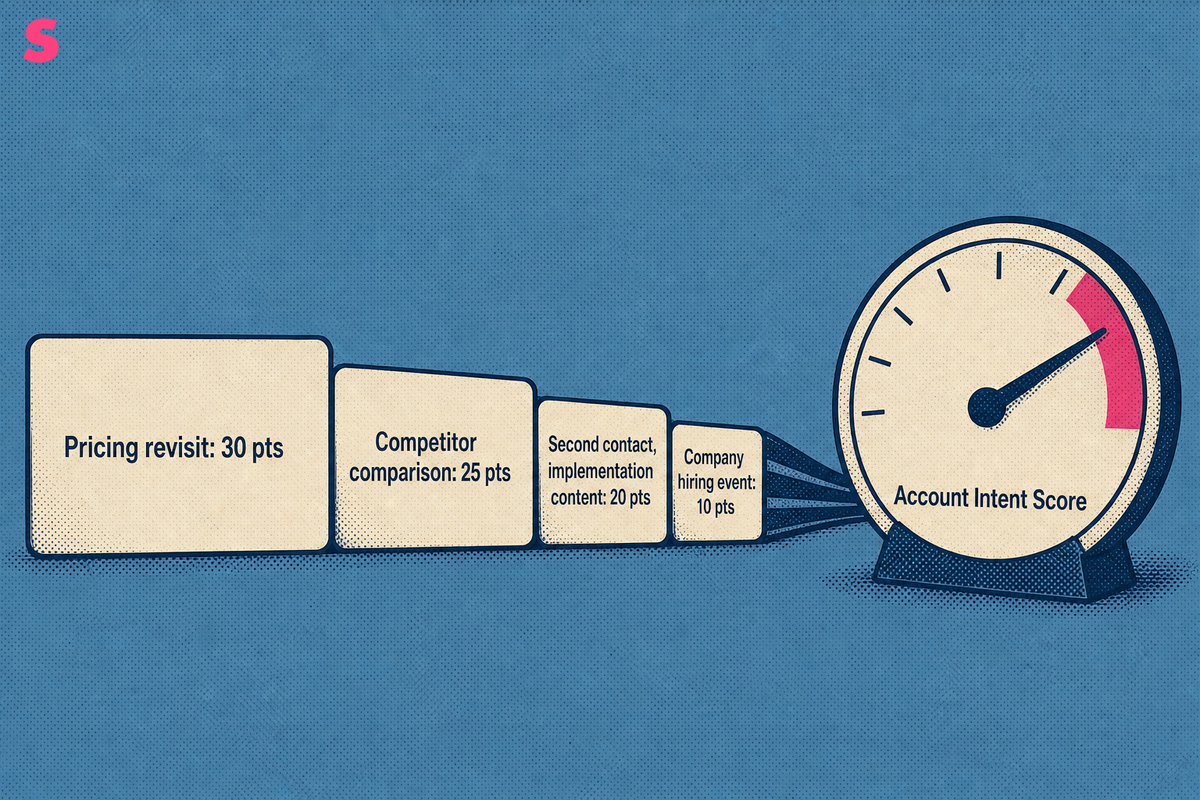
An account-level intent score should combine multiple weak observations rather than promote one page view into a sales alert. A transparent model weights evidence by source quality, recency, repetition, stage proximity, and identity confidence.
- Weight source quality: Give direct sales conversations and known first-party activity more weight than broad third-party topic research.
- Weight recency: Raise the value of a pricing revisit yesterday and reduce the value of an unrelated content read from weeks ago.
- Weight repetition: Treat a pattern of product, comparison, and pricing visits differently from one isolated session.
- Weight stage proximity: Give procurement questions more weight than introductory category research.
- Weight identity confidence: Separate a confirmed contact from an account match inferred through network data.
For an illustrative score, an account could receive 30 points for a recent pricing revisit, 25 for a competitor comparison, 20 for a second known contact consuming implementation content, and 10 for a relevant company hiring event. A single anonymous blog visit receives little weight. The point is evidence combination, not a universal formula.
Contact-level intent describes one known person. Person-level intent ties activity to an individual identity. Account-level intent rolls activity into the buying group, which matters because B2B evaluation rarely rests with one visitor. Sona AI Visibility can connect AI-referred activity to an account timeline, helping teams assess buying-group movement rather than isolated clicks.
When should a team act on a purchase signal before it decays?
A team should act before a signal loses relevance, reserving the shortest response window for clear evaluation behavior. Signal value decays because a buyer can complete research, choose another vendor, change priorities, or move from active evaluation into a dormant period.
Different evidence decays at different speeds. A demo request, pricing revisit, or procurement question is perishable. A hiring event, expansion, or executive change persists longer, but still requires periodic reassessment. Scores should include a decay term that reduces the value of older activity unless fresh evidence renews it.
| Signal tier | Example evidence | Owner | Example response window | Outcome to measure |
|---|---|---|---|---|
| Immediate | Demo request, pricing question, procurement discussion | Account executive | Same business day | Meeting held or next step agreed |
| High | Repeated pricing and comparison research by multiple contacts | Sales development and account executive | Within 1 business day | Qualified conversation created |
| Developing | Product research, integration reads, review-site activity | Demand generation | Within 3 business days | Further evaluation activity |
| Contextual | Hiring, expansion, restructuring, champion movement | Account-based marketing | Within 10 business days | Relevant account engagement |
These response windows are illustrative examples that each team should calibrate against its sales cycle. Consider an account where two contacts review pricing and a competitor comparison on Monday. Relevant outreach on Tuesday can address evaluation criteria. The same outreach two weeks later may reach an account that has already completed its shortlist.
Sona AI Visibility supports this timing model by reconstructing the likely question behind an AI-referred visit and updating an account score as new signals arrive. A team that runs the same prompt list daily can distinguish a four-day change from a one-day spike that a weekly snapshot would average away.
How accurate is buyer intent data, and where does it break down?
Buyer-intent data is directionally useful, not a factual declaration that an account will buy. Accuracy breaks down when anonymous visitor matching, topic inference, or score construction overstates confidence.
Anonymous identification can misidentify companies because IP resolution is affected by remote work, VPNs, shared networks, mobile networks, and privacy controls. A company match is weaker than a confirmed contact identity. Teams should use identity confidence as an input and favor repeated patterns across several visits.
Third-party research has a different boundary. Reading about a category can reflect purchase preparation, but it can also reflect professional education, competitor research, student work, or a future project. Score comparisons also fail across platforms because vendors use different data sources, baselines, lookback windows, and identity methods.
Ask every provider to explain the score inputs, decay rules, identity method, and account-matching confidence. Collect only the data necessary for the stated sales and marketing purpose, provide clear notice where required, and align activation with consent and internal data-governance policies.
What should a buyer-intent tool detect, score and activate, and what does it cost?
A buyer-intent tool should detect first-party activity, resolve identity with stated confidence, explain its scoring logic, account for decay, and activate qualified audiences in systems already used by sales and marketing. A score without evidence, timing, and activation creates another dashboard rather than an operating system.
- Detect repeat evaluation behavior across web, product, forms, calls, events, and relevant external properties.
- Show the evidence behind each account score, including timestamps and identity confidence.
- Roll several contacts into a buying-group view while retaining contact-level detail.
- Send qualified accounts into CRM records, ad audiences, alerts, and email programs with accountable owners.
Sona AI Visibility connects AI-referred visits to accounts, pipeline, and revenue, while Intent Signals reconstructs the likely question behind an AI-referred visit and assigns an account score from 0 to 100. Per Sona product documentation read in October 2026, the product rolls buying-committee activity into one account score and supports activation through Slack alerts, CRM sync, and live ad audiences.
As of October 2026, intent platforms typically cost $5,000–$15,000 per month, per an unnamed industry pricing listing. An entry plan at the low end is listed at $85 per month for up to 100 accounts, per an October 2026 listing, while some platforms use free-to-start models that increase with advanced features. For enterprise buying, reported ranges include $12,000–$40,000 for one topic-data provider and $60,000–$300,000+ for a predictive platform, per Sona, October 2026.
Small teams should begin with first-party behavior and clear owner rules. Mid-market teams benefit from account scoring, CRM activation, and buying-group views. Enterprise teams need stronger identity resolution, governance, and a documented scoring model. Monitoring which AI answers mention a brand is only half the job. Sona AI Visibility closes the loop by connecting those mentions to accounts, pipeline, and revenue.
What are the frequently asked questions?
What is the difference between buying intent signals and intent data?
Intent data shows which topics an account is researching. Buying intent signals show readiness through evidence such as pricing research, competitor comparisons, budget questions, and demo requests. Signals sit closer to a purchase decision and require faster action.
Are first-party buying intent signals more reliable than third-party signals?
Near purchase, first-party actions are stronger because repeat pricing-page visits or product evaluation occur on your properties. Third-party topic research can reflect general education, but it remains useful for finding accounts before they visit your site.
How many buying intent signals does an account need before it counts as in-market?
There is no fixed number. Require repeated, recent, relevant activity, ideally from more than one person at the account. Calibrate the threshold against your own opportunity creation, pipeline progression, and closed-won results.
How long does a buying intent signal stay useful?
Useful life depends on the signal type. A demo request or pricing revisit loses value quickly, while a hiring or growth signal remains relevant longer. Build a decay term into the score and establish a response window for each tier.
Can a small team use buying intent signals without a six-figure budget?
Yes. Start with repeat visits to pricing and comparison pages, sales conversations, and known account activity. As of October 2026, some tools offer free-to-start models or plans below $100 per month. The business case depends on consistent workflow adoption.
Is anonymous visitor identification accurate enough to act on?
Anonymous visitor identification is imperfect. IP and cookie matching can misidentify companies, especially with remote work, VPNs, and mobile networks. Treat identity confidence as one scoring input and favor patterns across several visits over a single company match.
Summarize this article with AI: ChatGPT · Claude · Perplexity · Google AI Mode
Last updated: October 2026







