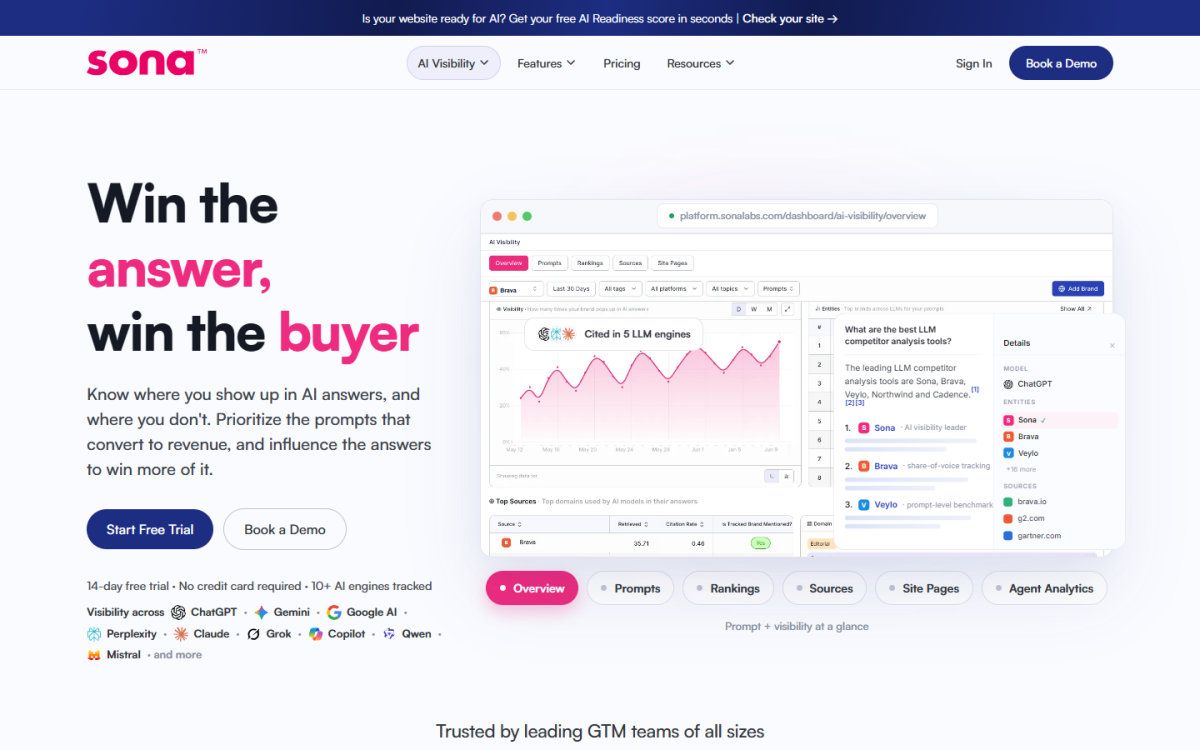
Community engagement can influence brand mentions in LLMs through third-party evidence: real conversations, reviews and creator content on Reddit, YouTube and review platforms provide models with recurring, independent signals when identifying brands. The data indicates correlation rather than confirmed causation, so outcomes require a tracked set of prompts before and after each initiative. Sona AI Visibility connects prompts and citations to pipeline and revenue, while showing AI crawler and agent activity along that same journey.
What is the difference between an LLM brand mention, a citation, a recommendation and sentiment?
Community engagement affects brand mentions in LLMs when useful, repeated participation in third-party communities increases the evidence associating a brand with a category or use case. A brand mention is the brand name in an answer. A citation is a source attached to that answer.
A recommendation presents a brand as suitable for a stated need. Sentiment describes the framing around the brand, such as positive, neutral, comparative, or critical. These signals overlap, but they are not interchangeable.
For example, an answer to “best project management software for agencies” might name a vendor in a comparison, cite a community discussion about agency workflows, and recommend the vendor for teams that need client reporting. The vendor has a mention, the discussion has a citation, and the recommendation carries positive sentiment.
Community engagement should not be judged by name recognition alone. The May 2026 Victorious study tested 177 brands across eight AI platforms, including ChatGPT, Perplexity, Gemini, Google AI Overviews, Claude, and Meta AI, per searchenginejournal.com. Only 18 of 177 brands recorded an AI mention rate above zero in Q1 2026, per searchenginejournal.com.
LLM visibility differs from traditional SEO rank tracking. Traditional SEO measures rankings and clicks. LLM visibility measures mention frequency, cited-source context, sentiment, and competitive presence in generated answers. A named brand without a recommendation is visible, but has not earned preference.
How does community engagement influence brand mentions in ChatGPT, Gemini and Perplexity?
Community engagement can influence LLM brand mentions when discussions, reviews, videos, and reference material repeatedly associate a brand with a category or use case. ChatGPT, Gemini, Perplexity, and other answer engines draw from different source patterns, so third-party references create more relevant material for their answers.
Training-time exposure and retrieval-time sourcing are different mechanisms. A model can produce an uncited brand mention from learned associations, while a retrieval-enabled answer can select current sources and expose those sources as citations. Community activity may therefore affect an answer through durable associations, current retrieval results, or both mechanisms.
The mechanism is practical. A subject-matter expert answers a detailed implementation question in a forum, a customer describes the product in a review thread, and a creator demonstrates a workflow on YouTube. Those sources connect the brand with buyer language, use cases, and product context.
Community and social content can amplify brand visibility in AI search results. Reputable media coverage, review sites, and community discussions are also sources from which LLMs gather training data for brand mentions, per linkedin.com.
Source weighting should assess topical relevance, independent authority, corroboration across sources, specificity, freshness, accessibility, and commercial bias. Earned editorial coverage can provide independent authority, reviews can provide product-specific experience, community posts can provide current practitioner detail, reference sources can reinforce category and entity consistency, and owned documentation can provide precise product evidence but carries commercial bias. A mention becomes more useful evidence when independent sources corroborate a specific, accessible claim.
The relationship is correlational, not guaranteed. Frequent posts with little substance do not establish reliable evidence of product fit. A useful answer that explains a problem, acknowledges trade-offs, and remains available for later discussion creates more durable context.
Marketing leaders should measure whether recurring community evidence changes mention rates for a fixed set of commercial prompts. That requires a baseline, consistent prompt wording, and measurement by answer engine.
Which community sources and engagement types are linked to more LLM brand mentions?
Community sources that combine practical discussion, independent validation, and clear product context are most relevant to LLM brand mentions. Reddit, Wikipedia, and YouTube appeared frequently among sources used by ChatGPT and Gemini in a June 2026 analysis updated in October 2026.
The strongest engagement serves the community before the brand. It includes technical explanations, implementation examples, customer problem-solving, and transparent comparisons. Sustained, relevant participation creates stronger evidence than promotional repetition.
| Community source | Useful engagement type | Brand signal created | Measurement to track |
|---|---|---|---|
| Disclosed answers to specific practitioner questions | Category relevance and real-user discussion | Mentions, citations, sentiment | |
| YouTube | Workflow demonstrations and product comparisons | Use-case evidence and recurring brand context | Source citations and recommendation rate |
| Review communities | Customer feedback with concrete use cases | Independent validation and sentiment | Positive, neutral, and critical framing |
| Reference sources | Accurate category and terminology coverage | Conceptual relevance and entity consistency | Source-domain share and brand association |
YouTube is especially notable in the available research. An analysis of 75,000 brands found YouTube mentions correlated more strongly with AI brand visibility than any other measured metric, per businesswire.com, May 2026. The report drew on 13 studies, including 146 million search-result pages and 730,000 AI responses, per businesswire.com, May 2026.
Correlation does not establish that publishing a video causes more mentions. It does indicate that teams should inspect source patterns rather than assume blog publishing alone will influence LLM answers.
What does documented evidence show about community engagement and LLM mentions?
No approved documented intervention currently shows that a specific community action caused a measured gain in real LLM outputs. Available studies link broad community presence with AI visibility, but they are correlational and do not provide an action date, fixed query set, pre-action and post-action mention rates, control series, and confounder analysis.
A May 2026 study of 177 brands found that 89.8% of tested brands were largely absent from AI search across eight measured platforms, per searchenginejournal.com. The finding shows how concentrated visible presence remains, but does not isolate a community action as the cause.
Another analysis found that brand mentions correlated three times more strongly with AI visibility than traditional backlinks, with correlation values of 0.664 and 0.218, respectively, in a study of more than 75,000 domains. The finding supports a measurement model that includes off-site discussion, not backlinks alone.
A B2B SaaS team can run a monitored pre/post observation, rather than claim causal proof. Log the community action, date, affected source, fixed prompt set, engines, markets, competitors, and repeated runs before and after publication. Track model updates, retrieval-index changes, seasonality, competitor activity, and unrelated coverage as confounders.
To support causal inference, run matched untreated prompts or markets as a simultaneous control series. A gain attributable to community activity is the change in the treated series relative to the control series, not simply a higher post-action mention rate.
Community engagement belongs in an evidence portfolio alongside product documentation, review coverage, technical accessibility, and direct buyer research. No single source type establishes durable LLM visibility.
Why do recurring brand references in communities count for more than one-off mentions?
Recurring brand references matter because they create patterns across trusted sources, matching contexts, and consistent reviews. A one-off mention is an isolated data point. Repeated references associate a brand with a recognisable category and use case.
LLMs recommend brands encountered frequently in trusted sources with consistent positive reviews and matching context. One-off mentions do not drive LLM visibility, while sustained visibility across trusted platforms creates a more coherent pattern, per linkedin.com.
Consider a B2B analytics platform mentioned once in a broad software list. That reference gives an answer engine little basis for associating the platform with a specific buyer need. If the same platform appears in RevOps discussions, implementation videos, buyer reviews, and category comparisons, the association becomes more specific.
The value is not raw volume. Ten copied comments create less useful evidence than three independent discussions describing distinct workflows. Repetition must remain credible, contextual, and distributed across sources with different audiences.
Recurring references also make measurement more stable. A brand that appears in 80% of responses to one prompt set has a materially different visibility profile from a brand that appears in 20%. The objective is to increase that probability through sustained, relevant evidence rather than a burst of promotional activity.
Do community sources affect visibility differently across AI engines?
Community sources affect visibility differently across AI engines because each answer engine retrieves, cites, and formats evidence differently. A source pattern that appears often in ChatGPT responses can play a different role in Gemini, Perplexity, Claude, and other answer engines.
A June 2026 analysis, updated October 2026, found that ChatGPT cited an average of 15 sources per response, while Gemini cited an average of 3 sources per response. The same analysis found frequent use of community and reference sources, including Reddit, Wikipedia, and YouTube, in ChatGPT and Gemini responses.
Training-time exposure can support an uncited mention based on learned associations. Retrieval-time sourcing can select newer, accessible evidence and display that evidence as a citation. Earned editorial coverage, reviews, community discussions, reference sources, and owned documentation can each contribute, but their value depends on topical relevance, independence, corroboration, specificity, freshness, accessibility, and commercial bias.
That citation difference has an operational consequence. A brand should not treat one engine’s source mix as a proxy for every engine. Measure the same commercial prompt across each engine, then record which sources appear, whether the brand is named, and how the answer frames the brand.
Google AI Overviews should be measured separately from conversational answer engines. Google AI Overviews are a Google Search feature, while ChatGPT, Perplexity, Gemini, Claude, and other answer engines produce AI answers through their own retrieval and model behaviour.
Source diversity reduces dependence on a single community. A balanced programme can include expert discussion, review evidence, videos, reference material, and owned pages that clearly explain the product. The goal is repeated relevance across the sources each engine uses.
How can a B2B SaaS company engage communities without astroturfing or breaking platform rules?
A B2B SaaS company can engage communities ethically by identifying employees, contributing expertise, and answering questions that remain useful even when the company is not selected. Astroturfing, undisclosed incentives, and copied endorsements weaken trust and can violate platform rules.
Use a simple engagement standard:
- Identify the employee’s relationship to the company where platform rules require disclosure.
- Answer the question directly before describing the product.
- Use concrete implementation detail, not vague claims of superiority.
- Disclose incentives, partnerships, and customer relationships.
- Accept criticism and correct factual errors without manufacturing consensus.
Paid or incentivised reviews are a risk, not a visibility tactic. Undisclosed incentives can erode the third-party trust that makes review and community sources useful. LLMs look for consistent patterns across independent sources, not high volumes of praise.
A product leader answering a community question about attribution gaps in AI-referred traffic can explain the measurement problem, describe trade-offs among methods, disclose the employer relationship, and invite correction. The contribution remains useful even if readers select another platform.
Community engagement also happens off-platform in an LLM-first environment, where brands can be recommended, compared, or cited inside AI answers. Treat community work as a durable reputation programme, not a short-term distribution tactic.
How do you measure whether community activity changed your LLM visibility?
Measure community activity against a fixed prompt set, by answer engine and date, before and after documented engagement. Track mention rate, citation share, source domains, sentiment, recommendation rate, and competitor presence. A changing prompt list cannot show whether community engagement changed visibility.
A team that runs the same prompt list daily can identify changes that a weekly snapshot may obscure. Answer-engine responses shift with retrieval indexes, model updates, and new competitor content. Treat isolated changes cautiously until results remain consistent across repeated runs.
| Metric | Definition | Community question answered | Breakdown | Review cadence |
|---|---|---|---|---|
| Mention rate | Share of tracked answers that name the brand | Did the brand appear more often? | Prompt, engine, date | Daily |
| Citation share | Share of answers citing a relevant community source | Which sources support the answer? | Source domain, engine | Daily |
| Sentiment | Positive, neutral, comparative, or critical framing | How is the brand described? | Prompt, competitor set | Daily |
| Recommendation rate | Share of answers presenting the brand as a fit | Did recognition become preference? | Use case, engine | Daily |
A brand-level visibility score is a dated snapshot, not a work item. Sona AI Visibility connects citations to pipeline and revenue on one account timeline, while AI Search Insights shows tracked prompts, cited sources, and page performance so a team can identify the prompt and source behind a movement.
Review prompt results daily and community strategy quarterly. Maintain a log of changes by prompt, source, and engine rather than relying on a single score detached from the work required.
Which tools can monitor brand mentions, sentiment and competitor presence in LLM answers?
Sona AI Visibility, Profound, Peec AI, Otterly.ai, Scrunch AI, and PromptWatch can monitor brand mentions, sentiment, and competitor presence in LLM answers. Evaluate LLM visibility monitoring tools on prompt coverage, answer engines, tracking cadence, source context, and their ability to connect visibility with business outcomes. Most platforms track mentions and competitors. Sona AI Visibility connects citations and AI-referred visits to pipeline and revenue, while also tracking AI crawler activity.
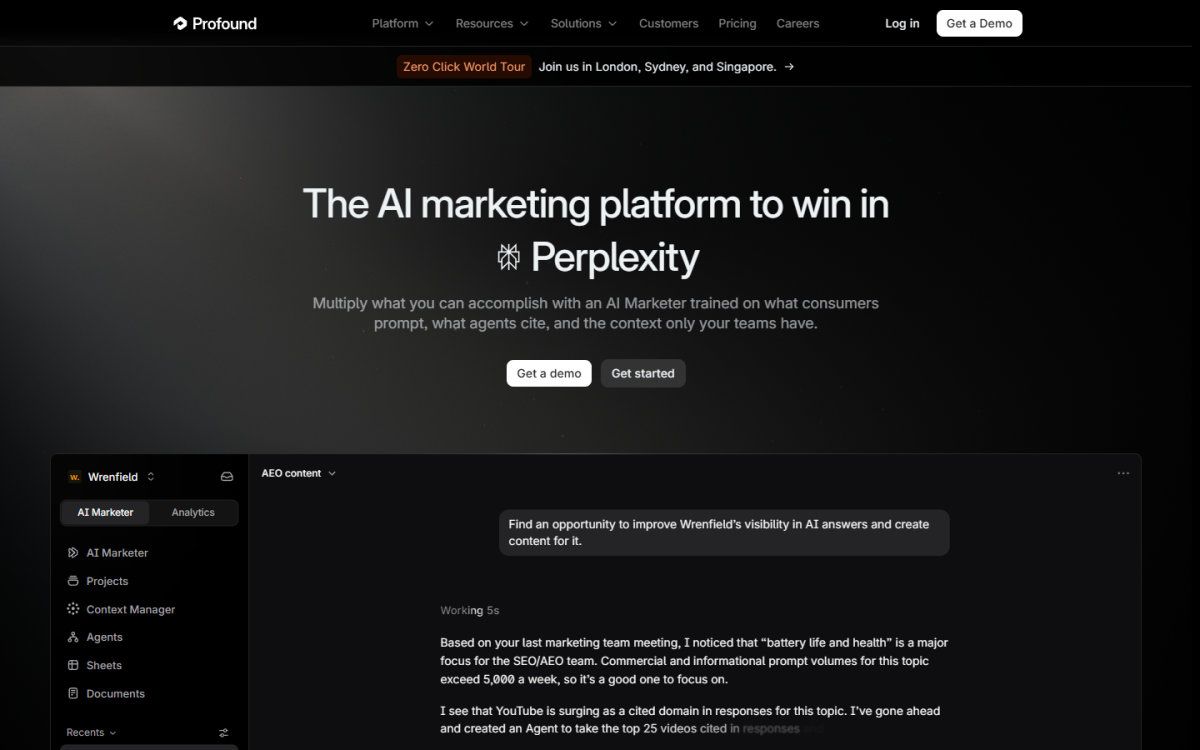
The comparison below lists published entry-plan details as of October 2026. Price alone is not a recommendation. Teams should determine whether they need mention monitoring, source analysis, agency management, attribution, or a combination of these requirements.
| Tool | Starting price | Agency Plans? (Yes/No) | # of Answer Engines Tracked | Answer Engines | # of Daily Tracked Prompts (entry plan) | Cost per Daily Tracked Prompt | Differentiation |
|---|---|---|---|---|---|---|---|
| Sona AI Visibility | From $75/month, billed annually | Yes | 3 | Not published | 5,000 credits/month, about 56 prompts tracked daily on 3 engines | $0.45 per daily tracked prompt | Connects AI citations and prompts to pipeline and revenue on one account timeline |
| Profound | Custom pricing | Yes | 3 | ChatGPT, Gemini, Google AI Overviews | 50 prompts daily during the 7-day trial | Cannot be calculated from custom pricing | AI visibility tracking across trial and enterprise plans |
| Peec AI | From $95/month | Yes | 3 | Not published | 50 prompts daily | $0.63 per daily tracked prompt | Prompt tracking across self-serve and agency plans |
| Otterly.ai | From $29/month | Yes | 4 | ChatGPT, Google AI Overviews, Perplexity, Microsoft Copilot | 15 prompts daily | $0.48 per daily tracked prompt | AI search monitoring for one domain on its Lite plan |
| Scrunch AI | From $250/month | Yes | 4 | ChatGPT, Perplexity, Google AIO, Copilot | 125 prompts, refresh cadence not published | No refresh cadence published | AI visibility tracking on Core and Enterprise plans |
| PromptWatch | From $95/month | Yes | Not published | Not published | 50 prompts; 6,000 responses/month | $0.48 per daily tracked prompt | Prompt and response tracking across monthly plans |
Sona’s listed brand plans start from $75 per month and agency plans start from $199 per month, with a 14-day free trial, as of October 2026. Published LLM visibility-tool entry prices ranged from $29 to $300 per month, while reviewed cost per daily tracked prompt ranged from $0.45 to $2.46, per sona.com, October 2026.
What are the frequently asked questions about community engagement impact on brand mentions in llms?
Does posting in Reddit communities make ChatGPT mention my brand?
Not on its own. Reddit is a community source that appears frequently in AI-answer source patterns, but no available study proves that posting alone causes brand mentions. Useful, disclosed participation improves the available evidence. Only a tracked prompt set can show whether the brand’s mention rate changed.
Is a brand mention the same as a citation in an AI answer?
No. A mention is the brand name in answer text, while a citation is a linked or listed source supporting the answer. The May 2026 study of 177 brands across eight AI platforms separated these signals, per searchenginejournal.com. A brand can be named without being cited, or cited without being recommended.
How long does it take for community engagement to show up in LLM answers?
No researched figure supports a fixed timeline. Retrieval-based answers can reflect new content sooner than training-based answers. Establish a baseline, rerun the same prompt set daily, and compare stable changes over time rather than expecting a predictable result from a single publication date.
Can paid or incentivized reviews improve my LLM visibility?
Treat paid or incentivized reviews as a risk, not a tactic. Incentivized or undisclosed reviews can break platform rules and erode the trust that makes third-party sources useful. Independent, consistent references across credible sources provide a more durable visibility signal.
Which metrics should I track to see community impact on AI visibility?
Track mention rate per prompt set, citation share, cited source domains, sentiment, and position against competitors, by engine and date. Keep prompts fixed and repeat runs because LLM outputs vary. A daily series helps distinguish persistent movement from a temporary answer change.
Are the studies on community sources and AI mentions reliable?
The studies are useful but vendor-led and correlational. Available research includes a 177-brand analysis across eight AI platforms, per searchenginejournal.com, May 2026, and a 75,000-brand analysis, per businesswire.com, May 2026. Independent replication is still needed, so no single study establishes causation.
Summarize this article with AI: ChatGPT · Claude · Perplexity · Google AI Mode
Last updated: October 2026