


To check brand visibility in ChatGPT, run a fixed set of buyer-intent prompts in fresh sessions, log every mention and citation, and repeat the test on a schedule; a single check tells you almost nothing. Most checkers stop at mention counts; Sona AI Visibility connects those AI citations and prompts to pipeline and revenue, and tracks the AI crawler activity that precedes them. Brands ChatGPT recommends are 2.5x more likely to get a visit within 7 days (Similarweb, June 2026).
What does brand visibility in ChatGPT actually mean?
Brand visibility in ChatGPT is the frequency and prominence with which ChatGPT names your brand, or links your domain, when people ask questions your product should answer. To check brand visibility in ChatGPT is therefore to measure two distinct things at once.
- A mention is your brand named in the answer text itself: "tools like X and Y handle this well."
- A citation is your domain linked as a source the answer drew from, whether or not the brand is named in the prose.
The two move independently. A brand can be mentioned constantly from the model's memory yet never cited, because retrieval never fetches its pages. A domain can be cited as evidence for a claim while the brand goes unnamed. Tracking one without the other misses half the picture.
ChatGPT visibility differs from traditional search visibility in kind, not degree. Google returns a ranked list, and position two still earns clicks. ChatGPT returns one synthesized answer that names a handful of brands and omits everyone else. There is no console reporting impressions, no rank to slip down gradually. You are in the answer or you are invisible, which is why measurement has to be deliberate rather than read off a dashboard someone else provides.
How does ChatGPT decide which brands to name in a response?
ChatGPT draws brand names from two supplies: training data and live retrieval. Training data is the parametric knowledge the model absorbed before release. Brands with broad, consistent coverage across the open web get named from memory, with no lookup at all. Live retrieval is different: when the model browses, it fetches current pages and can cite them as sources, so a recent comparison page can surface a brand the training data never learned.
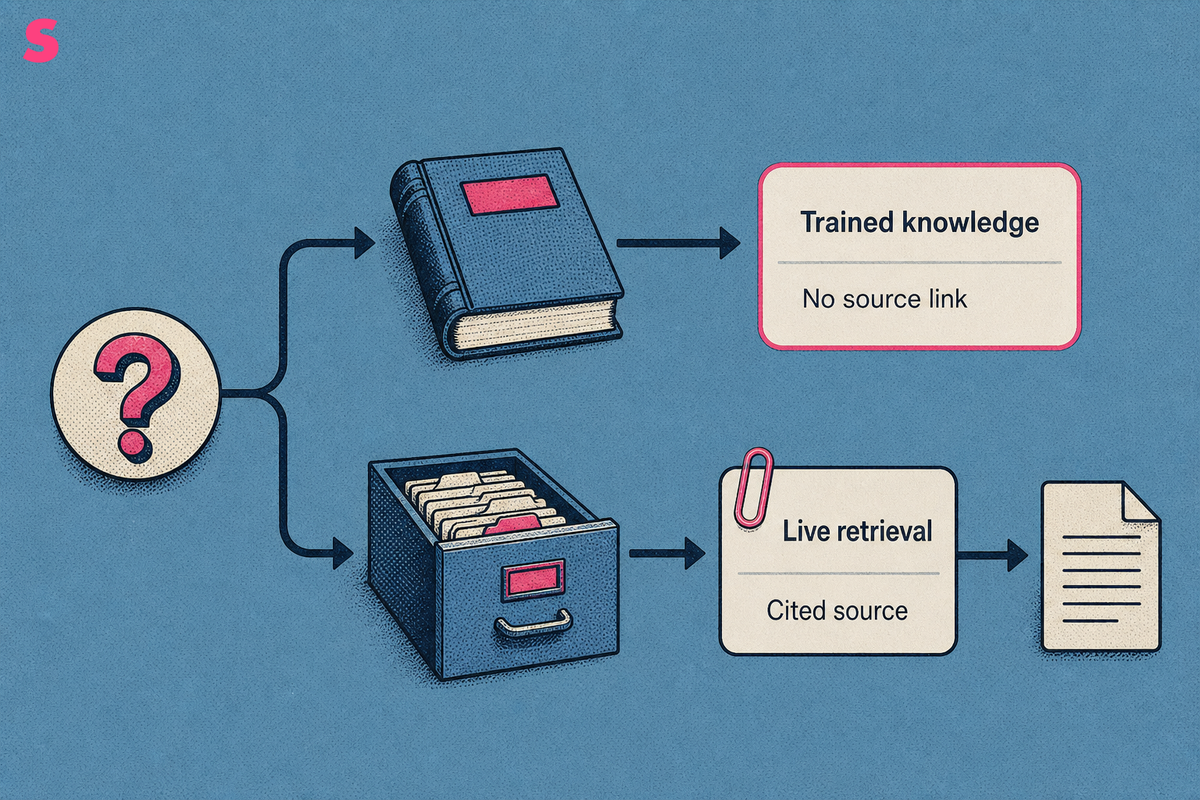
Which supply answers a given prompt changes which brands appear. A definitional question is often answered from memory. A "best tools for X this year" question is far more likely to trigger browsing, which means the brands named depend on which pages the retrieval layer fetched that day.
The same prompt surfaces different brands on different runs for three reasons. The model samples probabilistically, so identical inputs produce varied outputs. Retrieval pulls different sources on different days. And model or index updates move the baseline without notice.
One run is an observation. A series of runs is a measurement. Any checking method that ignores this variance will report noise as signal, in both directions.
How do you manually check whether your brand appears in ChatGPT?
Build a fixed prompt set from your services, run it in fresh ChatGPT sessions, and log how often the brand is mentioned. That is the whole method, and its value comes from repeating it identically.
- Write a prompt set from your services and buyer intents, broad enough to cover each core intent, split across informational, comparison and recommendation phrasings.
- Run each prompt in a fresh session with memory disabled, so prior chats cannot contaminate the answer.
- Log four things per response: brand mentioned yes or no, domain cited yes or no, position among the brands named, and which competitors appeared.
- Repeat the full set across multiple dates, recording each run's date.
- Compute mention rate per prompt: mentions divided by total runs.
Keeping the audit repeatable does not require publishing a full prompt-template methodology. It requires three disciplines: freeze the prompt list so month-over-month numbers compare like with like, store the verbatim answers rather than a summary of them, and note the model version at each run. When you add a prompt later, mark it as new rather than blending it into the historical rate.
The manual approach is free and honest. Its cost is time, which is exactly the constraint that determines when automated tracking earns its price.
Which metrics matter when you measure ChatGPT visibility?
A bottom-of-funnel buyer should prioritise two metrics first: mention rate on commercial and recommendation prompts, and citation rate for the domain. Everything else refines those two.
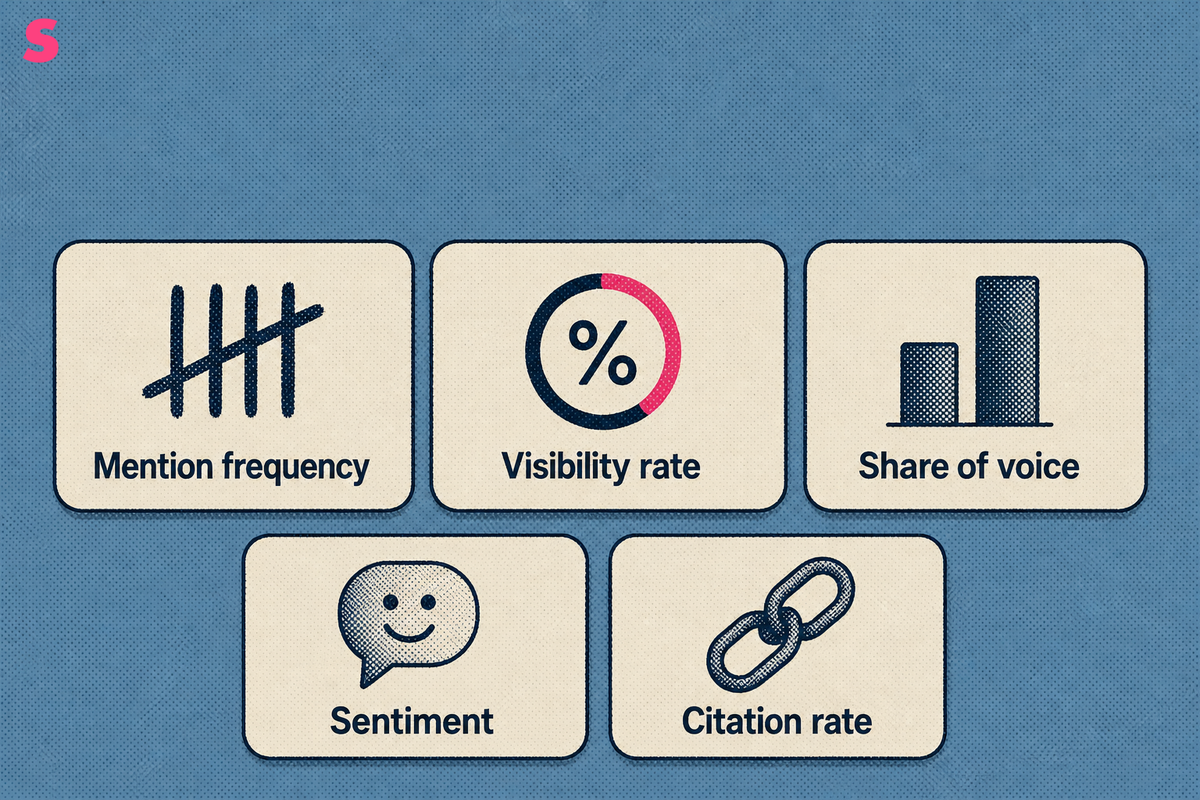
- Mention rate: the share of runs where the brand is named.
- Citation rate: the share of runs where the domain is linked as a source.
- Position: where the brand sits among the names in the answer.
- Sentiment: whether the framing is positive, neutral or negative.
- Share of voice: your mentions as a fraction of all brand mentions on the prompt.
- Competitor presence: who gets named when you do not.
Practitioner threads on reddit.com converge on the same three signals: which prompts surface the brand, which sources the LLM leans on when it mentions the brand, and how sentiment and context shift from one prompt to the next.
A single brand-level visibility score is a status report, not a work item. Knowing which specific prompts surface you, and which sources produce each citation, gives a team its work items: the prompt you lose is a content brief, and the source that never cites you is an outreach target. Sona's AI Search Insights operates at that level, tracking visibility and share of voice per prompt and per engine daily, alongside citation and source-authority tracking that shows which sites the engines cite and how often.
How often does ChatGPT mention brands versus cite them?
The honest answer is that the ratio is specific to your brand, your prompts and the date you measure, which is why the rate has to come from your own logged runs rather than a published benchmark. Score a mention when the brand appears in answer text and a citation when its domain appears as a linked source, then compute each rate separately by query type. Informational, comparison and recommendation prompts behave differently, so a blended figure hides the pattern that matters.
The gap between the two rates is the diagnostic, but read it carefully. A brand mentioned often yet cited rarely is consistent with two different causes: the model may know the name from training data, or retrieval may be fetching third-party pages that name the brand while never fetching the brand's own domain. Inspect the linked sources and the repeated answers before diagnosing anything; only then can you tell an awareness problem from a content and crawlability problem.
The reverse pattern, citations without mentions, means your pages are fetched as evidence while the brand goes unnamed in the synthesis. Comparison and recommendation prompts are the highest-leverage prompts to monitor first, because they are the prompts where a buyer is actively choosing between named options.
How reliable is manual checking compared with automated tracking?
Manual checking is reliable for direction and unreliable for precision. The three standard objections are all correct, and all three have the same fix.
Yes, ChatGPT visibility is volatile: the same prompt returns different brands across runs. Yes, manual checking is subjective, because a small change in phrasing shifts the answer. And yes, tool output is only as good as its prompt set and refresh cadence, so an automated tracker running a weak prompt list weekly automates the wrong measurement.
The fix in every case is sampling. Volatility stops being a problem when you measure a rate across sessions, dates and phrasings rather than reading a single answer. Phrasing sensitivity stops being a problem when each intent is tracked across several natural variants instead of one literal string.
Sampling is also why cadence matters more than most buyers assume. A change that persists across repeated daily runs is a trend; a one-day spike is not. A team that runs the same prompt list daily starts to see patterns a weekly snapshot would have averaged away, which is the practical dividing line between manual audits and automated tracking. Manual work supports weekly sampling at best. Daily resolution requires tooling.
Which tools can check your brand visibility in ChatGPT?
Free checkers exist that accept a brand name and report visibility across ChatGPT, Gemini, Perplexity and Copilot, and dedicated platforms add historical data, competitor tracking and the actual answer text. The options worth evaluating, starting with Sona AI Visibility, include Siftly, the Semrush AI Visibility Toolkit, the Ahrefs free checker and the Wellows free tracker.
| Tool | Starting price | Answer engines tracked | Tracked prompts (entry plan) | Cost per daily tracked prompt | Notable detail |
|---|---|---|---|---|---|
| Sona AI Visibility | Brands from $75/month, agencies from $199/month, both billed annually. 14-day free trial, no credit card | 11: ChatGPT, Gemini, Google AI Mode, Google AI Overviews and Perplexity on standard, plus Claude, DeepSeek, Grok, Copilot, Qwen and Mistral on premium | 5,000 credits/month on Starter 5K, about 166 prompts tracked daily on one model or 56 across three; 1 credit = 1 AI answer | $0.45 per prompt tracked daily | Connects citations to pipeline and revenue on one account timeline; tracks AI crawlers from server logs with no JavaScript tag |
| Siftly | Not published | 4 major AI engines, ChatGPT among them | Not published | Not published | Shows when ChatGPT mentions, cites or recommends a brand, and which competitors it names instead |
| Semrush AI Visibility Toolkit | From $99/month per domain, billed annually | 4 on the Base plan: ChatGPT, Google AI, Gemini and Perplexity, of which 3 LLMs of the buyer's choice are tracked | 25 custom prompts with daily AI rankings | $1.32 per prompt tracked daily | Domain-level Visibility Overview, sold per domain separately from the main Semrush subscription |
| Ahrefs free checker | Free checker | 4: ChatGPT, Gemini, Perplexity and Copilot | Not published | Not published | Accepts a brand name and returns a visibility read with no tracking setup |
| Wellows free tracker | Free tracker | 1 named: ChatGPT | 40 intent-driven queries generated from a domain | Not published | Builds its query set automatically from the domain you enter |
Judge any tool on two things: whether its prompt set matches your buyer intents, and whether its refresh cadence gives you a comparable series rather than a dated snapshot.
Does ChatGPT visibility actually drive traffic and pipeline?
A brand recommended in a ChatGPT answer is positioned to earn the visit that follows, but much of that value arrives disguised. A buyer who researched in ChatGPT and then typed your URL lands in analytics as direct traffic, with no keyword and no recognisable referral source. The mention happened, the visit happened, and the connection between them vanished.
The objection is still fair as stated: a mention count proves nothing about revenue on its own.
Most mention trackers stop at counts, which is exactly where the objection bites. Sona AI Visibility closes that gap by resolving the accounts and contacts behind AI-referred visits without cookies, and connecting citations to pipeline and revenue on one account timeline.
That changes the job the measurement does. A mention rate justifies a content decision. A citation tied to a named account, a deal and a closed-won number justifies a budget line, which is the standard a marketing leader will hold this channel against sooner or later.
How do you monitor ChatGPT visibility over time and across AI platforms?
Monitor with a fixed prompt set, run daily, logged historically, across more engines than ChatGPT alone. Different engines genuinely disagree, so a single ChatGPT score does not generalize: Gemini, Perplexity and Claude each retrieve from different sources and name different brands on identical prompts. Sona's own archive illustrates the spread: it counts eight answer surfaces, covering ChatGPT, Perplexity, Google AI Mode, Gemini, Mistral, Qwen, Claude and Google AI Overviews (Sona's own AI visibility data, August 2026).
Run two clocks. The prompt list runs daily, because a weekly sample cannot separate a real move from retrieval noise. The review runs monthly or quarterly: benchmarking against competitors, reading sentiment shifts, and comparing regions where your buyers differ. Keep every run, because the deliverable is the comparable series, not any single score.
Regional comparison needs its own benchmark to be valid. Maintain a fixed prompt set for each target region and language, and record region alongside engine, model and date on every run. Hold the other variables constant: change only the region under test, never the phrasing and the region at once, and never blend runs from different regions into one score. Benchmark each region separately first; only then do regional trends compare cleanly.
Four foundations raise mention probability across every engine and deserve standing attention without a program of their own: technical hygiene, meaning server-rendered HTML and a robots.txt that admits AI crawlers; a content strategy that answers commercial and comparison prompts on your own pages; UX, meaning accessible, navigable pages whose important answer content is readable without logins, popups or other blocked interactions, because an engine can only extract what it can reach and parse; and coverage on the third-party sources engines already cite.
Treat the channel like any other. Sona AI Visibility reports AI search with spend, deals and ROAS alongside every other channel, so the monitoring feeds the same revenue reporting the rest of marketing already produces each quarter.
Frequently Asked Questions
Can I check my brand visibility in ChatGPT for free?
Yes. Run a fixed prompt set manually in fresh ChatGPT sessions and log mentions, which costs only time. Free checker tools also exist that accept a brand name and report visibility across ChatGPT, Gemini, Perplexity and Copilot. A free check returns a snapshot; reading a trend requires repeating it.
How many prompts do I need to measure ChatGPT visibility reliably?
Enough to cover your core buyer intents across informational, comparison and recommendation phrasings, repeated across sessions and dates. A single prompt run is a snapshot, not a measurement, because responses vary between sessions. The rate across repeated runs is the number worth reporting, not any individual answer.
What is the difference between a mention and a citation in ChatGPT?
A mention names your brand in the answer text. A citation links your domain as a source the answer drew from. The two move independently: a brand can be mentioned from training data while its pages are never cited, so track both rates separately.
How often should I re-check my ChatGPT visibility?
Weekly for active programs, monthly at minimum for manual audits, while automated trackers run the prompt list daily. Model updates and retrieval changes shift results without notice, so the trend across checks matters more than any single result.
Does appearing in ChatGPT answers translate into website traffic?
Often, but analytics rarely labels it. A buyer who researched in ChatGPT and then typed the URL registers as direct traffic, with no keyword and no recognisable referral source, so the lift is real even where standard reports cannot attribute it.
Can I tell which ChatGPT prompts brought a visitor to my site?
Rarely from referrer data alone, which almost never carries the prompt. Sona AI Visibility infers the likely prompt behind an AI-referred visit and scores the account on intent, so sales sees which question brought the account in and how close it is to buying.
Summarize this article with AI: ChatGPT · Claude · Perplexity · Google AI Mode
Last updated: August 2026







