


Which buyer intent vendors also include sales enrichment out of the box?
The strongest vendors pair intent data with account and contact enrichment, giving teams firmographics, technographics, buyer details, and workflow-ready records in one system. ZoomInfo’s 2026 guide to 15 buyer intent data platforms profiles 15 platforms, which underscores how crowded the category is and why enrichment depth and activation readiness matter in evaluation.
For the full strategic overview, see our guide on buyer intent data providers.
How do intent plus enrichment vendors operationalize signals inside sales workflows?
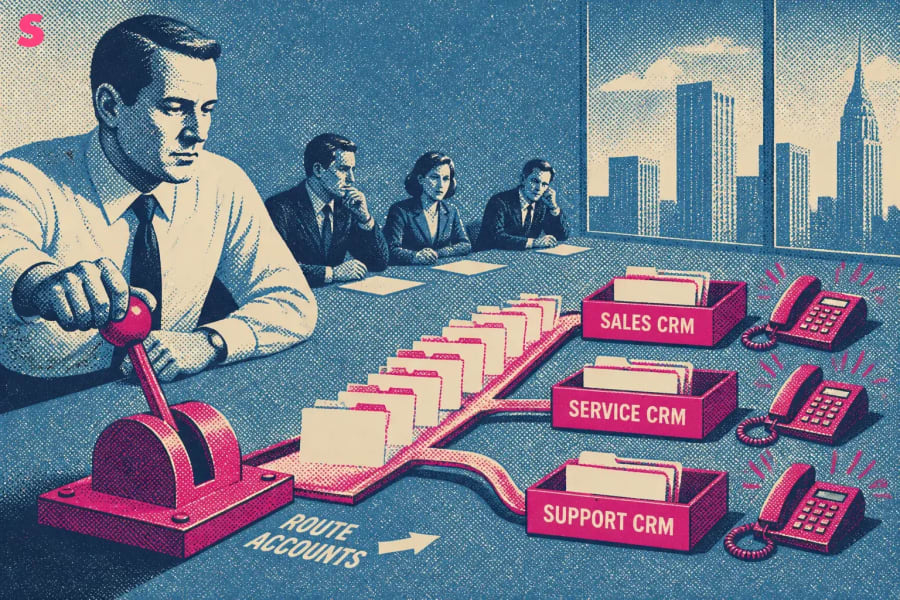
The best platforms push enriched accounts into routing, alerts, prioritization, sequences, and CRM workflows instead of leaving signals in a dashboard. HubSpot’s buyer intent workflow documentation shows this directly by letting teams add and enrich companies inside the CRM itself.
Key workflow patterns to look for:
- Sequence triggers when an account crosses an intent threshold
- Account routing to AE or BDR based on ICP, territory, or segment
- Real-time alerts for surging accounts and repeat high-value visits
- Lead and account scoring that combines fit, intent, and recency through Scoring
- CRM and MAP syncing into downstream tools and Destinations
- Workflow automation that removes CSV exports and manual handoffs through Workflows
This is the difference between collecting data and creating pipeline. Reps move faster when the platform decides who to route, what to enrich, and when to trigger outreach.
What should buyers compare when evaluating buyer intent vendors that overlap with sales intelligence databases?

Buyers should compare six things first: coverage, accuracy, recency, integrations, compliance, and pricing transparency. G2 lists 36 buyer intent data providers with free or trial options, so side-by-side testing is practical.
- Coverage: Measure account, contact, region, and industry coverage against your ICP, not a vendor’s headline database size.
- Accuracy: Ask how records are verified, how intent false positives are reduced, and how bad data is suppressed.
- Recency: Check how quickly contact changes, company updates, and intent spikes appear in the system.
- Integrations: Confirm native syncs with CRM, MAP, warehouse, sales engagement, ad platforms, and attribution systems such as Attribution.
- Compliance: Review GDPR and CCPA posture, consent handling, suppression logic, and auditability.
- Pricing model: Inspect seat limits, credits, record caps, activation fees, overages, and total platform cost. Compare that against long-term ROI and pricing structure.
A strong framework stops buyers from paying for records they cannot activate or measure.
How do vendors differ in the types of intent signals they combine with enrichment data?
Vendors differ mainly in whether they rely on first-party behavior, third-party co-op data, publisher networks, review-site activity, predictive modeling, or combinations of those sources. Demandbase explains that intent-based tools span behavioral, third-party, and account-based signal types, and that difference shapes signal quality and explainability.
The main signal categories are:
- First-party website and product activity: High-confidence engagement from your owned properties
- Third-party publisher and research co-op intent: Broader market coverage, but less direct journey context
- Review-site and comparison activity: Commercial research signals tied to active evaluation
- Technographic change signals: New tools, stack changes, and platform adoption patterns
- Hiring, funding, and trigger-event signals: External buying triggers that indicate timing
- Buyer-journey and committee-level engagement signals: Multi-touch engagement across accounts, buyers, and stages
The strongest systems connect these signals to Intent Signals and map them into visible Buyer Journeys, so sales sees not just that an account surged, but why.
When does integrated intent plus enrichment outperform standalone intent or standalone enrichment tools?
Integrated platforms outperform point tools when speed-to-action matters, especially for prioritizing accounts, enriching records instantly, and launching outbound or ad activation without manual handoffs. nRich describes using advanced data filters including sales trigger events, firmographics, technographics, and buyer intent, which shows why combined datasets produce tighter targeting.
The clearest use cases are:
- Prioritizing in-market ICP accounts for SDR outreach
- Enriching anonymous traffic into named account opportunities
- Triggering sequences when buying activity spikes
- Suppressing low-fit intent noise before reps spend time on it
- Syncing high-intent audiences into paid and sales channels with Audiences
- Connecting engagement to revenue impact through outbound programs such as Outbound Smart Prospecting
This is also where the content gap shows up. If your best-fit buyers never reach your site, or your key pages fail to capture the topics buyers research before they convert, even strong enrichment only operationalizes partial demand.
Is an all-in-one intent and enrichment platform better than stitching together point solutions?

An all-in-one platform is usually better for operational speed and measurement, while point solutions are stronger when a team needs best-in-class depth in one narrow area and has RevOps resources to connect everything. Default’s 2026 review of 15 B2B intent data providers frames the market as a choice between broader platforms and specialized tools.
For teams focused on unified measurement and action, an all-in-one system such as the Sona platform overview creates cleaner workflows and more reliable attribution. For teams with heavy RevOps support and narrow specialization needs, a stitched stack still fits.
What questions should you ask vendors about integrations, compliance, and real-world fit?
Buyers should ask vendors to prove how intent and enrichment data flow into CRM, MAP, sales engagement, and reporting systems, and how they validate quality, permissions, and compliance. Cognism’s 2026 provider comparison treats data quality, integrations, and compliance as practical buying criteria rather than bonus features.
Use this checklist:
- Which CRMs, MAPs, and sales engagement tools have native sync?
- Is enrichment account-level, contact-level, or both?
- How often are records refreshed?
- How are duplicate records, routing conflicts, and scoring conflicts handled?
- What evidence supports GDPR and CCPA compliance?
- Can the platform expose first-party journey context, not just a topic surge?
- How does pricing scale with seats, records, and activation use cases?
Ask vendors to show the workflow live in your environment or in a mirrored setup using their integrations and docs. Before you invest in more signal sources, use Sona’s free AI Visibility Checker to verify whether the content and buyer-journey pages powering your first-party intent capture are visible to AI answer engines. If AI systems cannot discover those pages, your first-party signal strategy starts with a coverage gap before enrichment ever begins.
Frequently asked questions
What is a buyer intent vendor with sales enrichment?
A buyer intent vendor with sales enrichment combines in-market signals with account, company, and contact data so revenue teams can identify, qualify, and route opportunities faster. The core value is operational readiness, not just signal collection.
Which features matter most in intent plus enrichment platforms?
The most important features are firmographics, technographics, contact data, CRM sync, scoring, routing, alerts, and workflow activation. Teams should also look for buyer-journey visibility and attribution so they can connect signals to revenue outcomes.
Is buyer intent data enough without enrichment?
No for most sales workflows. Intent without enrichment creates manual work because reps still need account context, contact records, and routing logic before they can act.
How is intent plus enrichment different from a sales intelligence database?
A sales intelligence database tells you who a company is. Intent plus enrichment also tells you whether that company is showing buying behavior now and whether the account fits your ICP.
What compliance questions should buyers ask?
Ask about data sourcing, verification, refresh cadence, GDPR and CCPA controls, suppression logic, and whether consent and audit processes are documented. Buyers should also confirm how the platform handles duplicates, permissions, and data retention.
Should we choose an all-in-one platform or separate intent and enrichment tools?
Choose all-in-one if speed, activation, and unified measurement matter most. Choose point solutions if you have specialized needs and strong RevOps support to integrate them.
Last updated: June 2026







