


Bizible, now known as Adobe Marketo Measure, is an enterprise revenue attribution platform, but teams seek alternatives for CRM flexibility, pricing clarity, or simpler implementation. Its pricing is customized and varies with database size and contracted features, so compare total costs instead of list price. Shortlist tools that support your CRM, buying-group identity matching, and lengthy B2B sales cycles, then test every attribution model against your own closed-won data before migrating. One option to include in that test is Sona Marketing Measurement, which connects every channel, AI search included, to accounts, pipeline and revenue on one identity graph.
TL;DR. Bizible is now Adobe Marketo Measure, an enterprise attribution platform with no published price. Attribution-capable alternatives vary by CRM, activation and pricing model. Sona Marketing Measurement is relevant for B2B teams measuring AI search alongside account identity, pipeline and revenue.
What is Bizible, and what does Adobe Marketo Measure do?
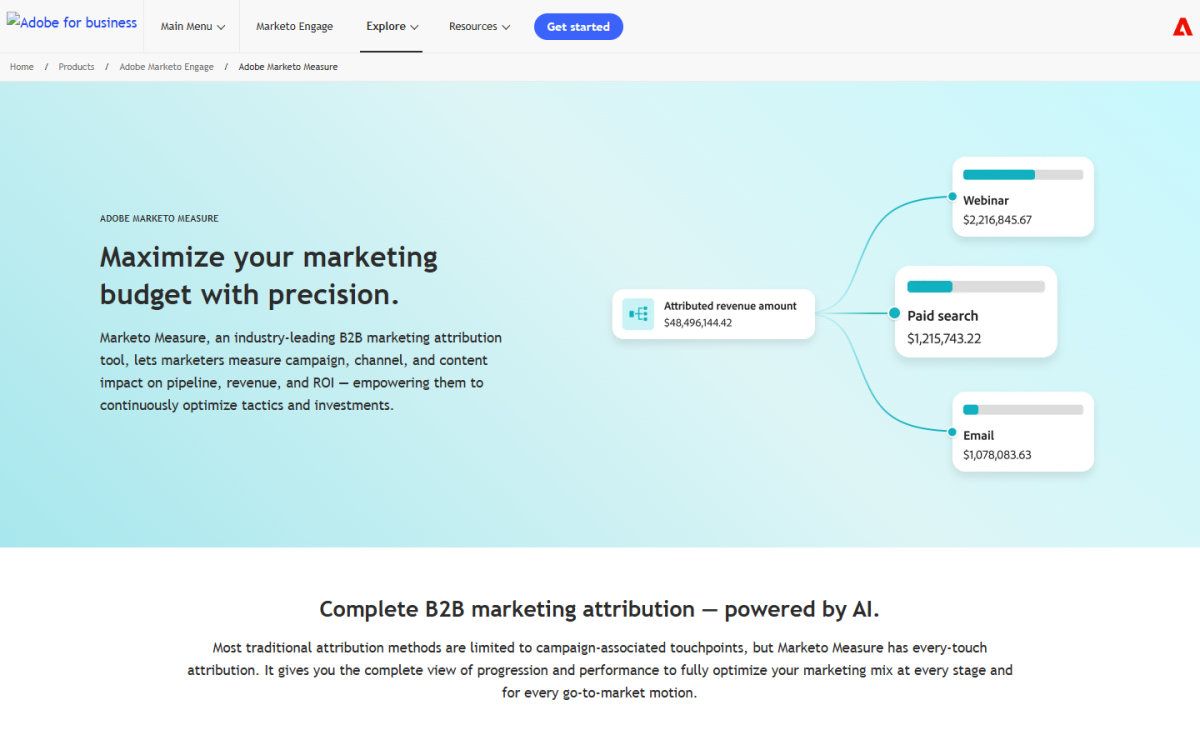
Bizible is the former name of Adobe Marketo Measure, an enterprise revenue attribution platform that tracks touchpoints across the marketing funnel and measures campaign, channel and content impact on pipeline, revenue and ROI. Searches for Marketo Bizible, Bizible Marketo and the misspelling Bizable refer to the same product.
Adobe Marketo Measure records marketing interactions as touchpoint data in Salesforce. Its data model includes Buyer Touchpoint, Buyer Attribution Touchpoints and Buyer User Touchpoints, which connect campaign activity with lead, opportunity and revenue records.
Marketers access Adobe Marketo Measure reporting in Salesforce by opening a report built on Buyer Touchpoint or Buyer Attribution Touchpoint data. Use Buyer Touchpoint records to examine the marketing interactions associated with people, accounts and campaigns. Use Buyer Attribution Touchpoint records when the analysis requires attributed revenue credit tied to opportunities.
In Salesforce, filter the report by campaign, date range or opportunity stage, then group results by channel, campaign or opportunity. Compare the revenue-credit fields for pipeline opportunities and Closed Won opportunities to identify which campaigns influenced opportunity creation and recognized revenue. Adobe Marketo Engage provides the marketing automation pairing for teams that want campaign execution and attribution within the same broader stack.
How do Bizible attribution models split revenue credit?
Adobe Marketo Measure begins each attribution calculation with 100% of revenue credit, then divides that credit across touchpoint records under a selected model. Six models are documented: First Touch, Lead Creation, U-Shaped, W-Shaped, Full Path and Custom.
U-Shaped assigns 50% to First Touch and 50% to Lead Creation. W-Shaped assigns 30% each to First Touch, Lead Creation and Opportunity Creation, while intermediary touches share the remaining 10%.
Full Path assigns 22.5% each to First Touch, Lead Creation, Opportunity Creation and Closed Won. Intermediary touches share the remaining 10%. The Custom model lets revenue teams define their own credit-allocation rules.
Why do B2B teams look for Bizible alternatives?
B2B teams look for alternatives when their CRM architecture, reporting needs or measurement scope no longer fit an Adobe-centered attribution deployment. The decision often reflects operating model and migration risk rather than dissatisfaction with Marketo Measure.
- Model structure. Six documented attribution models, including U-Shaped, W-Shaped, Full Path and Custom, are available.
- Credit allocation. The W-Shaped model allocates 30% each to First Touch, Lead Creation and Opportunity Creation, with 10% shared among intermediary touches.
- Enterprise pricing. Adobe Marketo Measure uses custom enterprise pricing that scales with database size and contracted features, with no public list price as of November 2026.
- CRM architecture. Marketo Measure is closely connected to Salesforce workflows, which matters for teams standardizing on HubSpot, Pipedrive or Odoo.
- AI search measurement. Teams that must report pipeline from AI search may need attribution built around that channel rather than an Adobe stack; Sona Marketing Measurement connects every channel, AI search included, to accounts, pipeline and revenue on one identity graph.
AI search changes the attribution question because buyers can research in ChatGPT, Perplexity, Claude, Gemini, Copilot and Google AI Overviews before visiting a website. When those buyers later search for a brand or enter a URL directly, click-based reporting can classify the visit as direct traffic rather than earlier AI influence.
How do the best Bizible alternatives compare on CRM, integrations and starting price?
The strongest alternatives differ most in CRM workflow, ad-platform activation and pricing transparency. The table compares confirmed integrations, attribution-capable pricing and entry-plan pricing as of November 2026 rather than treating every attribution platform as interchangeable.
| Tool | Best for | CRM integrations | Ad-platform integrations | Attribution-capable plan as of November 2026 | Lowest available plan, not necessarily attribution-capable |
|---|---|---|---|---|---|
| Sona Marketing Measurement | B2B teams connecting AI search, account identity and revenue measurement | HubSpot and Salesforce data and audience sync | Google Ads, LinkedIn Ads, Meta Ads, Microsoft Ads and ChatGPT Ads through Conversions API | Enterprise custom pricing | Growth $599/month billed annually, or $749/month billed monthly. Growth does not include cross-channel attribution. |
| Dreamdata | B2B SaaS revenue attribution and activation | HubSpot and Salesforce | LinkedIn, Google, Meta, Microsoft and OpenAI Ads | Advanced custom pricing | Free $0/month. The Free plan is not the attribution and activation plan. |
| HockeyStack | Product-led growth SaaS measurement | HubSpot and Salesforce | Conversion and attribution data sent to ad platforms | Custom pricing | Custom pricing |
| Factors.ai | Account-based marketing and intent programs | HubSpot and Salesforce | LinkedIn Ads, Google Ads and Meta Ads | Advanced attribution add-on, no published price | Lite $199/month. Lite does not state a price for advanced attribution. |
| Rockerbox | Cross-channel paid media measurement | Contact sales | Contact sales | Custom pricing | Custom pricing |
| Ruler Analytics | Offline conversions, calls and CRM revenue matching | HubSpot and Salesforce | Google Ads and Microsoft Ads | Small £299/month | Small £299/month |
| CaliberMind | ABM measurement and engagement scoring | HubSpot and Salesforce | LinkedIn Ads, Google Ads and Meta Ads | Custom pricing | Custom pricing |
| Wicked Reports | Multi-touch reporting for smaller revenue teams | API, Zapier and webhooks | Google Ads, Meta and Microsoft Ads | Measure $499/month | Measure $499/month |
Sona Marketing Measurement treats AI search as a native channel in the same identity graph as paid, content, email and sales. It resolves anonymous and known activity into account and contact profiles, weights attribution by stage transition, and can send first-party conversion events back to ad platforms.
What are the 8 best Bizible alternatives for B2B teams?
Sona Marketing Measurement: best for B2B teams measuring AI search and revenue
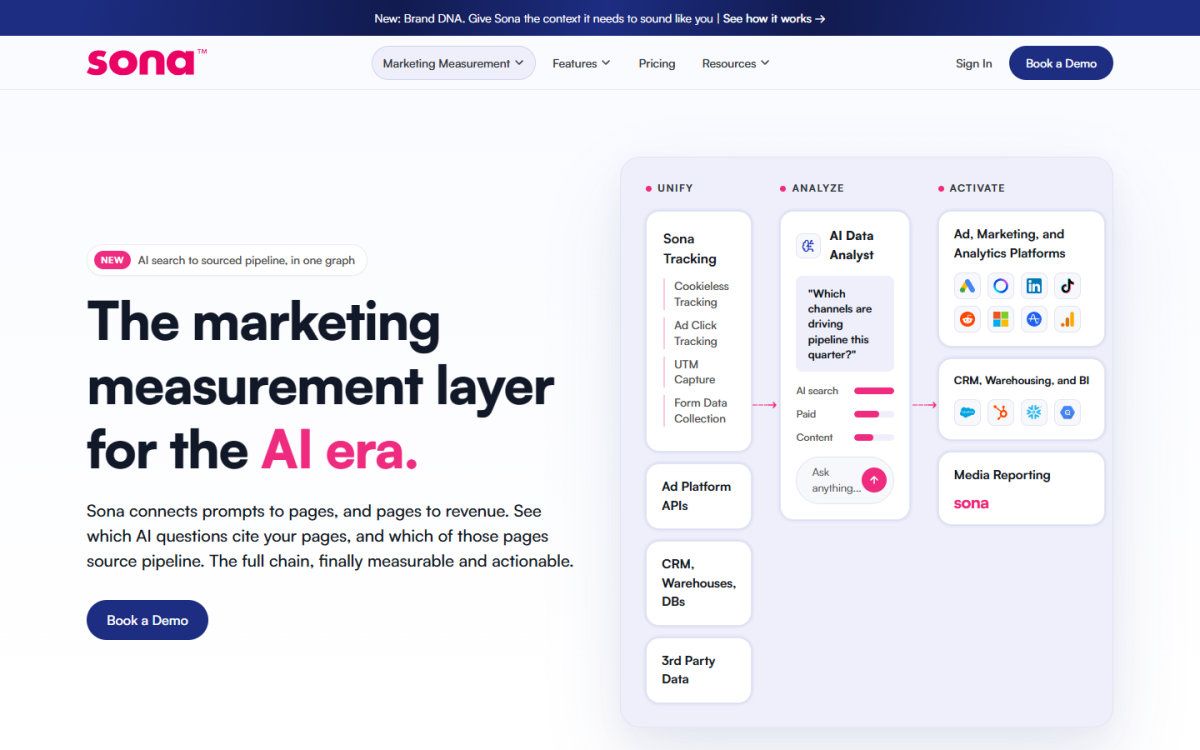
Sona Marketing Measurement serves B2B teams on Salesforce or HubSpot that want multi-touch attribution tied to revenue without adopting the Adobe stack. Its Enterprise tier includes cross-channel attribution, incrementality testing and warehouse sync, while Growth includes identity resolution, buyer journeys, intent activation and audiences.
Growth costs $599/month billed annually, or $749/month billed monthly, as of November 2026. Growth does not include cross-channel attribution. Enterprise uses custom pricing for cross-channel attribution. Moving requires connecting CRM and ad-platform data, installing one lightweight script and defining account, intent and workflow rules. Most teams are fully live within a week.
Dreamdata: best for B2B SaaS account-level revenue attribution
Dreamdata serves B2B SaaS teams that want attribution and activation across customer journeys connected to HubSpot or Salesforce. It also syncs conversion and pipeline data to LinkedIn, Google, Meta, Microsoft and OpenAI Ads.
Dreamdata offers a Free plan at $0/month for five seats and two months of user history, while Advanced attribution and activation uses custom pricing as of November 2026. The Free plan is an entry plan, not the attribution and activation plan. Migration requires CRM connection, touchpoint mapping and conversion definitions.
HockeyStack: best for product-led growth SaaS teams
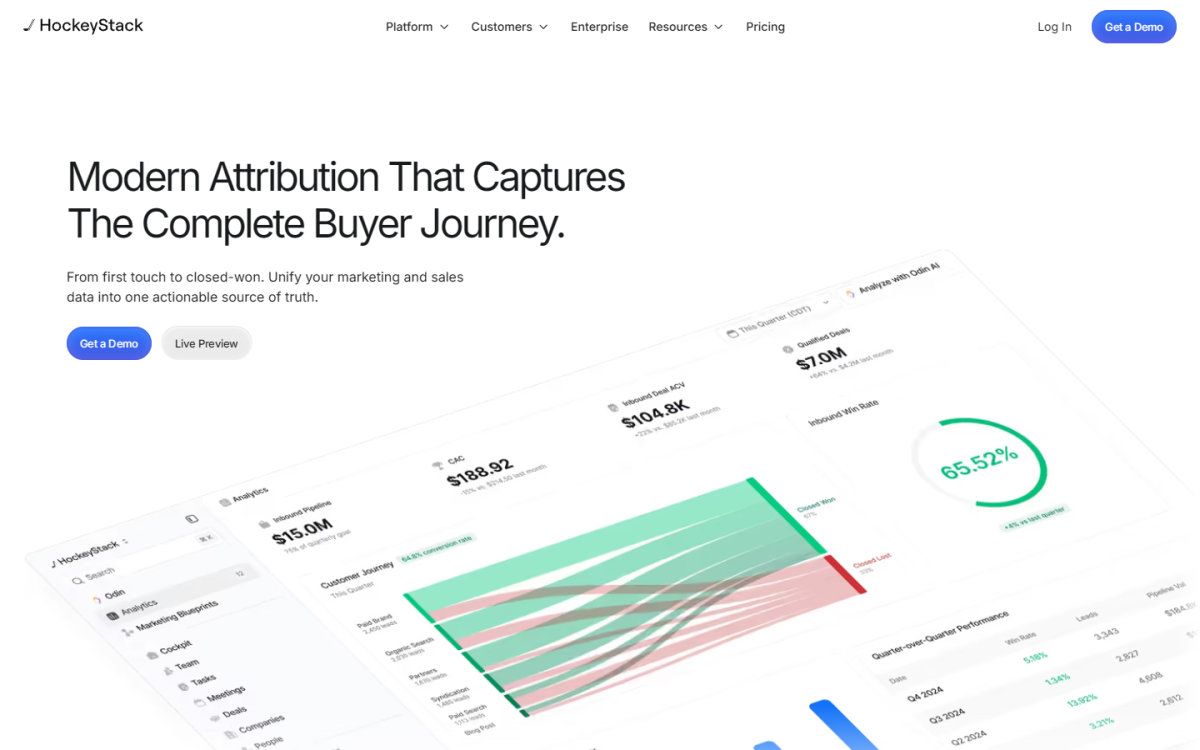
HockeyStack suits product-led growth SaaS teams that combine marketing activity with product usage and CRM data. It lists HubSpot and Salesforce integrations, supports two-way CRM syncing and sends conversion and attribution data back to ad platforms.
HockeyStack uses custom pricing and a demo-led sales process as of November 2026. It fits organizations where product events are central to the buyer journey and attribution model. Moving requires product-event instrumentation, CRM connection and agreement on the milestones that define meaningful product engagement.
Factors.ai: best for account-based programs using intent signals
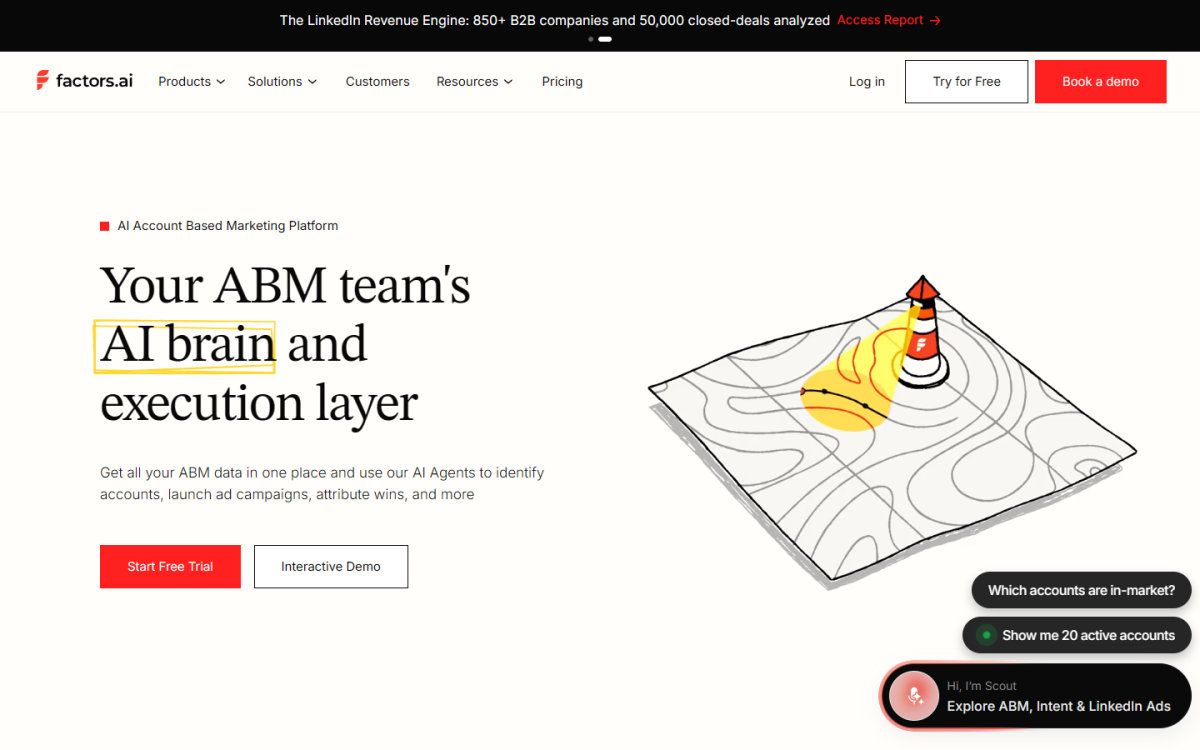
Factors.ai supports account-based programs that need account-level journeys, intent signals and advertising activation. It ingests data from HubSpot and Salesforce, connects LinkedIn Ads, Google Ads and Meta Ads, and sends conversions to LinkedIn and Google Ads.
Lite costs $199/month after a free trial, while Basic costs $6,000 a year, as of November 2026. Growth and Enterprise use custom pricing, and advanced attribution is sold as an add-on with no published price. Moving requires CRM data ingestion, account-matching rules and conversion-event configuration for the advertising platforms in use.
Rockerbox: best for teams with broad paid-media portfolios
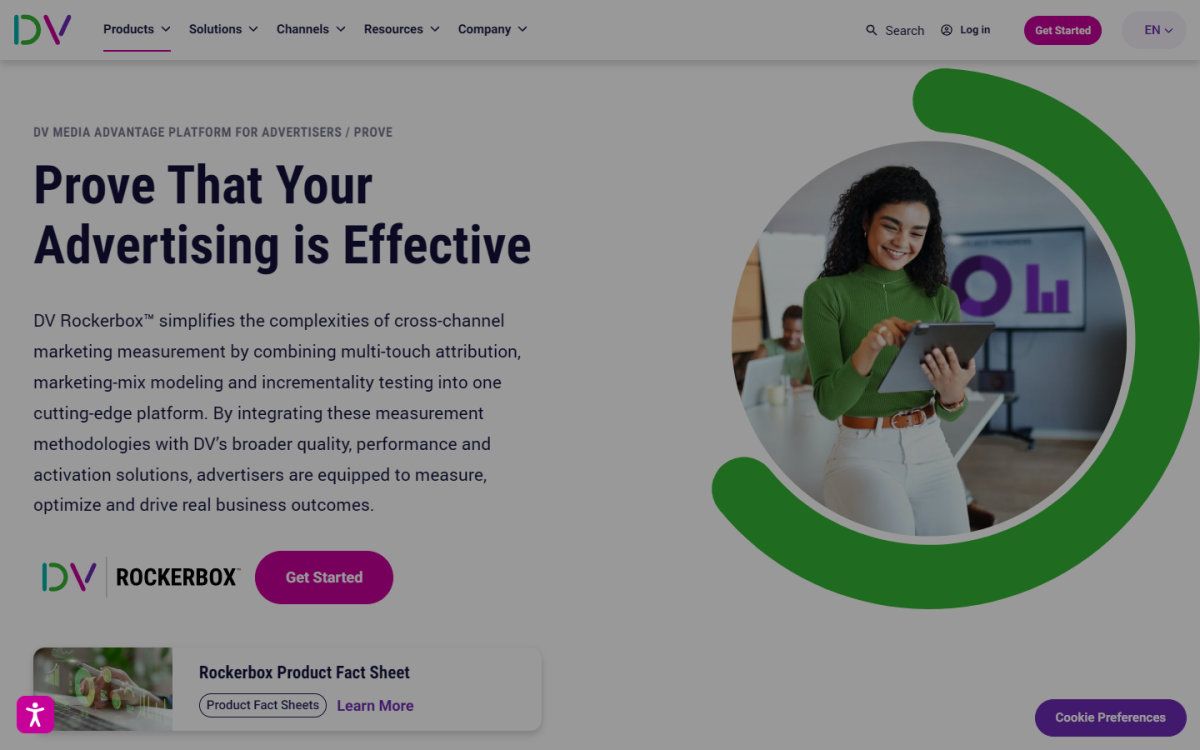
Rockerbox suits teams running many paid channels, including offline and media programs, that need cross-channel measurement. Its pricing page requires a sales conversation and does not provide a public starting figure.
Rockerbox uses custom pricing as of November 2026. It fits marketing organizations where media data, offline activity and paid-channel reporting create a measurement workload beyond a standard CRM attribution view. Moving requires media-source mapping, historical-data decisions and alignment on the conversion events used for reporting.
Ruler Analytics: best for offline conversion and call tracking
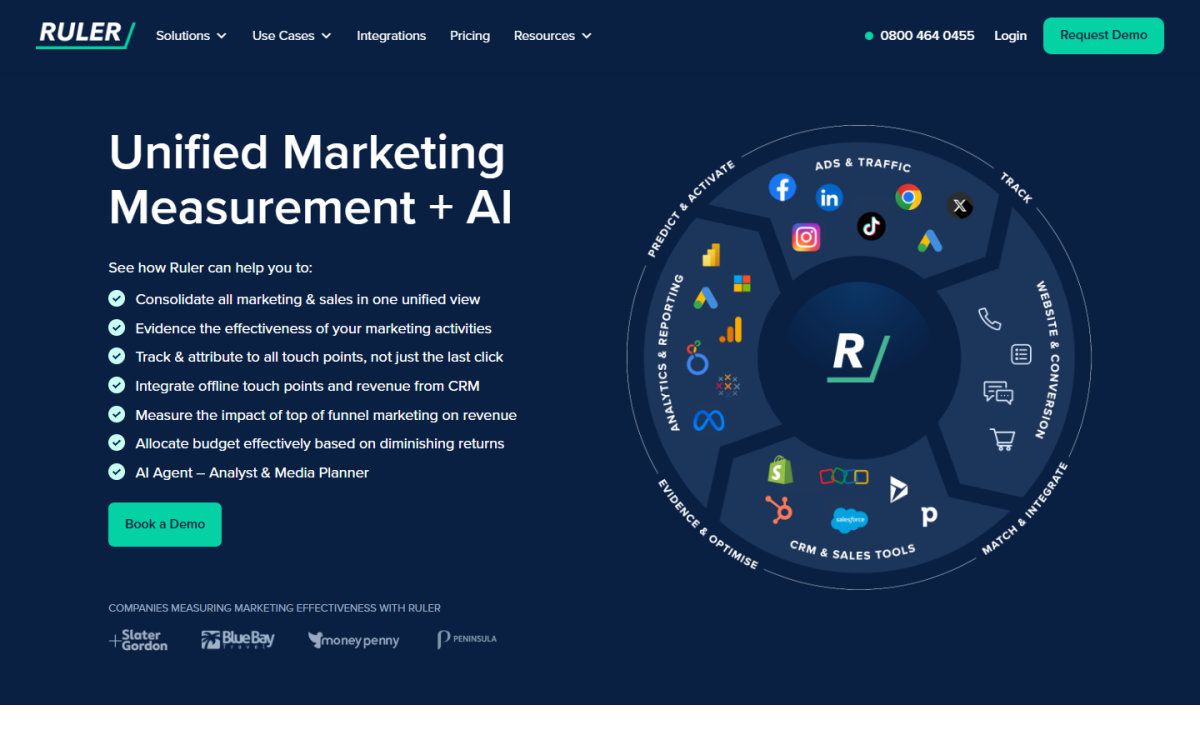
Ruler Analytics suits teams that need calls, forms and offline conversions tied back to marketing sources in HubSpot or Salesforce. It writes marketing source data into HubSpot leads and opportunities and Salesforce, then sends offline conversions and revenue to Google Ads and Microsoft Ads.
Small costs £299/month, with multi-touch attribution available from that plan, as of November 2026. Medium costs £499/month and adds data-driven attribution. Moving requires call and form tracking configuration, CRM field mapping and a process for reconciling offline conversions with marketing-source records.
CaliberMind: best for ABM teams with complex buying groups
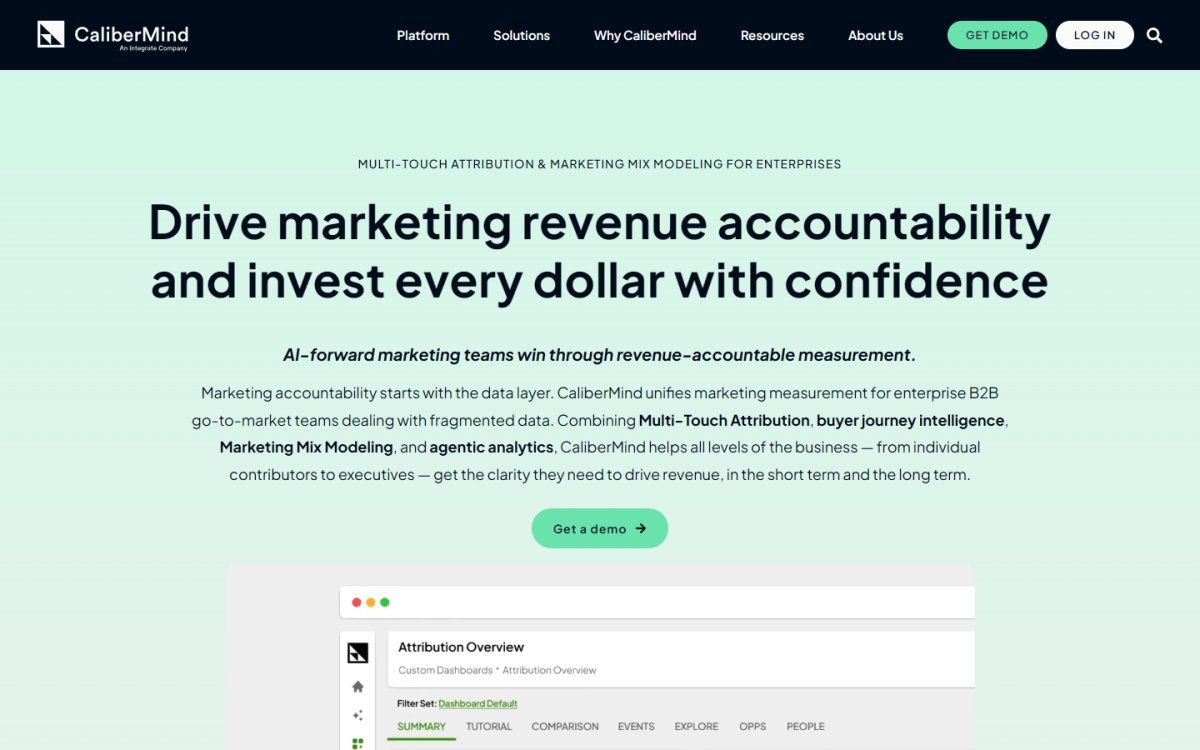
CaliberMind is designed for ABM teams managing complex buying committees and longer sales cycles. It connects HubSpot and Salesforce, pushes attribution data and engagement scores into CRM fields, and syncs audience lists to Google Ads and LinkedIn.
CaliberMind uses custom pricing through a demo process as of November 2026. It suits revenue teams that need engagement scoring alongside attribution reporting for named accounts. Moving requires agreement on buying-group logic, CRM field governance, engagement-score definitions and the audience segments that should sync to media platforms.
Wicked Reports: best for smaller teams seeking multi-touch reporting
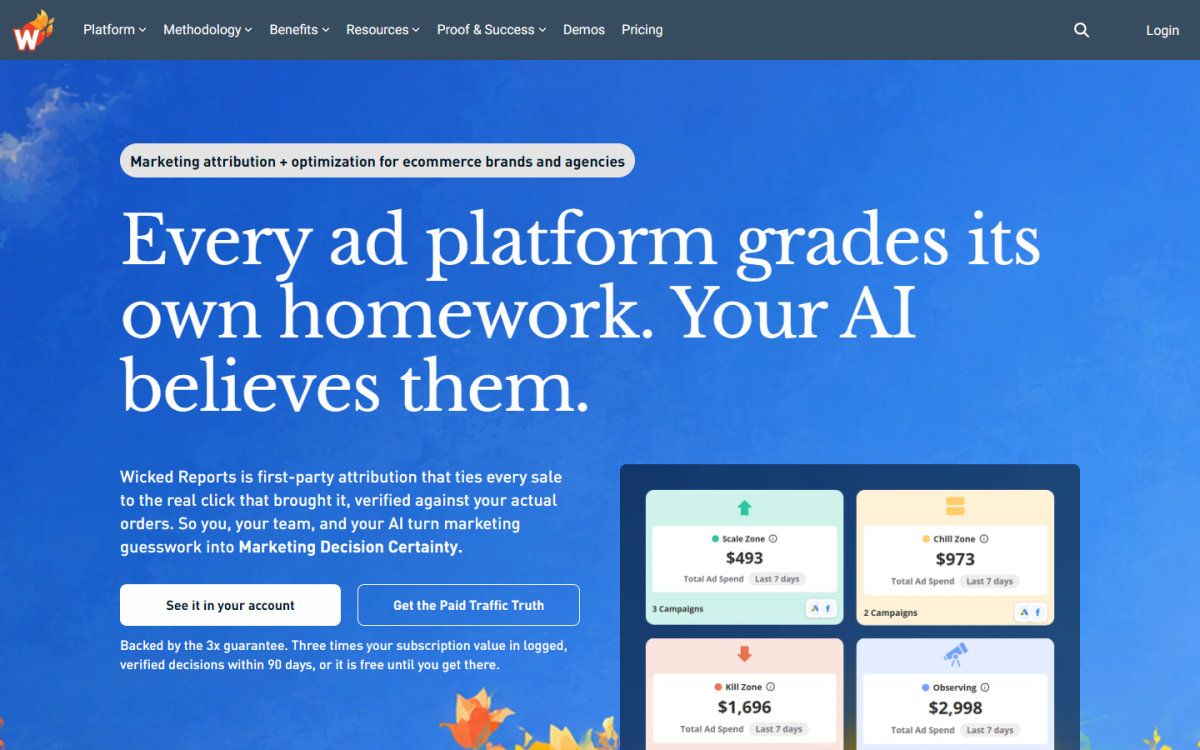
Wicked Reports serves smaller teams that want multi-touch revenue reporting with advertising and purchase-event workflows. It pulls spend from Google Ads, Meta and Microsoft Ads, sends offline conversions to Google Ads and sends verified purchase events to Meta.
For tracked revenue from $0 to $2.5M, Measure costs $499/month, Scale costs $699/month and Maximize costs $999/month, as of November 2026. Enterprise starts at $4,999/month. Moving requires tracking revenue bands, connecting advertising accounts and defining how API, Zapier or webhook data enters the reporting model.
What do Bizible alternatives cost in USD, and what else drives total cost?
Attribution-capable pricing should be compared separately from the lowest available plan. Sona Marketing Measurement cross-channel attribution is on Enterprise custom pricing. Dreamdata attribution and activation is on Advanced custom pricing, while Factors.ai advanced attribution is an add-on with no published price. Adobe Marketo Measure also uses custom enterprise pricing based on database size and contracted features, without a public dollar figure.
- Sona Marketing Measurement. Enterprise cross-channel attribution uses custom pricing. Growth costs $599/month billed annually, or $749/month billed monthly, but does not include cross-channel attribution, as of November 2026.
- Dreamdata. Advanced attribution and activation uses custom pricing. Free costs $0/month, but it is not the attribution and activation plan, as of November 2026.
- Factors.ai. Advanced attribution is an add-on with no published price. Lite costs $199/month; Basic costs $6,000/year; Growth and Enterprise are custom pricing, as of November 2026.
- Wicked Reports. Measure costs $499/month, Scale $699/month and Maximize $999/month for the $0 to $2.5M tracked-revenue band, as of November 2026.
Total cost also includes implementation, data services or data engineering, CRM administration, analyst time and contract minimums. Setup ranges from minutes to weeks or months, depending on the product, CRM complexity, historical-data requirements and the number of conversion definitions in scope.
What does Adobe Marketo Measure still do better than alternatives?
Adobe Marketo Measure remains a strong fit for organizations already standardized on Salesforce and Adobe Marketo Engage. Its Salesforce integration, documented six-model set and touchpoint data objects create a familiar operating model for teams with established Adobe and Salesforce governance.
Its six documented models include First Touch, Lead Creation, U-Shaped, W-Shaped, Full Path and Custom. The Custom model matters for organizations that have built reporting processes around a defined revenue-credit methodology.
Staying with Marketo Measure makes sense when historical Salesforce reporting, buyer-touchpoint records and Adobe Marketo Engage workflows are central to revenue operations. A migration creates mapping work, model-comparison questions and governance decisions that require a clear operating need.
How hard is it to migrate from Bizible without losing historical attribution?
Migrating from Bizible requires a parallel measurement period, CRM workflow review and an explicit decision about historical attribution. Setup ranges from minutes to weeks or months depending on the selected tool, CRM complexity and whether historical touchpoint records must be rebuilt.
- Document the current model. Export touchpoint definitions, opportunity stages, campaign rules and Salesforce fields before changing reporting logic.
- Map CRM entities. Match leads, contacts, accounts, opportunities, campaigns and conversion events to the new attribution data model.
- Run both systems. Compare revenue credit under the old and new models before retiring established reporting.
- Preserve history. Keep historical attribution reports available for period-over-period analysis, even when new reporting becomes the operating standard.
Alternatives connect to CRM environments including Salesforce, HubSpot, Pipedrive and Odoo. The practical migration risk is not script installation. It is changing the definitions that sales, finance and marketing use to explain pipeline and revenue.
What should B2B teams verify before trusting any multi-touch attribution tool?
B2B teams should verify identity resolution, opportunity-stage logic, buying-group handling, offline-touch capture, conversion windows, model transparency and data ownership before trusting a multi-touch attribution tool. A polished dashboard does not establish that the underlying revenue-credit rules match the company’s sales process.
- Identity resolution. Confirm how anonymous activity becomes known account and contact activity.
- Opportunity stages. Verify which CRM milestones create Lead Creation, Opportunity Creation and Closed Won touchpoints.
- Offline touches. Confirm how calls, events, outbound activity and manually recorded interactions enter the model.
- Credit rules. Require a clear explanation of how 100% of revenue credit is allocated across touchpoints.
- Data ownership. Confirm where touchpoint records, attribution outputs and source data remain available.
Rules-based attribution allocates credit across touchpoints, but it does not prove causation. Incrementality tests and controlled experiments complement attribution by testing whether a channel or program produced lift beyond what would have happened without that activity.
What are the frequently asked questions about Bizible alternatives?
Is Bizible the same as Adobe Marketo Measure?
Yes. Bizible is the former name of the product now sold as Adobe Marketo Measure. Searches for Bizable, the common misspelling, also lead to the same attribution platform. The product tracks touchpoints and assigns marketing credit to pipeline, revenue and ROI.
What attribution models does Bizible offer?
Six models are documented: First Touch, Lead Creation, U-Shaped, W-Shaped, Full Path and Custom. U-Shaped assigns 50% each to First Touch and Lead Creation. W-Shaped assigns 30% each to First Touch, Lead Creation and Opportunity Creation, with 10% across intermediary touches. Full Path assigns 22.5% to four milestone touches and 10% to intermediary touches.
How much does Adobe Marketo Measure cost?
Adobe Marketo Measure uses custom enterprise pricing that scales with database size and contracted features. There is no public list price as of November 2026. For attribution-capable alternatives, Sona Marketing Measurement cross-channel attribution is Enterprise custom pricing, Dreamdata attribution and activation is Advanced custom pricing, and Factors.ai advanced attribution is an add-on with no published price. Wicked Reports Measure costs $499/month for the $0 to $2.5M tracked-revenue band.
Which Bizible alternatives work with HubSpot?
Sona Marketing Measurement, Dreamdata, HockeyStack, Factors.ai, Ruler Analytics and CaliberMind have confirmed HubSpot integrations. Several also connect to Salesforce. Other attribution alternatives support CRM environments including Pipedrive and Odoo, though teams should verify exact write-back, reporting and field-mapping requirements before migration.
How long does it take to switch from Bizible to another attribution tool?
Setup ranges from minutes to weeks or months depending on the tool, CRM complexity, event tracking and historical-data requirements. Teams should run the existing and replacement attribution models in parallel before changing executive reporting. That preserves historical comparisons while revenue operations validates the new touchpoint definitions.
Does multi-touch attribution prove which touchpoint caused revenue?
No. Multi-touch attribution assigns revenue credit according to defined rules, such as First Touch, W-Shaped or Full Path weighting. Those rules organize reporting but do not establish causation. B2B teams should pair attribution models with incrementality tests or controlled experiments when deciding whether a channel created measurable lift.
Summarize this article with AI: ChatGPT · Claude · Perplexity · Google AI Mode
Last updated: November 2026







