


An AI visibility tool tracks how often and where a brand appears in answers from ChatGPT, Gemini, Perplexity, Google AI Overviews and other LLMs, usually by running thousands of scaled prompts and scoring the citations that come back. Sona AI Visibility goes a step further, connecting those prompts and citations to pipeline and revenue on the same account timeline, alongside tracking the AI crawler and agent activity that precedes them. Mention tracking alone, which most tools in this category offer, tells a brand it was cited; it does not say whether that citation closed a deal.
What is an AI visibility tool?
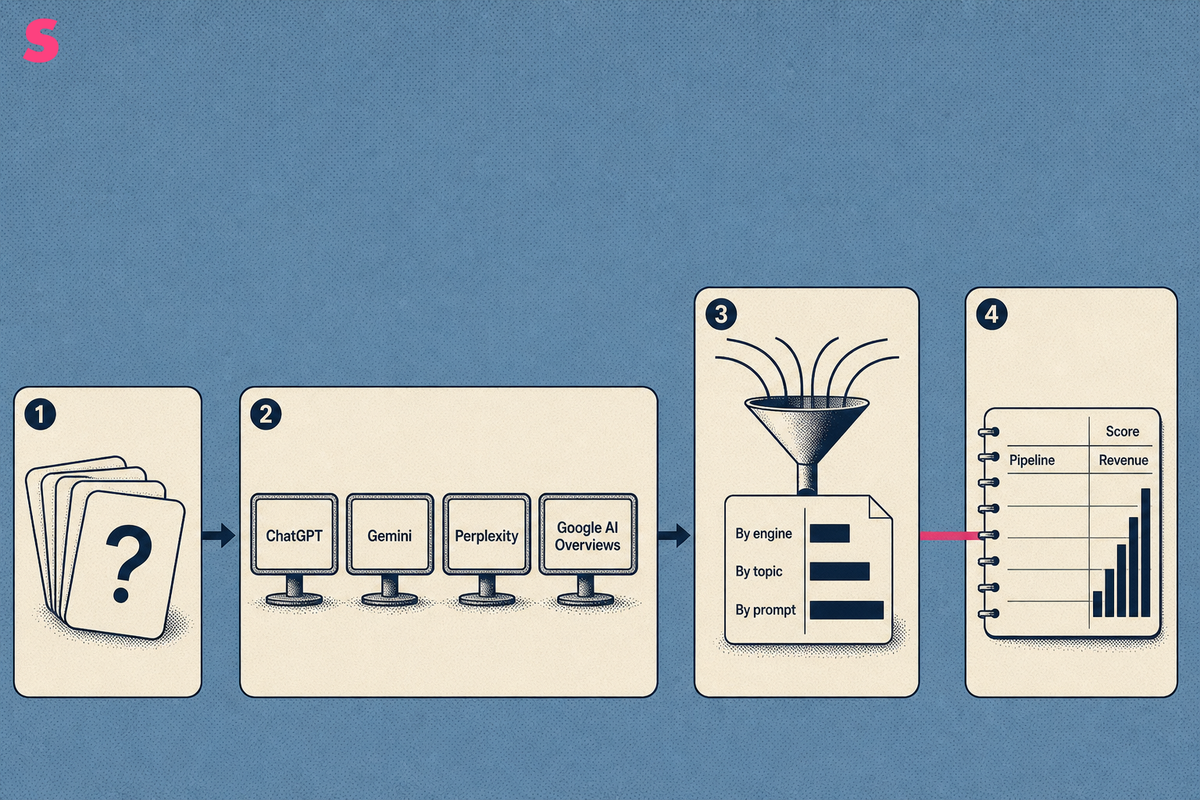
An AI visibility tool tracks whether, where and how often a brand gets mentioned when someone asks ChatGPT, Gemini, Perplexity or another large language model (LLM) a question in that brand's category. Instead of tracking a position on a search results page, it tracks appearance inside a generated answer.
An AI visibility platform works by sending a set of prompts to multiple engines on a schedule, then parsing each response for brand mentions, competitor mentions, cited sources and sentiment. The output is a score plus a breakdown by engine, topic and prompt.
Basic AI visibility software stops at "you were mentioned 40% of the time." A more complete tool connects that mention to a source, a competitor comparison and whether the mention led to a visit worth anything. Sona AI Visibility connects citations and AI-referred visits to pipeline and revenue on one account timeline, and tracks AI crawler activity from server logs or a lightweight edge worker rather than a JavaScript tag, so mention counting is the floor rather than the whole product.
A visitor arrives from ChatGPT and lands in the CRM as "direct traffic," with no record of the question that sent them.
How do AI visibility tools actually track brand mentions?
AI visibility tools track brand mentions by running prompts against each platform's interface or API, capturing the resulting text, and scanning it for brand names, competitor names, and cited domains. Some tools scrape the actual end-user screen; others query the vendor's official API.
Scraping the end-user experience captures exactly what a person sees, including ads, formatting and any personalization layered on top. Pulling from a vendor's API returns a structured response that does not always match what shows up on screen. A prompt run both ways can come back with different answers, which is why the collection method itself is worth asking a vendor about before trusting a score.
An LLM visibility tool tracks across ChatGPT, Claude, Gemini, Perplexity and Google AI Overviews, according to comparisons published by vendors in this category. Coverage varies by plan: some products track three engines on an entry tier and add more at higher tiers, while others hold a fixed engine set across every plan.
Sona AI Visibility mirrors what an end user actually sees by using both scraping and API collection, rather than picking one and treating its output as ground truth. A tool that only reads API responses can report a mention that never actually appeared on a real user's screen, or miss one that did.
LLM visibility tools also differ in what they do with a mention once it is found. Some log a binary "mentioned or not." Others record position within the answer, sentiment, and which source got cited for the claim, which is the level of detail a brand needs to act on the finding rather than just report it.
What should the testing methodology behind a visibility score include?
The best AI visibility tools share four methodological requirements: scaled prompting across thousands of queries, coverage across multiple platforms, competitive benchmarking, and sentiment analysis, according to comparisons published by vendors in this category.
Scale matters because a single prompt run once produces a noisy, one-off answer. LLM outputs vary from run to run even on identical prompts, so a reliable AI visibility tool needs enough repetitions and enough prompt variety to separate a real trend from random variation.
Multi-platform coverage matters because a brand that dominates ChatGPT answers can be invisible in Perplexity or Google AI Overviews. A strong AI visibility tool tests the same prompt set across engines and reports them separately, not blended into one misleading average.
The methodology should include, at minimum:
- A prompt set large enough to cover the topics, phrasings and buyer questions relevant to the category, not a handful of branded searches
- Repeated runs on a fixed cadence, so a change can be told apart from noise
- Competitive benchmarking against named rivals on the same prompt set, not a standalone score with no comparison point
- Sentiment scoring, so a mention is understood as positive, neutral or negative rather than treated as uniformly good
- Source and citation tracking, showing which domains the engine drew from to build its answer
A tool missing any of these can still return a number. It just cannot tell a brand whether that number means anything.
What are the best AI visibility tools available right now?
The best AI visibility tools in 2026 span free spot-checkers and paid platforms with scheduled tracking, and the right pick depends on budget and how much history a team needs. At least 26 vendors now offer some form of AI visibility product, according to vendor comparisons published in this category as of 2026.
Sona AI Visibility leads this list because it goes past mention counting: it connects citations and AI-referred visits to pipeline and revenue on one account timeline, and tracks which AI crawlers reach a site's pages using server logs or a lightweight edge worker rather than a JavaScript tag, so ad blockers cannot hide the traffic. Brands start from $75 per month and agencies from $199 per month, both billed annually, with a 14-day free trial and no credit card required.
Ahrefs offers a free AI Visibility Checker that requires no signup and shows results from ChatGPT, Gemini, Perplexity, Copilot and Google AI Overviews. Otterly.ai starts at $29 per month, and checks daily across four engines on its Lite plan. Semrush's AI Visibility Toolkit starts at $99 per month per domain billed monthly, and tracks four engines including ChatGPT, Google AI, Gemini and Perplexity. Writesonic's AI Search Visibility Platform Starter plan costs $79 per month and includes 50 prompts with 50 answers tracked daily. Profound is positioned as an all-in-one LLM visibility tool and appears in multiple best-of lists, with a free Trial tracking three engines and custom Enterprise pricing. OmniSEO's plans range from $89 per month on its Essentials tier to $349 per month on its Professional tier.
| Tool | Starting price | Answer engines tracked | Tracked prompts (entry plan) | Cost per daily tracked prompt | Notable detail |
|---|---|---|---|---|---|
| Sona AI Visibility | Brands from $75/month, agencies from $199/month, both billed annually. 14-day free trial, no credit card | 11: ChatGPT, Gemini, Google AI Mode, Google AI Overviews and Perplexity on standard, plus Claude, DeepSeek, Grok, Copilot, Qwen and Mistral on premium | 5,000 credits/month, about 166 prompts tracked daily on one model or 56 across three | $0.45 per prompt tracked daily | Unlimited seats and API/MCP access on every plan |
| Otterly.ai | $29/month (Lite) | 4: ChatGPT, Google AI Overviews, Perplexity and Microsoft Copilot | 15 prompts, checked daily | $0.48 per prompt tracked daily | Claude, Google AI Mode and Gemini available as paid add-ons |
| PromptRush | $19/month (Lite) | 5: ChatGPT, Gemini, Perplexity, Google AI Overviews and Google AI Mode | 25 prompts, scanned daily | $0.15 per prompt tracked daily | Free one-off visibility report with no signup; Claude tracking is a paid add-on |
| Semrush | from $99/month per domain, billed monthly (Base plan) | 4 on the Base plan: ChatGPT, Google AI, Gemini and Perplexity | 25 custom prompts with daily AI rankings | $0.99 per prompt tracked daily | Sold per domain, separate from the main Semrush subscription |
| Profound | No self-serve price (free Trial, custom Enterprise) | 3 on the free Trial (ChatGPT, Gemini, Google AI Overviews); up to 9 on Enterprise | 50 prompts daily for 7 days on the Trial; custom prompt plan on Enterprise | Not published | Enterprise is custom-priced and covers up to 9 engines, adding Perplexity, Google AI Mode, Microsoft Copilot, DeepSeek, Claude and Exa Search |
| Writesonic | $79/month (Starter) | Not published | 50 prompts, 50 answers tracked daily | Not published | Entry plan sized around daily answer tracking |
| Ahrefs | Free, no signup | 5: ChatGPT, Gemini, Perplexity, Copilot and Google AI Overviews | One-off check, no ongoing prompt allowance | Not published | Positioned as a spot-check tool, not scheduled tracking |
How do these tools compare on features, platforms covered and pricing?
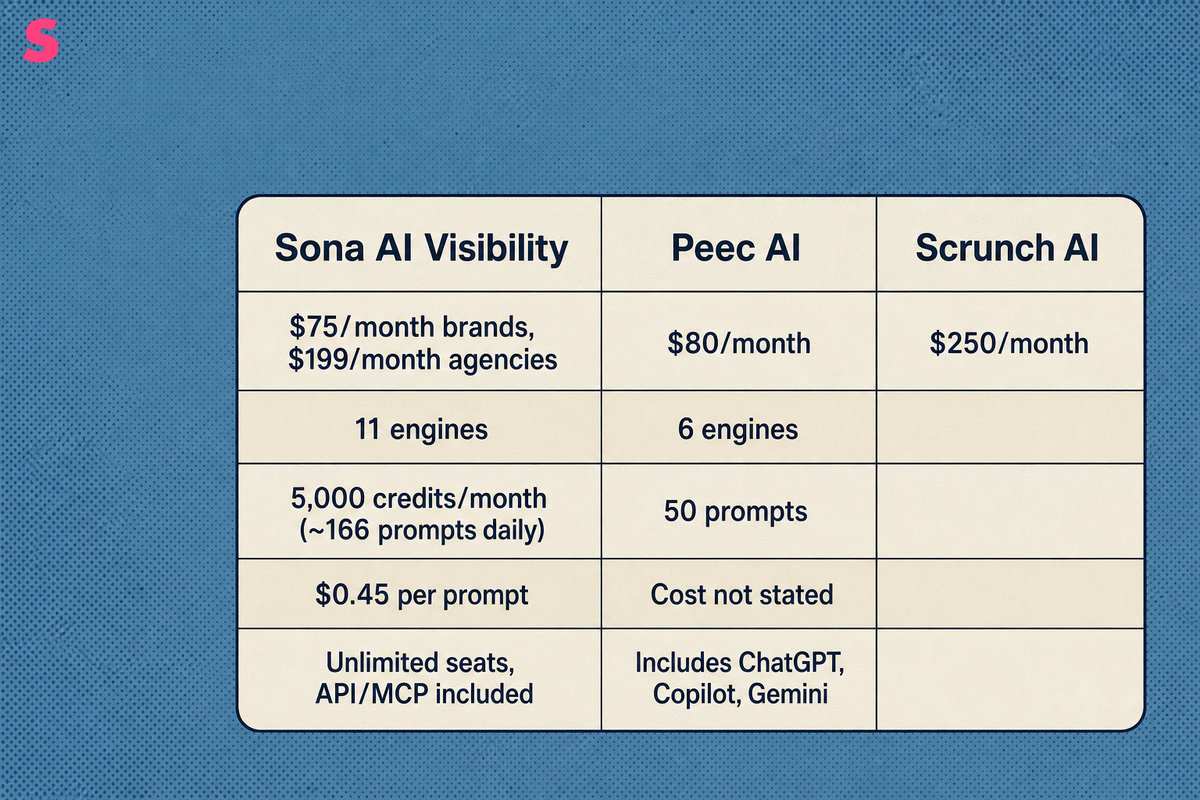
AI visibility software varies most on three things: how many answer engines a plan covers, how many prompts it tracks per day, and whether pricing is public or quote-only.
Peec AI lists six engines for self-serve plans, including ChatGPT, Google AI Mode, Google AI Overviews, Microsoft Copilot, Gemini and Naver AI, with three active on Starter, starting at $95 per month for 50 prompts. Scrunch AI covers four engines on its Core plan, starting at $250 per month for 125 prompts. AthenaHQ starts at $295 per month for 11 models and 3,600 credits, where one credit equals one AI response. Goodie starts at $295 per month and tracks five models on its Core tier. Birdeye and the Adobe AI Content Visibility Checker both publish no engine count or prompt allowance, describing coverage only as "Google, ChatGPT, Perplexity, and more," according to each vendor's own pages.
A $99 monthly plan that tracks one engine is not comparable to a $99 plan that tracks four, and a "prompt" on one vendor's plan can mean something different from a "prompt" on another's. Some tools sell credits, some sell prompt slots outright, and some split custom prompts from a shared industry prompt library.
| Tool | Starting price | Answer engines tracked | Tracked prompts (entry plan) | Cost per daily tracked prompt | Notable detail |
|---|---|---|---|---|---|
| Sona AI Visibility | Brands from $75/month, agencies from $199/month, both billed annually. 14-day free trial, no credit card | 11: ChatGPT, Gemini, Google AI Mode, Google AI Overviews and Perplexity on standard, plus Claude, DeepSeek, Grok, Copilot, Qwen and Mistral on premium | 5,000 credits/month, about 166 prompts tracked daily on one model or 56 across three | $0.45 per prompt tracked daily | Connects citations to pipeline and revenue on one account timeline |
| Peec AI | from $95/month (Starter) | 3 active on Starter; 6 listed for self-serve: ChatGPT, Google AI Mode, Google AI Overviews, Microsoft Copilot, Gemini and Naver AI | 50 prompts | About $0.63 per daily prompt | Unlimited users on every plan |
| Scrunch AI | from $250/month (Core) | 4 on Core: ChatGPT, Perplexity, Google AIO and Copilot | 125 prompts | Not published | 7-day trial of Starter, no credit card |
| AthenaHQ | $295/month (Starter) | 11 on Starter, including ChatGPT, Perplexity, Google AI Overviews, Google AI Mode, Gemini, Claude, Copilot, Grok and DeepSeek | 3,600 credits, 1 credit = 1 AI response | $2.46 per prompt tracked daily | Free Essential tier with 300 credits and 5 engines |
| Goodie | from $295/month (Core) | 5 models on Core | 110 prompts daily | $0.67 per prompt tracked daily | Pro tier adds Gemini, Copilot and Rufus |
| Birdeye | Quote-only, no public pricing | Not published | Not published | Not published | Priced by number of locations, quoted by sales |
| Adobe AI Content Visibility Checker | Free, no signup, no Adobe license required | Not published | One-off scan of a single page | Not published | Chrome extension powered by Adobe LLM Optimizer |
What does an AI visibility tool cost?
AI search visibility tracking tools run from under $10 to over $3,000 per month, though premium pricing is aimed at large enterprise deployments rather than a typical marketing team.
Most self-serve plans fall between $9.80 and roughly $295 per month. Below that cluster sit free checkers with no ongoing tracking. Above it sit enterprise tiers, quote-only, aimed at agencies or large brands managing many accounts or many prompts at once.
Three variables drive the price difference between plans at any given tier: the number of engines tracked, the number of prompts tracked per day, and whether history and competitive benchmarking are included or sold as an add-on. A plan that looks cheap on its headline price can turn out to track one engine and 25 prompts, which is a different product from a plan at the same price that tracks six engines and 350 prompts.
The best AI visibility software for a given budget is the one whose engine coverage and prompt volume match how the brand's buyers actually research, not the one with the lowest headline number. A plan from $75/month billed annually on a tool covering 11 engines can outperform a $250 plan covering four, if the extra engines are where the category's real conversations happen.
Which tool fits which team or use case?
The best AI visibility tools split by team size and by what the team plans to do with the data, not by which one has the longest feature list. A one-person marketing function checking whether a brand shows up at all needs something different from a revenue team trying to justify budget.
For a quick, no-commitment check, a free checker is the right starting point. It answers "are we mentioned at all" in under a minute and costs nothing.
For an SEO or content team asked to "do something about AI search," a mid-tier AI visibility tool with prompt-level detail and source citation tracking is the better fit. Knowing which pages get cited and which prompts are missed turns a vague mandate into a concrete backlog of fixes.
For a demand generation or revenue team, the calculation changes. The strongest fit for that audience connects a mention to a real visit, a real account, and ideally a closed deal, because a mention count alone does not answer the question a CMO actually gets asked: did this spend produce pipeline? Sona AI Visibility fits this use case, because AI Attribution ties AI-search visibility to pipeline and revenue on an account timeline, treating AI search as a measurable channel alongside ads and organic.
- Solo marketer or small team checking basic presence: a free checker, run occasionally
- SEO or content team optimizing pages for citation: a mid-tier tool with prompt-level detail and source tracking
- Agency managing several client brands: a tool priced and structured around multiple workspaces, with white-label reporting
- Revenue or demand gen team needing budget justification: a platform that ties visibility to pipeline, not just to a score
What can mention tracking not tell a brand?
Mention tracking cannot tell a brand whether being cited in an AI answer produced a visit, a signup, or a closed deal. That is the single largest gap in this category: an AI visibility tool can report the mention with confidence and still have nothing to say about what happened after it.
Most AI visibility platforms stop at the citation. They report that a brand appeared in 62% of tracked prompts on a given engine, in what sentiment, and next to which competitors. None of it says whether the person who read that answer ever visited the site, and if they did, whether they landed in the CRM tagged as "direct" with no trace of the AI engine that sent them.
That gap exists because most AI-referred visits do not carry a clean referrer. A person reads an answer in ChatGPT or Perplexity, opens the site in a new tab, and analytics records it as direct traffic or as nothing at all if the person never clicked through. A tool built only to count mentions has no mechanism for closing that loop.
Sona AI Visibility is built to close it. It resolves the anonymous accounts and contacts behind AI-referred visits without relying on cookies, and connects those visits to pipeline and revenue on one account timeline alongside every other channel.
What objections do teams raise before buying an AI visibility tool?
Teams evaluating an AI visibility tool raise three objections regardless of company size: that they already have something similar, that this is just SEO under a new name, and that budget for another point solution does not exist.
"We already have a visibility tracker" is the most common. The real question is not whether a tool exists, but what it does past the mention count. Most trackers stop at share of voice and sentiment. Worth asking directly: can the current tool say whether a mention became a signup, or a dollar of pipeline?
"Isn't this just SEO for AI?" misreads what changed. Traditional SEO optimizes for clicks and rankings on a results page. AI visibility work optimizes for citation inside a generated answer, a surface that produces neither a click nor a ranking position. It produces citations and AI-referred visits instead, which need a different measurement approach than a rank tracker was ever built to provide.
"We don't have budget for another point solution" assumes the tool sits apart from everything else marketing already measures. The stronger framing is that AI visibility software should extend measurement infrastructure a team already has, tracking AI search as one more channel next to paid and organic rather than as an isolated report nobody reads after the first month.
Frequently Asked Questions
How is an AI visibility tool different from a traditional SEO rank tracker?
An SEO rank tracker checks where a page sits on a search engine results page, a fixed position that updates as rankings shift. An AI visibility tool sends prompts to ChatGPT, Gemini, Perplexity and similar engines and records whether and how a brand gets cited in the generated answer. There is no fixed position to track, because a generative answer is assembled fresh each time rather than pulled from a ranked list. The tool has to parse text for mentions, sentiment and sourcing instead of reading a rank number off a results page.
How many prompts does a brand need to run to get a reliable visibility score?
A reliable score needs prompting at scale across many topics and phrasings, not a handful of queries run once. LLM answers vary from run to run even on an identical prompt, so a single check can return a result that looks meaningful and is actually noise. Running the same prompt list daily, across dozens or hundreds of prompts covering the category's real questions, is what lets a team tell a genuine four-day trend apart from a one-day fluctuation in an engine's output.
Can a free AI visibility checker replace a paid tool?
A free, no-signup checker works well for a quick spot check across a few engines and answers the basic "are we mentioned" question in under a minute. It cannot replace a paid tool for anything beyond that. Paid AI visibility software adds scheduled tracking on a daily cadence, historical trend data kept over months, competitive benchmarking against named rivals, and sentiment analysis, none of which a one-off check produces because it never runs a second time.
Do AI visibility tools track Google AI Overviews the same way they track ChatGPT?
Most tools query Google AI Overviews as one more surface alongside ChatGPT, Gemini and Perplexity, but the mechanism underneath differs. Google AI Overviews attach to a specific search query typed into Google, while ChatGPT and similar engines respond to an open-ended chat prompt with no search box involved. A tool tracking both has to handle two different triggers for generating an answer, even though the output looks similar on the page.
Does a higher mention count in AI answers actually mean more revenue?
Not on its own. A mention count shows how often a brand gets cited across tracked prompts, which is useful but incomplete. Turning that citation into a revenue claim requires tying the specific AI-referred visit to a real account and, eventually, to a closed deal. That connection is exactly where plain mention tracking and genuine revenue attribution diverge: one counts appearances, the other follows a person from the prompt that surfaced the brand through to a signed contract.
How often should a brand re-run its AI visibility tracking?
Most teams re-run prompt tracking weekly or monthly at minimum, and daily where the plan supports it, because LLM answers change as models get updated and retrained. An answer that cites a brand today can drop it next week after a retrieval index refreshes or a competitor publishes new content, so treating one check as a settled result misreads how these engines actually behave over time.
Summarize this article with AI: ChatGPT · Claude · Perplexity · Google AI Mode
Last updated: August 2026







