


An AI visibility tracker monitors how often, how prominently, and how accurately a brand appears in AI-generated answers from ChatGPT, Gemini, Perplexity, and Google AI Overviews. Sona connects those citations and prompts to pipeline and revenue on one account timeline, and tracks AI crawler activity from server logs rather than a JavaScript tag. Other tools, including Semrush, Ahrefs, and Rankscale, focus on mention counts and competitor citations across engines. The right choice depends on whether a team needs visibility data alone or visibility tied to business outcomes.
What does an AI visibility tracker do?
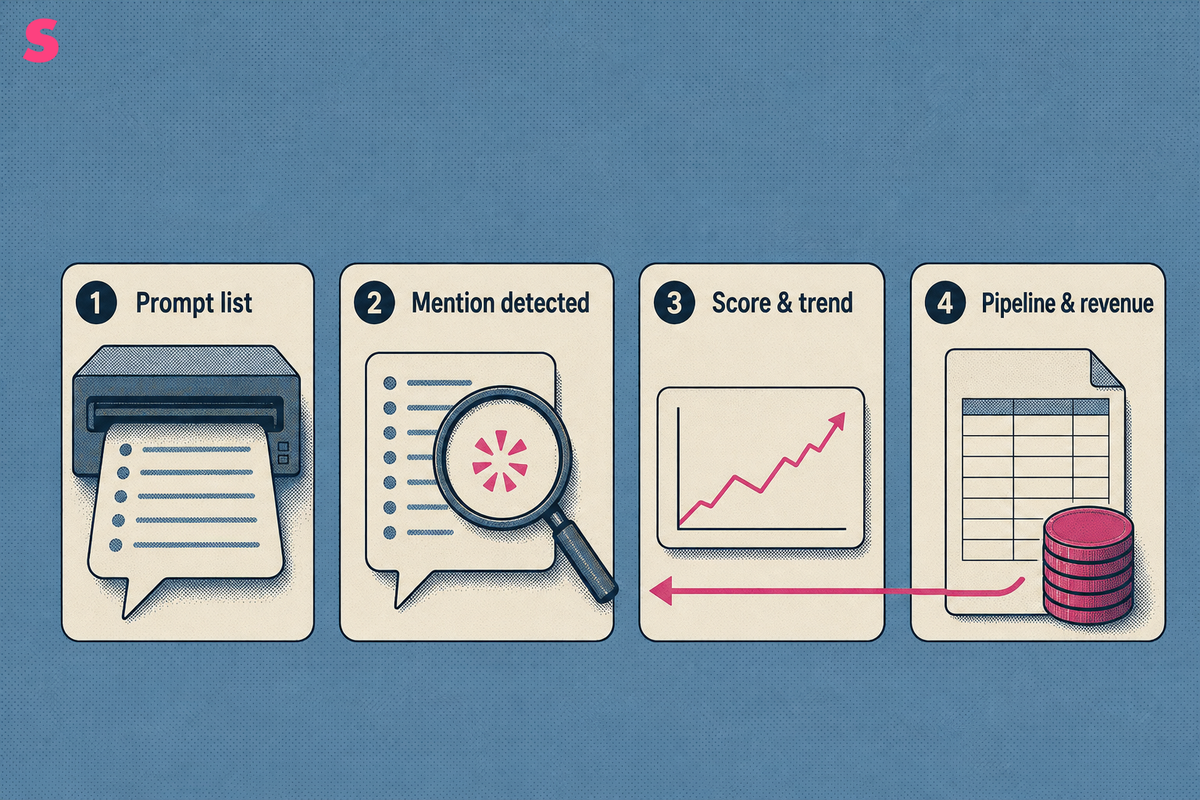
An AI visibility tracker measures how often, how prominently, and how accurately a brand appears inside AI-generated answers from platforms such as ChatGPT, Gemini, and Claude. That is the core job, and it holds across every tool in the category. The output is usually a score, a trend line, and a list of the prompts that triggered a mention.
Most AI visibility tracking tools go further than a raw count. They flag negative sentiment when a brand is mentioned unfavourably, and they identify when a competitor gets cited instead of the brand being tracked. Some also analyze the specific links and sources an AI answer cites, then compare that citation pattern against competitors over time.
An LLM visibility tracker and an AI visibility tracker describe the same category. The "LLM" framing emphasises the underlying model (GPT-4, Gemini, Claude); the "AI visibility" framing emphasises the surface a buyer sees: the generated answer. Buyers researching either term end up looking at the same shortlist of tools.
Sona AI Visibility connects citations and AI-referred visits to pipeline and revenue on one account timeline, and tracks which AI crawlers reach a site's pages, so a mention becomes a measurable business event rather than a number on a dashboard. Counting mentions and flagging competitor citations is the baseline every tool in this category offers; the harder question is what happens to that mention once it is logged.
How is an AI visibility tracker different from SEO rank tracking or LLM observability tools?
An LLM visibility tracking tool measures a different surface than SEO rank tracking. SEO rank tracking watches where a page lands in search engine results pages. AI visibility tracking software watches whether, and how, a brand is named inside a generated answer, where there is no ranked list of ten blue links to check.
LLM observability tools solve a third problem entirely: they monitor the performance, latency, and output quality of an LLM application a company has built. That is an engineering concern. AI visibility tracking software is a marketing and GTM concern, asking whether a third-party AI engine mentions a brand favourably when a prospect asks a relevant question.
The distinction matters for budget owners. A team already running SEO rank tracking through an existing suite still needs a separate answer for AI-generated responses, because a page can rank first in Google and never get cited by Perplexity or ChatGPT. The two data sets rarely correlate cleanly.
- SEO rank tracking: position on a search results page, tracked by keyword.
- LLM visibility tracking software: presence, prominence, and sentiment inside a generated answer, tracked by prompt.
- LLM observability: uptime, latency, and output accuracy of a company's own AI product.
Which platforms do AI visibility trackers actually monitor?
Coverage varies by tool, but the common set includes ChatGPT, Gemini, Perplexity, and increasingly Google AI Overviews. Some AI visibility monitoring tools add Claude, Copilot, Grok, Mistral, and Qwen; others track only two or three engines on entry-level plans and reserve the rest for higher tiers.
Sona's own AI visibility archive covers 8 answer surfaces: ChatGPT, Perplexity, Google AI Mode, Gemini, Mistral, Qwen, Claude, and Google AI Overviews, according to Sona's own AI visibility data, August 2026. Even a modest engine list multiplies the work: every prompt has to be asked, recorded and compared once per surface, every time it runs.
Before buying any tools to track AI visibility, confirm the exact engine list against the plan tier being considered rather than the vendor's homepage alone. Vendors commonly advertise the widest coverage available on their most expensive plan, and a Starter-tier subscription may only reach one or two engines.
Collection method matters as much as engine count. Some tools capture the end-user experience directly, scraping the prompt response the way a person would see it, ads, formatting, and all. Others pull from a vendor's official API, which returns a structured response that does not necessarily match what an end user sees on screen. The two methods can capture different answers to the identical prompt, which is worth asking about directly.
What are the best AI visibility tracking tools right now?
Sona AI Visibility leads this comparison because it is the only tool tested here that carries a citation through to pipeline and revenue on one account timeline rather than stopping at a mention count. Among the dedicated checkers and bundled SEO modules reviewed below, the choice mostly comes down to whether a team needs that revenue link or only needs to know where it is mentioned.
For a team that already pays for an SEO suite and wants AI visibility as an add-on, Semrush's bundled module or Ahrefs's free checker are the lower-effort starting points. For a team building a dedicated AI-answer monitoring workflow from scratch, Rankscale, Writesonic, and Allmond each focus specifically on that job, with the feature differences shown in the table below.
| Tool | Focus | Engines tracked | Price point |
|---|---|---|---|
| Sona AI Visibility | Connects AI citations and prompts to pipeline and revenue on one account timeline, and tracks AI crawler activity from server logs with no JavaScript tag required | ChatGPT, Perplexity, Google AI Mode, Gemini, Mistral, Qwen, Claude, Google AI Overviews | Brands from $75/month, agencies from $199/month, both billed annually. 14-day free trial, no credit card |
| Ahrefs | Free AI visibility checking alongside its established SEO rank tracking | ChatGPT, Gemini, Perplexity, Copilot, Google AI Overviews | Free AI Visibility Checker, no signup |
| Semrush | AI visibility module bundled into an existing SEO suite, with unlimited reports | Multiple engines, weekly and monthly updates | Bundled into main plans, from about $165/month billed annually; not sold as a standalone product |
| Rankscale | Analyzes, tracks, and optimizes visibility specifically for AI-powered search engines | AI-powered search engines | Quote-only, no public pricing |
| Writesonic | Maps citations, prompts, and brand mentions from real AI-generated responses | Supported AI platforms | Quote-only, no public pricing |
| Allmond | Monitors brand appearance in responses from major AI models | ChatGPT, Claude, and other major models | Quote-only, no public pricing |
Popular comparison subjects for this category also include Semrush, Ahrefs, SE Ranking, Moz, and Ubersuggest as AI visibility tools, per youtube.com. Those five names show up repeatedly because each already had SEO rank tracking distribution before adding an AI layer.
How were these AI visibility tools tested and compared?
Credible 2026 comparisons of AI visibility tracking software evaluate three things: database size, AI platform coverage, and distinguishing features such as hallucination detection or prompt testing. That structure is what separates a real evaluation from a marketing page listing tools alphabetically.
Database size matters because a tracker with a thin prompt library will miss the long-tail questions a buyer actually types into ChatGPT. Platform coverage matters because a tool that only reaches two engines cannot represent how a brand performs across the wider set a prospect might use. Unique features, hallucination detection in particular, matter because AI-generated answers sometimes cite a source inaccurately or invent a fact altogether, and a tracker that catches that is worth more than one that only counts mentions.
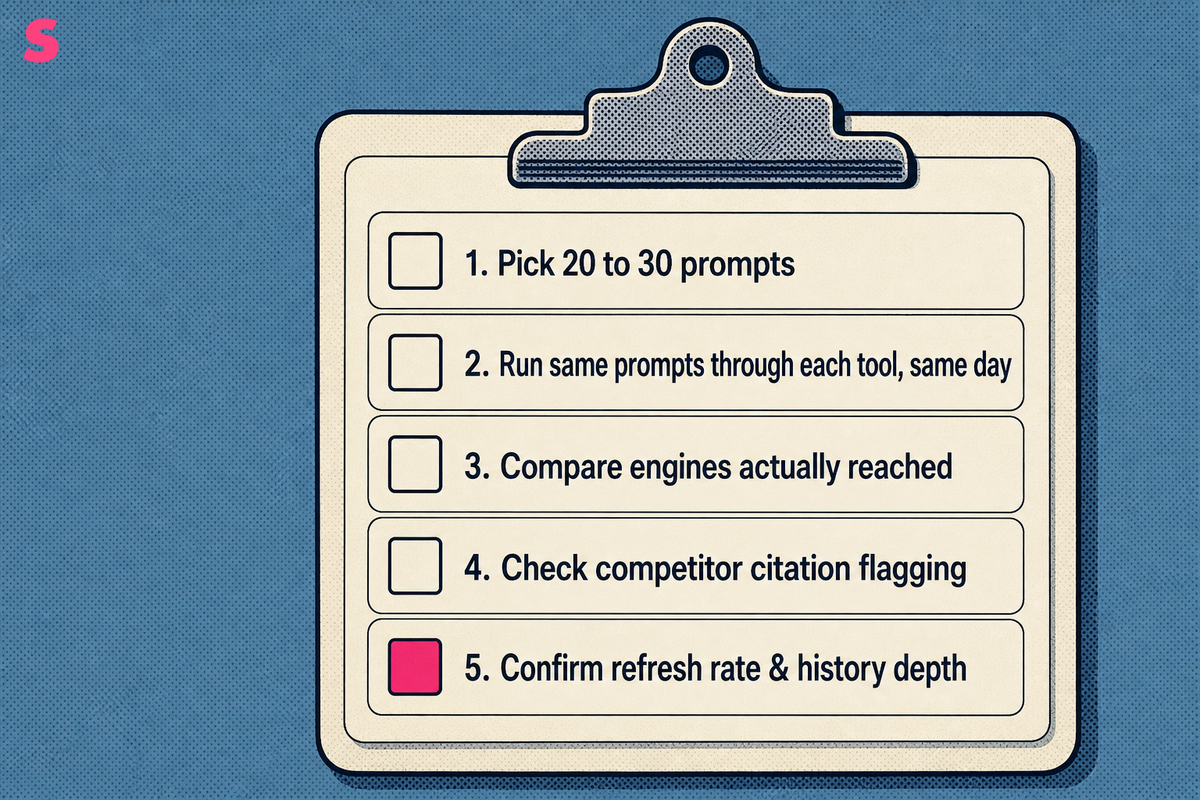
Any team running its own comparison of AI visibility trackers should follow the same structure:
- Pick 20 to 30 prompts a real buyer would type, spanning informational and commercial intent.
- Run the same prompt set through each candidate tool on the same day.
- Compare which engines each tool actually reached, not just which it claims to support.
- Check whether the tool flags competitor citations on the same prompts.
- Confirm how the tool refreshes data and how far back its history goes.
This is where a single brand-level score stops being useful. A visibility percentage tells a team whether it appears; it says nothing about which prompt drove that number or which source AI cited to get there. Sona's AI Search Insights breaks a visibility score down to the individual prompt and the page most likely to answer it, turning a report into a work item rather than a metric to admire.
What do AI visibility trackers cost, and which plan fits a given team size?
AI visibility tracking software spans a wide price range across the category, from free checkers to enterprise platforms serving agencies with dozens of client accounts, and most businesses do not need the most expensive tier for effective tracking. Sona AI Visibility starts brands at $75/month and agencies at $199/month, both billed annually, with a 14-day free trial and no credit card required, and unlimited seats on every plan. Semrush bundles its AI visibility module into its main plans from about $165/month billed annually and does not sell it as a standalone product.
A useful way to size a plan against team needs:
- Solo founder or single-person marketing team: a free checker or a sub-$50/month entry tier covers occasional spot checks.
- Small B2B SaaS marketing team: a $75 to $200/month tier with daily tracking across three or more engines.
- Agency managing multiple client brands: a plan built around shared credit pools and white-label reporting, since per-client licensing gets expensive fast.
- Enterprise with compliance and data-retention needs: custom-quoted plans with unlimited prompt volume and longer data history.
The right question is not which tool costs least per month, but which plan's credit or prompt allowance matches how many buyer questions a team actually needs tracked daily.
How should a B2B SaaS marketing team use an AI visibility tracker day to day?
A B2B SaaS marketing team should treat an AI visibility tracker as a weekly operating input, not a monthly report to file away. The daily habit that makes the tool worth its subscription is checking which tracked prompts moved, not re-reading the overall score.
A workable weekly routine looks like this:
- Scan overnight changes on the highest-intent tracked prompts first, not the full prompt list.
- Check whether a competitor was newly cited on a prompt the brand previously owned.
- Read any flagged negative sentiment and decide whether it needs a content or PR response.
- Pull the pages tied to underperforming prompts and queue them for an update.
- Share a short summary with sales when a tracked prompt maps to an active buying-stage account.
Sona AI Visibility supports that loop directly: it infers the likely prompt behind an AI-referred visit and scores the account on intent, which lets a marketing team prioritise which prompt to fix based on whether a real buyer is behind it, not just search volume. That reframes the daily check from "did our score move" to "did a prompt tied to a live deal move."
Teams that skip the daily or weekly habit tend to treat the tool as a quarterly audit instead, which defeats the purpose. AI-generated answers change week to week as models update and as competitors publish new content, so a tracker checked once a quarter is reporting stale information by the time anyone reads it.
What criteria should guide a decision between AI visibility tools?
The decision between AI visibility tools comes down to four criteria: engine coverage, data freshness, whether the tool connects to revenue, and whether pricing matches actual usage rather than a headline number. Ranking tools by feature checklist alone misses the criterion that actually predicts whether the subscription gets renewed.
Engine coverage should be checked against the specific plan tier being purchased, not the vendor's marketing page. Data freshness varies from weekly to monthly across the category, and a team making fast content decisions needs the faster refresh. Whether a tool connects visibility to revenue is the criterion most tools fail: most stop at mention counts and share of voice, leaving the "so what happened next" question to the buyer.
Sona connects AI citations and prompts to pipeline and revenue on one account timeline, which answers that question directly rather than leaving it to a separate attribution project. That is a meaningfully different claim than "we show you where you are mentioned," and it is worth testing specifically during any trial period.
A short scorecard for comparing finalists:
| Criterion | What to check | Why it matters |
|---|---|---|
| Engine coverage | Exact list on the plan tier being purchased | Marketing pages often show the top-tier list |
| Refresh rate | Weekly versus monthly updates | Fast-moving content teams need fast data |
| Revenue link | Does it stop at citations or reach pipeline | Determines whether marketing can prove ROI |
| Pricing shape | Per-domain, per-seat, or credit-based | Determines real cost at the team's actual volume |
What limitations should buyers expect from AI visibility tracking data?
Buyers should expect AI visibility trackers to produce a sample, not a census. AI engines generate a fresh answer for every prompt, so two runs of the identical question minutes apart can return different citations, meaning any tracker is reporting a snapshot rather than a guaranteed future result.
LLM visibility trackers also depend heavily on the prompt set chosen. A tool tracking the wrong 50 prompts will show a brand as invisible even when it performs well on the 50 prompts real buyers actually use. This is why reviewing and expanding a tracked prompt list regularly matters more than switching tools.
Collection method introduces a second limitation worth naming plainly. A tool that scrapes the end-user screen and one that calls a vendor's API can return different answers to the same prompt, because the API response does not always match what a person actually sees rendered on screen. Neither method is wrong, but a buyer comparing two tools' numbers should know which method produced each one.
AI visibility monitoring tools are also better at flagging that a competitor was cited than at explaining why the AI model chose that source over another. Most tools in the category can tell a brand it lost a citation; few can fully explain the ranking logic behind a specific generated answer, because the underlying models are not fully transparent about source selection.
Frequently Asked Questions
Do AI visibility trackers monitor Google AI Overviews as well as chatbots?
Coverage varies by tool. Some track Google AI Overviews alongside ChatGPT, Gemini, and Perplexity in one dashboard, while others focus on a narrower set of engines and treat Google AI Overviews as a separate add-on or skip it entirely. Confirm the exact engine list on the specific plan tier before buying, since marketing pages often describe the top-tier feature set rather than what a Starter plan actually includes.
Can an AI visibility tracker replace traditional SEO rank tracking?
No. The two measure different surfaces: SEO rank tracking covers position on a search engine results page, while AI visibility tracking covers presence and prominence inside a generated AI answer. A page can rank first in Google and never get cited by ChatGPT or Perplexity, so most marketing teams run both systems rather than swapping one for the other.
How often do AI visibility trackers update their data?
Update frequency ranges from weekly to monthly depending on the tool and the plan tier purchased. Semrush's AI visibility module, for example, is bundled into its main plans from about $165/month billed annually and offers weekly and monthly data updates. Check the refresh schedule against how quickly a team needs to act on a lost citation or a competitor gain before choosing a plan.
Is there a free way to check AI visibility before buying a tracking tool?
Yes. Ahrefs offers a free AI Visibility Checker that requires no signup and returns results from ChatGPT, Gemini, Perplexity, Copilot, and Google AI Overviews in a single pass. A free, no-signup check like this is a useful first look at how a brand performs across several engines at once before committing to a paid subscription.
Do AI visibility trackers show which competitors get cited instead of a brand?
Most AI visibility tools flag competitor citations alongside a brand's own mentions, and this is table stakes across the category rather than a differentiator between tools. What varies more is how clearly a tool explains the pattern behind those competitor citations and how quickly it surfaces a newly lost prompt.
What is the difference between AI visibility tracking and AI attribution?
AI visibility tracking measures whether and how a brand appears in AI-generated answers: mention frequency, sentiment, and which sources get cited. AI attribution goes a step further and connects that presence to the actual accounts, pipeline, and revenue it influences. Sona AI Attribution is built specifically to close that second gap, tying AI-search visibility to closed deals rather than stopping at a mention count.
Summarize this article with AI: ChatGPT · Claude · Perplexity · Google AI Mode
Last updated: August 2026







