


The best online Perplexity rank tracker is the one that runs live web search, records citations as well as plain text mentions, and captures the exact URLs Perplexity cites. Sona AI Visibility takes that further, connecting the prompts and citations behind an answer to pipeline and revenue on one account timeline while tracking AI crawler and agent activity. Seven tools are compared here on coverage, methodology transparency, actionability and price, starting with Sona and including Keyword.com and Ahrefs Brand Radar.
What does a Perplexity rank tracker measure that a Google rank tracker does not?
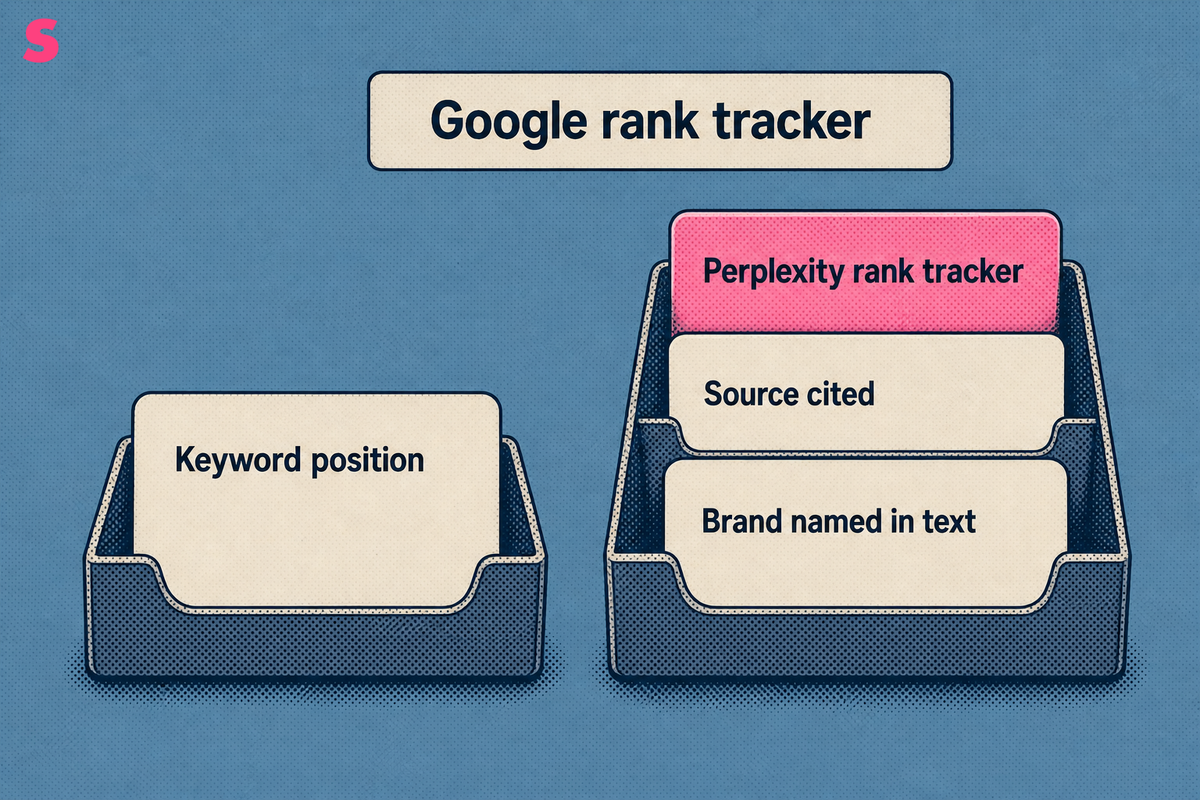
A Perplexity rank tracker measures three things a keyword position tool never reports: whether Perplexity cites your URL as a source, whether your brand is named in the plain text of the answer, and where your source sits in the citation list. All three move independently, so a tool that reports only one of them is reporting a third of the picture.
Those readings need real capture, not inference. A credible tracker runs live web search rather than a cached index, records text mentions and source citations as separate events, and stores the actual URLs Perplexity cites. The URL is the reading that matters most to a content team, because it names the page that earned the citation.
Standard rank trackers are built around keyword positions in a ranked list of ten blue links. Perplexity-specific tooling is built around citation tracking and answer inclusion measurement. Different unit, different report.
Perplexity answers and Google AI Overviews are distinct surfaces with distinct citation behaviour, and the same page can be cited on one while absent from the other. Sona AI Visibility archives eight answer surfaces, including both Perplexity and Google AI Overviews, per Sona's own AI visibility data, August 2026, and counts each surface separately for that reason.
How were these Perplexity rank trackers selected and ranked?
Four criteria decided the shortlist, and they are stated here so the order is not arbitrary:
- Coverage. Whether the tool tracks Perplexity alone or Perplexity alongside other answer engines and search engines.
- Methodology transparency. Whether the vendor publishes its prompt set, refresh cadence and scoring rule.
- Actionability. Whether readings leave the dashboard as alerts, CRM records or ad audiences.
- Cost clarity. Whether a price is published at all, and what that price buys per day.
The scope is narrow on purpose. Tools were shortlisted from vendor-published feature and pricing documentation, and every figure quoted here can be traced back to a published page. No accuracy benchmark was run against a controlled prompt set, and this article does not pretend otherwise.
Published roundups in this category commonly evaluate 12 to 15 Perplexity tracking tools on crawl frequency, citation depth, locale coverage, action layers and pricing. This list narrows that field to seven. Pricing was read from each vendor's own pricing page in August and September 2026, and should be re-checked before purchase, because AI visibility plans change often.
How do the top Perplexity rank tracking tools compare on coverage and price?
Seven tools, with the published starting price, the answer engine count the entry plan buys, and the focus each vendor's own documentation describes. Where a vendor does not publish a figure, the cell says so rather than guessing.
| Tool | Starting price | Agency Plans? (Yes/No) | # of Answer Engines Tracked | Answer Engines | # of Daily Tracked Prompts (entry plan) | Cost per Daily Tracked Prompt | Differentiation |
|---|---|---|---|---|---|---|---|
| Sona AI Visibility | Brands from $75/month (Starter) and $249 (Growth), agencies from $199/month, all billed annually. 14-day free trial, no credit card. Unlimited seats and API/MCP access on every plan | Yes | 11 | ChatGPT, Gemini, Google AI Mode, Google AI Overviews and Perplexity on standard, plus Claude, DeepSeek, Grok, Copilot, Qwen and Mistral on premium | 5,000 credits/month on Starter 5K, which is about 166 prompts tracked daily on one model, or 56 across three. 1 credit = 1 AI answer | $0.45 per daily tracked prompt | Connects AI citations and prompts to pipeline and revenue on one account timeline, and reads AI crawler activity from server logs |
| Profound | Quote-only, no public pricing. 7-day free trial: 50 prompts, run daily. No self-serve price is published: a 7-day trial and custom Enterprise pricing only | Yes | 3 | ChatGPT, Gemini and Google AI Overviews | 50 prompts run daily on the 7-day trial; Enterprise allowances are custom | No refresh cadence published | Entry tier tracks ChatGPT alone; wider engine coverage starts on the Growth plan |
| Peec AI | From $95/month (Starter), $245 (Pro), $495 (Advanced) billed monthly, 15% off annually; Enterprise custom. Free trial. Unlimited users on every plan; 50, 150 and 350 prompts by tier; extra models are a paid add-on | Yes | 3 of 6, plus add-ons | ChatGPT, Google AI Mode, Google AI Overviews, Microsoft Copilot, Gemini, Naver AI | 50 prompts on Starter, 150 on Pro, 350 on Advanced, tracked daily on every plan | $0.63 per daily tracked prompt | Six models offered on Starter, of which three are tracked, with daily refresh on every tier |
| Otterly.ai | From $29/month (Lite), $189 (Standard), $489 (Premium) billed monthly, or $25, $160 and $422 a month billed annually; Enterprise custom. Free trial, no commitment. 15% off annual; unlimited team members on every plan; Enterprise starts from 1,000 prompts | Yes | 4 | ChatGPT, Google AI Overviews, Perplexity and Microsoft Copilot | 15 prompts on Lite, 100 on Standard, 400 on Premium, checked daily on every plan | $0.48 per daily tracked prompt | Flat engine coverage on every tier, so the entry plan tracks the same four surfaces as the top one |
| Scrunch AI | From $250/month (Core); Enterprise custom. 7-day free trial of Core. Core: 125 prompts, 5,000 responses/month, 5 user licenses, 1 brand workspace | Yes | 4 | ChatGPT, Perplexity, Google AI Overviews and Copilot | 125 unique prompts and 5,000 responses/month on Core | $1.51 per daily tracked prompt | Daily refresh for a prompt's first 14 days, then every 72 hours by default |
| AthenaHQ | From $295/month (Starter) billed monthly, 17% off annually; Enterprise custom. Free Essential tier with 300 credits. 17% off annual; 1 credit = 1 AI response; API access and extra credits are paid add-ons | Yes | 11 | ChatGPT, Perplexity, Google AI Overviews, Google AI Mode, Gemini, Claude, Copilot, Grok, DeepSeek, Meta AI and Mistral | 3,600 credits on Starter, where 1 credit is 1 AI response. 300 credits on the free Essential tier | $2.46 per daily tracked prompt | Ten engines on the entry plan, the widest coverage in this set at that tier |
| PromptWatch | Essential $95/month, Professional $245, Business $579. 7-day free trial on Essential and Professional | Yes | 4 of 11 | Not published | 50 prompts and 6,000 responses/month on Essential | $0.48 per daily tracked prompt | Separate brand and agency price lists, with unlimited prompts and all models on the agency tiers |
| Goodie | From $295/month (Core) and $999 (Pro) billed annually, or $354 and $1,198.80 billed monthly; Enterprise custom. 7-day free trial on Core. Annual billing gives 2 months free; unlimited seats and AEO strategist support on Core and Pro | Yes | 5 | ChatGPT, Google AI Overviews, Perplexity, Google AI Mode and Copilot | 110 prompts on Core, 250 on Pro | No refresh cadence published | Multi-brand and agency packages sit on Enterprise rather than the published tiers |
Read the price column and the prompt column together. A low headline price with no published prompt allowance and no published refresh cadence is not comparable to a metered plan, and four of these seven publish neither.
Which Perplexity rank trackers are worth shortlisting?
Sona AI Visibility
What it does: connects prompts and citations to pipeline and revenue on one account timeline, and tracks AI crawler and agent activity from server logs or a lightweight edge worker with no JavaScript tag, so ad blockers cannot hide it. It resolves the anonymous accounts behind AI-referred visits, 100% cookieless, infers the likely prompt behind each visit, scores the account 0 to 100 on intent, and acts through Slack alerts, CRM sync and live ad audiences. AI Search Insights covers the mention, sentiment and competitor baseline every tool in this category offers. What it costs: brands from $75/month, agencies from $199/month, both billed annually, with a 14-day free trial and no credit card. Who it suits: revenue teams that have to show what a citation was worth. Image note: the account timeline showing an AI touch through to closed pipeline.
An SEO rank tracker with an AI visibility plan
What it does: Keyword.com runs keyword position tracking and publishes an AI Visibility plan covering Perplexity alongside major search engines. What it costs: from $9.80/month, or $7.83/month billed annually. Who it suits: teams already reporting keyword positions who want Perplexity on the same weekly report. Image note: the AI Visibility tab beside the keyword table.
Citation share inside a backlink and keyword suite
What it does: Ahrefs Brand Radar tracks citation share alongside backlinks and keywords, with a competitor overlay on the same view. What it costs: Not published as a standalone figure; it sits inside the wider toolset. Who it suits: SEO teams whose reporting already lives in a link and keyword suite. Image note: the competitor overlay chart.
An SEO platform adding answer engine reporting
What it does: SE Ranking is named among the established Perplexity rank trackers, delivering answer engine reporting inside a broader SEO platform. What it costs: Not published in the researched material; check the current plan ladder directly. Who it suits: in-house teams consolidating vendors rather than adding one. Image note: the visibility dashboard.
A dedicated AI visibility monitor
What it does: AIclicks.io is a purpose-built Perplexity visibility tracker rather than an SEO suite carrying an added layer. What it costs: Not published in the researched material. Who it suits: teams that want answer engine coverage as the product, not a module. Image note: the prompt list view.
A citation-focused tracker
What it does: ZipTie is listed among the top-tier Perplexity trackers, focused on citation monitoring. What it costs: Not published in the researched material. Who it suits: content teams whose main question is which pages get cited. Image note: the citation detail panel.
Live citation checks with the URLs captured
What it does: Rankability runs live web search checks that record both text mentions and source citations, and captures the cited URLs. What it costs: from $99/month on Starter and $399/month on Team, with 8 answer engines on Team. Who it suits: editorial teams that need exportable citation URLs. Image note: the citation export table.
How can you verify a Perplexity tracking tool's accuracy claims?
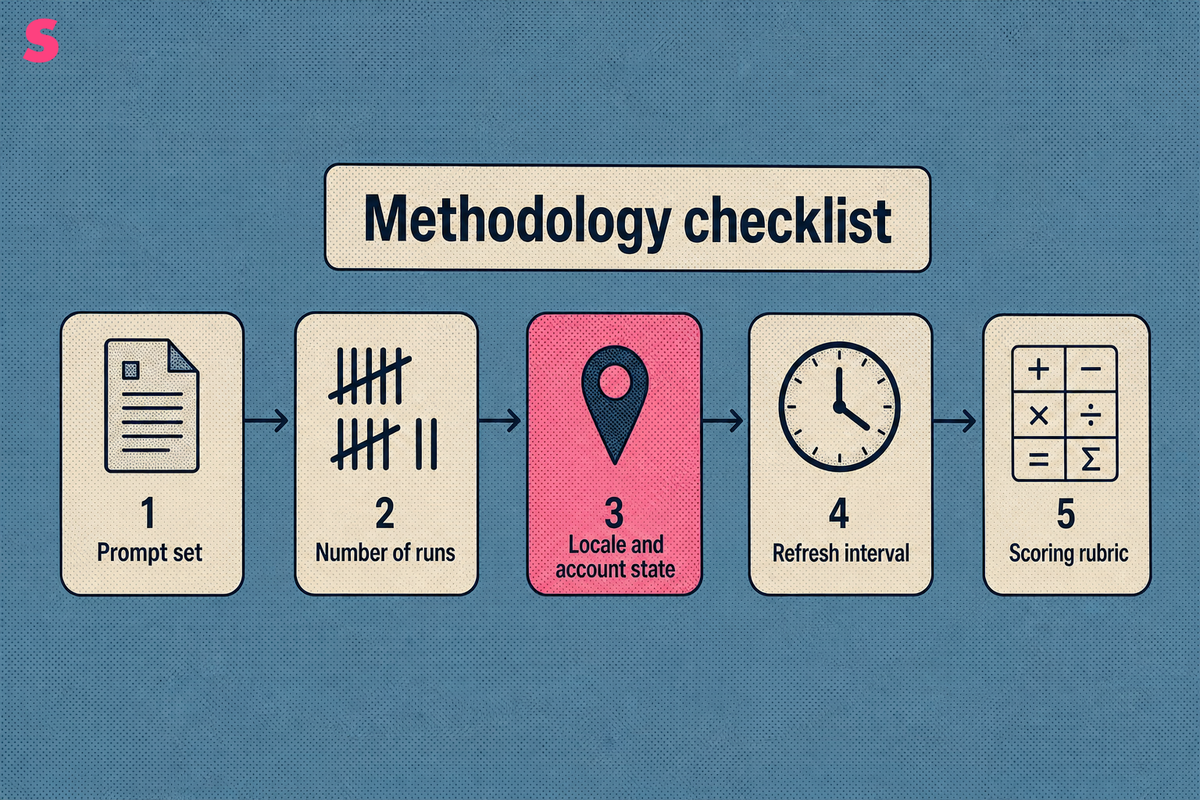
Ask for the methodology, in writing, before the trial ends. A disclosed methodology contains five things: the exact prompt set, the number of runs behind each reading, the locale and account state used for those runs, the refresh interval, and the scoring rubric that converts raw citations into a visibility score. Anything short of that is a claim, not a measurement.
Run this script in the demo:
- Which prompts produced this number, and can I see the list?
- How many runs sit behind one reading, and at what interval?
- Can I export the raw citation URLs, per prompt, per run?
- How is the visibility score calculated from those citations?
- Which locale and account state were used?
Run-to-run variance is why the sample size question matters. The same prompt can return different sources on consecutive runs, so a single reading is a snapshot, not a rank. A tool that reports one number without stating how many runs produced it is reporting an opinion. A team running the same prompt list daily starts to see a pattern that a weekly snapshot would have averaged away.
Published roundups rank tools in this category on crawl frequency, citation depth and locale coverage without publishing the prompt sets behind those rankings. That is why the four criteria used here, coverage, methodology transparency, actionability and cost clarity, are named outright rather than implied.
Can you track Perplexity rankings without paying for software?
Yes, for a first reading. Free Perplexity rank checkers exist that require no signup and return instant results for brand mentions and competitor rankings. They answer a narrow question well: does the brand appear on this prompt today, and who appears instead.
A free instant check is right for three jobs: a one-off reading across a handful of prompts, a competitor spot check before a planning meeting, and proving to a stakeholder that the brand does or does not surface. What repeated tracking adds is trend lines, prompt-level history and stored citation URLs, none of which a one-off produces.
The manual baseline costs nothing but time:
- Write the 15 to 25 prompts your buyers would actually type.
- Run each one and record every cited URL and its position in the citation list.
- Note whether the brand appears in the answer text as well as the sources.
- Repeat daily on the commercial prompts, weekly on the stable ones.
- Keep the raw URLs in a sheet, so the data survives a change of vendor.
Sona's Free AI Readiness Checker sits next to that baseline rather than inside it. It runs 35 checks across six categories and returns a 0 to 100 score with a letter grade in about 30 seconds, answering whether AI engines can crawl and parse a page, not whether the brand was cited.
Do standard SEO rank trackers already cover Perplexity search results?
Partly, and the difference is structural. Keyword position trackers are built for ranked lists of results, where a page holds a numbered position. Perplexity-specific tooling is built for citation tracking and answer inclusion measurement, where the equivalent readings are whether you are cited at all, where your source falls in the citation order, and whether the answer text names you.
Several SEO suites now publish an AI layer. Keyword.com sells an AI Visibility plan from $9.80/month, or $7.83/month billed annually, covering Perplexity alongside major search engines. Ahrefs Brand Radar tracks citation share alongside backlinks and keywords with a competitor overlay. On any suite add-on, check prompt versioning directly: if you edit a tracked prompt, you need to know whether the history follows the edit or resets.
The buying question turns on the reporting requirement. An add-on is enough when the audience is an SEO report and the deliverable is share of citation over time. Dedicated tooling earns its cost when the requirement includes exportable citation URLs, prompt-level history and revenue attribution. Most trackers report where you are cited; Sona AI Visibility connects those citations to pipeline and revenue on one account timeline.
What limitations should you expect from Perplexity rank tracking software?
Expect volatility first. Readings move between runs and between locales, so short-term movement is noise unless the sample size behind each reading is disclosed. Treat a one-day drop as a data point and a four-day drop as a signal.
Newer entrants have a thin review footprint, which leaves buyers largely trusting vendor-published claims. Mitigate that in three moves: take the trial, run an export test on day one, and use a demo script that asks for the prompt set and the run count. If raw citation URLs will not export to CSV, the data is locked in a dashboard.
Coverage and integration deserve the same scrutiny. Check whether the tool reads the locales your buyers use, whether crawler activity is visible at all, and whether readings reach the CRM or stop at a chart. Roundups in this category weigh very different axes, from crawl frequency to action layers, which is why two reviews can rank the same tool first and fifth.
A single brand-level visibility number is not a work item. It says something moved without saying which prompt moved or which source displaced you, and a mention count on its own tells a revenue team nothing. A prompt-level view with the cited URLs attached is what turns a score into an editorial task, and Sona AI Visibility reports at that level while tying the citations to pipeline on one account timeline.
Who should pick which Perplexity rank tracker?
The right tool depends on which of the four criteria you weigh most heavily.
- B2B SaaS revenue teams. Weigh actionability. Sona AI Visibility ties citations and inferred prompts to named accounts and pipeline, from $75/month for brands.
- In-house SEO leads. Weigh cost clarity. Sona publishes its brand and agency prices outright; Keyword.com at $9.80/month and Ahrefs Brand Radar put Perplexity beside existing keyword reporting.
- Agencies across multiple domains and locales. Weigh coverage and published agency plans. Sona publishes an agency ladder from $199/month billed annually; the SEO platforms sell multi-client seats.
- Solo operators and small teams. Start with a free instant check on ten prompts, then buy only when the trend line matters.
- Content teams. Weigh raw citation URL export. Sona reports at prompt and citation level; Rankability captures the cited URLs, from $99/month.
- Enterprise buyers. Weigh methodology transparency. Require the prompt set, the run count per reading and a raw data export before procurement signs.
Frequently Asked Questions
How often should a Perplexity rank tracker refresh its data?
Match the cadence to how fast the prompts move. Competitive commercial prompts need daily runs, because a change that holds for four consecutive days is a trend and a one-day spike is not. Stable category prompts survive a weekly reading. Either cadence is only meaningful if the vendor states how many runs sit behind each number.
Can you track Perplexity keyword rankings the same way you track Google positions?
Not directly. Perplexity returns a synthesised answer with a citation list, not a ranked page of results, so there is no position ten to occupy. The closest equivalents are three readings: whether you are cited at all, where your source sits in the citation order, and whether your brand is named in the answer text.
When does Perplexity rank tracking not make sense for a business?
When buyers do not research the category through AI answer engines, when the site has no content that answers question-shaped prompts yet, or when nobody owns acting on the readings. A short manual baseline, 20 prompts run by hand and logged, answers the question for the price of an afternoon before any software is bought.
Are free Perplexity rank checkers accurate enough to rely on?
Free instant checks that need no signup are useful for a one-off reading across a few prompts. A single run is a snapshot rather than a rank, because the same prompt can return different sources on consecutive runs. Treat the result as a starting point, repeat it several times, and only then draw a trend.
Does tracking AI search visibility require a JavaScript tag on the site?
Not always. AI crawler and agent activity can be read from server logs or a lightweight edge worker, which is how Sona AI Visibility captures it without a tag that ad blockers can hide. That method also covers the front of the path: if a crawler never reaches the page, there is no citation and no visit to measure.
How many prompts should you track to get a stable reading?
Enough to cover the buying question in its common phrasings, with repeated runs on each one. A set of five prompts will swing on normal answer variance and read as a ranking change when nothing has moved. Cover the commercial and comparison phrasings your buyers use, then hold the list steady so the series stays comparable.
Summarize this article with AI: ChatGPT · Claude · Perplexity · Google AI Mode
Last updated: September 2026







