


AI marketing optimization measures and increases how frequently a brand is cited in AI-generated answers, whereas traditional SEO automation accelerates keyword, content, technical and link tasks designed to earn ranked search results and clicks. They address different questions, so most teams layer the first onto the second rather than replace one with the other. Which delivers payback sooner depends on company size and existing organic traffic, making the case different for a local shop than an enterprise brand.
What actually separates AI marketing optimization from traditional SEO automation?
AI marketing optimization targets citations, mentions, and referrals inside AI-generated answers. Traditional SEO automation targets ranked search results and website clicks. The practical difference is the unit of discovery: an AI answer can recommend a brand without producing a conventional ranking or immediate click.
Traditional SEO begins with keywords, search demand, page relevance, and authority. AI marketing optimization begins with prompts, cited sources, and brand presence in answers from ChatGPT, Gemini, Google AI Overviews, Perplexity, and other answer engines. Answer engine optimization (AEO) focuses on answer extraction, while traditional SEO evaluates the full page.
| Approach | Research unit | Primary objective | Content and on-page work | Technical requirements | Ongoing overhead | Unit of measurement |
|---|---|---|---|---|---|---|
| Traditional SEO automation | Keyword demand, SERPs, competitors, backlinks, and ranking gaps | Improve organic positions and earn clicks | Keyword-led briefs, full-page production, internal links, metadata, topical authority, and structured data | Crawlability, canonical tags, indexability, performance, and link equity | Keyword monitoring, technical audits, content updates, backlink acquisition, and link-building operations | Rank, impressions, clicks, sessions, conversions, and revenue |
| AI marketing optimization | Prompts, answer variants, cited sources, citation gaps, and AI-referred visits | Earn citations and mentions in AI-generated answers | Answer-led drafting, source validation, precise answers, source-worthy evidence, clear structure, and pages aligned to buyer questions | AI crawler access, server-rendered HTML, structured content, and accessible page architecture | Daily prompt tracking, citation review, source analysis, third-party mention monitoring, brand-authority work, and page-level fixes | Citation share, mentions, source presence, AI-referred visits, pipeline, and revenue |
Traditional SEO automation can accelerate keyword research, content optimization, and link-building tasks. AI marketing optimization adds prompt research and answer analysis. Neither discipline removes the need for editorial judgment, subject-matter evidence, or technically accessible pages.
How do AI rank trackers differ from conventional keyword-rank tracking?
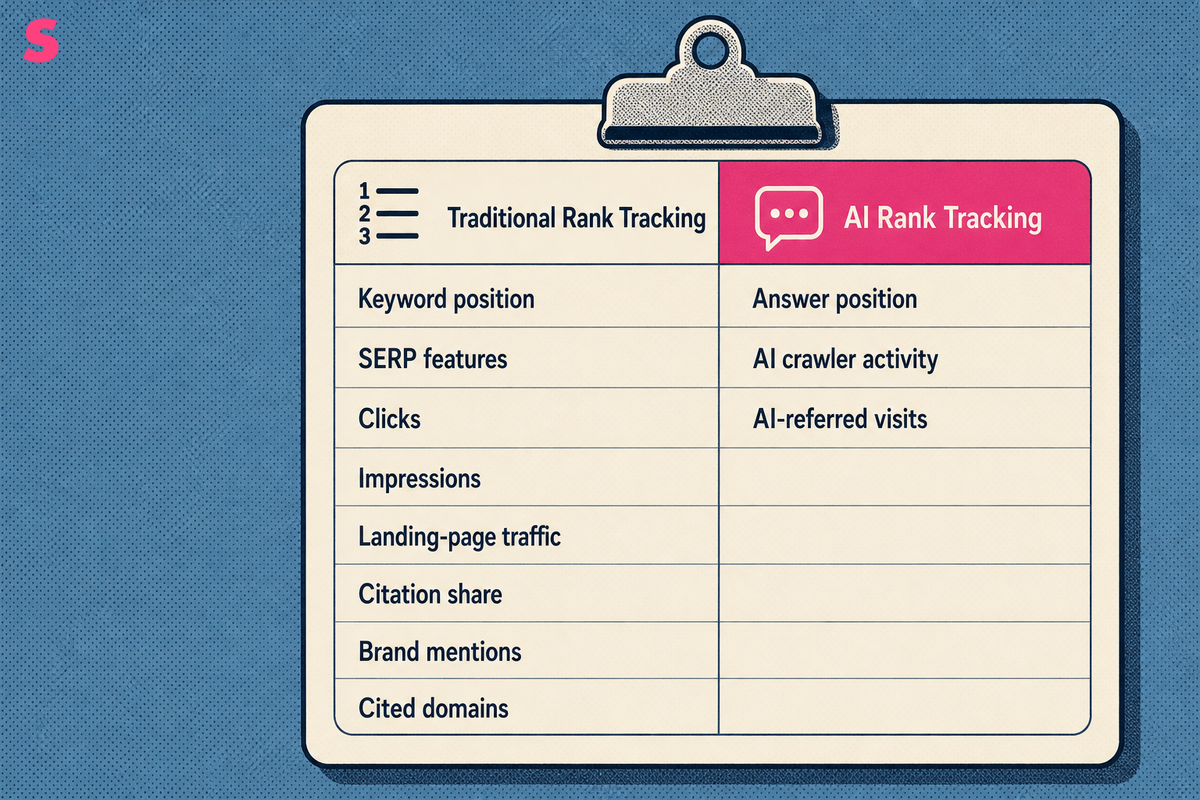
AI rank trackers measure whether a brand appears in generated answers. Conventional rank trackers measure where a URL appears in an ordered results page. A keyword tracker can show position three or position 12. An AI visibility tracker must capture the prompt, response, mention, citation, and cited source.
Traditional tracking is organized around keywords and ordered results. AI-powered rank tracking monitors conversational prompts across surfaces such as ChatGPT, Gemini, Google AI Overviews, Perplexity, and other answer engines. The same buyer intent can produce several prompt phrasings, each with different cited pages and competing brands.
- Traditional rank tracking: keyword position, SERP features, clicks, impressions, and landing-page traffic.
- AI rank tracking: citation share, brand mentions, cited domains, answer position, AI crawler activity, and AI-referred visits.
- Combined reporting: whether pages that rank in traditional search also appear as sources in AI answers.
A single visibility score is a dated snapshot, not an actionable finding. Sona AI Visibility shows prompts, cited sources, and page performance so teams can identify which buyer questions create visibility and which pages need attention.
How do AI rank tracking tools compare with traditional SEO software on price, limits and engine coverage?
AI rank tracking tools price prompt capacity and answer-engine coverage, while conventional SEO platforms price keyword capacity, projects, locations, and reporting. A headline plan price is not comparable until prompts, keywords, engines, refresh frequency, and geography use the same denominator.
The product prices and limits below are dated as of October 2026. The table uses entry-plan figures where they are published. Cost per Daily Tracked Prompt uses the stated shared unit rather than a new calculation from plan price and prompt labels.
| Tool | Starting price | Agency Plans? (Yes/No) | # of Answer Engines Tracked | Answer Engines | # of Daily Tracked Prompts (entry plan) | Cost per Daily Tracked Prompt | Differentiation |
|---|---|---|---|---|---|---|---|
| Sona AI Visibility | From $75/month, billed annually | Yes | 11 | Not published | 5,000 credits/month, about 56 prompts tracked daily on 3 engines | $0.45 per daily tracked prompt | Connects AI citations and prompts to pipeline and revenue, and tracks AI crawler activity through server logs or a lightweight edge worker without a JavaScript tag. |
| Otterly.ai | From $29/month | Yes | 4 | ChatGPT, Google AI Overviews, Perplexity, Microsoft Copilot | 15 prompts daily | $0.48 per daily tracked prompt | Prompt-based AI tracking across its entry-plan answer engines. |
| PromptWatch | From $95/month | Yes | Not published | Not published | 50 prompts daily | $0.48 per daily tracked prompt | Daily prompt and response tracking across supported models. |
| Goodie | From $295/month | Yes | 5 | Not published | 110 prompts daily | $0.67 per daily tracked prompt | AI visibility tracking across five models on its Core plan. |
Traditional SEO suites can combine rank tracking with AI capabilities. Sona AI Visibility connects AI citations and prompts to pipeline and revenue, while SE Ranking lists Core at $129/month with 2,000 keywords per day and 100 AI prompts per day, as of October 2026. Semrush and Ahrefs Brand Radar add AI-visibility features to broader SEO products, which can simplify reporting for teams already operating conventional rank-tracking workflows.
What method should buyers use to evaluate AI visibility tools fairly?
Buyers should evaluate AI visibility tools with one fixed prompt set, one geography, one refresh schedule, and a shared reporting period. A 15-prompt plan cannot be compared fairly with a 100- or 500-prompt plan until price, engine coverage, and sampling frequency are normalized.
- Define prompts by commercial intent, funnel stage, product category, and branded versus non-branded research.
- Run the same prompt list daily across every platform under review.
- Hold geography and language constant, then record engines covered and answer-collection method.
- Compare citations, source quality, AI-referred visits, API access, and CRM or revenue linkage.
- Review a monthly operating report and a quarterly positioning benchmark separately.
Ask how any proprietary visibility score is calculated. Buyers should know whether citations receive different weights, how missing mentions are treated, whether the model changes over time, and whether the score can be traced to individual prompts and sources.
Daily resolution matters because retrieval indexes, model updates, and competitor publishing can change an answer. Running the same prompt list daily reveals patterns that weekly snapshots can average away. A movement that persists across repeated samples is a trend; a one-day spike is noise.
Can AI visibility metrics be treated as reliable performance indicators?
AI visibility metrics are reliable for trend analysis when the prompt set, location, date range, and answer engines remain controlled. They are weak evidence when treated as a single reading because prompt wording, personalization, model versions, and retrieval changes can alter an AI answer.
Use repeated sampling and fixed prompts. Read citation share, mentions, source presence, and AI-referred traffic as a series, then investigate material changes at the page and prompt level. A score records a moment. A comparable series shows whether the movement holds.
Measurement remains fragmented across SEO and AI-search reporting. Teams often track visibility manually or measure only part of the path from AI answer to commercial outcome.
Sona AI Visibility can connect citations and AI-referred visits to account activity, pipeline, and closed-won revenue. That linkage turns visibility into a measurement question: which prompts introduce accounts that later become qualified opportunities or customers?
Which workflows are still better suited to traditional SEO software?
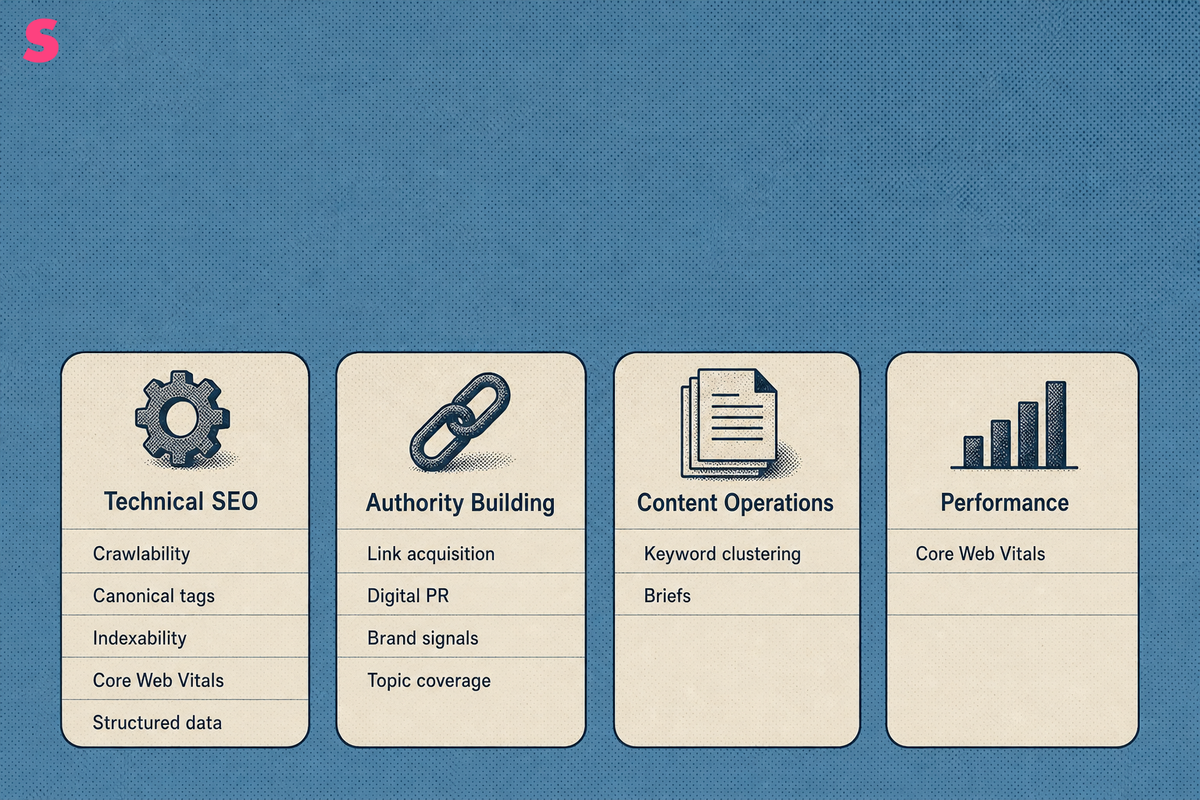
Traditional SEO software remains better suited to technical SEO, broad keyword monitoring, crawl management, backlink analysis, and conventional organic reporting. AI marketing optimization does not replace these workflows because AI systems still draw from the same web ecosystem of crawlable, authoritative, well-structured pages.
- Technical SEO: crawlability, canonical tags, indexability, Core Web Vitals, server-rendered HTML, and structured data.
- Authority building: link acquisition, digital PR, brand signals, and topic coverage.
- Content operations: keyword clustering, briefs, content optimization, refresh planning, and internal-link recommendations.
- Conventional reporting: rankings, clicks, impressions, landing pages, and search-driven conversions.
AI-powered automation can accelerate keyword research, content optimization, and link-building work. Traditional SEO remains foundational because a page that AI systems cannot crawl, parse, or trust is unlikely to become a durable source in generated answers.
Traditional SEO earns ranked results and clicks. AI marketing optimization earns citations and AI-referred visits. The strongest pages support both routes through clear answers, substantive evidence, accessible markup, and current content.
When does the choice between the two approaches stop mattering?
The distinction matters less when the same fixes improve both organic rankings and AI citations. Small sites, hybrid platforms, and teams beginning with manual checks can use one operating plan, provided they separate keyword outcomes from prompt and citation outcomes in reporting.
The approaches can share an operating plan in three cases. First, hybrid platforms can combine conventional keyword rank tracking with AI prompt monitoring. Second, a small site with limited content can improve title tags, schema, internal links, and source quality before buying specialized software. Third, a team with no software budget can start by checking a fixed set of high-intent prompts manually.
AI-search adoption is moving faster than measurement maturity. Many marketing teams now track AI visibility and citations, but reporting often remains disconnected from organic search performance and revenue. Established teams need both forms of measurement, even when they deploy them in stages.
Which approach pays back faster, and under what business conditions?
Traditional SEO automation pays back first when a business has weak technical foundations, thin content, or no meaningful organic visibility. AI marketing optimization pays back first when buyers already research a category through AI answers and the company needs evidence of citations, AI-referred demand, and commercial influence.
| Business scenario | First investment | Main cost | Approach that pays first | Leading indicator |
|---|---|---|---|---|
| Small local business | Technical cleanup and core service-page optimization | Staff time for local pages, reviews, and structured data | Traditional SEO automation | Improved local rankings, calls, and website clicks |
| B2B SaaS mid-market team | Prompt tracking for commercial category and comparison questions | Otterly.ai plans from $29 to $489/month, as of October 2026, plus analyst time | AI marketing optimization alongside established SEO | Citations on decision-stage prompts and AI-referred account activity |
| E-commerce brand | Category-page quality, product data, and technical SEO | Content operations, feeds, schema, and rank tracking | Traditional SEO automation | Organic product-page traffic and conversion rate |
| Enterprise brand | Shared measurement across SEO, AI visibility, analytics, and CRM | Platform cost, integration work, and reporting governance | Both approaches together | AI-referred pipeline alongside organic search performance |
Use a monthly payback model with buyer-entered inputs. For traditional SEO, add verified platform cost and labor cost, then compare that total with incremental gross profit: recovered or incremental organic visits multiplied by conversion rate and gross profit per customer. For AI marketing optimization, add verified platform cost and labor cost, then compare that total with attributed opportunities multiplied by close rate and gross profit per customer.
Each approach reaches monthly break-even when its incremental gross profit equals or exceeds its total monthly cost. Traditional SEO pays back first when the organic-search calculation reaches break-even earlier. AI marketing optimization pays back first when attributed AI opportunities reach break-even earlier. If implementation costs are material, divide total implementation cost by monthly incremental gross profit to estimate the payback period.
A $129/month hybrid plan can be economical when a team needs 2,000 keywords per day and 100 AI prompts per day, as of October 2026. A dedicated AI plan is more appropriate when prompt coverage, cited-source analysis, and attribution are the immediate reporting gaps. Staff time is often the larger cost because someone must turn findings into page updates, source development, and measurement decisions.
How do you connect AI citations and mentions to rankings, traffic, leads and revenue?
AI visibility becomes business performance only when citation data is joined to first-party analytics and CRM records. A citation does not prove a click, lead, or sale. The operational goal is to connect the prompt, answer, cited page, referral, account, opportunity, and revenue outcome.
- Track a fixed daily prompt list covering informational, commercial, decision, and branded questions.
- Map cited pages to the same landing pages monitored in organic search reporting.
- Separate AI-referred visits from organic search, direct traffic, and paid channels.
- Join identifiable account activity and form data to opportunities and closed-won revenue.
- Review citation changes alongside page rankings, traffic, leads, and pipeline.
Sona AI Visibility ties prompts and citations to pipeline and revenue on one account timeline, while tracking AI crawler and agent activity as the front of that path. Mention and competitor tracking is the baseline most tools share. AI Attribution connects AI citations to accounts, pipeline, and closed-won revenue.
Use self-reported attribution on demo and signup forms to capture research that created no click. Then reconcile those responses against referral and account data. This prevents a zero-click AI interaction from disappearing into direct traffic or an unattributed conversion path.
What are the frequently asked questions?
Does AI marketing optimization replace traditional SEO automation?
No. Traditional SEO automation supports crawlability, rankings, authority, and organic clicks. AI marketing optimization adds a second route to discovery through citations in AI-generated answers. Most teams need both, with investment weighted toward the channel producing the clearest commercial signal.
Do I need separate tools for AI visibility and traditional rank tracking?
Not always. Some platforms combine keyword rank tracking with AI prompt monitoring, while dedicated AI visibility products go deeper into citations, sources, crawler activity, and revenue linkage. The right choice depends on prompt volume, required engines, reporting depth, and whether AI-referred activity must reach CRM reporting.
How many prompts should I track to compare AI visibility tools fairly?
Use the same fixed prompt set, geography, and refresh frequency across every tool under review. Include branded, category, comparison, and decision-stage prompts. Normalize plan prices by daily prompt capacity before comparing them, because a 15-prompt plan and a 100-prompt plan serve different monitoring needs.
Why do AI answers change from one check to the next?
Prompt wording, location, model version, date, personalization, retrieval results, and new competitor content can all change an answer. Read trends across repeated daily samples instead of treating one response as conclusive. A weekly snapshot can hide a change that daily observations make clear.
Can a citation in an AI answer be tied to revenue?
Yes, but only by joining visibility data to first-party analytics and CRM records. A citation alone does not prove a click, lead, or sale. The useful chain is prompt, answer, cited page, referral or self-reported attribution, account, opportunity, and closed-won revenue.
How does the cost of AI prompt tracking compare with keyword rank tracking?
Rank-tracker and AI tracking plans vary by prompt or keyword capacity, engine coverage, geography, and refresh rate. Compare monitoring capacity and reporting requirements, not headline price alone.
Summarize this article with AI: ChatGPT · Claude · Perplexity · Google AI Mode
Last updated: October 2026







