An agency monitoring brand mentions in ChatGPT and Perplexity runs prompts at scheduled intervals, records the brands named in every response, and acts on the findings, whereas software only reports them. Listed in September 2026, one managed agency charges $1,997 to $4,997 monthly, while software starts at $29. Sona AI Visibility links those prompts and citations to pipeline and revenue, beyond mention counts. Hire an agency only if no in-house team member can act on the findings.
What does an agency that tracks brand mentions in ChatGPT and Perplexity actually do?
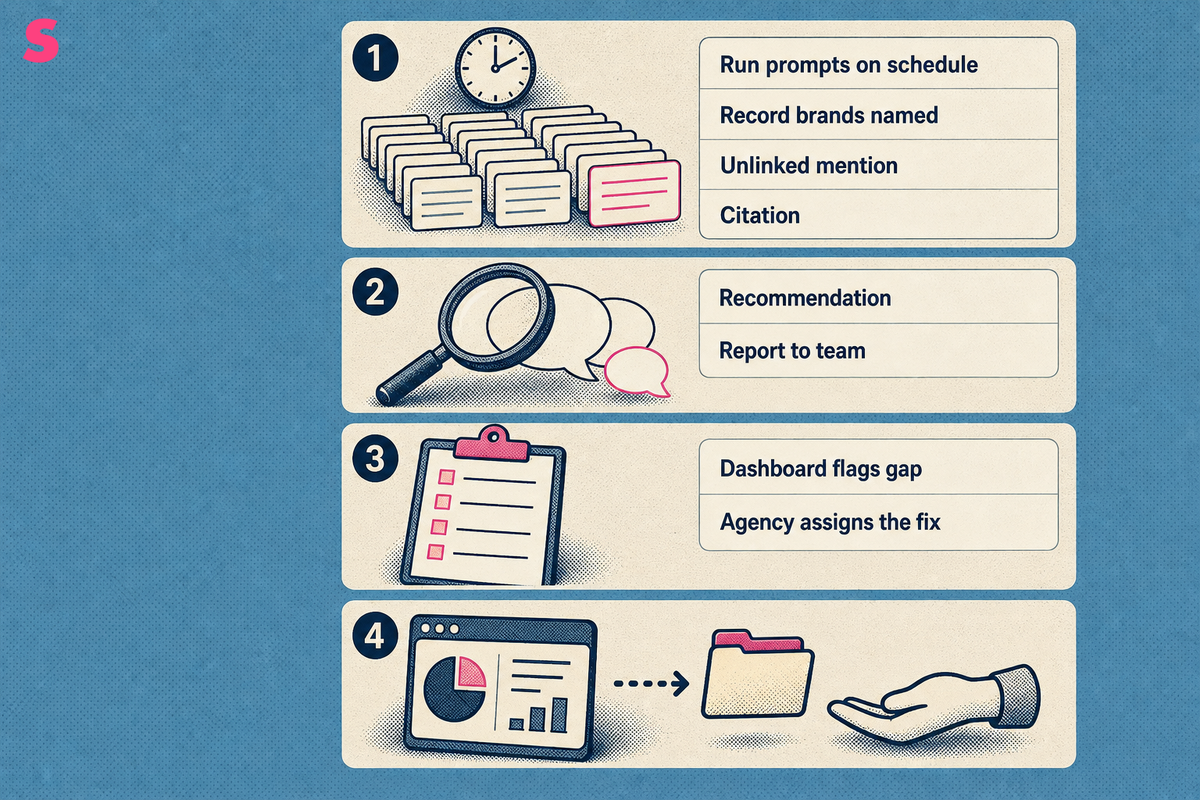
An agency that tracks brand mentions in ChatGPT and Perplexity runs a defined prompt set on a schedule, records which brands appear in the answers, and reports citations, recommendations, position, and competitor presence. It supports in-house marketing teams, multi-client agencies, and enterprise programs that need a repeatable record of AI search visibility.
Monitoring software automates collection and reporting. A managed service adds execution, including prompt research, editorial placements, content changes, technical fixes, and recurring reporting. A dashboard can identify a citation gap. An agency can assign and manage the work required to address that gap.
According to flint.com, AI visibility tracking tools monitor whether ChatGPT, Perplexity, Claude, Gemini, Google AI Overviews, and other answer engines name a brand. For a B2B team, the record shows whether a buyer asking for category advice encounters the company, its competitors, or neither.
Brand monitoring in AI answers distinguishes among unlinked mentions, cited sources, and direct recommendations. A brand may appear in an answer without receiving a visit. A cited comparison page can generate qualified research traffic. A tracker should preserve those distinctions rather than reduce every answer to one visibility percentage.
Should you hire an agency, buy software, or track brand mentions manually?
Use manual tracking for a short prompt list, software for recurring measurement owned by an internal team, and a managed agency when the business needs measurement and execution support. The choice depends on prompt volume, available skills, reporting demands, and ownership of follow-up work.
- Use a spreadsheet when the team has a limited priority prompt set, a narrow market scope, and enough time to capture results each day.
- Buy software when the team needs recurring prompt execution, competitor comparisons, citations, and a shared reporting record across ChatGPT, Perplexity, Gemini, Claude, and other answer engines.
- Hire a managed agency when nobody owns prompt design, content updates, editorial outreach, or stakeholder reporting after the tracker identifies a gap.
Running the same prompt list daily reveals patterns that a weekly snapshot can obscure. An answer can change after a retrieval-index update, a model update, or a competitor publication. Repeated observations under consistent conditions distinguish sustained movement from isolated noise.
Sona AI Visibility connects prompts and citations to pipeline and revenue while tracking AI crawler activity from server logs or a lightweight edge worker. The decision becomes less about collecting another mention score and more about whether AI-referred research contributes to accounts and deals.
How much does it cost to track brand mentions in ChatGPT and Perplexity?
Tracking costs range from staff time for a manual spreadsheet to several thousand dollars per month for managed execution. Software entry points begin at $29 per month, while one managed agency listed plans from $1,997 to $4,997 per month in September 2026.
Normalize pricing before comparing plans. Vendors package monitoring by prompts, credits, domains, answer engines, response volume, and client workspaces. A lower monthly figure can reflect a narrower prompt allowance or fewer engines, so compare the coverage required for the same operating model.
| Approach | Monthly cost | Setup time | Technical skill required | Coverage depth |
|---|---|---|---|---|
| Manual spreadsheet tracking | Loaded hourly rate × prompt runs × engines × repetitions, plus reporting time | Team-led prompt and logging setup | Low to moderate | Small fixed prompt set across selected engines |
| Entry-level software | From $29 per month, as of October 2026 | Vendor-guided setup | Moderate | Automated recurring monitoring across core answer engines |
| Mid-tier software | From $95 to $295 per month, as of October 2026 | Configuration and workflow setup | Moderate to high | More prompts, more engines, competitive reporting, and shared workflows |
| Enterprise software | Custom pricing or higher-volume plans | Cross-team implementation | High | Multi-market, multi-brand, and account-level measurement programs |
| Managed agency | $1,997, $3,497, or $4,997 per month, one managed agency listing, September 2026 | Agency-led onboarding | Low internal technical requirement | Monitoring plus execution support, with higher tiers covering editorial placements or custom prompts |
The September 2026 managed-agency listing included ChatGPT and Perplexity citation tracking at $1,997 per month, 10 editorial placements and four-engine monitoring at $3,497 per month, and custom prompts with four-engine monitoring at $4,997 per month. These packages cover labor and deliverables, not only a reporting interface.
How do ChatGPT and Perplexity tracking tools compare on price, engine coverage, and prompt capacity?
ChatGPT and Perplexity trackers differ in starting price, engine coverage, prompt capacity, collection method, and agency-plan availability. The comparison below separates entry-plan coverage from broader enterprise coverage, so buyers can compare published operating limits on a common basis.
The comparison below uses published entry-plan details as of October 2026. A tool can support more engines at higher tiers, but the table separates listed starting plans from enterprise coverage.
| Tool | Starting price | Agency Plans? (Yes/No) | # of Answer Engines Tracked | Answer Engines | # of Daily Tracked Prompts (entry plan) | Cost per Daily Tracked Prompt | Differentiation |
|---|---|---|---|---|---|---|---|
| Sona AI Visibility | From $75/month, billed annually | Yes | Up to 11 (3 on Starter) | Not published | 5,000 credits/month, about 166 daily tracked prompts on one model or 56 across three | $0.45 per daily tracked prompt | Tracks AI crawler activity from server logs or a lightweight edge worker. Growth from $249/month adds AI search attribution. |
| Profound | Free Trial, then custom pricing | Yes | Up to 9 (3 on free Trial) | ChatGPT, Gemini, Google AI Overviews | 50 prompts daily for 7 days | Cannot calculate from custom pricing | Tracks how brands appear across ChatGPT, Gemini, Claude, Perplexity, Copilot, and Google AI results on broader plans. |
| Peec AI | From $95/month | Yes | Up to 13 (3 of 6 on Starter, plus add-ons) | Not published | 50 prompts daily | $0.63 per daily tracked prompt | AI visibility tracking for prompts and brand presence across self-serve and agency plans. |
| Otterly.ai | From $29/month | Yes | Up to 7 (4 on Lite, 3 as paid add-ons) | ChatGPT, Google AI Overviews, Perplexity, Microsoft Copilot | 15 prompts daily | $0.48 per daily tracked prompt | Tracks brand visibility across four core answer engines at the Lite tier. |
| Scrunch AI | From $250/month | Yes | Up to 9 (4 on Core) | ChatGPT, Perplexity, Google AI Overviews, Microsoft Copilot | 125 prompts | No refresh cadence published | AI visibility measurement across four engines on Core, with broader enterprise coverage. |
| AthenaHQ | From $295/month | Yes | 11 | ChatGPT, Perplexity, Google AI Overviews, Gemini, Claude, Copilot, Not published | 3,600 credits/month, unlimited prompts | No refresh cadence published | Model coverage and credit-based tracking, with 300 credits on its free tier. |
Sona AI Visibility provides mention and competitor tracking across 11 answer engines. On Growth plans from $249 per month, it connects AI citations and prompts to pipeline and revenue on one account timeline. It also tracks which AI crawlers reach site pages, making AI-referred research measurable against accounts and deals.
A single brand-level visibility score is not a work item. A prompt-level view is. Sona AI Visibility identifies the prompts where a brand appears, the sources cited in those answers, and the pages that should surface but do not, so a team can assign a content or technical task.
What should a tracker measure: mentions, citations, recommendations or revenue?
A useful tracker should measure mentions, citations, recommendations, sentiment, share of voice, qualified visits, conversions, and revenue influence as separate signals. A mention is awareness evidence. A cited page is source evidence. A recommendation is stronger buying-context evidence. Revenue requires attribution beyond the answer itself.
- Unlinked mention: the answer names the brand without a source URL.
- Citation: the answer links or attributes a claim to a page.
- Recommendation: the answer presents the brand as a suitable choice for the prompt.
- Qualified visit: an AI-referred visitor reaches the site and shows relevant engagement.
- Conversion and revenue influence: the visitor or account becomes associated with a signup, opportunity, or closed-won deal.
Run ChatGPT, Perplexity, and a third engine such as Gemini in the same tracking program. The three-engine view shows whether a brand appears consistently or only in one answer environment. It also prevents a team from treating one engine's retrieval behavior as the whole market.
Most AI visibility tools report whether a brand was mentioned. Sona AI Visibility uses AI Attribution to connect AI citations to accounts, pipeline, and closed-won revenue on one timeline, including research that never produced a click through self-reported attribution.
How do you track brand mentions manually in ChatGPT and Perplexity, step by step?
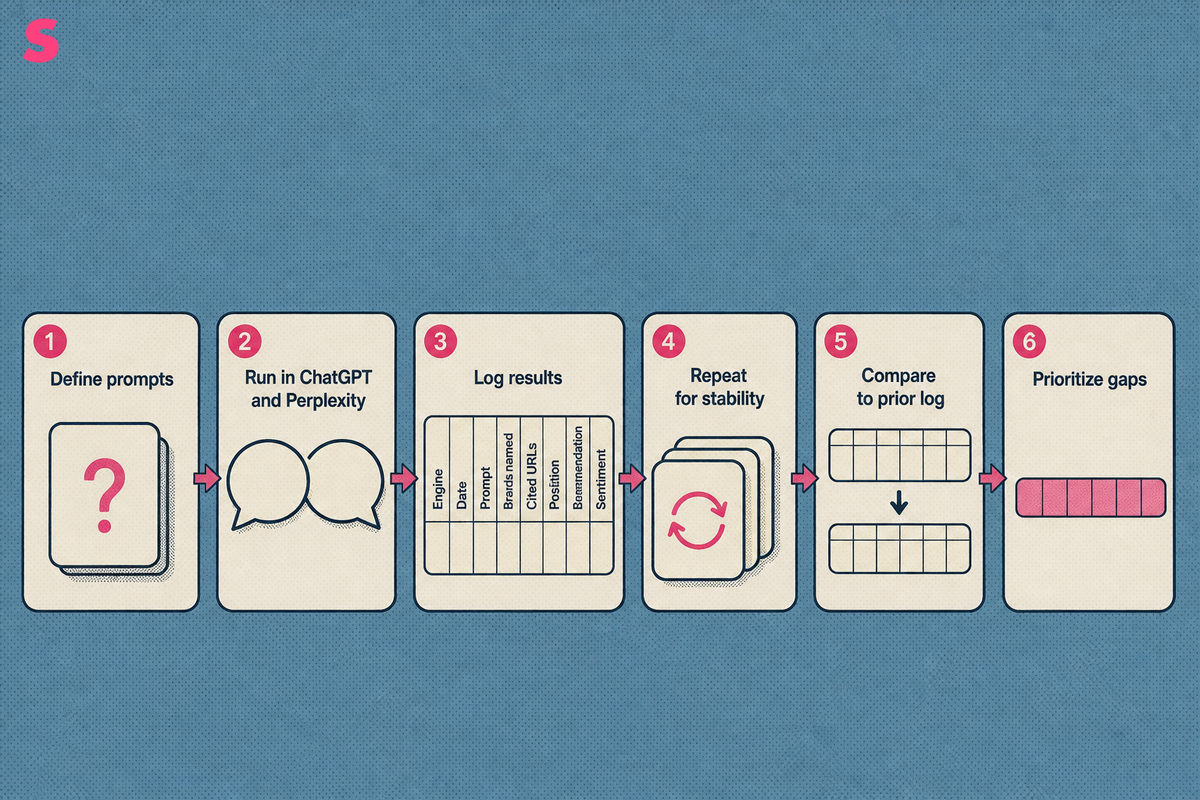
Manual tracking works when a team uses a fixed prompt set, runs every prompt daily, and logs each answer in a consistent spreadsheet. The workflow is reproducible, but it becomes labor-intensive as the prompt list expands across markets and answer engines.
- Define the category, competitor, problem-led, and location-led questions buyers use.
- Run each prompt in ChatGPT and Perplexity with the same wording, location, and account conditions.
- Record the engine, date, prompt, brands named, cited URLs, average position, recommendation status, and sentiment.
- Repeat the same prompt several times during the sampling period to identify unstable answers.
- Compare daily results with the prior record, then prioritize persistent citation or recommendation gaps.
Use a copyable prompt template: What are the best [category] options for [audience] with [requirement] in [location]? Example prompts include:
- What are the best AI visibility platforms for B2B SaaS teams?
- How does [your brand] compare with three alternatives for marketing attribution?
- How can a demand generation team attribute pipeline to AI search?
- What AI search tracking tools serve enterprise SaaS companies in North America?
A daily prompt log distinguishes sustained movement from an isolated answer variation. Keep the wording fixed. Change only one variable, such as location or audience segment, when testing a deliberate hypothesis.
What does competitive benchmarking look like in a single tracking run?
A competitive benchmark compares the same prompt set, engines, and scoring rules for every brand. The illustrative run below uses the same prompts across ChatGPT and Perplexity, with each metric labeled as an example rather than observed market data.
| Brand | Mention rate | Citation rate | Average position | Sentiment |
|---|---|---|---|---|
| Your brand | Illustrative moderate | Illustrative low | Illustrative middle position | Positive illustrative |
| Competitor A | Illustrative high | Illustrative high | Illustrative leading position | Positive illustrative |
| Competitor B | Illustrative moderate | Illustrative moderate | Illustrative middle position | Neutral illustrative |
| Competitor C | Illustrative low | Illustrative low | Illustrative trailing position | Mixed illustrative |
Act first on a persistent citation gap for high-intent prompts, rather than the lowest mention rate. A brand that appears often but earns few citations has a source-authority or page-coverage problem. Review the cited URLs for the leading competitor, then determine whether the gap concerns evidence, page structure, recency, or missing comparison content.
Benchmark reports work best as a monthly or quarterly review layer. The prompt list should still run daily. Daily collection creates the log, while periodic review turns repeated patterns into content, PR, and technical priorities.
How reliable are AI visibility scores, and what common tracking mistakes distort them?
AI visibility scores are reliable only when the collection method is disclosed and repeated consistently. Common mistakes include changing prompt wording, mixing prompt types, failing to preserve answers and citations, using inconsistent run conditions, and relying on one aggregate score.
ChatGPT and Perplexity answers are nondeterministic. Retrieval sources change, models update, and answer formatting varies between sessions. A score that does not preserve the underlying answer, cited URLs, and run conditions cannot show whether movement came from the brand, the engine, or the sample.
- Keep the prompt wording fixed during measurement.
- Run the prompt list daily and compare repeated samples.
- Separate location-specific prompts from global prompts.
- Do not combine branded, category, and comparison prompts into one undifferentiated score.
- Review the cited sources, not only the final percentage.
Sona AI Visibility tracks Google AI Overviews alongside other answer engines and connects AI citations and prompts to pipeline and revenue. Rankscale was listed with visibility tracking across more than 17 engines, including ChatGPT, Perplexity, Claude, Gemini, and Google AI Overviews, in an October 2026 listing. A smaller prompt set with stable sampling and clear commercial intent can still produce a more actionable operating record.
Who should not hire an agency or buy a brand mention tracker?
Brand mention tracking is not for every business. Teams without content, PR, product marketing, or technical capacity to act on findings should delay a software or agency commitment. A tracker identifies gaps. It does not write missing evidence, earn placements, or update pages without clear ownership.
Manual tracking suits businesses with a small prompt set and a narrow market. A spreadsheet is also enough for teams that need a one-off check rather than an ongoing program. The Free AI Readiness Checker is useful for checking whether AI engines can technically crawl and parse a site, but it does not measure brand mentions or citations.
In-house teams should buy software when they can manage prompt research, reporting, and execution. Agencies should use multi-client plans when they need separate client workspaces and repeatable reporting. Enterprise programs should use a platform or managed service when multiple brands, markets, buying committees, and revenue systems require a common measurement model.
Businesses whose buyers rarely use AI search should not prioritize broad monitoring before validating demand. Start with a limited prompt set, run it daily, and examine whether relevant category and comparison questions produce meaningful brand, citation, or referral signals.
Frequently asked questions about tracking brand mentions in ChatGPT and Perplexity
What is an agency that tracks brand mentions in ChatGPT and Perplexity?
An agency that tracks brand mentions in ChatGPT and Perplexity runs a fixed set of prompts in both engines on a schedule, records which brands are named and cited, and reports changes over time. Managed services also add optimization work, including editorial placements, content updates, technical fixes, and reporting. Software alone collects and reports results.
How much does it cost to monitor brand mentions in ChatGPT and Perplexity?
Software starts at $29 per month in the dated listings, while mid-range plans run from about $95 to $295 per month, as of October 2026. One managed agency listed plans from $1,997 to $4,997 per month in September 2026. Compare prompt volume, engine coverage, and execution support alongside price.
Can I track brand mentions in ChatGPT and Perplexity for free?
Yes. Run the same prompts on a schedule and log the answers in a spreadsheet. Manual tracking costs time rather than a software subscription, but it becomes harder to manage as the prompt list expands across markets and answer engines.
How often should brand mention prompts be run?
Run each prompt daily and repeat it several times during the sampling period because answers vary between runs. Keep wording, location, engine settings, and account conditions fixed. Repeated observations under those conditions distinguish sustained movement from an isolated spike.
Is a brand mention the same as a citation in an AI answer?
No. A mention names the brand in answer text. A citation attributes an answer claim to a source page or links to that page. A useful tracker records both signals, along with whether the brand was recommended, its position in the answer, and the sentiment surrounding the reference.
Does tracking AI brand mentions show whether they lead to revenue?
Mention tracking alone does not show revenue. Sona AI Visibility connects prompts and citations to pipeline and revenue, allowing a team to examine which AI answers lead to identifiable accounts, opportunities, and closed-won deals.
Summarize this article with AI: ChatGPT · Claude · Perplexity · Google AI Mode
Last updated: October 2026