


For tracking brand mentions in AI search, choose a fixed set of buyer prompts, run every prompt three to five times per engine in new chats, and record whether your brand is mentioned, recommended, cited or omitted. Divide these counts by total runs to calculate mention rate, citation rate and share of voice. Sona AI Visibility automates this logging, connects prompts and citations to pipeline and revenue, and monitors AI crawler activity; a spreadsheet works for small prompt sets. Repeat monthly, or every two weeks during campaigns.
What should you define before you track brand mentions in AI search?
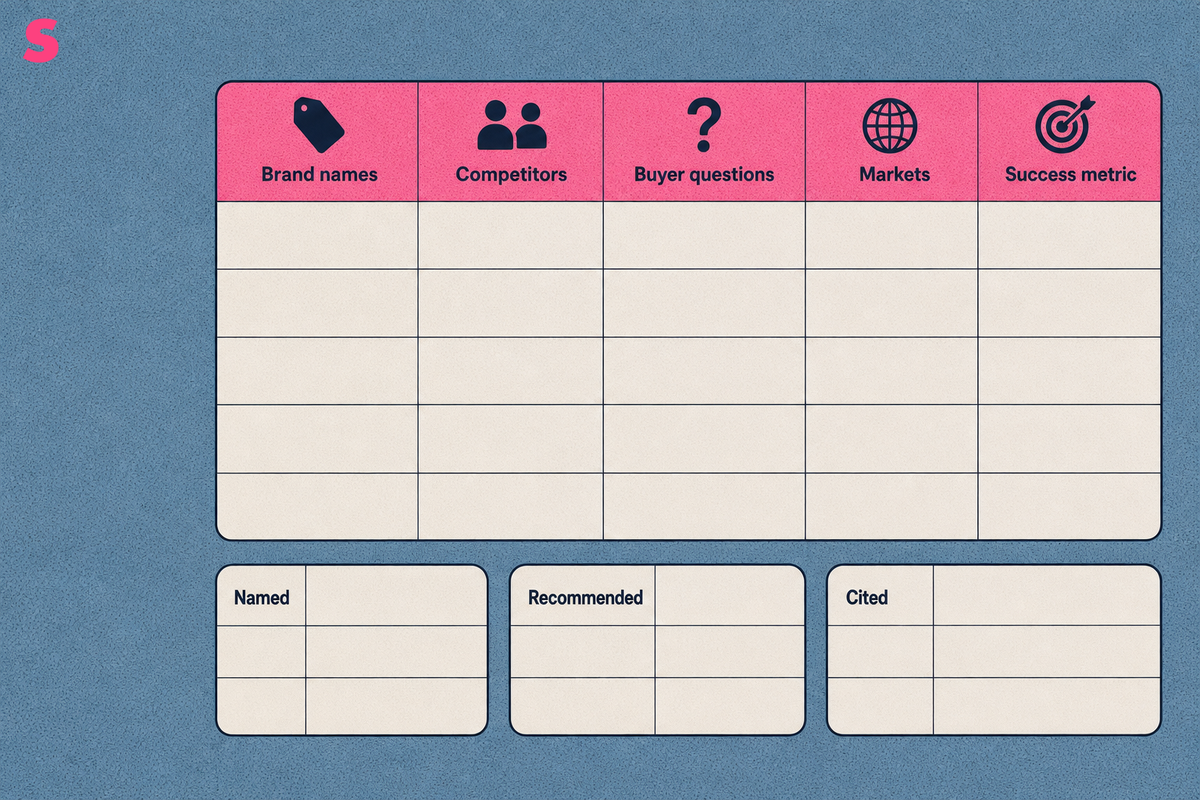
To track brand mentions in AI search, define the brand, competitors, buyer questions, target markets, and success metric before collecting answers. Without those controls, a mention count combines unrelated prompts and produces a number nobody can use.
Prerequisite: create a shared tracking sheet or workspace with one row per prompt, engine, run date, answer text, mention status, recommendation status, cited sources, and notes. Manual AI brand tracking requires submitting target prompts to answer engines and recording whether the brand appears.
- Define the exact brand names, product names, common abbreviations, and misspellings that count as a mention.
- List the competitors that buyers genuinely compare, rather than every company in the category.
- Choose the markets, languages, and buyer roles represented in the test.
- Set a decision rule, such as whether a brand name alone counts or whether the answer must recommend the brand.
A useful baseline separates three outcomes: named, recommended, and cited. A brand can appear in a long vendor list without endorsement. An owned page can also be cited without the brand appearing in the visible answer.
The first output is a dated baseline, not a verdict. Record the prompt set and scoring rule beside each result so later movement reflects a real change rather than a changed definition.
Which AI engines should you monitor, and how do their answers differ?
Monitor the answer engines your buyers use, including ChatGPT, Perplexity, Gemini, Google AI Overviews, Claude, Copilot, Grok, and other answer engines. Each system can retrieve, synthesize, and cite different material.
Google AI Overviews appear within Google results and often foreground cited web pages. Chat-based systems can recommend a vendor without a visible search-results layout. Perplexity makes source inspection central to the response. The same prompt can produce a mention in one engine, a citation in another, and neither in a third.
- Use the same prompt wording across engines during the baseline test.
- Record the exact model or surface, including Google AI Overviews rather than a generic Google search.
- Keep country and language stable for every comparable run.
- Separate answer text from sources, because source links answer a different measurement question.
Perplexity research reports that 88.6% of queries expand into exactly two sub-queries. That behavior shows why the original wording is only a starting point. An engine can interpret a buyer question through multiple retrieval paths, then return a different vendor set from the same underlying web.
How do you build a prompt set that represents how buyers ask?
Build a prompt set from buyer jobs, commercial comparisons, implementation questions, and category definitions. Write each prompt as a complete question. A strong set measures brand representation when a prospect needs to choose, validate, or replace a solution.
Start with 20 to 30 prompts across awareness, consideration, decision, and purchase intent. Include non-branded prompts such as “best software for [job],” comparison prompts such as “[category] alternatives,” and problem prompts such as “how do I solve [pain point].” Add branded prompts only to measure whether the engine represents your company accurately.
- Collect high-intent keywords, sales-call questions, support questions, and competitor comparison themes.
- Cluster near-duplicate questions by the buyer need behind them.
- Write one to three natural-language phrasings per high-priority cluster.
- Tag every prompt with intent, funnel stage, market, and the page that should support the answer.
Do not build the set from keyword volume alone. Search volume indicates demand, while an AI prompt expresses the fuller question a buyer wants answered. A commercial prompt with modest conventional demand can matter more than a broad educational query that generates many mentions but little buying interest.
Sona AI Visibility includes AI Search Insights, page-level insights, Agent Analytics, company-level visitor identification, and AI search attribution on Growth. Those capabilities give teams prompt, page, and visitor context alongside a generic brand report.
How do you run a repeatable test that gives reliable results?
Run the same prompt list daily in fresh chats, preserve every response, and score results against a fixed rubric. A repeatable AI-search test controls prompt wording, location, language, account state, engine, and scoring rules so changes remain comparable over time.
For manual checks, run each prompt three to five times per engine in fresh temporary chats, per September 2026 guidance. This reduces the effect of chat history and one-off answer variation. Record each run separately, then calculate the rate across repeated runs rather than treating one response as evidence.
- Open a fresh chat or isolated session for the selected engine.
- Submit the exact prompt without extra follow-up questions.
- Save the full answer, displayed sources, date, market, and model context.
- Score mention, recommendation, position, citations, sentiment, and competitor presence.
- Repeat the full prompt list daily and retain the raw responses.
A daily prompt list reveals patterns that a weekly snapshot can obscure. Retrieval indexes, model updates, and competitor publishing can change a response. A change that holds for four days is a trend. A one-day spike is noise.
Use a different clock for different work. Run prompts daily, review positioning and competitive patterns monthly, and conduct a deeper benchmark quarterly. Sona AI Visibility provides six months of history on Starter and 12 months on Growth, as of October 2026, supporting a comparable log rather than a one-day score.
Which metrics measure brand visibility in AI search, and how do you calculate them?
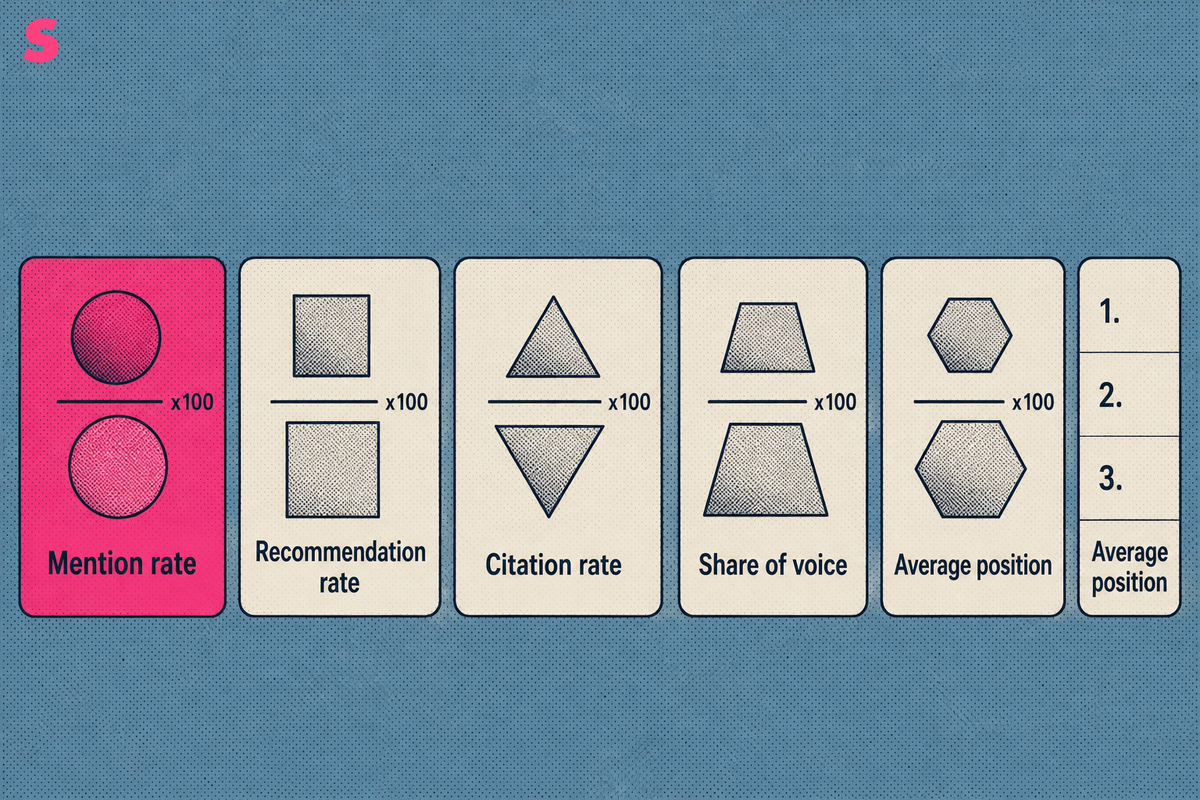
Measure AI brand visibility with mention rate, recommendation rate, citation rate, share of voice, and prompt-level position. Visibility Score and Share of Voice measure brand visibility across AI platforms, but formulas must remain consistent within the same test.
- Mention rate: prompts where the brand appears divided by all tested prompts, multiplied by 100.
- Recommendation rate: prompts where the answer explicitly recommends or includes the brand as a viable choice, divided by all tested prompts, multiplied by 100.
- Citation rate: responses that cite an owned domain, divided by all responses with visible sources, multiplied by 100.
- Share of voice: brand mentions divided by all tracked brand and competitor mentions within the same prompt set, multiplied by 100.
- Average position: the mean placement of the brand when an answer presents an ordered list.
Score every prompt at the answer level before aggregating by engine, topic, funnel stage, and market. A 0–100 visibility score is a dated snapshot, per searchengineland.com, April 6, 2026. The underlying prompt rows explain what moved.
A single brand-level score is not a work item. A prompt-level view identifies which questions lost visibility and which sources shaped the answer. Sona AI Visibility provides AI search attribution, helping teams evaluate AI search alongside other commercial measurement.
How do you track which pages and publishers AI engines cite about your brand?
Track cited pages by saving every visible source URL or publisher name beside the prompt and answer where it appeared. Citation analysis shows whether AI engines rely on owned pages, third-party reviews, editorial coverage, competitor pages, or outdated information when they describe your brand.
For each cited source, classify the source as owned, earned, partner, marketplace, review site, competitor, or unknown. Capture the exact page title, the claim it supports, the engine, and the prompt. This creates an evidence map rather than a loose list of links.
- Export or copy the sources attached to each AI answer.
- Normalize domains so subdomains and URL parameters do not create duplicate records.
- Tag the publisher type and whether the page names, recommends, or merely references the brand.
- Map owned citations to the page responsible for the result.
- Review repeated third-party sources for accuracy, recency, and competitive framing.
AI search citations are page-level evidence. A site can have strong domain authority while an obsolete page, weak comparison page, or missing implementation guide leaves the engine with poor material to cite. Sona AI Visibility includes page-level insights on Growth, as of October 2026.
Keep citation analysis separate from crawler access. A cited page proves that one answer used a source. Crawler access can help explain whether an engine can reach a page for future retrieval, but it does not prove that the page influenced a specific answer.
How can you test whether a monitoring tool catches AI-generated mentions and not just web mentions?
Test an AI mention-monitoring tool with a controlled prompt set and compare its captured answers with fresh manual runs. The tool passes when it identifies the brand, answer context, engine, prompt, and cited sources from AI-generated responses rather than merely finding web pages that contain the brand name.
Use 10 prompts that cover a category query, a competitor comparison, a use-case query, a branded query, and a negative or corrective query. Run each prompt manually three times in fresh chats, then compare the saved outputs against the platform’s report for the same engine and date.
- Check whether the tool stores the visible AI answer, not only a derived score.
- Check whether a mention is distinguished from a recommendation and a citation.
- Check whether sources are attached to the relevant prompt and response.
- Check whether country, language, and engine are visible in the result.
- Check whether response history remains available after the next refresh.
Record the test date, browser environment, account state, prompt, engine, manual answer, tool capture, retained answer text, retained citations, and any web-only false positive. No controlled tool-test results are presented here, so this protocol should not be treated as an observed pass or fail result.
A genuine AI-answer mention is distinguishable from a web mention when the saved manual answer contains the brand and the monitoring record retains the same engine, prompt, run date, answer context, and visible citations. If the evidence cannot be inspected, treat the result as directional rather than auditable.
Some tools capture answers as users see them, while others pull answers through an AI vendor’s API, which can return a different result. Test the collection method against the manual record before relying on an automated score.
Which tools automate AI brand mention tracking, and what do they cost?
Choose an AI brand mention tracker by matching its answer-engine coverage, daily prompt capacity, evidence retention, and measurement objective to your operating model. Most platforms report mentions and citations. Sona AI Visibility provides page-level insights, Agent Analytics, company-level visitor identification, and AI search attribution on Growth.
The comparison below uses public plan information as of October 2026. Cost per daily tracked prompt uses the same comparison unit for rows where a daily cadence and sufficient plan detail are published. Price alone does not show whether a tool captures the prompts, sources, and account outcomes your team needs.
| Tool | Starting price | Agency Plans? (Yes/No) | # of Answer Engines Tracked | Answer Engines | # of Daily Tracked Prompts (entry plan) | Cost per Daily Tracked Prompt | Differentiation |
|---|---|---|---|---|---|---|---|
| Sona AI Visibility | From $75/month, billed annually | Yes | Up to 11 (3 on Starter) | Not published | 5,000 credits/month, about 56 daily tracked prompts on 3 engines | $0.45 per daily tracked prompt | Page-level insights, Agent Analytics, company-level visitor identification, and AI search attribution on Growth |
| Peec AI | From $95/month | Yes | Up to 13 (3 of 6 on Starter, plus add-ons) | Not published | 50 prompts daily | $0.63 per daily tracked prompt | AI visibility tracking across self-serve and agency plans |
| Otterly.ai | From $29/month | Yes | Up to 7 (4 on Lite, 3 as paid add-ons) | ChatGPT, Google AI Overviews, Perplexity, Microsoft Copilot | 15 prompts daily | $0.48 per daily tracked prompt | Brand monitoring across four answer engines on Lite |
| Scrunch AI | From $250/month | Yes | Up to 9 (4 on Core) | ChatGPT, Perplexity, Google AI Overviews, Copilot | 125 prompts; refresh cadence not published | No refresh cadence published | AI search visibility reporting for brand and agency plans |
| AthenaHQ | From $295/month, billed annually | Yes | 11 | Not published | Unlimited prompts; 3,600 credits/month; run frequency not stated | No refresh cadence published | Unlimited prompts with response credits on Starter |
| PromptWatch | From $95/month | Yes | Not published | Not published | 50 prompts daily | $0.48 per daily tracked prompt | Prompt tracking with monthly response allowances |
| Goodie | From $295/month | Yes | Up to 14 (5 on Core) | Not published | 110 prompts daily | $0.67 per daily tracked prompt | Multi-model visibility tracking with agency plans |
Automation becomes worthwhile when the prompt set requires daily scheduling, stored answer text, citation extraction, competitor reporting, or stakeholder alerts. Keep a manual audit sample after adopting software. The sample verifies that the reporting system reflects the answers buyers actually see.
Configure exact-match filters for the brand, product names, abbreviations, and approved variants. Exclude owned domains, job listings, duplicate responses, and irrelevant namesakes. Filter the resulting records by engine, market, language, sentiment, recommendation status, and whether a mention is linked or unlinked.
Route immediate alerts for a new negative mention, inaccurate description, high-value competitor recommendation, or an influential new third-party citation. Send lower-priority changes, such as routine positive mentions and repeated answer patterns, to a scheduled digest. Assign each alert a severity level, owner, due date, and source record.
How do you know your tracking worked, and what do you do when results look wrong?
AI brand tracking worked when the same controlled prompt set produces a dated, inspectable record of answers, mentions, recommendations, citations, and changes over time. Success means knowing which prompt changed, what source shaped the answer, and what the team should investigate.
Run a validation check after the first week. Select five prompts, compare the stored output with fresh runs, and verify that the scoring rule was applied consistently. Confirm that country, language, engine, and chat state were preserved for every result.
- Missing brand mentions: verify spelling variants, prompt wording, and whether the tool monitored the intended engine.
- Unexpected competitor wins: inspect the cited sources and classify whether the answer relied on reviews, editorial pages, or competitor-owned material.
- Large day-to-day swings: review repeated runs before declaring a trend.
- Wrong citations: confirm that citation extraction attached sources to the correct answer rather than a related web result.
Results often look wrong because the test changed without documentation. Restore the original prompt wording, run fresh isolated sessions, rescore against the written rubric, and mark the flawed run as non-comparable rather than deleting the record. A clean log preserves the reason a number moved.
- Positive and accurate mention: preserve the supporting owned page and record the source, owner, status, and follow-up test.
- Inaccurate description: correct the relevant owned content, then rerun the original prompt after publication.
- Missing or outdated citation: update the page associated with the missing claim, citation, or buyer question, then test the original prompt again.
- Incorrect influential third-party source: brief the publisher or source owner with the factual correction and retain the outreach status.
- Competitor recommendation: analyze the cited sources and claims that supported the competitor, assign a content or research owner, and rerun the original prompt after the response work.
Sona AI Visibility provides company-level visitor identification and AI search attribution on Growth, as of October 2026. That evidence helps teams evaluate AI-referred activity alongside brand visibility.
What are the frequently asked questions about how to track brand mentions in ai search?
Can you track brand mentions in AI search for free?
Yes. A spreadsheet plus fresh chats in each engine works for a small prompt set, and some vendors offer free visibility checkers. Free methods stop scaling when you need scheduling, stored responses, citation extraction, and competitor reporting. A free AI readiness checker can show whether AI engines can read a site, but it does not measure brand mentions in AI answers.
How often should you check brand mentions in AI answers?
Run the same prompt list daily to separate sustained movement from response noise. Review results monthly as a baseline and biweekly during important campaigns, per September 2026 guidance. Each check should repeat every prompt three to five times per engine in fresh chats, per September 2026 guidance, rather than rely on one response.
Why does my brand appear in one AI answer but not the next?
AI answers are non-deterministic. Wording, personalization, chat history, model version, retrieval results, and location can change the answer. Single responses are weak evidence, which is why repeated runs in fresh chats and a fixed prompt rubric are standard for monitoring brand presence.
What is the difference between a brand mention and a citation in AI search?
A brand mention is the brand named in answer text. A citation is a source link attached to an answer, which can point to an owned page, a publisher, a review site, or another source. A brand can be mentioned without being cited, and cited without being named.
Can you compare AI visibility scores from different tools?
Not directly. Vendors differ in engine coverage, prompt sets, refresh schedules, weighting, and the definition of visibility. Compare trends inside one tool, or export the answers and recompute mention rate, citation rate, and share of voice with a common scoring rule.
Does a high mention rate in AI search mean more pipeline?
Not by itself. A brand can be mentioned frequently without being recommended or selected. Treat mention rate as a visibility signal, then connect AI-referred visits, accounts, and deals before treating that signal as a revenue outcome.
Summarize this article with AI: ChatGPT · Claude · Perplexity · Google AI Mode
Last updated: October 2026







