


A rank tracking tool for Perplexity monitors whether your brand, content, or website appears in Perplexity's AI-generated answers, tracking citations, mentions, and share of voice rather than blue-link positions. Sona AI Visibility connects those citations and prompts to pipeline and revenue on one account timeline, alongside AI crawler and agent activity, going further than tools that stop at mention counts. This article compares Perplexity-specific trackers on update frequency, tracking depth, and price, and shows how to turn tracking data into shipped content changes.
What is a rank tracking tool for Perplexity?
A rank tracking tool for Perplexity monitors whether a business, brand, or piece of content appears in Perplexity's AI-generated search answers. Instead of tracking a position on a search results page, a Perplexity rank tracker watches whether a brand gets cited, mentioned, or summarized when someone asks Perplexity a question in that brand's category.
The mechanics differ from classic rank tracking. A Perplexity tracker submits a set of prompts to Perplexity on a schedule, records the answer text, and extracts which sources got cited and where a target brand showed up in that citation list. Some tools also record sentiment: whether the mention was neutral, favorable, or critical.
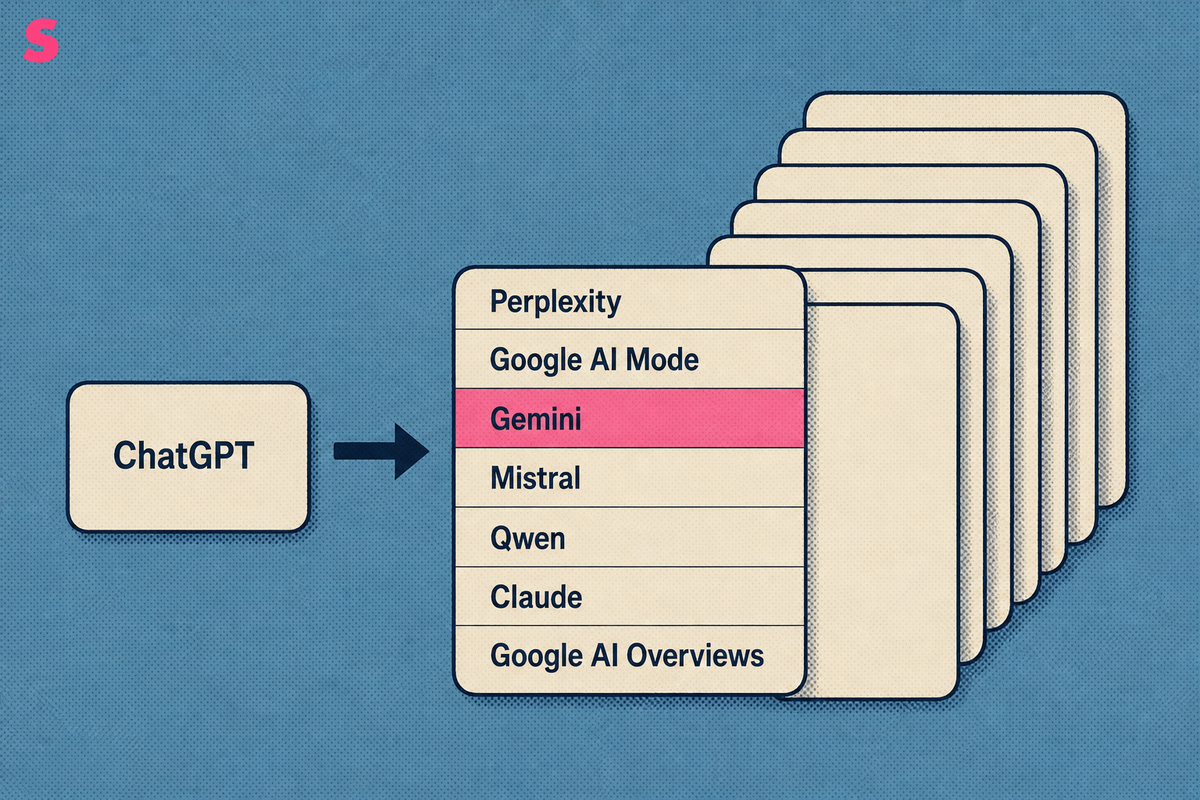
Most Perplexity ranking trackers fold this into a broader answer-engine tracking product that also covers ChatGPT, Gemini, and Google AI Overviews, because a marketing team rarely cares about Perplexity in isolation. Sona's own AI visibility archive, for comparison, covers eight answer surfaces: ChatGPT, Perplexity, Google AI Mode, Gemini, Mistral, Qwen, Claude and Google AI Overviews (Sona's own AI visibility data, August 2026).
A Perplexity rank tracking tool is therefore not a single-purpose gadget. It is one module inside a wider category of answer-engine visibility software, sized and priced according to how many prompts and engines a team wants to run.
How does tracking rankings on Perplexity differ from tracking Google rankings?
Google returns a ranked page of results a searcher scans and clicks; Perplexity retrieves a narrower set of sources and synthesizes them into a single written answer, so the unit worth tracking changes from a position on a page to a mention inside a paragraph. This shift in what gets measured is the starting point for any Perplexity tracking approach.
This is why teams tracking rankings on Perplexity need a different measurement approach than a keyword rank tracker requires. There is no page one, page two structure to check. There is an answer, and a brand either appears in the sources behind it or it does not.
Perplexity website rank tracking also has to account for answer volatility. The same prompt can return a different answer, with different citations, from one day to the next, because the underlying retrieval index and the model itself both change. A once-a-month check on Google rankings still tells a team something useful; a once-a-month check on a Perplexity answer may have already missed several shifts.
The practical reason to track Perplexity rankings at all is that the traffic and trust benefits look different too. A citation in a Perplexity answer does not behave like a blue link; it behaves like being quoted by a source the reader already trusts, which is why authority and citation depth matter more here than backlink volume does in classic SEO.
What metrics should a Perplexity rank tracking tool actually measure?
The best tool for tracking Perplexity rankings measures four things at minimum: whether a brand was mentioned, how it was cited, how often competitors appeared instead, and which sources Perplexity trusted enough to cite. Perplexity rank tracking software that only reports a single visibility score is giving a headline without the underlying story.
Concretely, a useful Perplexity rank tracking setup should report:
- Mention rate: the share of tracked prompts where the brand appears at all
- Citation position: where the brand sits among the sources cited in an answer
- Source overlap: which competing domains Perplexity cites on the same prompts
- Sentiment: whether the mention reads as positive, neutral, or negative
- Answer stability: how much a given prompt's answer changes across repeated checks
Most checkers stop at these mention counts and source lists; Sona AI Search Insights connects prompts and citations to pipeline and revenue on one account timeline, and surfaces the AI crawler activity behind a page getting cited in the first place, rather than leaving a team with one number and no next step.
A comparison table further in this article shows how published tools differ on prompt counts and engine coverage, which is the practical version of these metrics in commercial terms.
Why should a business track its rankings on Perplexity?
A business should track Perplexity rankings because Perplexity now sits in the same research path as Google for a growing share of buyers, and a brand invisible there is invisible at the exact moment someone is comparing options. Tracking rankings on Perplexity turns a guess about AI visibility into a measurable, repeatable check.
There are three concrete reasons this matters beyond curiosity:
- Perplexity answers cite sources by name, so a missing citation is a specific, findable gap, not a vague ranking drop.
- Competitors who do appear in those answers are capturing consideration-stage attention a brand never sees in its analytics, because that research often produces no click at all.
- A small authority improvement can move a brand from absent to cited in a Perplexity answer faster than the same effort would move a Google ranking, since the two surfaces reward different signals.
Why track Perplexity rankings comes down to accountability, too. Without a repeatable check, a team is relying on anecdote: someone typed a question into Perplexity once and did not see the brand. A tracking tool replaces that anecdote with a dated, comparable record.
Perplexity rank tracking tools can track brand mentions, citations, rankings, and share of voice in Perplexity's AI-generated answers (topcited.ai), which is what turns "we think we're missing from Perplexity" into a number a marketing leader can put in a board deck.
Which are the best Perplexity rank tracking tools available now?
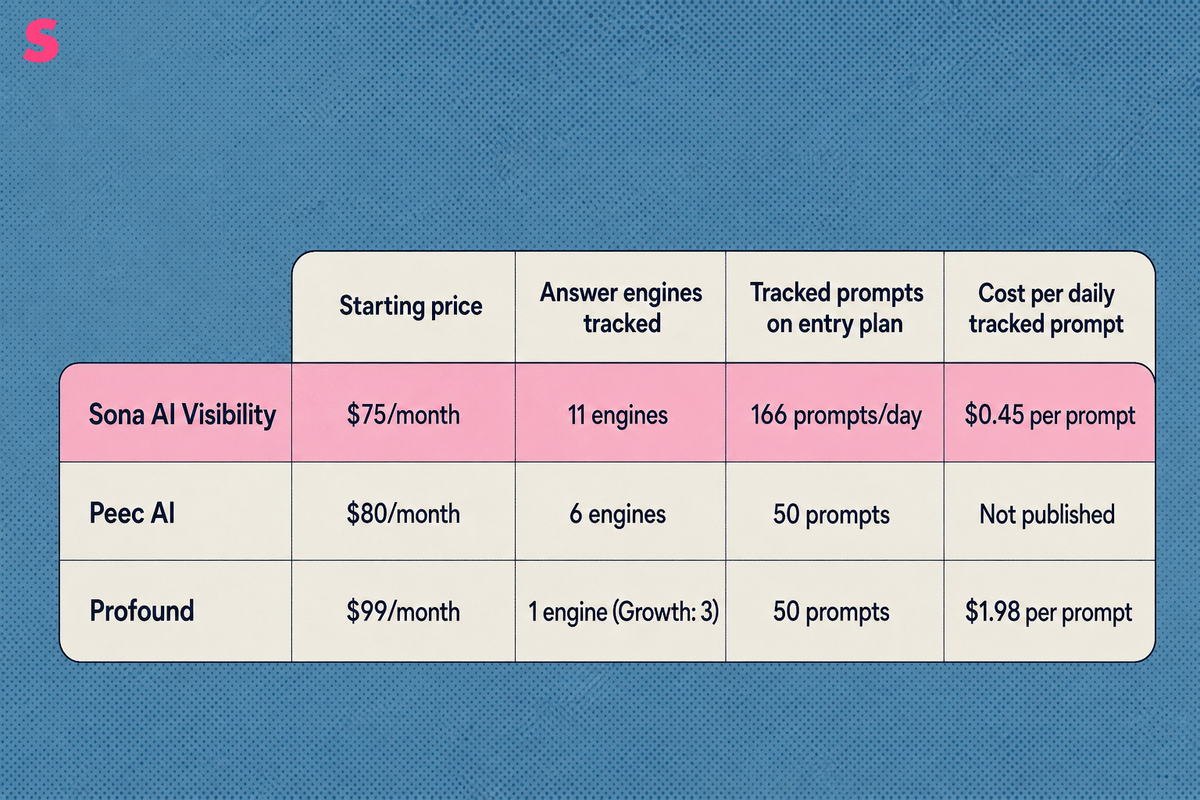
There is no single best Perplexity rank tracker; the right choice among Sona, Peec AI, Profound, PromptRush, Otterly.ai, Scrunch AI, AthenaHQ and Semrush depends on engine coverage, daily prompt allowance, refresh cadence, and cost per prompt tracked daily. The table below compares them on the columns that actually decide a purchase: what each plan tracks, how many prompts it buys, and what a daily tracked prompt costs on one shared denominator.
| Tool | Starting price | Answer engines tracked | Tracked prompts (entry plan) | Cost per daily tracked prompt | Notable detail |
|---|---|---|---|---|---|
| Sona AI Visibility | Brands from $75/month, agencies from $199/month, both billed annually. 14-day free trial, no credit card. Unlimited seats and API/MCP access on every plan | 11: ChatGPT, Gemini, Google AI Mode, Google AI Overviews and Perplexity on standard, plus Claude, DeepSeek, Grok, Copilot, Qwen and Mistral on premium | 5,000 credits/month on Starter 5K, about 166 prompts tracked daily on one model or 56 across three. 1 credit = 1 AI answer | $0.45 per prompt tracked daily | Resolves anonymous accounts behind AI-referred visits and scores intent, rather than reporting mentions alone |
| Peec AI | From $95/month (Starter), $245 (Pro), $495 (Advanced), Enterprise custom, billed monthly. Unlimited users on every plan; 50, 150 and 350 prompts by tier | 6 listed for self-serve: ChatGPT, Google AI Mode, Google AI Overviews, Microsoft Copilot, Gemini and Naver AI, with 3 active on Starter. Enterprise up to 13 | 50 prompts on Starter, 150 on Pro, 350 on Advanced | About $0.63 per daily prompt | Unlimited users on every plan |
| Profound | No self-serve brand price: a free Trial and custom Enterprise. The Trial tracks 3 answer engines | 3 on the Trial: ChatGPT, Gemini and Google AI Overviews. Up to 9 on Enterprise | 50 prompts daily for 7 days on the Trial; Enterprise has a custom prompt plan, daily | Not published | Perplexity coverage requires the Growth tier |
| PromptRush | From $19/month (Lite), $99 (Growth), $279 (Scale), Enterprise custom. Free one-off visibility report, no signup. 15% discount on annual billing; Claude tracking is a add-on from $39/month | 5 on every plan: ChatGPT, Gemini, Perplexity, Google AI Overviews and Google AI Mode. Claude is a paid add-on, not included | 25 prompts on Lite, 150 on Growth, 400 on Scale, scanned daily on every plan | $0.15 per prompt tracked daily | Free one-off visibility report with no signup |
| Otterly.ai | From $29/month (Lite), $189 (Standard), $489 (Premium), Enterprise custom. Free trial, no commitment. 15% off annual; unlimited team members on every plan | 4 on every plan: ChatGPT, Google AI Overviews, Perplexity and Microsoft Copilot. Claude, Google AI Mode and Gemini are paid add-ons | 15 prompts on Lite, 100 on Standard, 400 on Premium, checked daily on every plan | $0.48 per prompt tracked daily | Unlimited team members on every plan |
| Scrunch AI | From $250/month (Core), Enterprise custom, billed monthly. 7-day trial of Core, no credit card. Annual discount not stated | 4 on Core: ChatGPT, Perplexity, Google AI Overviews and Copilot. 9 on Enterprise | 125 prompts on Core, custom on Enterprise | Not published | 7-day trial of Starter, no credit card |
| Semrush | AI Visibility Toolkit from $99/month per domain, billed monthly (Base plan). Separate free AI Search Visibility Checker; 7-day trial. Sold per domain, separately from the main Semrush subscription | 4 on the Base plan: ChatGPT, Google AI, Gemini and Perplexity, of which 3 LLMs of the buyer's choice are tracked | 25 custom prompts with daily AI rankings on the Base plan | About $0.99 per daily prompt | Sold per domain, separate from the main Semrush subscription |
Birdeye and Adobe's AI Content Visibility Checker publish no engine count or prompt allowance, which is itself a real finding rather than a gap in this research; Birdeye is quote-only and priced by location count, and Adobe's tool is a free, single-page scan with no ongoing tracking.
How much do Perplexity rank tracking tools cost?
Published Perplexity rank tracking software ranges from $19/month at the low end to several hundred dollars a month for enterprise-grade coverage, with the difference driven by how many prompts and engines a plan includes, not just a headline number. PromptRush starts at $19/month for 25 prompts scanned daily across five engines including Perplexity.
At the middle of the market, SE Ranking's Core and Growth plans cost $129 to $279 a month and track 100 to 250 prompts daily, though on ChatGPT, Gemini and Google rather than Perplexity. Sona's Brands plans start at $75/month billed annually, with unlimited seats and API/MCP access included on every plan.
At the higher end, Scrunch AI's Core plan starts at $250/month billed monthly, covering 125 prompts across four engines. AthenaHQ's Starter plan starts at $295/month, covering 3,600 credits, where one credit equals one AI response, across 11 models. Enterprise tiers across almost every vendor in this category are quote-only rather than published.
The cheapest published plan is not necessarily the cheapest per prompt tracked daily. PromptRush's $19/month plan works out to $0.15 per prompt tracked daily, while a $99/month plan elsewhere in the market can cost more per prompt if it buys fewer daily checks. Comparing the sticker price alone misses that.
What criteria should decide which Perplexity rank tracker you buy?
The best Perplexity rank tracker for a given team is decided by four criteria: engine coverage, prompt volume, refresh frequency, and whether the tool connects citations to a business outcome. A Perplexity rank tracking tool that scores well on engine coverage but reports weekly is solving a different problem than one refreshing daily but covering only Perplexity.
Work through these in order:
- Confirm Perplexity is actually included in the entry plan. Profound's Starter tier, for example, tracks ChatGPT only; Perplexity coverage requires an upgrade.
- Check how many prompts the entry plan buys, and divide the monthly price by the number of prompts tracked daily to get a real unit cost, not the headline prompt count.
- Verify the refresh cadence. A tool that checks weekly cannot separate a real citation change from a one-day fluctuation in Perplexity's answer.
- Ask whether the tool stops at a mention count or ties a citation back to traffic, pipeline, and revenue.
That fourth criterion is where most comparisons of the best tool for tracking Perplexity rankings stop short. Mention and competitor tracking across engines is table stakes; nearly every vendor in this category offers it. What varies is whether a tool can say a citation turned into a signup or a closed deal: Sona connects Perplexity citations and prompts to pipeline and revenue on one account timeline, which is a different question than whether a mention happened at all.
How do you turn Perplexity tracking data into shipped content changes?
Turning Perplexity rank tracking data into a shipped fix requires mapping each missed citation to a specific page, a specific source gap, and a specific technical or content correction, not just noting that visibility dropped. That mapping is the difference between a dashboard and a work queue.
A practical workflow looks like this:
- Pull the list of tracked prompts where the brand's citation rate is lowest.
- Identify which competing domains Perplexity cited instead on those same prompts.
- Check whether the brand's own page on that topic exists, and if it does, whether it has been updated recently, since Perplexity's retrieval favors fresher content over stale pages with the same information.
- Fix the specific gap: add a missing FAQ section, tighten the page's structured data, or publish the page that does not exist yet.
- Re-run the same prompt list daily. A team that runs the same prompts every day starts to see a pattern a weekly snapshot would have averaged away, because a change that holds for several consecutive days is a real move and a single-day spike is not.
Why track Perplexity rankings at all, in practical terms, comes down to this loop. Tracking without a fix attached is just a report; a fix without tracking to confirm it worked is a guess. The output that matters is not one score, it is the comparable series of scores over time with a ranked fix attached to each page that moved, so a team can tell whether the change actually worked rather than merely logging that something changed.
What objections come up before a team buys a Perplexity rank tracker?
The most common objection is "we already have a visibility tracker," and the honest follow-up question is whether that tracker can say a Perplexity mention turned into a signup or a pipeline dollar, or whether it stops at a mention count. Most Perplexity rank tracking tools, including many marketed as the best Perplexity rank tracker, are built to answer the first question and not the second.
A second objection is budget: "we don't have room for another point solution." That is a fair concern when a tool only reports Perplexity mentions in isolation. It matters less when the same subscription also covers crawler analytics, competitive benchmarking, and revenue attribution, because then it is extending measurement infrastructure a team needs anyway rather than adding a narrow new line item.
A third objection treats this as redundant with SEO work already underway. Perplexity rank trackers are not solving the same problem as a keyword rank tracker. SEO optimizes for clicks and page-one rankings; Perplexity visibility produces citations and often zero-click research, which needs its own measurement rather than being folded into a search console report.
A fourth, quieter objection is that the answers change too fast to bother tracking. That is backwards: answer volatility is the argument for daily tracking, not against tracking at all. A tool checking once a week will report noise as signal and miss real trend shifts entirely.
Frequently Asked Questions
Does a Perplexity rank tracker replace a Google rank tracker?
No. Google and Perplexity track fundamentally different surfaces: one measures a position on a results page, the other measures whether a brand gets cited inside a generated answer. Most teams run both, because a Google ranking drop and a Perplexity citation gap point to different problems and different fixes.
How often do Perplexity rank tracking tools refresh their data?
Refresh frequency varies by vendor, from daily automated scans to weekly checks. PromptRush, for example, scans prompts daily on every plan, Perplexity included. Frequency matters because Perplexity's answers to the same prompt shift with the retrieval index and model updates, so a weekly check cannot distinguish a real move from a one-day fluctuation.
Can a Perplexity rank tracking tool track competitors as well as your own brand?
Most tools track share of voice and competitive mentions alongside a brand's own citations, and this is table stakes across the category rather than a differentiator. That comparison typically shows which competing domains Perplexity cites on the same prompts a brand is missing from, which is the fastest way to spot a specific source gap worth closing.
What counts as a good citation rate in Perplexity's answers?
There is no universal benchmark for a good citation rate. What drives the number is authority and source trust, since Perplexity's answers draw on a narrower set of cited sources than a page of Google results does. A team is better served comparing its own citation rate over time and against direct competitors than chasing an industry-wide figure that does not exist.
Do Perplexity rank tracking tools work for local or multi-location businesses?
Coverage varies by locale support across vendors, and it is one of the criteria worth checking before buying. A tool that covers locales well for a national brand may not support the same granularity for a business tracking rankings across dozens of individual locations, so this needs verifying per tool rather than assumed.
Is manually checking Perplexity's answers a viable alternative to a tracking tool?
Manual spot-checks miss scale and consistency. Checking a handful of prompts by hand once in a while cannot catch the answer volatility that automated daily or weekly scans are built to catch, because a single manual check has no comparable history behind it. Without a repeatable, dated record, there is no way to tell whether a citation gap is a one-day anomaly or a genuine trend worth fixing.
Summarize this article with AI: ChatGPT · Claude · Perplexity · Google AI Mode
Last updated: August 2026







