


Marketing or growth should own the AEO budget, led by one accountable leader and supported by a shared execution team spanning SEO, content, product marketing, communications, sales and RevOps. Initially fund it by shifting 15–20% of current SEO spending, which a September 2026 strategy guide presents as a recommendation, not a verified benchmark. Keep measurement connected to pipeline: Sona AI Visibility links prompts and citations with pipeline and revenue, enabling the owner to justify the budget line with revenue evidence.
What does it mean to own the AEO budget, and what does it not include?
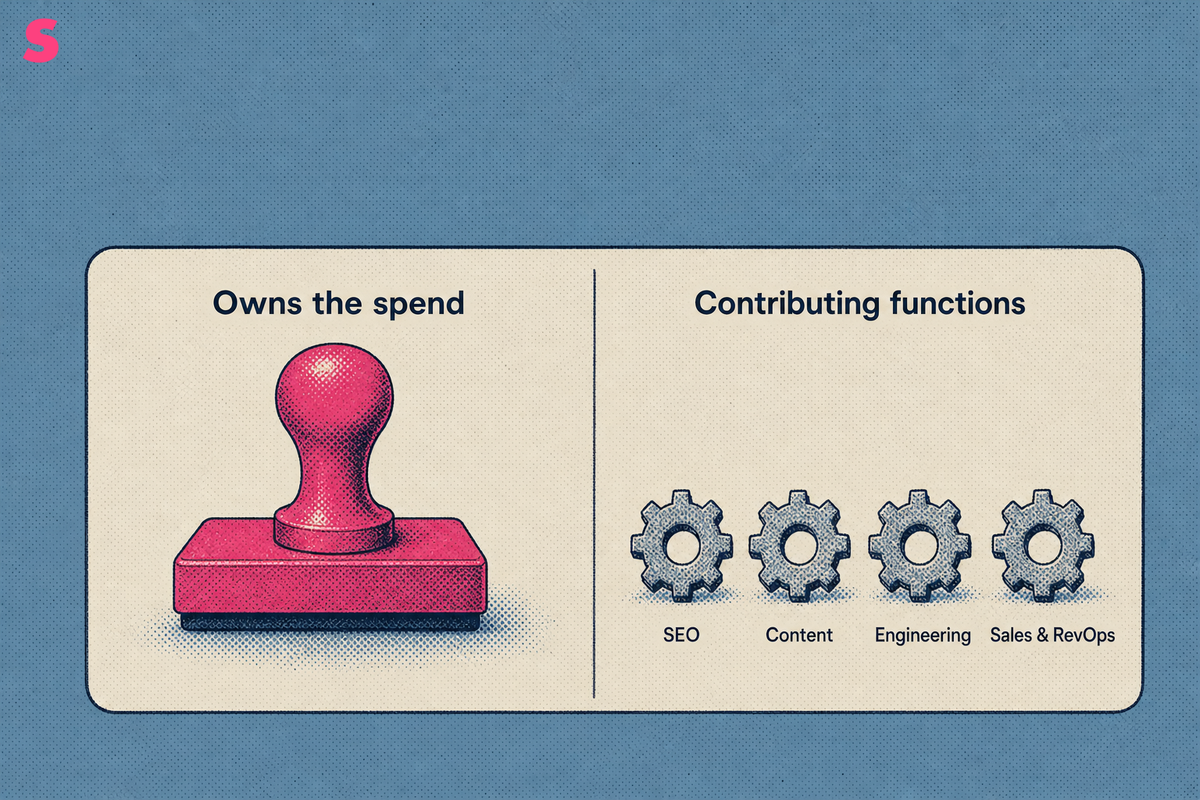
Owning the AEO budget means controlling the spend, setting priorities, and answering for answer engine optimization (AEO) results. The budget owner decides which buyer prompts matter, which work receives funding, and how performance is judged.
Budget ownership does not mean completing every task. SEO, content, communications, engineering, sales, and RevOps all contribute. One accountable leader prevents scattered experiments, duplicate agency briefs, and reports that measure citations without connecting them to business value.
AEO budget ownership is often confused with a rebranded SEO line item, a software subscription, or a content calendar. SEO remains essential, but AEO funds work that helps a company appear accurately in answers from ChatGPT, Perplexity, Gemini, Claude, Google AI Overviews, and other answer engines. A monitoring platform is one program cost, not the program.
The owner should fund a measurable operating system: a defined prompt set, content and technical fixes, citation-quality review, and a revenue measurement plan. That separates buying reports from managing a channel.
Who should own the AEO budget in a B2B SaaS company?
A marketing or growth leader should own the AEO budget in a B2B SaaS company, supported by an execution council across SEO, content, product marketing, RevOps, communications, and sales. The accountable owner needs authority over pipeline priorities, not only search rankings or publishing capacity.
Marketing should own this cross-functional channel because it governs category positioning, demand creation, budgets, and pipeline reporting. Shared execution does not require shared accountability. One leader makes trade-offs when a technical fix competes with a product page, comparison page, or campaign.
| Function | Best contribution | Strength as budget holder | Why it should or should not own the budget |
|---|---|---|---|
| SEO | Prompt research, technical requirements, crawlability, page diagnostics | Strong execution lead | SEO should shape the plan, but its remit often stops before pipeline attribution and sales activation. |
| Content | Subject-matter pages, refreshes, source quality, answer structure | Useful delivery owner | Content controls production capacity but rarely controls the full channel budget or revenue model. |
| Demand generation | Campaign priorities, audience activation, qualified-conversation targets | Strong candidate | Demand generation can own the budget when AI-referred demand is measured alongside other acquisition channels. |
| Product marketing | Positioning, category language, competitive claims, proof points | Supporting owner | Product marketing should govern message quality, but it does not normally fund technical and measurement work. |
| RevOps | Account matching, CRM rules, pipeline reporting, revenue attribution | Measurement partner | RevOps should validate business impact, but it should not become the editorial or channel strategy owner. |
The practical model assigns a CMO, VP of Marketing, or head of growth as the single owner, with SEO as the operating lead. This structure ties AEO to commercial priorities while preserving specialist judgment.
What does each team do once marketing holds the AEO budget?
When marketing holds the AEO budget, each team should own decisions within its discipline while the marketing or growth owner sets prompt priorities and release sequencing. The model works when every citation gap has a named route to resolution.
- SEO defines high-intent prompts, evaluates crawlability, and identifies the pages best suited to answer each topic.
- Content creates and refreshes pages that answer buyer questions with current, structured evidence.
- Product marketing approves category language, product claims, competitive framing, and proof points.
- Communications develops authoritative source material, executive expertise, and announcements worth citing.
- Sales records objections and questions from qualified conversations, then feeds them into the prompt backlog.
- RevOps connects AI-referred accounts to opportunities, pipeline stages, and closed-won revenue.
When an answer engine cites a competitor instead of your company, the budget owner logs the gap. SEO identifies the page that should address it, product marketing verifies the claim, content rewrites or creates the asset, and communications determines whether new third-party evidence is needed. RevOps then checks whether accounts arriving through related AI referrals progress into qualified conversations.
Sona AI Visibility supports that operating loop through AI Attribution, which connects AI citations to accounts, pipeline, and closed-won revenue on one timeline. The evidence gives the budget owner a basis for assigning work.
Should AEO be funded from the SEO budget, content, or a shared growth pool?
AEO should begin as a controlled allocation within the existing SEO or content budget, then move into a shared growth pool after the company shows repeatable commercial signals. A separate cost center is premature before the team has a working prompt set, delivery process, and measurement model.
A September 2026 recommendation proposes reallocating 15–20% of existing SEO spend toward AEO content creation. That figure is a planning recommendation, not an independently verified benchmark. The stronger budget case is not that AEO requires new money, but that existing money requires a better allocation case.
For example, a hypothetical company with a $10,000 monthly SEO budget could reserve $1,500 to $2,000 for prompt research, content refreshes, technical fixes, and measurement. That allocation gives leadership a bounded experiment rather than an open-ended request.
Budget pressure is real. A 2026 survey of more than 250 enterprise marketing leaders found that 94% planned to increase AEO and GEO investment during 2026, per markets.businessinsider.com, 2026. The response should be evidence before expanded spend, not a new channel without controls.
How should an AEO budget be split across measurement, content, technical work, and authority?
An AEO budget should fund measurement first, then content, technical readiness, and authority-building work. The right tier depends on internal capacity, but software is rarely the largest cost. Internal staff time, content refreshes, engineering work, and extra tool seats sit outside most retainers.
| Spend range | What it pays for | What the business should have accomplished | Primary budget emphasis |
|---|---|---|---|
| $29–$489 per month | Self-serve monitoring and a limited prompt set | A baseline prompt list, recurring visibility checks, and a documented gap backlog | Measurement |
| $500–$2,000 per month | Basic AEO, keyword research, and content optimization | Priority pages aligned to commercial buyer questions | Content and research |
| $1,500–$5,000 per month | Startup GEO program, content production, and technical remediation | A repeatable content and technical workflow with accountable owners | Content and technical work |
| $3,000–$10,000 per month | Mid-market agency program or broader internal execution | Coverage across priority topics, evidence development, and executive reporting | Authority and operating capacity |
| From $25,000 per month | Enterprise program, reporting, governance, and multi-team delivery | Multi-brand or multi-market governance with pipeline-level measurement | Enterprise coordination |
The self-serve range of $29–$489, the $3,000–$10,000 mid-market range, and enterprise programs from $25,000 were listed in October 2026. Basic AEO for small firms at roughly $500–$2,000 was listed by higoodie.com in October 2026. These are planning ranges, not outcome guarantees.
How much should a company spend on AEO software, and which pricing variables matter?
AEO software should be the smallest and most comparable budget line. Compare plans by prompt volume, answer-engine coverage, monitoring frequency, brands, users, and historical data, rather than monthly price alone. Daily prompt tracking reveals patterns that weekly snapshots can obscure.
Answers shift with retrieval-index changes, model updates, and competitor publishing. Treat repeated movement across a stable prompt set as a trend, and treat isolated changes cautiously. Full technical re-audits, positioning reviews, and competitive benchmark reports can run monthly or quarterly.
| Tool | Starting price | Agency Plans? (Yes/No) | # of Answer Engines Tracked | Answer Engines | # of Daily Tracked Prompts (entry plan) | Cost per Daily Tracked Prompt | Differentiation |
|---|---|---|---|---|---|---|---|
| Sona AI Visibility | From $75/month, billed annually | Yes | 11 | ChatGPT, Gemini, Google AI Mode, Google AI Overviews, Perplexity, Claude, DeepSeek, Grok, Copilot, Qwen, Mistral | 5,000 credits/month, about 56 prompts tracked daily on 3 engines | $0.45 per daily tracked prompt | Connects AI citations and prompts to pipeline and revenue on one account timeline |
| Profound | Free Trial; Enterprise custom pricing | Yes | 3 | ChatGPT, Gemini, Google AI Overviews | 50 prompts daily | Not calculable from public pricing: free trial; Enterprise custom pricing | Daily prompt tracking across three trial engines |
| Peec AI | From $95/month | Yes | 3 | Not published | 50 prompts daily | $0.63 per daily tracked prompt | Prompt tracking across self-serve AI engines |
| Otterly.ai | From $29/month | Yes | 4 | ChatGPT, Google AI Overviews, Perplexity, Microsoft Copilot | 15 prompts daily | $0.48 per daily tracked prompt | Multi-engine prompt monitoring |
| AthenaHQ | From $295/month, billed annually | Yes | 11 | Not published | 3,600 credits/month, unlimited prompts | No refresh cadence published | Credit-based AI response monitoring |
| PromptWatch | From $95/month | Yes | Not published | Not published | 50 prompts daily | $0.48 per daily tracked prompt | Prompt and response-volume tracking |
Pricing, engine coverage, and allowances in the table are current as of October 2026. Before committing, confirm that the plan covers priority prompts daily, preserves enough history for trend analysis, supports required users and brands, and measures commercial outcomes. Ask how Sona AI Visibility connects citations to pipeline and revenue rather than treating visibility as the final metric.
Which technical and content foundations does the AEO budget need to cover?
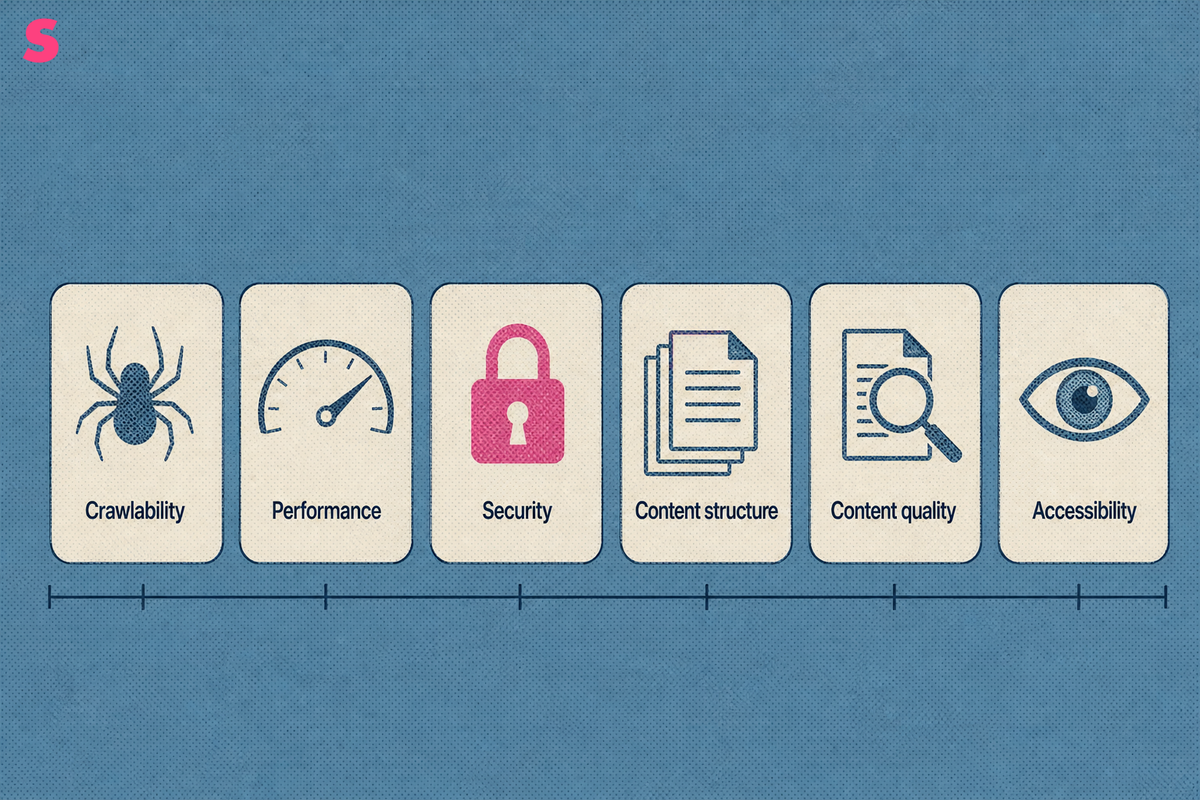
An AEO budget needs to cover six readiness dimensions: crawlability, performance, security, content structure, content quality, and accessibility. These foundations determine whether answer engines can reach, parse, trust, and reuse a page.
Crawlability covers robots.txt, canonical tags, indexability, and access for answer-engine crawlers. Performance covers server-rendered HTML, Core Web Vitals, and JavaScript dependence. Security includes transport and response-header hygiene. Content structure includes schema markup, metadata, semantic hierarchy, and valid FAQPage JSON-LD.
Content quality and recency require recurring spend because claims, proof, and category pages age. Accessibility also requires ongoing review for alt text, ARIA attributes, contrast, and explicit image dimensions. Engineering fixes such as header configuration or rendering changes are often one-off projects, while audits and content refreshes recur.
Sona AI Visibility tracks AI crawler activity from server logs or a lightweight edge worker, without a JavaScript tag. That helps a budget owner distinguish pages needing technical access work from pages needing stronger content. The useful output is the severity-ranked fix attached to the page that moved.
What operational results can each AEO budget level realistically produce?
AEO budget levels should be judged by stage-exit criteria, not promised traffic lifts or citation-rate benchmarks. The available evidence does not provide measured spend-to-performance outcomes for the listed budget ranges. Teams should therefore treat the ranges as planning investments and set their own targets for coverage, citation quality, branded search, AI referral visits, and qualified conversations.
- Entry level: cover a defined high-intent prompt set, establish a baseline, and identify pages with technical or content gaps.
- Growth level: improve the share of priority prompts where the brand appears, raise citation quality, and maintain a daily operating log.
- Scale level: connect AI referral visits to named accounts, qualified conversations, opportunity creation, and influenced revenue.
For an October 2026 planning cycle, begin with a bounded set of commercially important buyer queries rather than attempting category-wide coverage. Score prompts by commercial intent and buying stage. A brand appearing in a decision-stage comparison prompt deserves more attention than a brand appearing in a broad educational prompt.
Sona’s own AI visibility data, September 2026, covers 8 answer surfaces: ChatGPT, Google AI Overviews, Perplexity, Google AI Mode, Gemini, Mistral, Qwen, and Claude. Use a defined surface set and stable prompt list so changes can be interpreted rather than merely observed.
What triggers moving the AEO budget up a tier or bringing in an agency?
Move the AEO budget up a tier when the tracked prompt set shows sustained improvement, internal content capacity is exhausted, AI-referred accounts produce pipeline signals, or leadership needs enterprise reporting. Keep execution in-house while the team can publish, fix, and measure priority work without a delivery bottleneck.
An agency earns its cost when the company needs more specialist capacity than internal teams can provide, not because AEO is novel. Validate the channel first with a lean subscription and internal execution. Retainers fit recurring monitoring and execution, but require clear monthly deliverables, change-control rules, and exit terms to avoid open-ended scope. Hourly billing fits bounded specialist support with uncertain scope, but requires estimates, approval thresholds, and time reporting to control cost. Project pricing fits defined audits, migrations, or remediation, but requires acceptance criteria and a written list of excluded work.
Ask each agency what the fee includes, which work triggers additional charges, who owns implementation, how many prompts and pages are covered, and how results are reported. Transparent pricing and no long-term contracts are sensible selection criteria, per an October 2026 listing.
Monitoring which AI answers mention a brand is only half the job. Sona AI Visibility connects prompts and citations to accounts, pipeline, and revenue, while also tracking AI crawler and agent activity; its done-for-you services cover content, AI search optimization, technical fixes, strategy, and reporting on top of a Growth plan or above.
Escalate from a project to a retainer when repeated gaps require ongoing content, technical, and authority work. Escalate from a retainer to enterprise reporting when multiple brands, markets, or sales teams need one accountable view of AI-driven demand.
What are the frequently asked questions about AEO budgets?
Can a free tool track Claude search visibility?
Some tools list free tiers or trials. October 2026 listings include a five-model free tier and a 25-prompt trial, but engine coverage differs by plan. Confirm that Claude is included before relying on a free tier for Claude visibility.
Should the CMO or the head of SEO own the AEO budget?
Put one accountable owner in marketing or growth, often the CMO or head of growth, because AEO spans content, communications, technical work, and sales feedback. The head of SEO is a strong execution lead and core member of the shared council.
Should AEO have its own budget separate from SEO?
Start with a controlled allocation inside SEO or content. A September 2026 recommendation suggests 15–20% of existing SEO spend. Create a standalone line when prompt coverage, citation signals, and commercial measurement justify a dedicated operating model.
How much should a startup spend on AEO each month?
Startups typically spend $1,500–$5,000 per month on generative engine optimization, per an October 2026 listing. Self-serve monitoring alone ranges from $29–$489 per month in the October 2026 listings, so software is often the smaller share of the program.
What role does RevOps play in the AEO budget?
RevOps should not hold the AEO budget. RevOps supplies the measurement link between AI-referred visits, accounts, pipeline stages, win rates, and influenced revenue. That evidence justifies increased program funding.
When does an agency make sense for AEO?
An agency makes sense when internal content and technical capacity is exhausted and a lean subscription has shown measurable movement across the tracked prompt set. Mid-market agency programs run roughly $3,000–$10,000 per month, per an October 2026 listing.
Summarize this article with AI: ChatGPT · Claude · Perplexity · Google AI Mode
Last updated: Octoberr 2026







