AI agents can support SEO by handling high-volume, data-intensive work including keyword research, content gap analysis and technical audits, while a human approves each change. Begin with observation and recommendations, link Search Console and crawl data, and expand agent permissions only after its output clears a written test. Rework's August 2026 analysis found that just 16% of claimed production agents plan, observe and adapt instead of following fixed sequences, so assess execution, not the label.
What is an AI SEO agent, and how does it differ from a regular SEO tool or automation?
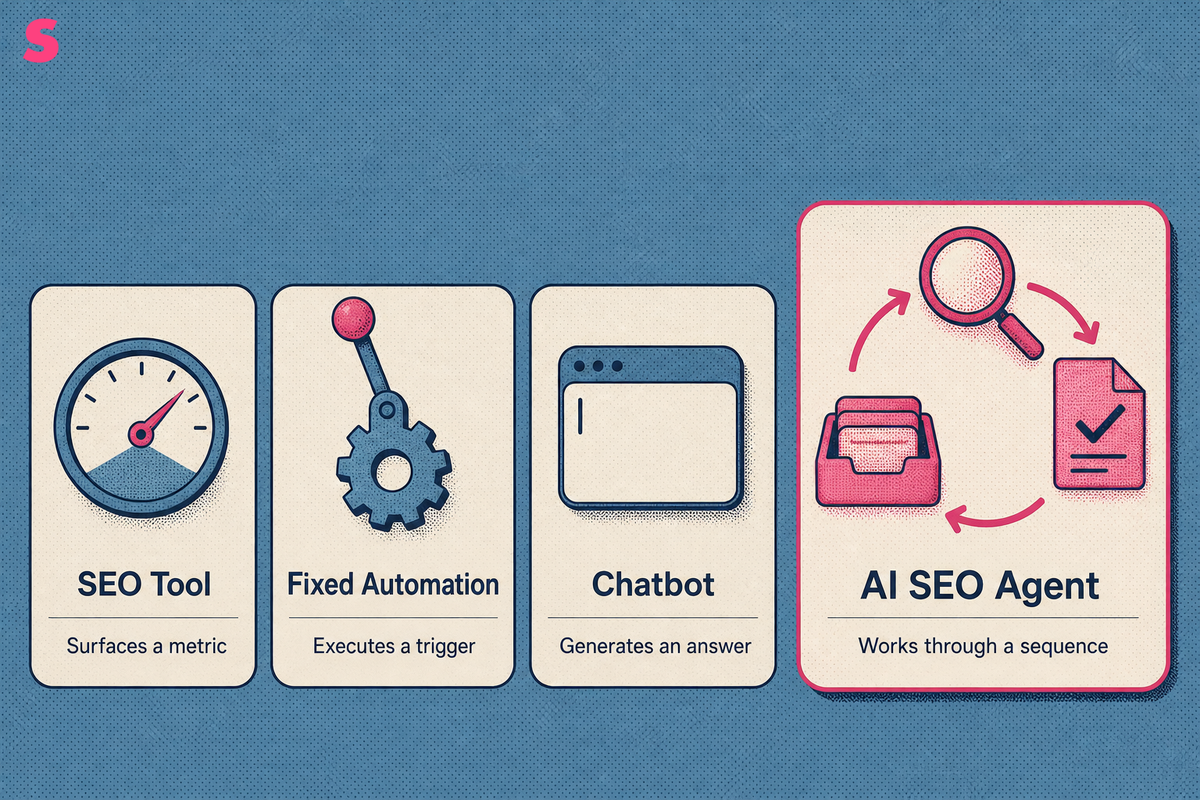
An AI SEO agent is software that plans, decides, and acts across a multi-step SEO workflow using reasoning, tool access, and memory. For teams asking how they can use AI agents for SEO, the practical starting point is a bounded workflow, such as finding content gaps, preparing refresh briefs, or triaging crawl issues.
A conventional SEO tool reports data, such as rankings, crawl errors, or search volume. Fixed automation follows a defined rule, such as creating a ticket when a 404 error appears. A chatbot responds to a prompt but does not carry work through connected steps. An AI SEO agent can retrieve data, compare sources, select a next action, and assemble a recommendation for review.
- SEO tool: surfaces a metric or report.
- Fixed automation: executes a predefined trigger and action.
- Chatbot: generates an answer from a user prompt.
- AI SEO agent: works through a sequence, using data and instructions to produce an auditable output.
Many products described as agents still run fixed workflows. Resources.rework.com, August 17, 2026, reported that 16% of purported AI agents in production perform genuine planning, observation, and adaptation rather than fixed sequences. Test the work performed, not the product label.
What do you need in place before handing SEO work to an AI agent?
Before assigning SEO work to an AI agent, document the manual workflow, appoint a named approver, and begin with read-only access. The agent should use the same source data and decision criteria as the SEO team, without permission to change pages, redirects, or CMS settings.
Choose a workflow with a clear input, repeatable decision rule, and reviewable output. Building an AI SEO agent requires documented manual workflows, an agent framework, and defined skills and tools. Give the agent enough context to complete the task, but no more permission than the task requires.
| Prerequisite | What the agent needs | Initial access level | Human control | Success signal |
|---|---|---|---|---|
| Documented workflow | Inputs, decision rules, output format | Read-only documentation | SEO lead owns the operating procedure | Two people can reproduce the workflow manually |
| Search performance data | Search Console, rank tracking, click-through rates | Read-only API or export | Analyst validates anomalies | Recommendations cite source fields |
| Site health data | Crawl data, server logs, indexation reports | Read-only project access | Technical SEO owner approves fixes | Issues include affected URLs and evidence |
| Content inventory | CMS export, URL map, page ownership | Read-only CMS access | Editor approves all changes | Drafts map to named pages |
| Approval system | Ticketing queue and rollback owner | No publishing access | Named approver for every deployment | Every change has a reversible record |
Provide access to Search Console, analytics, crawl data, the CMS, and rank tracking in that order. Read-only access exposes weak data definitions before the agent can cause damage. A named approver should own publication decisions, while a technical owner controls redirects, canonicals, robots.txt, and deployment permissions.
How can an AI agent do keyword research and find content gaps?
Use an AI SEO agent first for keyword research and content-gap analysis because the output is a recommendation, not a live site change. The agent can identify opportunities, compare existing pages against leading results, and produce a structured brief for an editor or SEO strategist.
Step 1: Build a recommendation queue
- Provide a defined page set, target market, and content objective.
- Give the agent search volume, competition metrics, historical performance, click-through rates, and ranking correlations.
- Ask the agent to group related queries by intent and map each group to an existing URL, a consolidation candidate, or a proposed new page.
- Require each recommendation to cite the source data and state the expected page owner.
AI agents can compare existing content with top-ranking competitors to identify coverage gaps and propose additional subtopics. The useful output is a prioritized queue that identifies the topic, page, evidence, missing subtopics, and editorial decision required.
Keep the first scope narrow. Ask the agent to assess one product cluster or one set of declining pages. The team can then assess whether the recommendations reflect commercial intent, customer language, and product positioning before expanding the workflow.
How can an AI agent refresh and optimize existing content without making it generic?
An AI SEO agent can refresh existing content without making it generic when people retain ownership of expertise, claims, and editorial judgment. The agent should handle research, page comparison, prioritization, and controlled drafting, while subject-matter experts preserve knowledge competitors cannot reproduce.
Step 2: Use the agent to prepare a refresh brief
Give the agent an existing URL, its historical performance, internal-link inventory, target query cluster, and approved product language. Ask for missing subtopics, outdated sections, broken or weak internal links, and a proposed outline. Require it to distinguish additions supported by source material from statements requiring expert review.
- Retain customer evidence, product expertise, and original analysis with human authors.
- Use the agent to identify repeated questions, topic gaps, and stale sections.
- Require citations or source references for factual additions.
- Review every internal-link recommendation against the destination page’s intent.
Generic content results from broad prompts without proprietary inputs. Supply approved terminology, customer objections, product constraints, and examples from sales or support. The agent should produce an editorial draft with marked assumptions, not an unreviewed replacement page.
How can an AI agent run technical SEO audits and propose fixes safely?
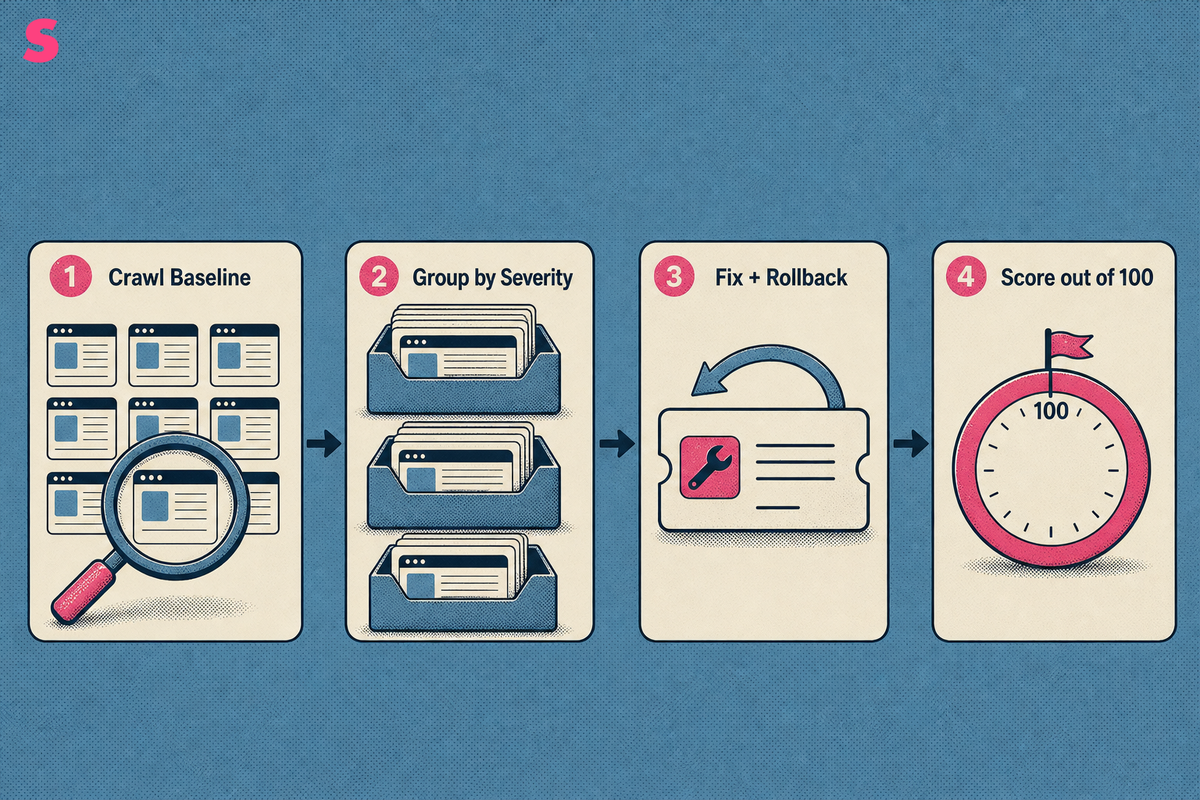
An AI SEO agent can run technical SEO audits safely when it converts crawl findings into prioritized tickets or code diffs rather than making live changes. Technical work should remain approval-based because a bad redirect, canonical tag, robots.txt rule, or JavaScript change can affect many URLs at once.
Step 3: Convert crawl findings into reviewable work
- Run a crawl against a controlled URL set and capture the baseline.
- Ask the agent to group issues by severity, affected templates, and likely root cause.
- Require a proposed fix, evidence, owner, and rollback instruction for every ticket.
- Deploy approved changes in a limited release, then rerun the crawl.
A visibility score shows an outcome, but a technical audit identifies the page-level cause. Sona AI Visibility’s Site Pages scores a page out of 100 across six categories, ranks findings as critical or medium with the fix attached, and re-runs on a watch so a team can see whether the fix landed.
Use a full technical re-audit monthly or after major releases, rather than daily. Success is narrower than a ranking promise: the deployed fix resolves the documented issue, the crawl confirms the change, and a rollback path remains available if a regression appears.
How can AI agents help your pages get cited in Google AI Overviews, ChatGPT, Perplexity, and other answer engines?
AI agents can help pages earn citations in Google AI Overviews, ChatGPT, Perplexity, Gemini, Claude, and other answer engines by checking crawlability, extractable page structure, and citation gaps. The agent should identify pages that answer important buyer prompts but lack the technical or content conditions required for retrieval and citation.
Step 4: Check pages against prompts, structure, and crawler access
Start with a prompt list tied to commercial topics and the pages intended to answer them. Run that prompt list daily. Daily results reveal changes that a weekly snapshot can average away, including shifts from retrieval indexes, model updates, and competitor publishing.
Agentic bot, crawler, and agent traffic exceeded 50% of internet traffic in June 2026, according to a June 2026 listing that attributed the figure to Cloudflare CEO Matthew Prince. Searches for AI search tracking rose 184% over the measured period, per a July 24, 2026 listing. Crawler access and page structure are operational SEO concerns, not a separate reporting exercise.
Sona AI Visibility connects prompts and citations to pipeline and revenue, while its crawler analytics shows AI crawler and agent activity from server logs or a lightweight edge worker without a JavaScript tag. Mention tracking is the baseline every AI visibility tool offers. The more useful question is whether cited pages contribute to measurable buyer journeys.
Use the Sona AI Crawl Checker to diagnose whether AI crawlers can reach and load a page. The check should identify blocked retrieval paths, then send a specific remediation task to the site owner. A citation score is a dated snapshot. Daily prompt results show whether movement persists.
How do you set approval gates and a rollback plan so an agent cannot publish unchecked?
Set approval gates by separating observation, recommendation, drafting, approval, and publishing into distinct permissions. An AI SEO agent should not publish unchecked content or deploy technical changes, because factual errors, unsuitable internal links, and incorrect implementation details create brand and SEO risk.
Step 5: Use a human-in-the-loop release path
- Observe: the agent reads approved data sources and records evidence.
- Recommend: the agent creates a brief, ticket, or proposed diff.
- Draft: the agent prepares controlled copy or implementation guidance.
- Approve: the assigned editor, SEO lead, or engineer reviews the output.
- Publish: a human deploys the approved version and records the change.
A common failure is an agent shipping a factual error, bad internal link, or incorrect technical change. Recovery should be immediate: pause the agent’s permissions, revert the deployment, log the cause, correct the source instruction or data access, and tighten the failed approval gate.
Every workflow needs a rollback owner and a version record. For content, that record includes the prior page copy and internal-link map. For technical work, it includes the prior configuration, release identifier, and validation crawl. Controlled reversibility is the maturity milestone.
How do you test whether an AI SEO agent actually works before you trust it?
Test an AI SEO agent with a fixed prompt set, a stated sample size, repeated runs, and a scoring rubric before trusting it with production work. Measure execution quality against first-party data and instructions, rather than relying on agentic marketing claims.
Resources.rework.com, August 17, 2026, reported that 57% of organizations have AI agents in production. The same analysis reported that only 16% perform genuine planning, observation, and adaptation. A repeatable evaluation protocol separates useful workflow execution from polished but unreliable output.
Step 6: Run a controlled evaluation
- Select 20 representative SEO tasks across keyword research, content refreshes, and audit triage.
- Run the same prompt set three times using identical data access and instructions.
- Score every output before showing results to the team.
- Pass the agent only when the aggregate score meets the defined threshold and no critical error appears.
- Keyword research template: Provide the approved URL set, target market, query export, and content objective. Return a table with query cluster, intent, mapped URL, evidence, missing subtopics, owner, and recommendation. Exclude unsupported search terms and new product claims. Cite the source row or first-party record for every recommendation.
- Content refresh template: Provide the existing URL, performance history, internal-link inventory, target query cluster, and approved product language. Return a proposed outline, additions, removals, internal-link changes, and assumptions requiring expert review. Exclude unapproved claims and unsupported factual additions. Cite the source record for each proposed change.
- Audit triage template: Provide the controlled URL set and crawl export. Return a ticket list with affected URLs, severity, likely root cause, evidence, proposed fix, owner, and rollback instruction. Exclude live changes and findings without crawl evidence. Cite the relevant crawl record for every ticket.
| Rubric criterion | What to inspect | Scoring method | Failure condition | Passing evidence |
|---|---|---|---|---|
| Accuracy | Claims against first-party data | 0 incorrect, 1 partially correct, 3 correct | Invented or contradicted data | Recommendations match source records |
| Traceability | Source for each recommendation | 0 absent, 1 partial, 2 complete | Unsupported recommendation | Every recommendation names a data source |
| Instruction adherence | Scope, format, exclusions, permissions | 0 failed, 1 partial, 2 complete | Action outside the approved task | Output follows the operating brief |
| Edit distance | Changes needed before approval | 0 rewrite, 1 material, 2 light | Human must rebuild the output | Reviewer makes bounded edits |
| Error severity | Impact of each mistake | 0 medium or critical, 1 low or none | Critical factual or technical error | No critical errors across repeated runs |
Score each output out of 10. The agent passes only when the overall average and the average for each workflow type are at least 8 out of 10, every recommendation traces to a source, and no repeated run contains a critical factual or technical error. Keep the sample, prompts, data snapshot, and scoring decisions. That record makes the next evaluation comparable.
Should you buy an AI SEO agent or build one with a workflow framework?
Buy an AI SEO agent when the workflow is common and the team needs a fast, managed implementation. Build one with a workflow framework such as n8n when the process depends on proprietary data, unusual approvals, or integrations that packaged software cannot represent cleanly.
Suite-embedded agents work well when relevant data already lives in the SEO platform. Standalone agents suit teams that need a focused workflow across several sources. A custom build starts with a documented manual process, then connects the agent to selected tools, permissions, and approval steps.
Entry prices in 2026 listings range from $19/month to $249/month, per listings dated October 12, 2026. Implementation effort, usage charges, site count, approval requirements, and integration limits determine the real operating cost.
- Buy: choose this path for standard workflows, predictable setup, and a smaller internal implementation burden.
- Build: choose this path when workflow logic and proprietary data create the advantage.
- Use a hybrid: adopt a managed tool for reporting and build only the workflow steps that require custom routing.
The lowest listed price is not automatically the lowest-cost choice. Evaluate task volume, integration effort, human review load, and audit-trail quality before selecting a deployment model.
What are the frequently asked questions about AI SEO agents?
What is an AI SEO agent?
An AI SEO agent is software that plans, decides, and acts across a multi-step SEO workflow using reasoning, tool access, and memory. Unlike a fixed script, it can use workflow context to determine the next step, then produce a recommendation or draft for review.
Which SEO tasks should I give an AI agent first?
Start with high-volume, sequential, data-dependent work that produces recommendations rather than live changes. Keyword research, content-gap analysis, refresh prioritization, and audit triage are strong first tasks because a human can validate the output before publication or deployment.
What data does an AI SEO agent need access to?
At minimum, an AI SEO agent needs Search Console, analytics, crawl data, and rank tracking. CMS access should remain read-only until the agent has passed controlled tests for accuracy, traceability, instruction adherence, and error severity.
Can an AI agent publish content on its own?
An AI agent can publish content, but a human approval gate and rollback procedure should sit before anything goes live. Content and technical changes need a named approver, a version record, and a documented reversal path for factual errors, bad links, or implementation regressions.
Do AI agents help with Google AI Overviews, ChatGPT, and other answer engines visibility?
AI agents help by checking crawlability, extractable page structure, and citation gaps for pages tied to important buyer prompts. Track the same prompt list daily over consistent rolling periods, because daily results distinguish a sustained change from a one-day answer fluctuation.
How much do AI SEO agents cost?
Listed entry prices in 2026 range from $19/month to $249/month, per listings dated October 12, 2026. Usage charges, site limits, approval requirements, integrations, and setup effort can materially change the real cost of operating an AI SEO agent.
Summarize this article with AI: ChatGPT · Claude · Perplexity · Google AI Mode
Last updated: October 2026