A Perplexity AI visibility optimisation agency boosts how frequently and accurately a brand is cited in Perplexity answers through prompt testing, content and structured-data improvements, and authority-source building. Retainers are often listed at $2,000 to $10,000+ monthly in 2026 listings, so require a disclosed prompt panel and scoring rules before signing. Sona provides done-for-you services alongside Sona AI Visibility, linking prompts and citations to pipeline and revenue. Sell measurement rather than guaranteed inclusion.
What does a Perplexity AI visibility optimization agency actually deliver beyond SEO?
A Perplexity AI visibility optimisation agency improves the likelihood that Perplexity cites a brand’s pages in answer cards, Pages, Shopping results, and Deep Search results. Conventional SEO focuses on rankings and clicks from lists of links. Perplexity produces concise, citation-backed answers, so agency work also covers citation eligibility, prompt coverage, source selection, and answer-level measurement.
The overlapping work still matters: crawlability, canonical tags, useful pages, authoritative referring domains, and accurate entity information. Perplexity-specific work begins where conventional reporting ends. An agency should test buyer questions, identify cited source types, build pages that answer those questions precisely, and measure linked citations separately from unlinked brand mentions.
Providers differ in execution depth and measurement discipline. One may deliver a prompt inventory and content briefs. Another may also handle technical remediation, structured data, digital PR, local listings, and recurring answer analysis. A credible engagement ties each workstream to a defined prompt panel instead of reporting a single brand score.
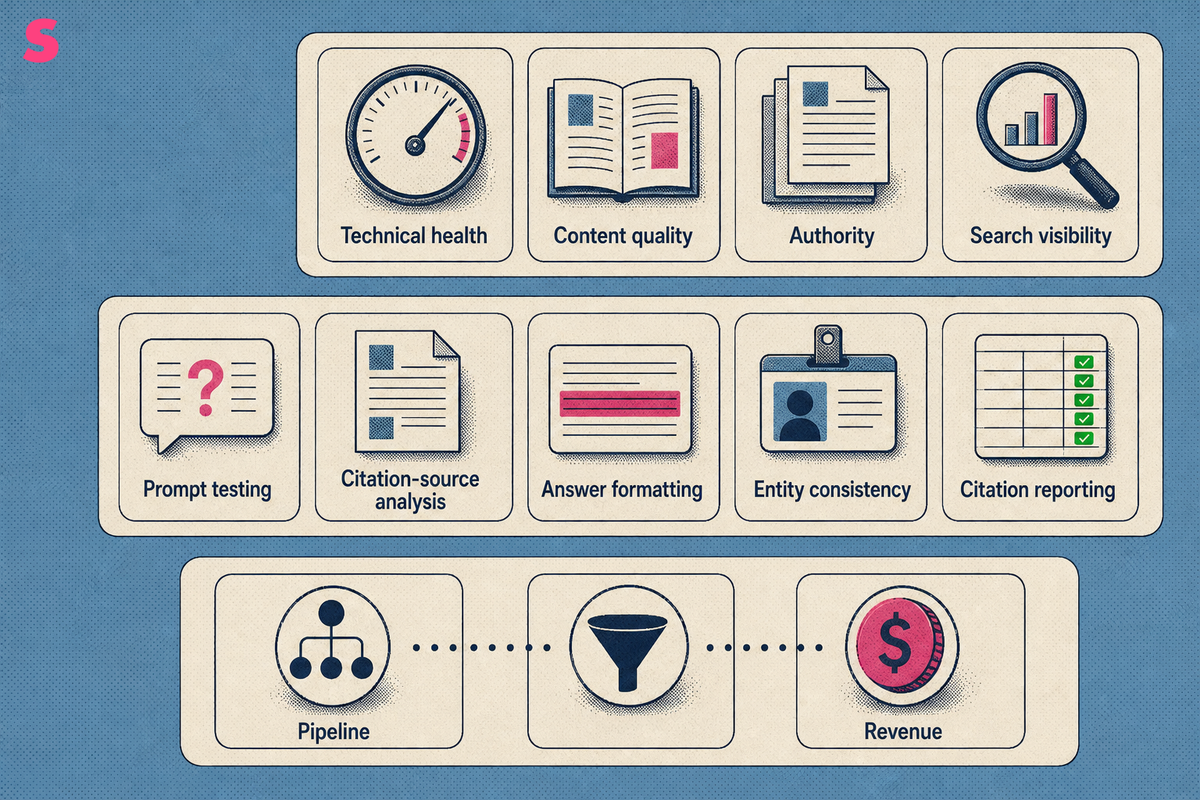
- SEO baseline: technical health, content quality, authority, and traditional search visibility.
- Perplexity optimization: prompt testing, citation-source analysis, answer formatting, entity consistency, and citation reporting.
- Business measurement: connecting AI-referred visits and citations to accounts, pipeline, and revenue where the data permits.
Which prompt patterns and query types earn Perplexity citations in your industry?
A Perplexity prompt panel should cover buyer decision paths, not a short list of category keywords. Build it around definitions, comparisons, recommendations, implementation questions, pricing research, and location-specific needs. The panel becomes the agency’s test set and the basis for reporting visibility changes.
For B2B software, test prompts such as “what is [category],” “best [category] for [use case],” “[brand] alternatives,” “how to implement [workflow],” and “[category] pricing.” These prompts commonly require category definitions, implementation documentation, comparison evidence, pricing pages, and use-case pages. The agency should inspect whether cited results provide direct product facts, constraints, integration details, named alternatives, or pricing evidence, then create or revise the corresponding category page, comparison page, implementation guide, or pricing resource.
Professional-services firms should test problem-led queries, jurisdiction or specialty questions, and comparison prompts that reflect how clients assess expertise. These prompts commonly require practitioner credentials, service definitions, location or jurisdiction evidence, case-relevant expertise, and clear explanations of scope. The agency should inspect whether cited results establish qualifications, local relevance, specialty coverage, or practical process, then build service pages, professional profiles, location pages, and evidence-led guidance that answer those requirements.
Ecommerce brands need product comparison, fit, care, compatibility, buying-guide, and price prompts. These prompts commonly require product specifications, compatibility facts, sizing or fit guidance, care instructions, availability, and price evidence. The agency should inspect whether cited results use product detail pages, buying guides, retailer listings, reviews, or manufacturer documentation, then create citation-ready product pages, comparison guides, fit resources, care instructions, and compatibility references.
Local-service businesses need a distinct panel. Perplexity draws real-time local information from Google Maps, Google Business Profiles, Yelp, and Facebook for local queries. Test service-plus-location prompts, urgent-intent prompts, review-led prompts, hours and availability questions, and “best [service] near [location]” queries. These prompts commonly require consistent business facts, service-area details, current hours, reviews, and location evidence. The agency should inspect which cited results supply those facts, then maintain accurate local profiles and useful service-location pages.
- Definition: “What is managed detection and response?”
- Comparison: “What is the difference between [product type] and [product type]?”
- Best-for query: “What is the best [product type] for a mid-market SaaS company?”
- How-to query: “How do I reduce [specific operational problem]?”
- Pricing query: “How much does [product category] cost?”
- Local-intent query: “Best emergency plumber in [city]”
Run the same prompt list daily. Daily tracking exposes changes that a weekly snapshot can average away as retrieval indexes, models, and competitor content change. Treat isolated movements as noise until repeated runs confirm them, and require the agency to document its own trend threshold and rationale.
How does Perplexity choose its sources, and which tactics move citations?
Perplexity citation work starts with pages that answer a specific question clearly, accurately, and with enough supporting evidence for an answer engine to use them. Google rankings do not automatically transfer to Perplexity citations. A page can perform well in traditional search yet fail to match the source type, freshness, structure, or precision Perplexity uses for a prompt.
Technical work should confirm that important pages are crawlable, canonicalized, fast, and available in server-rendered HTML. Structured data should align with visible page content rather than substitute for substance. An agency should inspect robots.txt controls, internal linking, duplicate pages, and page-level metadata before treating content production as the answer.
Editorial work should make the answer easy to extract. Perplexity optimization favors brevity and precision. Long introductions, marketing filler, and extended storytelling weaken citation eligibility. Lead with the direct answer, use descriptive headings, define terms, show constraints, and keep claims close to supporting evidence.
Digital PR and entity-building improve the surrounding evidence environment. An entity and knowledge-graph approach starts with canonical descriptions for the organization, products, people, and locations, then defines the relationships among them. Match visible facts with structured data, maintain consistent identifiers and profiles across owned and third-party sources, and check for conflicting third-party facts. Accurate company descriptions, consistent product facts, specialist commentary, third-party coverage, and complete local profiles help Perplexity interpret the brand as a credible source.
What should a 30-, 60- and 90-day Perplexity engagement produce?
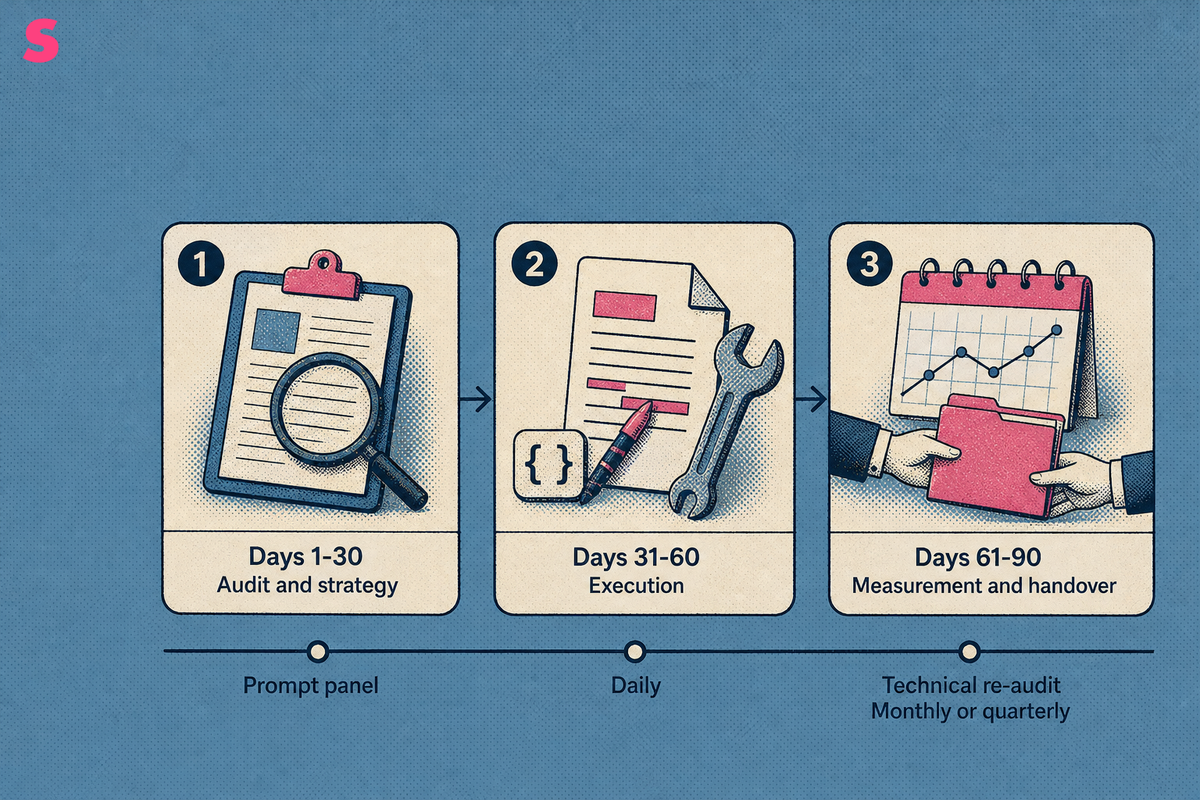
A 90-day Perplexity agency engagement should move from baseline audit to prioritized execution and repeatable reporting. The first 30 days establish current results, cited pages, commercially relevant prompts, and technical or entity inconsistencies that block progress.
- Days 1–30, audit and strategy: define the prompt panel, capture answer snapshots, classify mentions and citations, review pages and source domains, and produce an execution backlog.
- Days 31–60, execution: publish or revise priority pages, improve structured data and technical access, strengthen entity consistency, and begin digital PR or local-profile work.
- Days 61–90, measurement and handover: compare the daily prompt history against the baseline, document what changed, retain the prompt panel, and assign the next quarterly backlog.
Sona AI Visibility connects AI citations and prompts to pipeline and revenue on one account timeline, while tracking AI crawler activity from server logs or a lightweight edge worker without a JavaScript tag. That measurement helps an agency distinguish visible answers from answers that produce identifiable commercial activity.
Prompt tracking and technical review operate on different schedules. Run the prompt panel daily because answer volatility requires dense observations. Schedule a full technical re-audit monthly or quarterly, because remediation needs time to land and be evaluated.
How should you measure Perplexity visibility, and which metrics can you trust?
Measure Perplexity visibility with a fixed prompt panel, separate citation and mention reporting, and daily trend lines. A mention names the brand in an answer. A citation links to the brand’s page as a supporting source. These outcomes require separate reporting.
Useful reporting includes citation rate across the defined prompt set, share of voice across named competitors, cited-domain quality, answer sentiment, position or prominence within the answer, and AI-referred visits. Every provider should disclose its formula. “Visibility” and “share of voice” have no universal definition, so a percentage without its denominator is not decision-grade evidence.
A brand-level score is a dated snapshot, not a work item. A prompt-level view identifies the question that produced a result and the source that won the citation. Sona AI Visibility records prompts, cited sources, and page performance, so a team can identify the page and prompt pair that requires work rather than react to a domain-wide number.
Keep the panel stable for trend reporting, then add new prompts in a separately labeled cohort. This protects the baseline from artificial movement caused by a changing sample. Report answer volatility as part of the result, rather than hiding it in the dashboard.
How much do Perplexity agency retainers and tracking software cost?
Perplexity agency costs range from software-level budgets to high-touch optimization programs. Published 2026 listings place small-business packages from about $1,500 per month and commonly reported retainers at $2,000–$10,000+ per month. Scope drives the difference: prompt volume, number of assistants tracked, content production, digital PR, local work, and reporting all affect a retainer.
| Cost tier | Typical scope | Reported monthly cost | Date basis |
|---|---|---|---|
| Small-business agency package | Focused Perplexity optimization engagement | From about $1,500 | Published listing, February 18, 2026 |
| Common agency retainer | Ongoing optimization, content, and reporting | $2,000–$10,000+ | Published listing, February 18, 2026 |
| Local optimization program | Local prompts, profiles, and location evidence | From $5,000 | Published listing, September 21, 2026 |
| Enterprise agency program | Broader prompt volume and multi-assistant coverage | $15,000–$25,000, often with a 3-month initial term | Published listing, September 21, 2026 |
| Tracking software | Prompt and citation monitoring without agency execution | About $29–$189 | Published listings, October 2026 |
A wider agency-market range of $5,000–$150,000+ appeared in a 2026 industry listing from hamstergarage.com. Treat broad ranges carefully. The better buying question is which deliverables the retainer funds, how many prompts it monitors, and who owns execution after the initial term.
As of October 2026, Sona AI Visibility starts from $75 per month billed annually. Sona’s done-for-you services are monthly, sit on top of an AI Visibility Growth plan or above, and cover content and AI search optimisation.
Which software tracks Perplexity prompts and citations, and how do the capabilities differ?
Perplexity tracking software is a lower-cost option when an in-house team can execute content, technical, and PR work. The meaningful differences are prompt capacity, answer-engine coverage, refresh cadence, agency workspaces, and whether the product connects citation data to commercial outcomes rather than stopping at answer monitoring.
| Tool | Starting price | Agency Plans? (Yes/No) | # of Answer Engines Tracked | Answer Engines | # of Daily Tracked Prompts (entry plan) | Cost per Daily Tracked Prompt | Differentiation |
|---|---|---|---|---|---|---|---|
| Sona AI Visibility | From $75/month, billed annually | Yes | Up to 11 (3 on Starter) | ChatGPT, Gemini, Google AI Mode, Google AI Overviews, Perplexity, Claude, DeepSeek, Grok, Copilot, Qwen, Mistral | 5,000 credits/month, about 166 daily tracked prompts on one model or 56 across three | $0.45 per daily tracked prompt | Connects AI citations and prompts to pipeline and revenue, and tracks AI crawler activity without a JavaScript tag. |
| Profound | Free Trial, Enterprise custom pricing | Yes | Up to 9 (3 on free Trial) | ChatGPT, Gemini, Google AI Overviews | 50 prompts daily for 7 days | No public entry-plan unit price | Trial prompt monitoring, with agency workspaces available from $99/month billed yearly. |
| Peec AI | From $95/month | Yes | Up to 13 (3 of 6 on Starter, plus add-ons) | ChatGPT, Google AI Mode, Google AI Overviews | 50 prompts daily | $0.63 per daily tracked prompt | Self-serve AI visibility tracking with agency plans from $245/month. |
| Otterly.ai | From $29/month | Yes | Up to 7 (4 on Lite, 3 as paid add-ons) | ChatGPT, Google AI Overviews, Perplexity, Microsoft Copilot | 15 prompts daily | $0.48 per daily tracked prompt | Prompt monitoring across four entry-plan answer engines, with agency plans from $189/month. |
| Scrunch AI | From $250/month | Yes | Up to 9 (4 on Core) | ChatGPT, Perplexity, Google AI Overviews, Copilot | 125 prompts, refresh cadence not published | No refresh cadence published | Four-surface Core plan, with an Agency Core plan from $500/month. |
Prices and plan details reflect published information as of October 2026. Most checkers stop at mention counts; Sona AI Visibility connects citations to pipeline and revenue, which matters when a marketing leader must justify agency and software spend against commercial outcomes.
What evidence should an agency show before you sign?
A Perplexity agency should show its measurement method before requesting a retainer. Ask for the actual prompt set, the number of prompts in each topic, the countries and locations used, answer refresh cadence, and scoring rules for visibility, share of voice, citations, and sentiment.
- Separate reporting for linked citations and unlinked brand mentions.
- Prompt-level screenshots or exports that show the answer and cited domains.
- A disclosed sample size and a documented process for adding or retiring prompts.
- Daily prompt tracking, with monthly or quarterly technical and strategy reviews.
- Page-level recommendations tied to named prompts and source opportunities.
- A practical explanation of how AI-referred traffic, signups, pipeline, or revenue will be attributed.
No credible provider guarantees inclusion in Perplexity answers. Prompt wording, freshness, location, model behavior, and retrieval sources change results. A provider can guarantee process, reporting cadence, and agreed deliverables, but it cannot guarantee that an answer engine will cite a particular domain.
Ask who owns the assets at the end of the engagement. The prompt library, reporting definitions, content briefs, technical backlog, and source inventory should remain useful to the internal team after the agency relationship ends.
When is an agency worth it, and who should not hire one?
A Perplexity agency is worth hiring when a company has a clear commercial category, enough existing authority to build from, and an internal owner who can approve pages, claims, and technical changes. The agency premium pays for execution across content, technical work, entity-building, local evidence, and measurement, not for a dashboard alone.
Software costs less when in-house SEO, content, PR, and demand-generation teams have capacity. A team can use daily prompt tracking to prioritize work, then execute changes without an external retainer. Sona AI Visibility can provide the citation, crawler, and revenue measurement layer while internal specialists own implementation.
This service does not suit brands seeking guaranteed rankings or citations. It is also a poor fit for companies with no credible content, product evidence, customer proof, or authority base to develop. An agency cannot substitute for the material that makes a brand worth citing.
It also does not suit budgets that cover tracking software only. A $29–$189 monthly monitoring budget, based on published October 2026 tool listings, buys measurement capacity. It does not fund writing, technical remediation, digital PR, or the operational attention required to act on findings.
What are the frequently asked questions?
Can an agency guarantee that Perplexity will cite my brand?
No. Perplexity answers vary with prompt wording, model updates, location, freshness, and retrieval sources. A credible provider sells measurement, content, technical work, and authority-building that increase citation eligibility. It should not sell guaranteed inclusion in a specific Perplexity answer.
How much does a Perplexity AI visibility agency cost per month?
Published 2026 listings place small-business packages from about $1,500 per month, with commonly reported retainers at $2,000–$10,000+ per month. Larger programs were listed at $15,000–$25,000 per month, often with a 3-month initial term, in September 2026.
Is Perplexity optimization different from Google SEO?
Partly. Technical health, useful content, and authority still matter, but content that ranks in Google does not automatically earn a Perplexity citation. Perplexity work adds prompt-level testing, citation-source analysis, answer formatting, sentiment review, and reporting for citations versus unlinked mentions.
What is the difference between a mention and a citation in Perplexity?
A mention names a brand in the answer text. A citation links the brand’s page as a supporting source for the answer. Buyers should require agencies to report both separately, because a visible brand name and a linked source page create different measurement and traffic outcomes.
Can tracking software replace a Perplexity optimization agency?
Tracking software measures visibility and can start below $30 per month, based on published October 2026 pricing. It does not write content, run digital PR, repair technical issues, or maintain local business evidence. An agency premium is justified only when the provider executes those workstreams.
How do I know whether an agency’s visibility numbers are reliable?
Ask for the prompt list, sample size, refresh cadence, countries or locations tested, and scoring definitions. Visibility, share of voice, and citation rate are calculated differently across providers. Reliable reporting also separates citations from unlinked mentions and preserves a fixed prompt panel for trend analysis.
Summarize this article with AI: ChatGPT · Claude · Perplexity · Google AI Mode
Last updated: October 2026