


A merchant evaluating credit card processors rarely browses at leisure. They're comparing rates against a renewal deadline, chasing a better rate after a rejected chargeback, or scrambling to replace a processor that just froze their account, and they search Google the moment the problem becomes urgent. Google Ads meets that moment, putting your offer in front of a prospect while they're actively comparing providers, not weeks later after a slow-moving lead nurture. Paired with tools that connect ad clicks to your CRM, you can follow a prospect from that first search through underwriting to a signed merchant agreement, targeting the segments that matter (high-risk merchants, multi-location retailers, e-commerce platforms) and measuring ROI on actual signed accounts rather than clicks.
How to Generate Credit Card Processing Services Leads with Google Ads: A Step-by-Step Guide

Credit card processing companies face immense competition in digital advertising, where only the most precise strategies capture high-value leads at scale. A data-driven Google Ads approach lets B2B teams quickly identify intent-rich buyers and convert interest into actionable opportunities.
Modern marketers demand more than basic campaign management. By leveraging unified go-to-market data, teams gain clarity into which companies engage with their ads, enabling dynamic budget allocation and faster pipeline acceleration.
- Crafting targeted keyword and audience strategies: Successful lead generation for credit card processing hinges on targeting keywords and audiences that align with real buyer intent. This means focusing on search terms like "best merchant account provider," "B2B payment processing," or popular credit card keywords instead of broad, generic queries. Smart segmentation goes beyond standard demographics, layering in firmographic details, recent site behavior, and engagement timelines. Using company-level visitor identification, marketers can see which businesses are visiting their site, track how their buying committees engage over time, and shift spend toward in-market accounts showing the strongest signals of purchase intent. Keyword and audience lists stay current, reflecting new data as prospects move through the funnel.
- Ensuring landing page and ad creative alignment: High-performing credit card processing ads direct users to tailored landing pages that reinforce the promise of the ad copy. Alignment reduces friction and maximizes conversion rates, especially for complex financial products. Analytics platforms now allow teams to dissect which audience segments engage with specific messages and creative variants, down to the company level. When visitors are identified in real time, every landing page experience can be personalized to match the visitor's industry, business size, or solution needs, creating higher conversion opportunities and stronger lead quality.
- Employing performance optimization techniques: Continual optimization is essential given how quickly the credit card processing ad landscape shifts. Marketers must track behavior across every touchpoint, from ad click to form submission, and adapt bidding and creative strategies in response. By integrating advanced conversion tracking, revenue teams connect online ad interactions to offline sales activities, attributing closed deals back to the original Google Ads click. This holistic view ensures campaigns are measured by true ROI, not superficial metrics, and that underperforming segments are quickly flagged for budget reallocation.
- Syncing Google Ads with other marketing channels: A unified marketing ecosystem breaks down data silos that hinder campaign effectiveness. By syncing enriched audiences and lead data from platforms like CRM, email, and web analytics directly into Google Ads, B2B teams maintain consistent messaging and nurture flows at every stage. This keeps audiences fresh, enables real-time retargeting, and ensures high-intent leads are engaged across channels without duplication or delay. For credit card processing marketing, with its long underwriting and compliance review cycles, this orchestration is what sustains momentum across a multi-month sales cycle.
Why Does Google Ads Matter for Credit Card Processing Services

Credit card processing service providers compete in a digital landscape where timing, precision, and visibility drive revenue outcomes. Google Ads offers the unique ability to reach business decision-makers and merchants exactly when they are evaluating payment partners, often capturing high-value opportunities missed by slower, less targeted channels.
- Capturing specialized audiences: Google Ads pinpoints buyers actively searching for credit card processing solutions. These are sophisticated prospects with complex requirements, such as multi-location support or high-risk merchant accounts, that often evade traditional analytics and generic targeting. By leveraging advanced visitor identification, marketers can decode anonymous website traffic, revealing both the companies and decision-makers behind each inquiry. This clarity accelerates prospect qualification and prioritizes outreach to accounts with genuine in-market intent.
- Winning high-margin deals: Search-based advertising for credit card processing services enables instant responses to high-value leads. Unlike email or social media, where engagement can lag and opportunities slip away, Google Ads delivers timely exposure to merchants during critical decision windows, often the days right before a contract renewal or right after a bad experience with an incumbent processor. When these leads are identified in real time, sales teams can follow up immediately, dramatically increasing conversion rates and reducing the risk of lost deals.
- Responding to demand spikes: The payment solutions market experiences sharp seasonal and industry-specific surges, such as during retail peak seasons or regulatory changes. Google Ads supports dynamic audience lists that update as leads progress through the funnel or as new intent signals emerge. This agility allows marketers to reallocate budget and shift messaging to capitalize on live demand, ensuring that every advertising dollar targets the accounts most likely to close.
- Enhancing analytics and attribution: Credit card processing providers benefit from Google Ads’ end-to-end measurement capabilities, linking every click and impression to downstream outcomes like contract signings and account activations. Integrating CRM data and advanced conversion tracking ensures that marketing teams can attribute revenue to specific campaigns, optimizing spend for the highest ROI and justifying investment to executive stakeholders. For more guidance, explore our marketing analytics blog.
- Driving awareness in emerging markets: In markets where payment data is scarce or fragmented, Google Ads' precise geographic and demographic targeting allows providers to build brand visibility and engagement from the ground up. For new entrants or established firms expanding into new regions, this capability enables efficient customer acquisition even without extensive historical performance benchmarks, ensuring that early marketing investment translates into real business growth.
Common Types of Google Ads Campaigns for Credit Card Processing Services
- Performance Max: Performance Max campaigns let credit card processing advertisers reach prospects across Search, Display, YouTube, and Gmail from a single campaign, using Google's automated bidding to find in-market merchants wherever they're browsing. Feeding it strong conversion signals, such as offline data on funded accounts, helps the algorithm prioritize the audiences most likely to close rather than the ones that merely click.

- Search Campaigns: Search campaigns remain the backbone of online advertising for credit card processing services. By targeting high-intent queries such as “business credit card processing” or “merchant payment solutions,” marketers can intercept potential buyers at the decision-making stage. Leveraging real-time audience lists, teams can ensure their targeting evolves as new leads emerge and existing prospects progress through the sales funnel. With enriched visitor identification, marketing teams move beyond anonymous clicks, enabling precise campaign refinement that prioritizes engaged companies and decision-makers.
- Display Ads: Display campaigns boost brand visibility on finance-related and business sites, effectively complementing ongoing content marketing. These ads keep your services top-of-mind for audiences researching payment processing solutions or financial products. By integrating behavioral data, marketers allocate more budget toward placements where high-intent accounts are actively browsing, using contextual signals to maximize relevant impressions. For a deeper dive into optimizing display efforts, explore our marketing analytics blog.
- Video Ads: Video campaigns offer a compelling format for explaining complex payment solutions, demonstrating product features, or sharing customer success stories. Through visually rich storytelling, these ads capture attention and clarify unique value propositions, especially in a crowded financial services market. Advanced conversion tracking enables teams to connect video engagement directly to pipeline outcomes, bridging the gap between top-of-funnel interest and measurable sales activity.
- Remarketing: Remarketing campaigns re-engage visitors who showed intent but did not convert, such as those who abandoned a sign-up or demo request. By focusing spend on these high-propensity return visitors, marketers elevate conversion rates and optimize budget efficiency. Dynamic audience updates ensure remarketing lists stay current, automatically shifting users in or out based on real-time engagement and CRM signals. This closed-loop approach keeps messaging relevant while accelerating the customer journey for qualified prospects.
- Assets: Ad assets, such as call buttons, location details, and trust badges, reinforce credibility and drive higher engagement from searchers. For credit card processing ads, these assets can showcase PCI compliance certifications or customer support access, addressing key buyer concerns instantly. When matched with real-time account activity, the most relevant assets display alongside ads, increasing both click-through rates and downstream conversion potential.
Where to Find Growth Opportunities?

Modern B2B marketers in credit card processing services know that growth does not happen by accident. Identifying and acting on high-value opportunities comes from intentional analysis, targeted outreach, and a willingness to adapt strategies as market signals evolve. For marketers looking to streamline this process, Sona can help reveal which companies are visiting your website, even before they fill out a form.
Data-driven teams are maximizing ROI by leveraging real-time audience insights and dynamic audience workflows. This approach allows revenue leaders to move budget and resources toward high-converting accounts as soon as signals shift, ensuring every ad dollar is focused on prospects with true purchase intent. To see how new Google Ads payment changes might impact your campaigns, explore this overview of upcoming changes to payment methods.
- Vertical Keyword Targeting: Focusing on niche, high-intent keywords such as "secure payment methods in Google Ads" or "credit card processing ads" delivers more relevant traffic and stronger lead quality. By continuously monitoring company interactions and updating keyword lists to reflect the latest industry conversations, marketers can ensure their campaigns are always aligned with how buyers are searching. Marketers using advanced visitor identification technology can go beyond anonymous site traffic to pinpoint which companies are researching credit card processing solutions, enabling hyper-targeted keyword expansion and immediate budget shifts when new buying signals are detected.
- Competitive Gap Analysis: Growth-minded teams regularly audit competitor visibility across Google Ads placements to identify under-served keyword segments and service lines. When a gap emerges, such as a new billing option or a unique compliance feature, B2B marketers can quickly tailor their targeting and creative to win market share before competitors respond. Integrating intent data and CRM insights ensures that these campaigns are aimed at accounts with both need and authority to buy, not just companies that fit the demographic profile.
- Industry-Specific Placements: Advertising financial services and credit card processing solutions on curated industry forums and payment-focused news sites allows marketers to reach decision-makers at critical moments. These placements outperform broad targeting, as they attract professionals already seeking new payment partners or reviewing Google Ads payment policies. By syncing CRM segments and enriched audience data with Sona, teams can ensure their display and native ads appear only in environments where their ideal buyers are active.
- Content Retargeting: Retargeting strategies succeed when they prioritize value-based assets such as whitepapers, webinars, or compliance guides tailored to credit card processing decision-makers. By analyzing engagement in real time, marketers can identify which companies are consuming high-value content and automatically retarget them with ads promoting demos, case studies, or consultations. Dynamic audience lists that update as leads move through the funnel keep campaigns efficient, ensuring ads are shown to the right buyer at the right moment, with messaging that aligns to their current stage of interest.
Uncovering growth opportunities in this trade depends on actionable data and integrated workflows. Revenue teams that unify digital signals, visitor identification, and CRM actions find and act on opportunities faster than competitors still working from anonymous traffic reports, building pipelines that hold up even as processing rates and compliance requirements shift underneath them.
How to Apply Audience Segmentation for Credit Card Processing Services

Precise audience segmentation is crucial for credit card processing services seeking to drive measurable results from digital advertising. By dividing prospects into highly targeted groups based on business model, transaction needs, and operational scale, marketers can deliver messaging that resonates and converts at a higher rate. This approach also allows for efficient allocation of budget and resources, ensuring outreach efforts focus on the segments with the most immediate revenue potential. For actionable tips on segmenting your traffic and identifying high-value accounts, explore identifying and segmenting accounts.
- Define key segments: Start by identifying core customer profiles such as online retailers, physical storefronts, high-risk merchants, or rapidly scaling SaaS companies. Each has distinct processing pain points and regulatory considerations. Customizing ad content to address the specific challenges of an e-commerce brand versus a brick-and-mortar shop increases both relevance and engagement. For example, highlighting omnichannel integrations for stores or advanced chargeback protection for online merchants helps differentiate your offer and improve response rates. Learn more about changes to Google Ads payment methods and how they may impact ad strategy for various merchant types.
- Overlay intent signals for precision: Enhance segmentation by monitoring behavioral cues and real-time intent data. Track signals like searches for “new merchant account,” recent visits to compliance resource pages, or engagement with pricing calculators. This enables campaign managers to identify businesses currently evaluating processors, separating in-market buyers from those merely researching. With access to real-time audience insights, budget can be shifted instantly to accounts showing high conversion likelihood, improving return on ad spend and accelerating pipeline velocity.
- Create specialized ad groups per segment: For each defined segment, build dedicated ad groups within your Google Ads for Credit Card Processing Services campaigns. This ensures keyword lists, ad copy, and landing pages are tailored to each audience’s unique needs. Dynamic audience capabilities allow lists to update automatically as prospects move through the funnel, ensuring messages remain relevant and timely. This granular approach enhances click-through and conversion rates by maintaining clarity in targeting and ad relevance.
- Validate conversion paths with CRM integration: Robust segmentation is only effective if you can accurately measure which segments deliver qualified leads and sales. By integrating CRM systems and marketing automation tools, marketers gain visibility into user journeys from ad click to closed deal. Attribution that spans both online and offline conversions unifies lead data, letting revenue teams optimize spend based on true ROI. As enriched audience and engagement data sync across platforms, sales and marketing respond faster to high-value opportunities while cutting spend on low-quality segments.
This is also where measurement changes the economics. With Sona Marketing Measurement you can identify the companies and buyers behind your ad clicks, not just anonymous sessions, and segment audiences by who actually becomes a customer. That lets you build bid adjustments and audience signals around the segments that convert and de-prioritize the ones that don't, so you feed Google's algorithms "this click became a paying credit card processing services customer" instead of just "someone filled out a form."
Keyword Strategy & Sample Target Terms
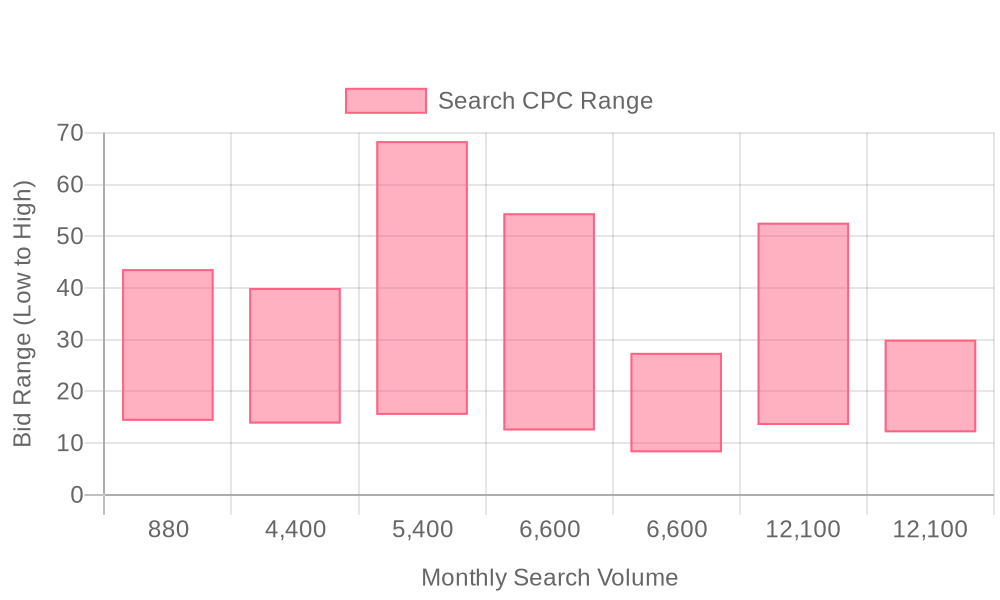
| Industry | Keyword | Monthly Search Volume | Competition Level | Low Bid | High Bid |
| Credit Card Processing Services | credit card processing services | 880 | LOW | 14.32 | 43.64 |
| Credit Card Processing Services | best credit card processing for small business | 4400 | MEDIUM | 13.79 | 40 |
| Credit Card Processing Services | credit card processing companies | 5400 | MEDIUM | 15.47 | 68.39 |
| Credit Card Processing Services | credit card processing for small business | 6600 | MEDIUM | 12.46 | 54.44 |
| Credit Card Processing Services | credit card machine | 6600 | HIGH | 8.24 | 27.45 |
| Credit Card Processing Services | credit card processing | 12100 | MEDIUM | 13.51 | 52.61 |
| Credit Card Processing Services | square credit card processing | 12100 | MEDIUM | 12.11 | 30 |
Credit card processing services operate in a highly regulated, fiercely competitive vertical where campaign efficiency and qualified lead acquisition make or break ROI. Effective keyword strategy for Google Ads in this industry means identifying terms that directly reflect both high search intent and real purchase potential, minimizing wasted budget on generic or low-converting clicks. To discover which keywords drive action in the payments space, review this list of popular credit card-related keywords for PPC campaigns.
**Focus on intent-rich keywords**: Target phrases such as "Google Ads payments for credit card services," "credit card processing marketing," and "google ads payment methods." These keywords capture prospects actively seeking solutions or making decisions about merchant services, payment gateways, or financial product advertising. Monitoring trends in search intent enables marketers to anticipate demand shifts and deploy content or bid adjustments fast, keeping campaigns relevant and top-performing. For deeper insights on identifying and segmenting high-value accounts, explore the guide to account identification.
Enable automatic intent updates: Using dynamic keyword lists and real-time analytics, advertisers can refresh target terms as audience behavior evolves. For example, if new payment policy changes drive a spike in searches for "google ads billing options" or "google ads payment issues," prioritize those terms immediately. Sona's Identity Resolution lets marketers go beyond anonymous impressions, enriching keyword selection with direct insight into which businesses are actually in-market.
Implement negative keywords to filter out waste: Adding exclusion terms like "free," "student," or "how does credit card processing work" prevents low-intent queries from consuming budget. This negative keyword strategy sharpens ad delivery, keeping spend focused on conversion-ready segments. By syncing CRM data with Sona's intent signals, dynamic audience lists automatically adjust as accounts move through the buying cycle, keeping keyword targeting aligned to sales potential.
**Leverage conversion-focused keyword groups**: Group search terms by business use cases, such as "merchant account setup," "B2B credit card processing ads," or "advertising financial services." Ad groups mapped directly to these intent buckets allow for hyper-relevant copy and landing experiences, which consistently outperform generic campaigns. Advanced conversion tracking, especially when integrating online and offline sales data, provides clear attribution so the highest-value keywords receive ongoing investment. To learn more about maximizing ROI through offline channels, see the guide to offline attribution.
Keep campaign targeting agile: As the regulatory landscape and Google Ads payment policies shift, so do search behaviors. Automated systems that surface new high-converting terms and push them into active campaigns keep credit card processing advertisers ahead of the market. This agility matters for maintaining visibility, compliance, and cost efficiency in an environment where both buyer intent and Google's own requirements change quickly.
Step-by-Step Campaign Execution Framework
Step 1: Build Targeted Keyword Lists
Constructing a robust keyword list is foundational when marketing credit card processing services through Google Ads. Begin by clustering keywords according to service lines, such as merchant accounts, POS integration, or online payment gateways, while layering in local intent signals to capture nearby, high-value prospects. Continually review and refresh these clusters to align with market shifts, regulatory updates, and evolving customer queries, ensuring your campaigns remain relevant and competitive. For a deeper dive into trending search terms, review this list of popular credit card-related keywords.
Equally important is the creation of a comprehensive negative keyword list. By systematically excluding searches related to consumer inquiries, unrelated payment types, or competitor names, you protect your budget from low-value clicks and irrelevant leads. Advanced identification solutions transform this process, allowing you to move beyond generic targeting and identify the specific companies and decision-makers engaging with your ads, so your keyword strategy continuously adapts to actual in-market activity. For more tactical guidance, visit our playbooks library.
The upgrade most credit card processing services advertisers miss is going beyond raw keyword volume to layer in intent and identity signals. By connecting website-visitor data and CRM records with Sona Marketing Measurement, you can see which specific search terms bring in the accounts and customers that actually convert, and weight your keyword and bidding strategy toward those rather than the terms with the highest search volume alone.
Step 2: Develop Compelling Ad Copy
Ad copy for credit card processing services must speak directly to the pain points of business owners and finance professionals. Use language that addresses common concerns such as transaction security, transparent pricing, and seamless integration, while prominently featuring social proof, trust badges, and industry certifications. Highlight unique features that differentiate your solution in a crowded market, ensuring every headline and description is tailored to the intent behind each keyword group.
Leverage real-time behavioral data to refine messaging dynamically, focusing spend on segments that demonstrate in-market readiness. With granular insight into visitor attributes and account-level engagement, you can deploy tailored messaging that resonates with each stage of the buyer journey. This precision ensures that your ads are not only relevant but also persuasive, driving higher engagement and conversion rates. For expert answers to attribution and measurement questions, explore Ask Sona.
Step 3: Design Conversion-Focused Landing Pages
A well-designed landing page creates a frictionless path from ad click to lead capture, critical for credit card processing marketing. Each landing page should map directly to its corresponding ad group, reinforcing the promise made in the ad and providing clear, actionable next steps. Integrate CRM-powered forms for instant data sync, enabling sales teams to follow up promptly with enriched lead profiles.
Dynamic audience technologies keep landing pages relevant as prospects progress through the funnel, updating content and offers in real time based on user behavior and firmographic data. This approach streamlines the customer journey and enables marketing and sales teams to act quickly on high-intent signals, ensuring no opportunity is missed. Learn more about maximizing your website's impact in our guide to account identification.
Step 4: Implement Continuous Optimizations
Optimize your credit card processing ads by deploying smart bidding strategies that leverage conversion data across both online and offline channels. By importing offline conversion events, such as closed deals or funded accounts, into Google Ads, you align optimization with true revenue outcomes rather than superficial metrics. For current updates on Google Ads payment policy shifts, see this overview of upcoming changes to Google Ads payment methods. Real-time data integration ensures bid adjustments reflect current pipeline value, not just past campaign performance.
Advanced attribution models provide a full-funnel view of marketing effectiveness, capturing every touchpoint from the first click to the final sale. Automated audience sync with CRM systems lets you move leads seamlessly between nurture streams and high-intent retargeting pools, maximizing ROI.
Sona Marketing Measurement closes the gap between clicks and revenue. It captures ad clicks with first-party tracking, then ties that click through UTM capture and ad-platform APIs to the actual record in your CRM, reporting ROAS by keyword and campaign instead of by last-click form fill. Feeding that revenue signal back into Smart Bidding and Performance Max compounds over time: the algorithms optimize toward booked credit card processing services revenue, not cheap leads.
Tips on Expanding Your Credit Card Processing Services Presence
Expanding your credit card processing services requires a data-driven approach that addresses both reach and conversion efficiency. By combining digital advertising with precise audience intelligence, your campaigns can scale profitably while maintaining strong lead quality.
- Cross-promote with educational content in digital retargeting: Launch remarketing initiatives that deliver targeted educational resources to site visitors based on their specific interests and past engagement. This not only builds trust but positions your brand as an authority in payment processing, increasing the likelihood of conversion when prospects are ready to act. By analyzing engagement data, you can refine these retargeting segments to prioritize high-intent visitors and encourage deeper funnel movement. For actionable tactics on campaign optimization, explore our marketing analytics insights.
- Use segmented audiences to upsell complementary services: Leverage behavioral and demographic signals to identify prospects likely to benefit from add-ons such as fraud protection, loyalty integrations, or advanced analytics. Building segmented audiences within your Google Ads for Credit Card Processing Services campaigns allows you to tailor upsell messaging and creative, ensuring relevance and increasing average contract value. By syncing CRM data with your ad platforms, you can dynamically update these segments as leads advance or change status.
- Partner with industry groups for expanded reach: Collaborate with established associations and trade groups to access pre-qualified audiences and boost your credibility. Co-branded webinars, sponsored content, and joint events can introduce your processing solutions to a broader network of decision-makers. These partnerships also serve as strong trust signals in your advertising financial services efforts, reinforcing your expertise among competitive vendors.
- Optimize local targeting for increased visibility in key markets: Use refined demographic, firmographic, and engagement insights to prioritize high-value regions or verticals. Localized campaigns that reflect unique pain points or compliance needs of specific markets drive stronger engagement and higher conversion rates. Advanced audience identification tools help pinpoint not only anonymous visitors but also the companies behind site traffic, allowing for precision targeting and efficient budget allocation.
Mastering online advertising for credit card processing services is a continuous process of aligning campaign structure, creative, and audience data. Enriching your advertising audiences with real-time intent signals unlocks higher conversion rates and more predictable revenue outcomes. By streamlining CRM and ad platform workflows, revenue teams can track true ROI, attribute conversions accurately, and get ahead of emerging market opportunities.
Beyond Google Ads: Winning the AI Answers Credit Card Processing Services Buyers Now Trust
Paid search captures demand at the moment someone types a query. But a fast-growing share of credit card processing services buyers no longer start at Google at all, they ask ChatGPT, Gemini, or Perplexity before they ever run a search, and Google's own AI Overviews increasingly summarize an answer above the traditional results. If your business isn't referenced in those AI answers, you're invisible at the exact moment buyers build their shortlist.
Sona AI Visibility shows where your business shows up across ChatGPT, Gemini, Perplexity, Google AI Overviews, and 10+ engines, and, much like a keyword report, which prompts actually send you buyers, so you can prioritize the ones that convert. Run the two together and you cover the entire buyer path: get cited where buyers research (AI Visibility), then prove which of that demand turns into booked revenue (Marketing Measurement).
Helpful resources
Conclusion
Google Ads for credit card processing services rewards precision over volume: keywords tied to real buyer intent, ad copy that speaks to underwriting and compliance concerns, and campaign structures built around how merchants actually shop for a processor.
The processors winning new accounts right now are the ones treating Google Ads as one input into a measurement system, tying clicks to funded accounts and letting that revenue signal, not raw lead volume, steer bids and budget going forward.
Ready to take your advertising strategy to the next level? Start for free to see how Sona can unify your go-to-market data for actionable insights.
FAQ
What payment methods does Google Ads accept for credit card processing services?
Google Ads has recently changed its payment methods and no longer accepts credit and debit cards for credit card processing services. It is important to review the latest updates on Google Ads payment policies to understand current acceptable payment methods.
How can I set up Google Ads for my credit card processing business?
To set up Google Ads for a credit card processing business, start by building targeted keyword lists, develop compelling ad copy, design conversion-focused landing pages, and implement continuous optimizations. Use insights from advanced visitor identification and CRM integration to refine your audience segmentation and maximize ROI.
What are the billing options available in Google Ads for financial services?
Google Ads offers billing options that require staying updated with policy changes, such as the recent discontinuation of credit and debit card payments. It is recommended to explore the latest guidelines and billing options directly from Google's resources.
Are there specific advertising policies for credit card processing on Google Ads?
Yes, Google Ads has specific advertising policies for credit card processing services that include restrictions on payment methods and guidelines for targeting high-intent keywords and segments. Marketers should ensure compliance with these policies to effectively run their campaigns.
How do I resolve payment issues with Google Ads for my credit card processing services?
To resolve payment issues with Google Ads, review the recent changes in payment methods, such as the non-acceptance of credit and debit cards, and consider alternative billing options. Staying informed through Google's updates will help prevent and address any payment-related challenges.







