


AI search tracking is the practice of monitoring whether your brand is mentioned or cited in AI-generated answers from Google AI Overviews, ChatGPT, Claude and Perplexity. Sona, starting with connecting those citations to pipeline and revenue rather than stopping at mention counts, sits alongside dedicated checkers like Nightwatch, Profound and Rankscale that focus on citation and mention tracking. This article tests a defined set of tools against a published methodology so you can pick one based on evidence, not a vendor's own claims.
What is AI search tracking?
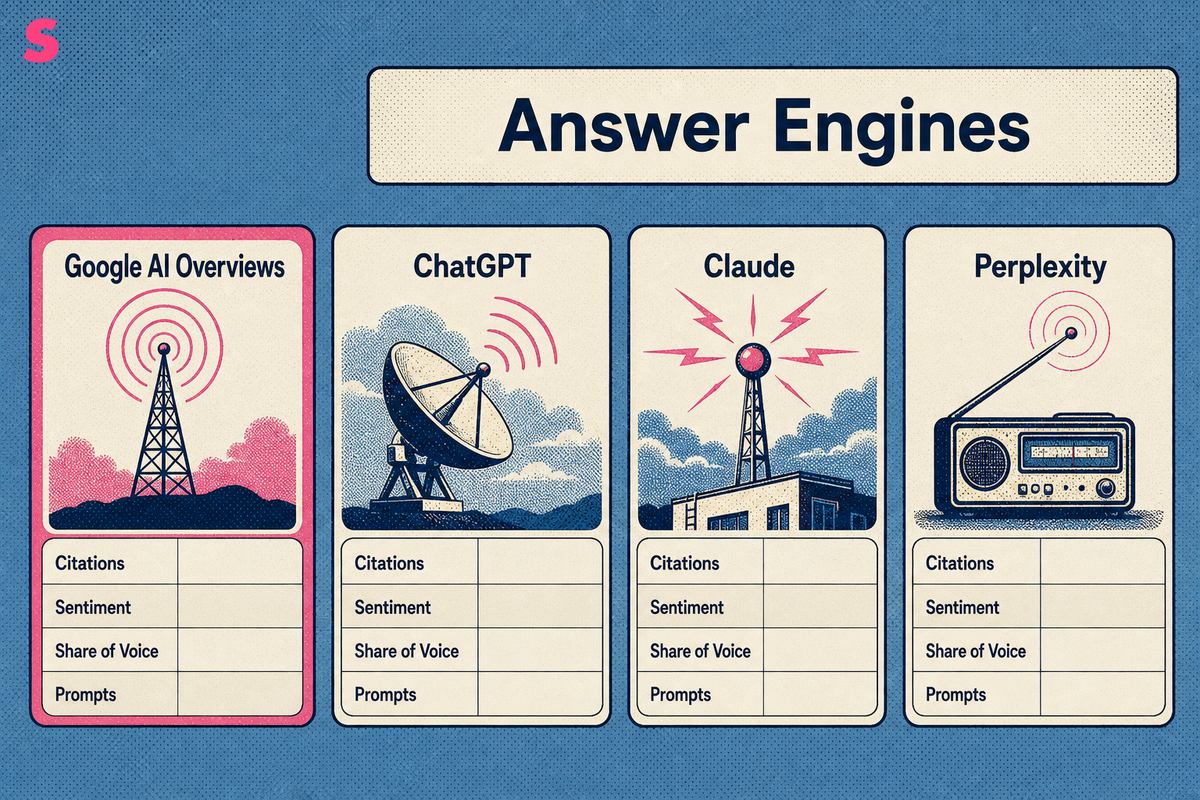
AI search tracking is the practice of monitoring whether and how a brand appears inside answers generated by AI-powered search engines, rather than on a traditional page of blue links. It covers citations, direct mentions, sentiment, and the prompts that trigger a brand's appearance in the first place.
The scope is broader than a single engine. AI search tracking monitors brand visibility across Google AI Overviews, ChatGPT, Claude, and Perplexity, since each engine draws on different sources and produces different answers to the same question. A brand cited heavily in one engine can be invisible in another.
This is a distinct discipline from search engine optimization (SEO) rank tracking, which watches position on a results page. AI search tracking watches whether a source got pulled into a generated answer at all, and if so, how it was framed. That framing, positive, neutral, or dismissive, matters as much as the citation itself.
Sona AI Search Insights approaches this by tracking citations, sentiment, and share of voice across the engines a brand actually competes in, and by identifying the specific prompts driving each mention. That level of detail is what separates a status report from something a marketing team can act on.
How does AI search monitoring actually work?
AI search monitoring works by running a fixed set of prompts against target AI engines on a recurring schedule, then recording whether a brand's domain, name, or content appears, and in what position or sentiment. The mechanics differ depending on how the data gets collected.
Two collection methods exist, and they do not produce identical results. Some tools scrape the end-user experience directly, capturing the exact response, formatting, and ads a person would see on screen. Others pull from a vendor's official API, which returns a structured response that does not necessarily match what a real user sees. These are not interchangeable: the same query can return a different answer depending on which method retrieved it.
That distinction matters more than most buyers realize when comparing AI search monitoring tools. A tool that only calls an API may miss layout quirks, ad placements, or follow-up prompts that shape the real user experience. Sona uses both scraping and API access specifically to mirror what an end user actually sees, rather than settling for whichever method is cheaper to run.
Once an answer gets captured, the tool parses it for brand mentions, competitor mentions, cited URLs, and tone. That data then rolls up into a visibility score, a share-of-voice percentage, and a citation list, the three outputs most AI search tracking platforms report as their baseline.
How do you track your brand inside Google AI Overviews specifically?
Tracking Google AI Overviews requires a tool built to detect whether a given URL is cited as a source inside Google's AI-generated search summaries, since Overviews behave differently from a standard search result and are not exposed through Google's normal ranking data. This kind of tool answers one specific question: does a URL show up as a cited source in that summary panel.
The practical approach has three steps:
- Build a list of the queries where AI Overviews actually appear for your category. Not every search triggers one, so this list has to be checked and refreshed regularly.
- Run each query on a schedule and log whether your domain appears as a cited source, and in what position among the other citations.
- Cross-reference cited pages against your own site, so you know which URLs are winning citations and which competitor domains keep displacing you.
A domain-level audit of past Google AI Overviews performance can show every AI Overview keyword a domain has already claimed, which is useful for understanding historical standing even without prompt-level detail. Monitoring can also extend across multiple geographic regions, which matters for any brand whose AI Overview visibility varies by market.
A single domain-level citation count answers whether a brand shows up at all. It does not say which prompts are producing that visibility or which specific pages are getting cited. Sona AI Search Insights closes that gap by mapping citations down to the prompt and the page, so a marketing team knows exactly which content to defend or fix, not just that the brand's overall number moved.
What methodology did we use to test these AI visibility tools?
This comparison is built from each vendor's own published pricing and product pages, read in August 2026, and from Sona's own AI visibility archive where a measurement is explicitly labeled as such. It is not a scored, prompt-by-prompt test of every listed tool: no shared prompt set was run against each platform for this article, so no per-tool score appears below, and no ranking claim rests on one.
Sona's own AI visibility archive illustrates the coverage that kind of testing needs to be credible. The archive covers 8 answer surfaces: ChatGPT, Perplexity, Google AI Mode, Gemini, Mistral, Qwen, Claude and Google AI Overviews, per Sona's own AI visibility data, August 2026. That archive is a measurement of Sona's own tracked answers; it is not a cross-tool test sample, and no other tool's results were measured against it.
That volume matters for methodology because a single day's snapshot cannot separate a genuine visibility trend from noise in how an AI engine phrased one answer. A dataset spanning more than four months and thousands of answers can distinguish a real shift in citation share from a one-off fluctuation, which is the standard any future prompt-level test on this topic should meet.
The comparisons that follow in this article rest on engine coverage as published by each vendor, pricing transparency, and whether a tool reports prompt-level detail or only a domain-wide score. Those three factors determine whether a tool functions as a monitoring dashboard or as something a team can actually act on.
Which AI visibility tools performed best in testing?
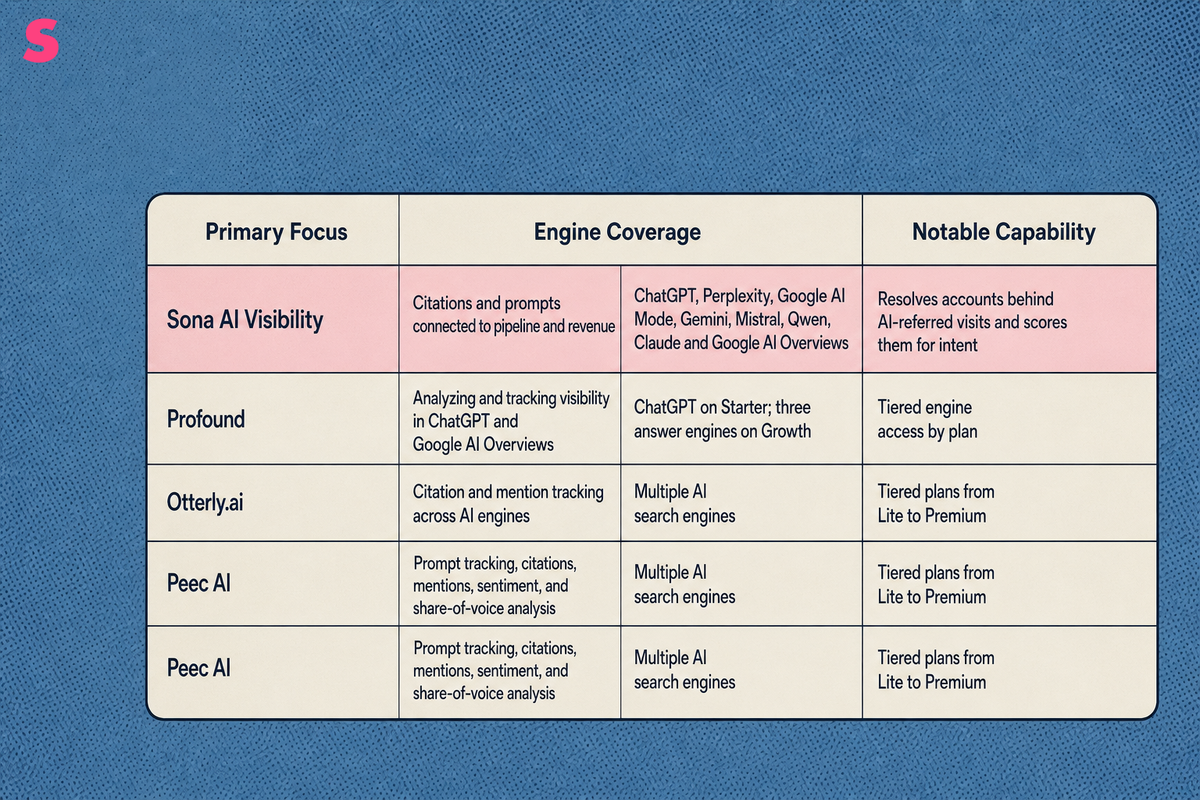
This article did not run a scored test across these tools, so the comparison below describes what each platform is built to do, drawn from vendor-published information, rather than a ranked result. Sona AI Visibility connects citations and prompts to pipeline and revenue on a single account timeline, rather than stopping at a mention count the way most dedicated trackers do. It also tracks AI crawler activity from server logs or a lightweight edge worker, with no JavaScript tag required, so ad-blocking software cannot hide crawler traffic from the report.
The rest of the category clusters around a narrower job: telling a brand whether and how often it gets cited. Evaluating a provider on the number of large language models (LLMs) and AI tools it covers is one useful lens, since a tool that only checks one engine cannot represent overall AI visibility on its own. Engine coverage and reporting depth are the two variables worth examining directly when comparing platforms.
| Tool | Primary focus | Engine coverage | Notable capability |
|---|---|---|---|
| Sona AI Visibility | Citations and prompts connected to pipeline and revenue | ChatGPT, Perplexity, Google AI Mode, Gemini, Mistral, Qwen, Claude and Google AI Overviews | Resolves the accounts behind AI-referred visits and scores them for intent |
| Profound | Analyzing and tracking visibility in ChatGPT and Google AI Overviews | ChatGPT on Starter; three answer engines on Growth | Tiered engine access by plan |
| Otterly.ai | Citation and mention tracking across AI engines | Multiple AI search engines | Tiered plans from Lite to Premium |
| Peec AI | Prompt tracking, citations, mentions, sentiment, and share-of-voice analysis | Multiple AI engines | Prompt volume scales by tier, from 50 to 350 |
| Rankscale | Helping website and brand owners analyze, track and optimize their visibility in AI-powered search engines like ChatGPT and AI Overviews | ChatGPT and Google AI Overviews | Positioned around ongoing optimization, not just monitoring |
| AI Search Watcher | LLM rank tracking that monitors brand visibility on popular AI search engines, with free tracking | Popular AI search engines | Offers free tracking as an entry point |
Most rows in that table describe tools built to answer one question: was the brand mentioned. Sona's row is the exception because AI Attribution ties every one of those citations back to an account timeline that already includes ad, web, and CRM data, so a mention becomes something measurable against pipeline rather than a number that sits in a separate dashboard.
How much do AI search tracking tools cost?
AI search tracking tools range from free checkers to quote-only enterprise plans, with published self-serve pricing running from $19 a month at the low end to $489 a month at the high end before hitting a quote-only or custom tier, depending on prompt volume and engine coverage. Pricing structure varies as much as the price itself: some vendors charge per prompt tracked, others per AI model covered, and a few bundle AI visibility into a broader suite.
| Tool | Starting price | Free option | Notes |
|---|---|---|---|
| Sona AI Visibility | Brands from $75/month, agencies from $199/month, both billed annually | 14-day free trial, no credit card | Unlimited seats and API/MCP access on every plan |
| PromptRush | From $19/month (Lite) | Free one-off visibility report, no signup | Claude tracking is a $39-$129/month add-on |
| Otterly.ai | From $29/month (Lite) | Free trial, no commitment | Unlimited team members on every plan |
| Peec AI | From $80/month (Starter) | None listed | Unlimited users on every plan |
| Profound | From $99/month (Starter) | Free trial on Growth | Starter tracks ChatGPT only |
| Scrunch AI | From $250/month (Starter) | 7-day trial, no credit card | 17% discount on annual billing |
| AthenaHQ | From $295/month (Starter) | Free Essential tier with 300 credits | 1 credit equals 1 AI response |
| Goodie | From $399/month (Explorer) | 7-day free trial | Explorer tracks 3 AI models |
Semrush bundles AI visibility into its main plans, starting around $165 a month billed annually, rather than selling it as a standalone product, and it offers a separate free AI visibility checker alongside a 7-day trial. Birdeye is quote-only with no public pricing, priced instead by number of business locations, but it does offer a free AI visibility checker. Adobe's AI Content Visibility Checker is free with no signup and no Adobe license required, though it functions as a standalone browser diagnostic rather than an ongoing monitoring platform.
What features should you look for when choosing an AI search tracking tool?
The features that matter most in an AI search tracking tool are engine coverage, prompt-level reporting, sentiment analysis, citation tracking, and whether the tool connects visibility data to a business outcome rather than reporting it in isolation. A tool missing any one of these leaves a gap a competitor will exploit.
Engine coverage comes first because a brand invisible in one engine and strong in another needs to know which is which. A provider's coverage of LLMs and AI tools is worth checking directly, since narrow coverage means the reported visibility score cannot represent the brand's actual standing across the category. A tool checking only one engine measures a fraction of the picture.
Beyond coverage, look for:
- Prompt-level detail, not just a domain-wide visibility percentage, so you know which questions are driving or costing you citations.
- Sentiment and share-of-voice scoring, since being mentioned negatively is a different problem than not being mentioned at all.
- Citation source tracking, showing which third-party domains an AI engine trusts enough to cite alongside or instead of you.
- Multi-region support, if your brand operates in more than one market with different AI answer behavior.
- A path from visibility data to revenue, rather than a dashboard that ends at a mention count.
That last point is where most AI search monitoring tools stop short. Sona AI Search Insights reports citations, sentiment, and the prompts driving every answer, and pairs that with AI Attribution, which ties AI touchpoints into a single account timeline alongside ad, web, and CRM data so a mention can be measured against pipeline, not just logged as an event.
Can Google Search Console track AI Overview visibility?
No. Google Search Console does not currently provide built-in Google AI Overviews visibility tracking capabilities, according to reddit.com. Search Console reports impressions, clicks, and position for standard search results, but it has no dedicated field or report for whether a page was cited inside an AI Overviews panel.
This gap is why a dedicated tracking category exists for this specific job: confirming whether a given URL is cited as a source inside Google's AI-generated search summaries, filling exactly the reporting hole Search Console leaves open. Without one, a brand has no reliable way to confirm whether its content is being pulled into these summaries at all.
Some teams try to infer AI Overview presence indirectly, watching for unusual changes in impressions or click-through rate on queries known to trigger an Overview panel. That approach is unreliable because Search Console cannot distinguish a click lost to an AI Overview from a click lost to a competitor's standard listing or an algorithm change.
Until Search Console adds direct Google AI Overviews reporting, brands serious about this visibility need a purpose-built tracker running alongside their existing SEO monitoring, not instead of it. The two data sources answer different questions and neither substitutes for the other.
How do you turn AI citation tracking into a revenue signal?
Turning AI citation tracking into a revenue signal requires connecting every citation, prompt, and AI-referred visit to a real account, then following that account through to pipeline and closed revenue, rather than stopping at a visibility percentage. A citation count on its own tells you nothing about whether it produced a customer.
The practical path runs through four stages:
- Capture the citation or mention across the AI engines relevant to your category.
- Identify the AI-referred visit that follows, even when analytics tools log it as direct traffic.
- Resolve that visit to a real account, using self-reported attribution or identity resolution where the visit itself is anonymous.
- Track that account through to pipeline and closed revenue on the same timeline used for every other marketing channel.
This is precisely the gap most AI search monitoring tools leave open, because they report mentions and sentiment but stop before pipeline. AI Attribution builds one account timeline that places every AI touchpoint alongside ads, web, and CRM data, uses attribution models that credit AI search fairly rather than defaulting to last click, and captures self-reported attribution on demo and signup forms to close the zero-click gap where a buyer researched in an AI engine but never clicked through.
The result is channel ROI reporting that treats AI search the same way a team already treats paid media: spend, deals, and return on ad spend (ROAS), rather than a separate report that never connects back to the number a CFO actually asks about.
Frequently Asked Questions
Is AI search tracking the same as traditional rank tracking?
No. AI search tracking monitors citations and mentions inside AI-generated answers, while traditional rank tracking watches position on a page-one search results listing. The two measure fundamentally different surfaces, and a full comparison of how they differ in method and output deserves its own dedicated article.
Which AI engines should an AI search tracking tool cover?
Coverage should span, at minimum, Google AI Overviews, ChatGPT, Claude, and Perplexity, since AI search tracking monitors brand visibility across these major AI-powered search engines. Ranking which of those engines matters most for a given brand is a separate question, addressed in its own dedicated article.
How often should you run AI search monitoring checks?
AI-generated answers can change between one check and the next, sometimes citing a different set of sources for the identical query on repeated runs. A recurring cadence, daily or weekly depending on the tool, catches those shifts. A one-off check only captures a single moment and misses the trend entirely.
Do AI search tracking tools work for multiple regions?
Yes. Some tools in this category support monitoring across regions including the USA and Europe, which matters for any brand with a multi-market presence where AI answer behavior can differ significantly between countries.
What is an AI Overview tracker?
An AI Overview tracker is a tool built to confirm whether a given URL is cited as a source inside Google's AI-generated search summaries. It answers a narrower question than general AI search tracking: specifically whether Google's Overview panel, rather than another AI engine, is citing a particular page.
Can you track AI search visibility without a dedicated tool?
You can, by running prompts manually across each AI engine and logging the results in a spreadsheet by hand. That approach breaks down quickly at scale, since AI-generated answers shift often and a manual process cannot cover enough prompts, engines, and regions consistently to catch the pattern a dedicated tracking tool exists to surface.
Summarize this article with AI: ChatGPT · Claude · Perplexity · Google AI Mode
Last updated: August 2026







