


An AEO playbook is a repeatable method for ensuring AI systems can retrieve, cite and recommend your content, while measuring whether their answers mention your brand. Execute it in five phases: repair crawl access, create a buyer-intent prompt set, reorganize pages into direct answers, reinforce third-party sources, and measure results. Sona AI Visibility connects prompts and citations to pipeline and revenue, while monitoring AI crawler and agent activity. Evaluate outcomes by recommendation quality, since a mention by itself does not demonstrate pipeline.
What is an AEO playbook, and how is it different from SEO and GEO?
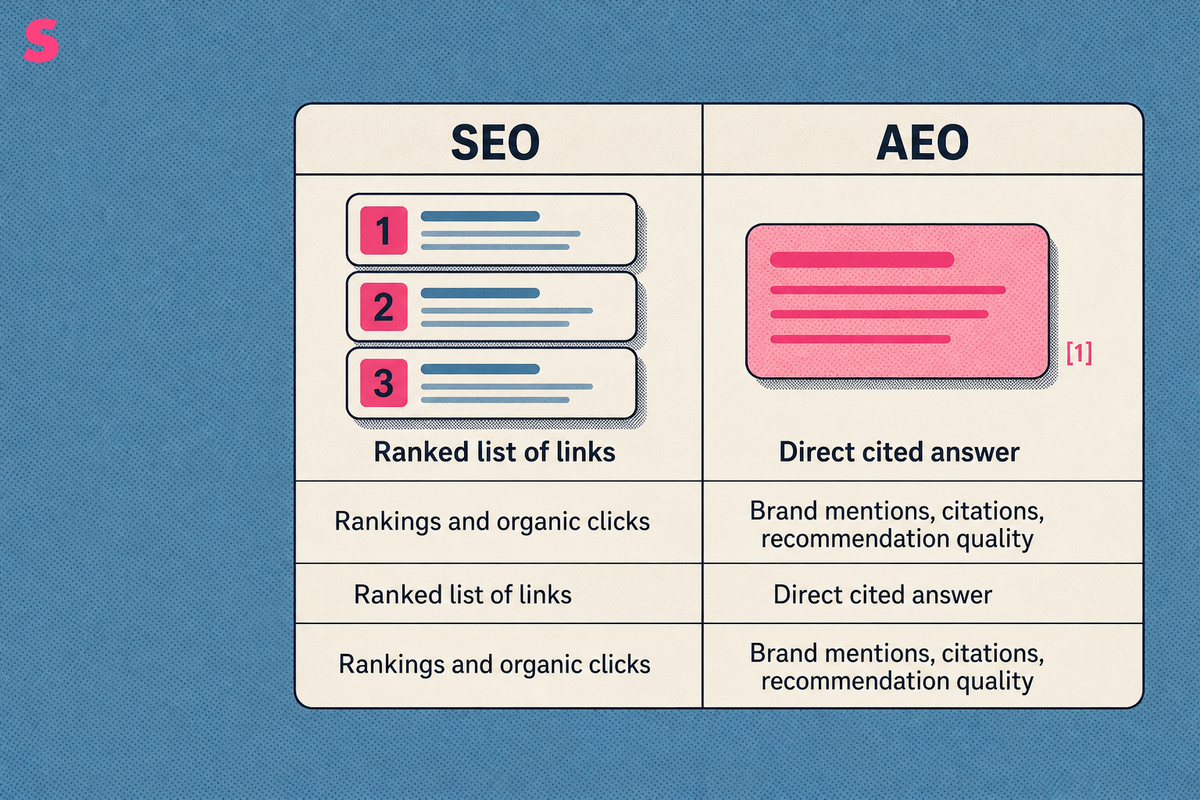
An AEO playbook is a documented process for making content easy for AI systems to retrieve, quote and recommend, then measuring whether answers cite your brand. It targets visibility inside AI answers, where buyers receive a response rather than a ranked list of blue links.
An effective playbook defines the pages to improve, buyer prompts to test, answer engines to monitor, external sources that shape recommendations and metrics that connect visibility to commercial outcomes. Answer engine optimization (AEO) measures brand mentions, citations and recommendation quality. SEO measures rankings and organic clicks.
AEO focuses on whether an AI answer names, cites or recommends your brand, while GEO, Google Engine Optimization, focuses on whether your content appears in Google results. The practical overlap includes crawlability, authority, clear writing and sound content structure. AEO adds answer-level citation analysis, prompt measurement, variation between runs and assessment of whether an answer recommends the brand.
The rebranded-SEO objection is partly correct. Strong pages have always required useful information and technical access. AEO adds a different unit of analysis: the prompt, the returned answer, the sources cited and the quality of the recommendation. A high organic rank does not prove that an AI answer names a company, and a citation does not prove buyer trust.
Why does an AEO playbook matter if a citation does not equal pipeline?
An AEO playbook matters because B2B SaaS buyers can form shortlists inside AI answers before reaching a vendor website. A citation is not pipeline, but it shows that a brand entered the buyer’s consideration set. The job is to connect that evidence to branded search, AI-referred visits, demo requests, assisted conversions and sales feedback.
Being mentioned and being recommended are different outcomes. A mention can place a brand in a neutral list. A recommendation places the brand in a favorable comparison, often with supporting reasons, category fit or third-party proof. Marketing teams should score both outcomes separately because a growing mention rate can conceal weak recommendation quality.
External proof changes answer context. Comparative reviews, current product information and credible third-party references can affect which sources an answer engine cites for best-in-category questions. Review quality therefore belongs in an AEO measurement plan alongside owned-page improvements.
Sona AI Visibility connects AI citations and AI-referred visits to pipeline and closed-won revenue on one account timeline. That measurement distinguishes a visibility report from a commercial operating model, while preserving an important boundary: citations influence research, but sales outcomes require corroboration from conversion data and buyer conversations.
How do you check that AI engines can reach, render and trust your pages?
Phase 1 is a technical readiness audit that confirms whether answer engines can fetch, render, interpret and trust the pages you want cited. The audit covers six connected dimensions: crawlability, performance, security, content structure, content quality and accessibility.
- Crawlability: review robots.txt rules, canonical tags, indexability and AI crawler access through server logs.
- Performance: inspect rendered output, Core Web Vitals and dependence on client-side JavaScript.
- Security: verify HTTPS and response headers such as Strict-Transport-Security and Content-Security-Policy.
- Structure: use clear headings, semantic HTML, schema markup and machine-readable page elements.
- Quality and accessibility: provide direct answers, current information, alt text, ARIA attributes, sufficient contrast and explicit image dimensions.
Consider a comparison page that loads its product table only after a JavaScript request. A retrieval crawler receives thin server-rendered HTML, encounters a blocked script or slow response, and never sees the comparison content. The page can rank in traditional search while failing to provide usable evidence for an AI answer.
The Sona AI Crawl Checker identifies blocked access caused by rules such as robots.txt restrictions, WAF responses or rate limiting. The Free AI Readiness Checker evaluates technical readiness across crawlability, performance, security, content structure, content quality and accessibility. A score is a dated snapshot. The operational value comes from fixing the pages that need attention.
How do you build a buyer-intent prompt set you can defend?
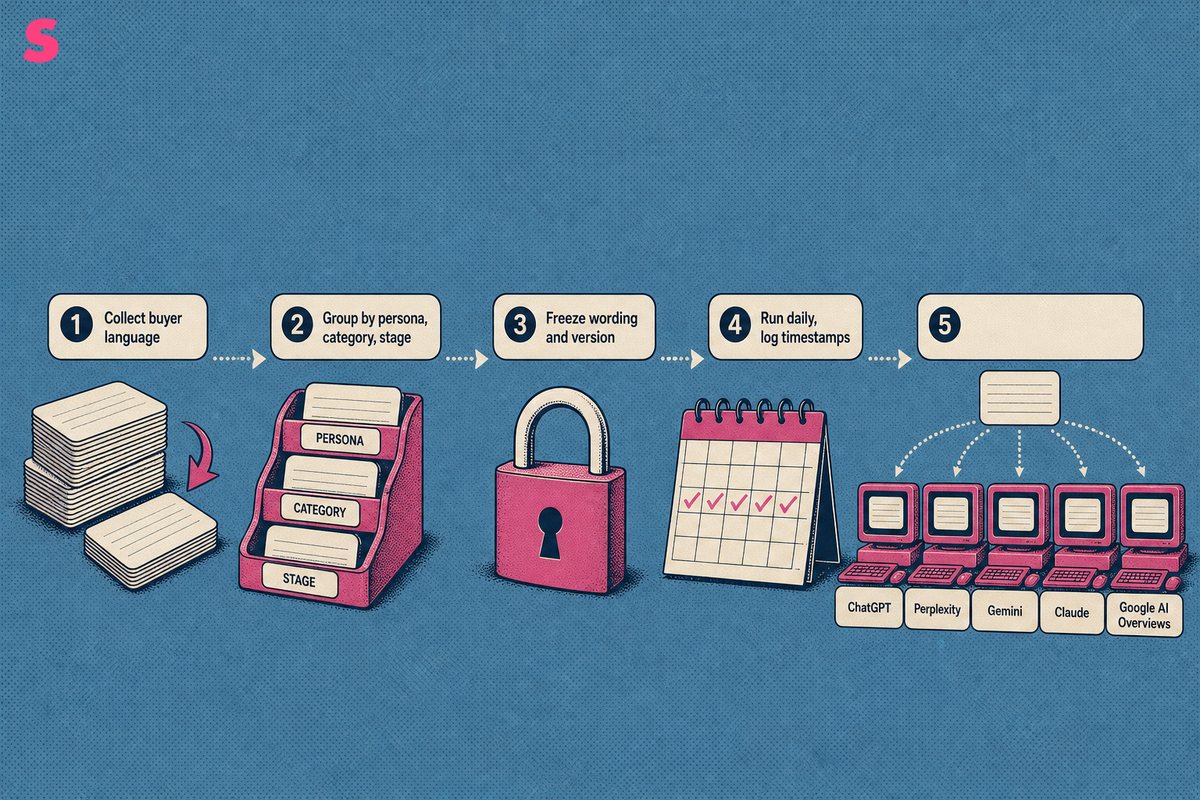
Phase 2 builds a fixed prompt set from buyer intent, personas, product categories and funnel stages. Start with questions that influence evaluation, such as category comparisons, implementation questions, alternatives and use-case recommendations. Avoid generic educational questions that create visibility without commercial relevance.
- Collect language from sales calls, search queries, customer interviews and competitive research.
- Group prompts by persona, product category and buying stage.
- Freeze prompt wording, version number and target geography before measurement begins.
- Run the same set daily, record timestamps and retain the full returned answer, citations and recommendation classification.
Monitor ChatGPT, Perplexity, Gemini, Claude and Google AI Overviews as the five core research surfaces, as of August 2026. Sona's own AI visibility data, September 2026, counts eight answer surfaces: ChatGPT, Google AI Overviews, Perplexity, Google AI Mode, Gemini, Mistral, Qwen and Claude. Expand coverage only when the team can explain why each additional surface matters to its buyers.
AI answers are unstable, but instability is a measurement problem rather than a reason to avoid measurement. A team that runs the same prompt list daily can distinguish a pattern from a weekly snapshot. Classify a change as a trend only after it persists across the team’s pre-registered observation window and repeated runs. Treat isolated spikes as noise. Report repeat runs, timestamps and prompt versions, then state that results reflect sampled answers rather than a permanent ranking.
How should you structure a page so AI systems can quote it?
Phase 3 makes high-value pages easier to quote by placing direct answers near the top, using question-led headings and ensuring every section can stand alone. Start with pages that support revenue-critical prompts, including comparison pages, product-category pages, implementation guides and pages used in sales follow-up.
Before a rewrite, a section might open with a broad claim: Our platform transforms marketing measurement. After a rewrite, the heading becomes How does marketing measurement connect AI search to revenue?, followed by a direct answer that defines the mechanism, names the data inputs and states the practical outcome. The second format gives an AI system a discrete claim to retrieve and quote.
Use schema markup where it accurately represents page content. Choose a schema type that matches visible content, include only claims present on the page and implement the markup in a machine-readable format. Validate the markup, verify parity between the markup and rendered content, then recheck it after page changes. Retain semantic heading hierarchy and make supporting evidence easy to locate. Content architecture for AI consumption, schema markup implementation and machine-readable websites are core implementation components, according to shellypalmer.com. Authority signals also matter: identifiable authorship, accurate product details, current evidence and pages that answer the stated question without detours.
A brand-level visibility score is not a work item. A prompt-level view that identifies the cited source and the page that should answer a missing prompt is actionable. Sona AI Visibility shows prompts a site should appear in but does not, alongside the pages connected to those opportunities. These fundamentals overlap with strong content strategy, so this phase should remain disciplined rather than elaborate.
How do G2, Reddit and Wikipedia influence what AI answers say about you?
Phase 4 addresses the third-party sources that shape AI recommendations: review platforms, communities, reference pages and editorial coverage. G2, Reddit and Wikipedia-style references can provide independent context that an owned product page cannot. They are inputs to the public information environment, not channels a company fully controls.
Map the cited sources that recur in answers for your category. For each prompt, record which domains appear, what claim they support, whether the brand is mentioned favorably and whether the source is accurate. The source map identifies where a company needs better factual representation, stronger customer proof or a correction to outdated information.
- Maintain accurate company and product profiles on relevant review sites.
- Encourage genuine customer reviews without scripting or incentives that distort sentiment.
- Participate in communities by answering real questions with useful, verifiable information.
- Earn editorial coverage through evidence, subject expertise and newsworthy product developments.
Manipulating reviews, planting community comments or editing references for promotional gain creates reputational and compliance risk. Third-party presence should improve because the information is accurate and useful. A company can influence its contribution, but it cannot dictate the answer produced by a community, editor or answer engine.
Which AEO metrics and alert thresholds show the playbook is working?
Phase 5 turns AEO work into an operating dashboard by measuring visibility, recommendation quality, technical access and downstream demand together. Before monitoring begins, register a baseline period, tolerance, persistence window and minimum sample requirement for each metric. In the table, B is the baseline rate or count, T is the declared tolerance, W is the persistence window, and N is the minimum sample requirement. Alert only when the stated condition holds with n at or above N.
| Metric | What it measures | How to collect it | Review cadence | Suggested alert trigger |
|---|---|---|---|---|
| Mention rate | Share of tracked answers that name the brand | Classify each frozen-prompt response | Daily, with weekly review | If n ≥ N and rate < B − T for W consecutive runs |
| Citation share | Share of cited sources that point to owned pages | Capture citations per prompt and engine | Daily | If n ≥ N and owned-source share < B − T for W consecutive runs |
| Recommendation quality | Mentioned versus favorably recommended | Apply a documented answer rubric | Weekly | If n ≥ N and recommendation rate < B − T for W consecutive runs while mention rate remains within T of B |
| Sentiment | Positive, neutral or negative answer framing | Tag answer language and rationale | Weekly | If n ≥ N and negative-framing rate > B + T for W consecutive runs |
| Competitor share of voice | Relative presence across the prompt set | Classify brands named in each answer | Weekly | If n ≥ N and competitor share > B + T for W consecutive runs |
| AI crawler activity | Which AI bots reach priority pages | Review server logs or edge-worker data | Weekly automated alerts, monthly manual review | If n ≥ N and priority-page crawl activity < B − T for W review periods |
| AI-referred visits | Visits arriving from answer engines | Analyze referral and attribution data | Weekly | If n ≥ N and visits < B − T for W review periods while visibility remains within T of B |
| Downstream conversion | Branded search, demos and assisted conversions | Join analytics, CRM and sales feedback | Monthly | If n ≥ N and demand signals < B − T for W review periods after a visibility decline meeting its alert rule |
Confidence comes from repeatability. Preserve the prompt version, run date, engine, answer text, citations and scoring rules, then report trends rather than a single answer. State limitations clearly: answers change, citation behavior differs by engine and zero-click research will not always create a traceable visit.
Sona AI Visibility uses AI Attribution to connect AI citations to accounts, pipeline and closed-won revenue on one timeline. That allows a team to examine whether visibility changes coincide with commercial signals while keeping answer-level metrics and revenue attribution as separate measures.
How do you compare AEO tools when list prices are not comparable?
Compare AEO tools by the measurement model, not the lowest list price. Check engine coverage, prompt limits, refresh frequency, historical data, API access, integrations, reporting and whether AI tracking is bundled with SEO features. Software spans roughly $50 to $1,000 per month, while B2B AEO and GEO services span $2,000 to $10,000 per month, based on October 2026 market listings.
The plan details below were checked in October 2026. Sona AI Visibility is listed first because it connects AI citations and prompts to pipeline and revenue on one account timeline, and tracks AI crawler activity through server logs or a lightweight edge worker without a JavaScript tag.
| Tool | Starting price | Agency Plans? (Yes/No) | # of Answer Engines Tracked | Answer Engines | # of Daily Tracked Prompts (entry plan) | Cost per Daily Tracked Prompt | Differentiation |
|---|---|---|---|---|---|---|---|
| Sona AI Visibility | From $75/month | Yes | 3 | Not published | 5,000 credits/month, about 56 prompts tracked daily on 3 engines | $0.45 per daily tracked prompt | Connects citations and prompts to pipeline and revenue, with server-log or edge-worker crawler activity. |
| Profound | Custom pricing | Yes | 3 | ChatGPT, Gemini, Google AI Overviews | Free Trial: 50 prompts daily for 7 days | Cannot be calculated from custom pricing | AI-answer visibility analytics with daily trial prompt tracking. |
| Otterly.ai | From $29/month | Yes | 4 | ChatGPT, Google AI Overviews, Perplexity, Microsoft Copilot | 15 prompts daily | $0.48 per daily tracked prompt | AI search monitoring across four answer engines on the Lite plan. |
SE Ranking starts at $129 per month for Core and includes AI tracking on three engines with 100 prompts tracked daily, as of October 2026. Its AI Search add-on costs $89 per month and adds 200 prompts on Google AI Overviews, Google AI Mode and ChatGPT. Compare the required bundle, reporting workflow and daily prompt resolution before treating any entry price as equivalent.
How often should a B2B SaaS team run the AEO playbook?
A B2B SaaS team should run its frozen prompt list daily, review findings weekly, inspect conversion signals monthly and reassess positioning quarterly. Daily prompt tracking provides enough resolution to distinguish a persistent answer change from a one-day fluctuation caused by retrieval changes, model updates or new competitor content.
- Assign prompt ownership to demand generation or SEO, technical access to web engineering and downstream reporting to marketing operations.
- Change one variable at a time, such as a page section, schema implementation or third-party profile.
- Re-run the unchanged prompt set daily and compare results against the documented baseline.
- Record cited sources, recommendation quality, AI-referred visits and sales feedback in the same review.
Keep the clocks separate. Run prompts daily. Review automated crawler alerts weekly and priority-page technical findings monthly. Conduct a full technical re-audit, competitive benchmark and positioning review quarterly. The output is a log rather than merely a score, because a comparable series reveals whether a change held long enough to justify action.
Sona AI Visibility connects prompts and citations to pipeline and revenue, then tracks AI crawler and agent activity reaching site pages. Leadership reporting should use that chain to show visibility movement, associated demand signals, pipeline evidence and what sales teams heard from buyers, without claiming that an individual citation caused a deal.
What are the frequently asked questions about an AEO playbook?
What is an AEO playbook in one sentence?
An AEO playbook is a documented, repeatable process for making content easy for AI systems to retrieve, quote and recommend, paired with a fixed method for measuring whether AI answers name the brand.
Is AEO just rebranded SEO?
AEO and SEO share fundamentals such as crawlability, authority, clear writing and well-structured content. AEO adds answer-level citations, prompt-based measurement, variation between engines and runs, and a focus on whether an answer recommends a brand rather than where a page ranks.
Which AI engines should a B2B SaaS team track first?
Start with the surfaces buyers use in research: ChatGPT, Perplexity, Gemini, Claude, Google AI Overviews, and other answer engines, as of August 2026. Prioritize the engines that appear in sales conversations, then expand coverage when the prompt set and reporting process can support additional surfaces.
Can AI answers be measured reliably when they change between runs?
Yes, with limits. Freeze prompt wording and versions, repeat each run, timestamp results and report trends rather than single answers. State variability openly and treat daily repeated observations as stronger evidence than an isolated response.
How do you connect AEO results to pipeline?
Track AI-referred visits, branded search, demo requests and assisted conversions alongside mention and recommendation metrics. Add sales feedback about whether buyers mention AI tools during discovery, then evaluate whether visibility changes coincide with sustained commercial signals.
Can you control what review sites and communities say about your brand?
Not directly. Keep profiles accurate, encourage genuine customer reviews and contribute useful answers in relevant communities. Avoid manipulation because it creates reputational and compliance risk, while inaccurate or forced advocacy weakens the evidence buyers and answer engines encounter.
Summarize this article with AI: ChatGPT · Claude · Perplexity · Google AI Mode
Last updated: October 2026







