


For GEO optimization, ensure every page is crawlable, begin each section with a direct answer, support claims with cited data and named experts, and re-test a fixed set of prompts across engines. Google's Search documentation from October 2026 states that its AI features use crawlable, helpful content, meaning SEO fundamentals remain the priority. Since many formatting tactics have no published experiments, measure them before relying on them. Sona AI Visibility links prompts and citations to pipeline and revenue while monitoring AI crawler activity, letting you identify which edits deliver results.
What do you need in place before you optimize content for GEO?
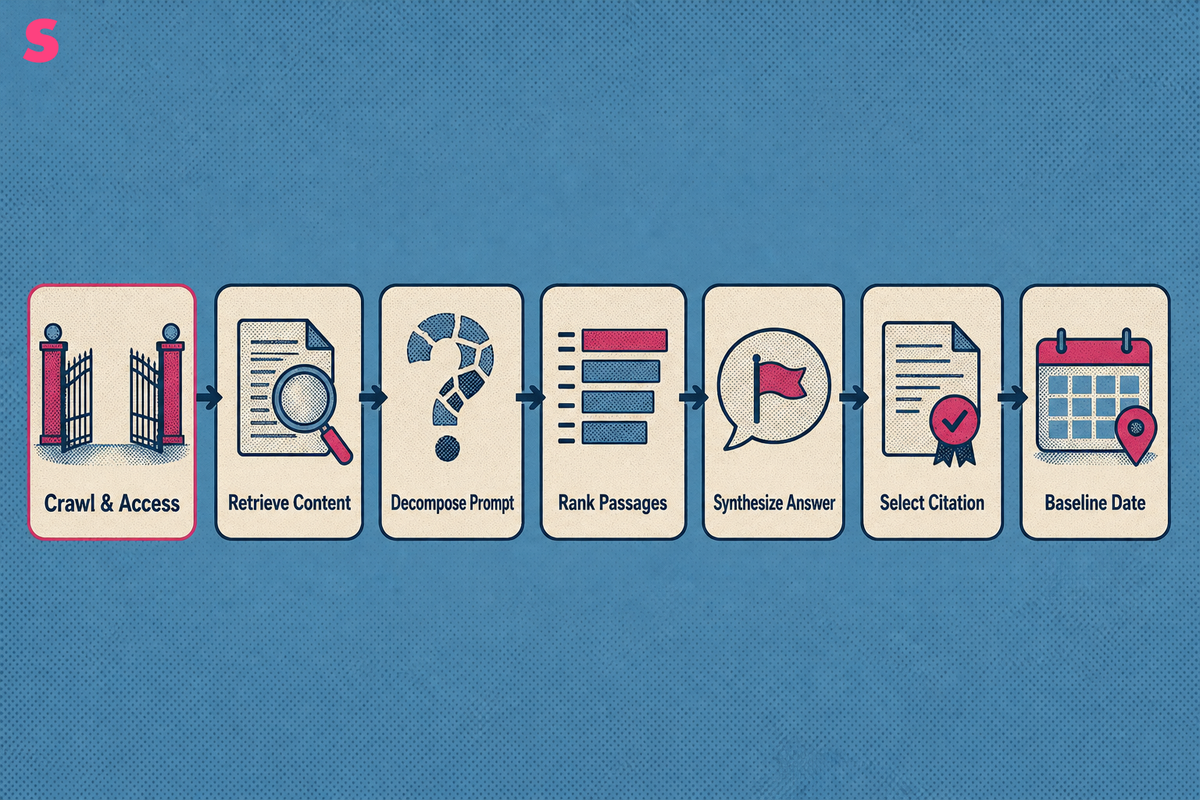
To optimize content for GEO, start with publicly accessible, crawlable pages and sound SEO fundamentals. Google’s Search documentation, October 2026, states that generative search features use crawlable public content and recommends technically sound structure plus unique, valuable material.
Generative engine optimization (GEO) shapes content so LLM-based systems can retrieve it, extract an answer, and cite the source page. GEO builds on SEO but adds a measurement layer for citations, prompt coverage, answer inclusion, and AI share of voice.
Generative engines generally follow a sequence: they discover or access a page, crawl or retrieve its content, decompose a prompt into information needs, rank candidate passages, synthesize an answer, and select sources for citation. Traditional SEO primarily targets keyword ranking in search results. GEO also prepares passages for retrieval, extraction, answer synthesis, and citation without assuming undocumented engine-specific ranking rules.
For a new SaaS site, SEO remains the foundation. GEO changes how the team structures, validates, and measures content. Sona AI Visibility connects citations to pipeline and revenue on one account timeline after a page begins appearing in AI answers.
- Build a fixed prompt set from buyer questions.
- Audit each target page against technical and content criteria.
- Restructure pages for direct extraction and citation.
- Fix crawlability, rendering, schema, security, and accessibility issues.
- Add verifiable evidence that supports claims.
- Test results across Google AI Overviews, ChatGPT, Perplexity, Claude, and other answer engines.
- Measure citations, traffic, and pipeline against a dated baseline.
How do you build a prompt set from your buyers’ real questions?
Build a GEO prompt set from questions buyers ask during research, not from a keyword export alone. Prompts capture the problem, comparison, and decision language buyers use in ChatGPT, Perplexity, Gemini, Claude, and other answer engines.
Start with buyer-journey stages. Awareness questions define a problem. Consideration questions compare approaches. Decision questions compare vendors or requirements. Purchase questions address pricing, implementation, or risk. Assign every prompt a funnel stage and revenue-potential label before editing a page.
- Collect questions from sales calls, support conversations, search queries, product documentation, and existing content briefs.
- Rewrite each question as a natural-language prompt a buyer could enter into an answer engine.
- Tag each prompt by buying stage, commercial intent, page owner, and revenue relevance.
- Prioritize revenue-linked branded and conversion-oriented queries. An October 2026 vendor listing recommends isolating the top 10 keywords that trigger Google AI Overviews for this purpose.
- Freeze the prompt list and record its creation date, target market, and tracked engines.
A fixed prompt set makes later tests comparable. Sona AI Visibility supports this workflow by organizing tracked prompts around visibility, position, mentions, buying stage, intent, and prompt history, rather than treating a question list as a one-time research exercise.
How do you audit your existing content against GEO criteria, step by step?
Audit GEO content page by page with a repeatable scoring sheet that separates technical access from answer quality. Record whether AI systems can reach, render, parse, trust, and extract each page, then rank pages by the revenue value of the prompts they should answer.
Use the following sequence for every URL. The table provides the criterion reference and evidence requirements for the inspection steps.
- Map the URL to the fixed prompts it should answer, then assign funnel stage, owner, and revenue relevance.
- Capture the citation baseline, including answer inclusion, cited URL, tracked engine, prompt, and date.
- Test public access, crawlability, canonicalization, and server-rendered content before reviewing copy.
- Inspect structure, direct-answer quality, recency, evidence, and accessibility against the table criteria.
- Record pass, fail, or needs-review status with the supporting evidence for every criterion.
- Assign each failure a critical or medium priority and attach one specific fix.
- Rank the page backlog by prompt revenue potential and technical severity.
- Implement one controlled content or technical change, then re-run the audit and fixed prompt set.
| Audit dimension | What to inspect | Pass/fail check | Threshold or guidance | Evidence to record | Priority if failed |
|---|---|---|---|---|---|
| Crawlability | robots.txt, canonical tag, indexability, public access | Answer engines and search crawlers can access the canonical page | Google requires publicly accessible, crawlable content, per Google’s Search documentation, October 2026 | HTTP response and crawler-access result | Critical |
| Performance and rendering | Server-rendered HTML and JavaScript dependence | Core copy and headings appear without heavy client-side rendering | Server-rendered HTML and reduced JavaScript dependence are listed in Search Engine Land guidance, September 2026 | Rendered HTML review | Critical |
| Security and headers | HTTPS and response-header hygiene | Page loads securely without avoidable header issues | No tested threshold supplied | Header review | Medium |
| Content structure | Question headings, schema markup, summaries, semantic hierarchy | Page has extractable sections and valid relevant structured data | FAQs and reviews are cited as useful structured-data formats | Schema validation and heading map | Medium |
| Content quality | Direct answer, recency, evidence, query alignment | Section answers the buyer question with support | Keep the direct answer under 300 words and review quarterly to identify outdated information and replace old sources, following September 2026 vendor guidance | Answer text, sources, last review date | Medium |
| Accessibility | Alt text, ARIA, contrast, image dimensions | Images and interface elements remain interpretable | No tested threshold supplied, use pass/fail checks for alt text, ARIA, contrast, and image dimensions | Accessibility findings | Medium |
Rank the resulting page list by revenue potential from the fixed prompt set, then save the baseline before changing copy. A dated score is a snapshot. The useful record is a sequence of audits and citation checks showing whether a page moved after a specific edit.
A visibility score shows that a page is absent from AI answers, but it does not identify the page element blocking inclusion. Sona AI Visibility’s AI Search Insights scores a page out of 100 across six categories, ranks findings as critical or medium with a fix attached, and re-runs the audit on a watch so teams can confirm whether a fix landed.
How should you structure a page so AI engines can extract and cite it?
Structure GEO content around answer-first sections, question-based subheads, short paragraphs, and evidence that supports the answer. Open each section by answering the heading directly, then add context, caveats, examples, and supporting detail for human readers.
Use the reader’s actual query in the title, summary, and relevant headings. A September 2026 vendor listing recommends meta descriptions of 155–160 characters. Another February 2026 vendor listing recommends paragraphs of 2–4 sentences. Treat both as guidance to test, not proven citation thresholds.
- Open each major section with a direct answer under 300 words, using the September 2026 vendor guidance as a working limit.
- Use question-based subheads that match prompt language.
- Write a concise opening summary rather than burying the conclusion.
- Keep paragraphs focused on one claim, process step, or example.
- Use tables when readers need to compare criteria, options, or outcomes.
- Pair direct answers with useful explanation so the page remains people-first.
Robotic answer blocks remove the reasoning buyers need before acting. A strong GEO page provides an extractable answer, then explains why it is true, where it applies, and what evidence supports it. Conversational, direct writing mirrors the question-and-answer form of generative search without reducing the page to fragments.
Which technical fixes still matter for AI search visibility?
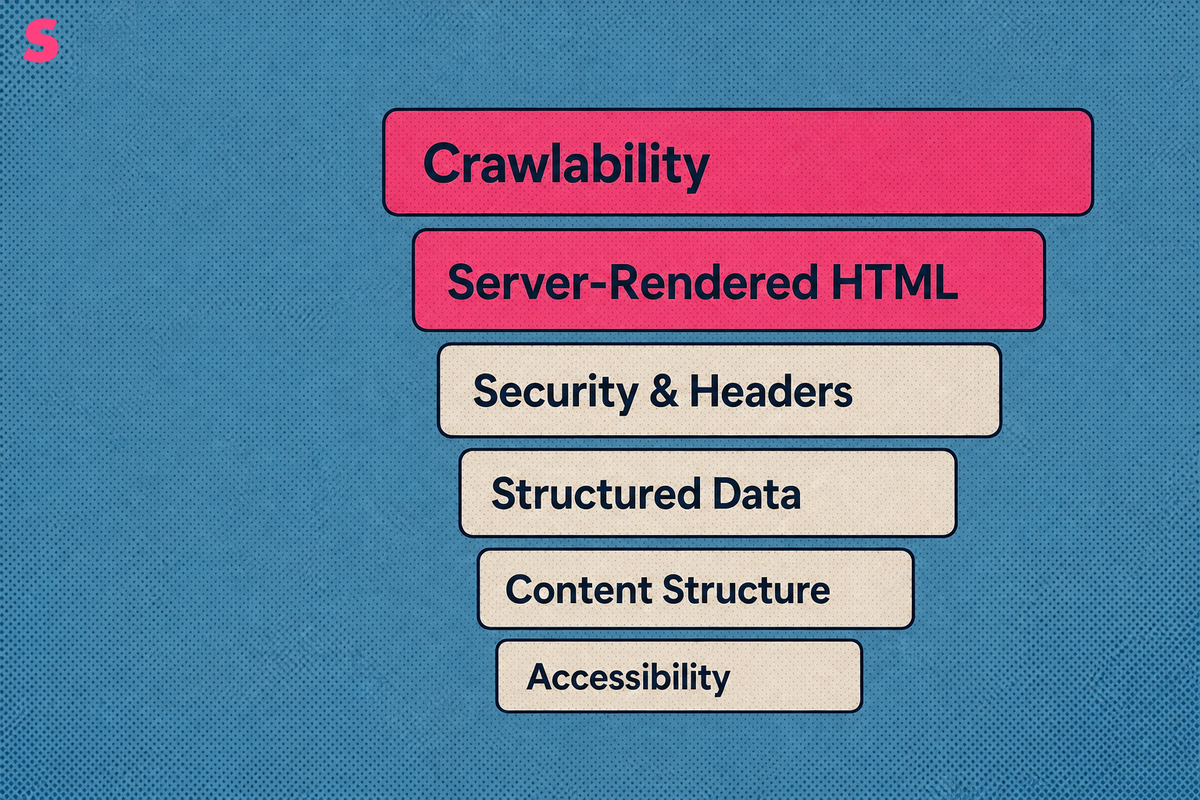
Technical GEO fixes begin with crawlability, server-rendered HTML, clean markup, structured data, security, and accessibility. Google’s Search documentation, October 2026, makes crawlable public content a prerequisite. Search Engine Land guidance, September 2026, identifies server-rendered HTML and reduced JavaScript dependence as practical content-delivery improvements.
Fix audit findings in order of impact. Resolve blocked crawling and broken canonicalization first. Then ensure the primary answer appears in server-rendered HTML, reduce unnecessary JavaScript, and maintain semantic heading structure. Add relevant structured data such as FAQs and reviews only where the page genuinely contains that information.
Security and accessibility affect whether a page remains stable and interpretable. Check HTTPS, response headers, alt text, ARIA attributes, contrast, and explicit image dimensions. Sona AI Visibility can show which AI crawlers reach pages, helping teams distinguish an editorial issue from a page-access issue before rewriting content.
Do not block AI crawlers by default. Blocking can limit retrieval and visibility, but crawler access is also a legal, licensing, privacy, and commercial decision. Document which crawler categories are allowed, why they are allowed, and who owns future changes.
Do original data, expert quotes and citations make a page more likely to be cited?
Verifiable evidence makes GEO content easier to assess, trust, and reuse in an AI answer. Add clear statistics, named sources, original data where available, and expert quotations only when the quotation is real, relevant, and attributable.
A 2024 Princeton GEO paper, cited in research retrieved from Reddit, found that adding expert quotes, clear statistics, and readability improvements can help optimize content for generative engines. The finding supports evidence-led editing, but it does not establish a universal formula for every answer engine or topic.
A February 2026 vendor listing claims a 30–40% visibility lift for content containing citations, expert quotations, and data, but the listing does not identify an underlying study. Treat that range as an unverified vendor claim, not a forecast for a content program.
- Replace unsupported assertions with evidence that readers can inspect.
- State the date, scope, and source beside each statistic.
- Use expert quotations only when the original words and speaker are available.
- Remove stale data before it contradicts newer evidence.
- Keep the page focused on answering the prompt, rather than adding citations as decoration.
Google’s published guidance provides the firmer foundation: crawlable pages, useful content, technical quality, and originality, per Google’s Search documentation, October 2026. Evidence-heavy formatting is plausible and worth testing, but measure citation gains against the fixed prompt baseline.
Should you optimize differently for Google AI Overviews, ChatGPT, Perplexity and Claude?
Use one strong GEO foundation across Google AI Overviews, ChatGPT, Perplexity, and Claude, then test engine-specific hypotheses against the same prompt set. Crawlable, clear, evidence-backed pages are common requirements. Only Google’s guidance is documented in the supplied evidence, so engine-specific tactics remain hypotheses to test.
| Answer engine | Common GEO requirement | Documented guidance | Testing hypothesis |
|---|---|---|---|
| Google AI Overviews | Public, crawlable, technically sound, useful content | Google’s Search documentation, October 2026 | Compare pages with stronger query-aligned summaries against the fixed prompt set |
| ChatGPT | Clear, evidence-backed pages that can be retrieved and parsed | No engine-specific guidance supplied | Test whether direct answer sections change citation frequency |
| Perplexity | Clear answers supported by sources and structured sections | Perplexity research reports that 88.6% of queries produce exactly two expanded sub-queries | Test adjacent question variants and supporting subtopics |
| Claude | Accessible, readable, evidence-backed pages | No engine-specific guidance supplied | Test whether deeper explanatory context affects inclusion |
Do not create four conflicting versions of the same page. Keep core content consistent, log the engine, prompt, date, cited sources, and answer inclusion, then compare results over repeated runs. Perplexity’s reported sub-query expansion is a reason to test related buyer questions, not proof that every prompt follows the same path.
How do you measure whether your GEO changes worked?
Measure GEO changes by re-running the same dated prompt set daily across several answer engines, then comparing citations, prompt coverage, AI share of voice, competitors, attributed traffic, and pipeline against the baseline. Success means target pages are cited more often across repeated runs and engines, with resulting visits traceable to commercial outcomes.
Running the same prompt list daily reveals changes that a weekly snapshot can obscure. Answer engines change with retrieval indexes, model updates, and new competitor content. Treat isolated movement as a signal for further testing, not a conclusion.
- Record the baseline date, prompt, engine, answer inclusion, cited URL, and competitor citations.
- Publish one controlled content or technical change at a time where practical.
- Re-run the fixed prompt list daily and preserve the answer record.
- Review the prompt story quarterly, alongside a full technical re-audit and content refresh.
- Connect AI-referred visits to qualified accounts, pipeline, and closed-won revenue where measurement permits.
Sona AI Visibility connects prompts and citations to pipeline and revenue, while tracking AI crawler and agent activity. Mention and competitor tracking are the baseline in this category. The measurement question is whether a citation generated a valuable buyer journey, not only whether a brand appeared.
What goes wrong when you optimize content for GEO, and how do you recover?
Common GEO failures include missing baselines, robotic answer blocks, stale evidence, inaccessible pages, and copied tactics that nobody tests. Recovery starts with measurement discipline: establish the baseline, fix technical access, improve readability, and repeat the same prompt tests daily.
- No baseline: Record current citations, prompt coverage, and page ownership before publishing edits.
- Robotic answer blocks: Add context, examples, and clear reasoning. Roll back edits that reduce readability for people.
- Outdated sources: Review GEO content every quarter and replace old information and sources, following September 2026 vendor guidance.
- Failed crawling or rendering: Recheck robots.txt, canonical tags, public access, server-rendered HTML, and JavaScript dependence.
- Copied tactics: Treat every tactic as a hypothesis and test it against the fixed prompt set.
Use quarterly reviews for content freshness, technical re-audits, and positioning decisions. Use daily tracking for the prompt list. Sona AI Visibility provides page-level audit findings and prompt history so teams can tie a page change to a dated measurement record.
The GEO roadmap is straightforward: establish baselines, restructure content for generative engines, measure the result, and repeat. Content teams do not need to predict every answer engine. They need pages that are accessible, useful, evidence-backed, and measured against the buyer questions that matter.
What are the frequently asked questions about GEO?
What is generative engine optimization?
Generative engine optimization, or GEO, is the practice of shaping content so LLM-based tools such as Google AI Overviews, ChatGPT, Gemini, Perplexity, and other answer engines can retrieve it, extract an answer, and cite the source page. GEO work combines content structure, technical accessibility, evidence, and measurement.
Is GEO just rebranded SEO?
Partly. Google’s guidance still stresses crawlable, helpful content and SEO fundamentals, per Google’s Search documentation, October 2026. The distinct GEO layer measures citations, prompt coverage, answer inclusion, and AI share of voice rather than relying only on rankings and clicks.
How long should the direct answer at the start of a section be?
Keep the direct answer under 300 words, then add explanation and evidence. Use paragraphs of 2–4 sentences for readable extraction units. Both thresholds are vendor guidance from September 2026 and February 2026, not proven universal rules, so test them against your fixed prompt set.
Should we block AI crawlers to protect our content?
Blocking AI crawlers can limit retrieval and visibility. The decision also involves legal, licensing, privacy, and commercial factors, so make it deliberately rather than by default. Review crawler access by category and maintain a documented ownership process for robots.txt and firewall changes.
How often should we review content for GEO?
Review GEO content every quarter to identify outdated information and replace old sources, following September 2026 vendor guidance. Re-run the fixed prompt set daily on a dated schedule because answer-engine responses change frequently enough that weekly snapshots can hide meaningful patterns.
How much does it cost to optimize content for GEO?
Pricing observed in October 2026 places DIY GEO tools and AI visibility software at roughly $10–$1,000+ per month. GEO agency services range from roughly $1,500–$50,000+ per month. Costs vary with prompt volume, engine coverage, technical work, reporting requirements, and whether the team needs revenue attribution.
As of October 2026, Sona AI Visibility starts from $75/month billed annually and tracks about 56 prompts daily across 3 engines.
Summarize this article with AI: ChatGPT · Claude · Perplexity · Google AI Mode
Last updated: October 2026







