


An AI brand visibility tool tracks where and how your brand shows up in answers from ChatGPT, Gemini, Perplexity and Claude, flagging sentiment and competitor mentions along the way. The best starting point is Sona, alongside options like Semrush, Otterly, SE Ranking and Profound, depending on whether you need agency reporting, enterprise governance or revenue-linked attribution. Pick based on LLM coverage, update frequency and what happens after you spot a gap, not on price alone.
What is an AI brand visibility tool and why does it matter now?
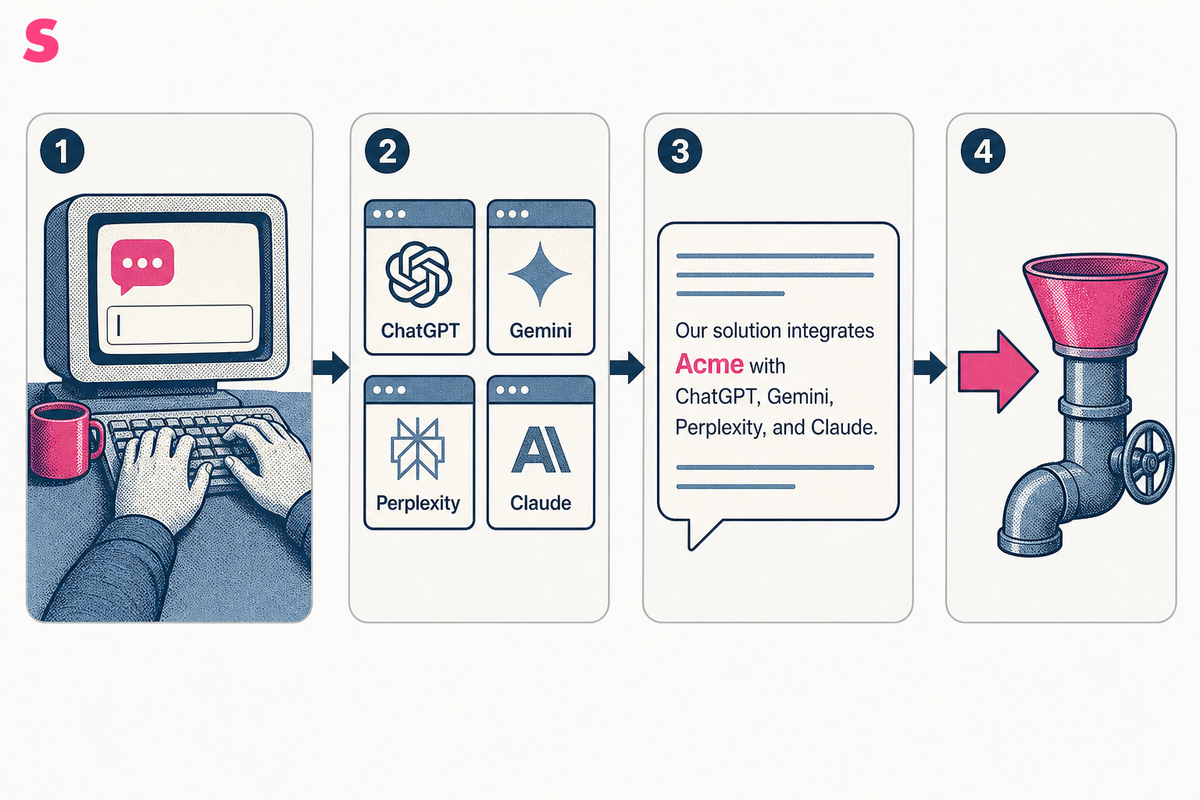
An AI brand visibility tool tracks where and how your brand appears in AI-generated answers. Instead of watching a search results page, it watches ChatGPT, Gemini, Perplexity and other engines to see whether your brand gets mentioned, in what context, and next to which competitors.
This matters because buyers are asking these systems questions they used to type into Google. Someone comparing project management software might just ask ChatGPT for a recommendation and buy whatever it names first. If your brand is not in that answer, you have lost the deal before your website was ever visited.
An AI brand visibility tool flags negative sentiment when it appears, catches competitor mentions you did not know about, and shows which prompts trigger your brand's name in the first place. That last part matters more than most teams expect. Knowing the exact question that surfaces you, or fails to, tells you what content or positioning gap to close.
Sona AI Visibility approaches this by showing where AI engines mention your brand and turning that visibility into pipeline, rather than treating it as a vanity metric to check monthly. The distinction between watching mentions and acting on them is where most of this category still falls short.
How is AI visibility actually measured and scored?
Most AI brand visibility tools score visibility using a handful of consistent signals: how often your brand appears across a set of tracked prompts, how you rank relative to competitors named in the same answers, and the sentiment attached to each mention.
Share of voice is the core number. It tells you, out of every answer that could have mentioned a brand in your category, what percentage mentioned yours instead of a competitor's. A tool typically runs the same prompts repeatedly across ChatGPT, Gemini, Perplexity and Claude, then aggregates the results into a score you can track week over week.
Sentiment scoring adds a second layer. Being mentioned is not the same as being recommended. A tool that only counts mentions will miss the difference between "consider Sona" and "avoid Sona due to limited reviews." Good tools score tone alongside frequency.
Citation tracking is the third piece: which sources the AI model pulled from to generate its answer. If a competitor's blog post keeps getting cited and yours does not, that is a concrete, fixable gap. Sona AI Visibility's AI Search Insights feature builds on this by tracking citations and source authority alongside sentiment, so a visibility score stays tied to the specific prompts and sources driving it, not just a number on its own.
Which AI models and search systems should your brand prioritize?
Prioritize ChatGPT, Gemini, Perplexity and Claude first. These four are the engines that AI brand visibility tools monitor most consistently, and they represent the bulk of consumer and professional AI search volume today.
ChatGPT matters because of sheer usage volume and its role as the default AI assistant for millions of professionals researching purchases. Gemini matters because it is woven into Google's ecosystem, including Google AI Overviews, which now appear above traditional search results for many queries. Perplexity matters because it is built specifically as an answer engine with visible citations, making it a useful proxy for how AI-driven research behavior works generally. Claude matters for technical and enterprise audiences who lean on it for research and comparison tasks.
Beyond these four, some tools also track Microsoft Copilot and Google AI Overviews specifically, since Overviews sit inside standard Google search and reach an enormous audience without the user ever opening a dedicated AI chat interface.
Your priority list should follow your audience, not the industry default. A B2B software company selling to technical buyers may find Claude and Perplexity mentions worth more than ChatGPT ones. A consumer brand should weight Google AI Overviews heavily, given how much organic search traffic now routes through that surface before a user clicks anything.
Is AI visibility just SEO with a new name?
No. AI visibility and SEO measure different things, even though they draw on overlapping skills. SEO tracks rankings and clicks on a results page. AI visibility tracks whether your brand gets named inside a generated answer, and if so, how.
The mechanics differ sharply. Traditional SEO rewards keyword targeting, backlinks and page structure that a crawler can rank. AI visibility rewards content that a language model finds authoritative enough to cite or paraphrase when constructing an answer, which is a different kind of signal entirely. A page can rank well in Google and never get pulled into an AI answer, and the reverse happens too.
There is also no click involved in a pure AI answer. If ChatGPT names your brand and moves on, you have gained visibility and possibly influenced a decision, but you get no referral traffic to show for it in Google Analytics. This is part of why AI brand visibility tools exist as a separate category rather than a feature bolted onto rank trackers.
That said, the disciplines feed each other. Content built to earn citations in AI answers, meaning clear, well-sourced, structured to answer a specific question, often performs well in traditional search too. Teams that treat AEO and GEO as extensions of SEO strategy, rather than replacements for it, tend to get more out of both.
What should you look for when choosing an AI brand visibility tool?
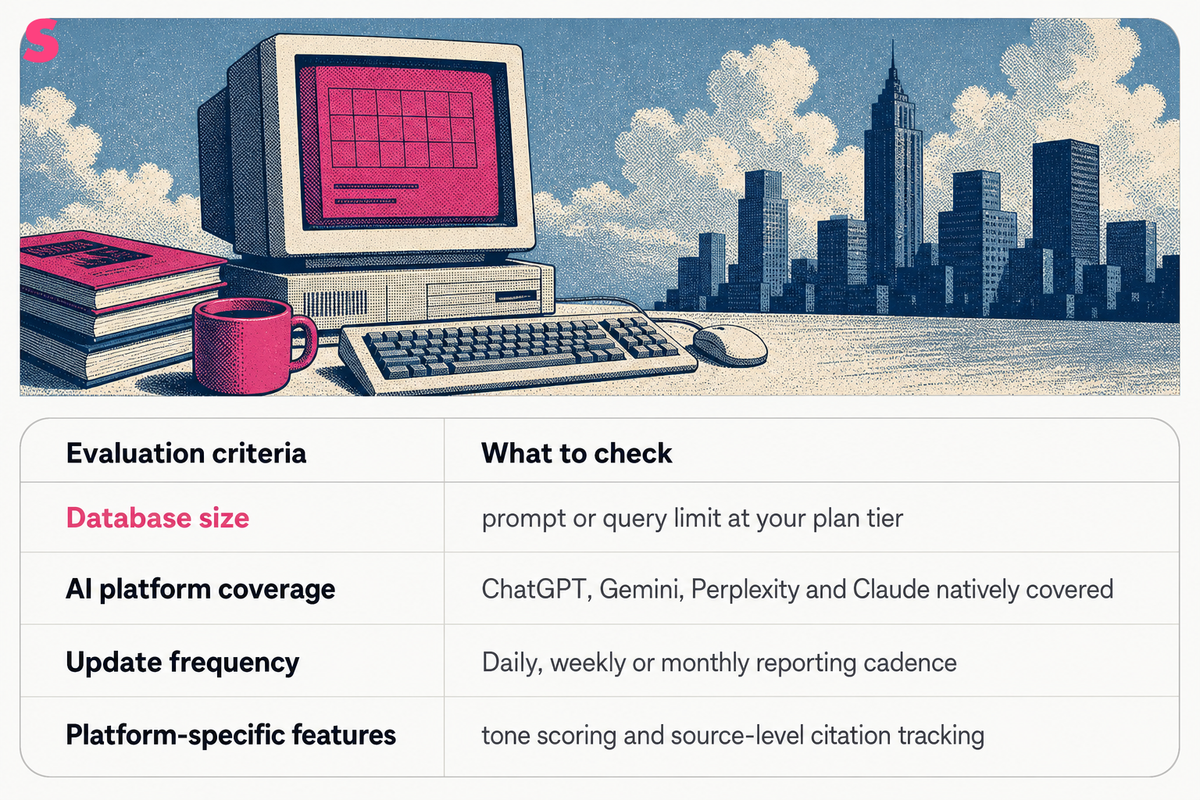
Evaluate four things before you commit: database size, AI platform coverage, update frequency and platform-specific features. These four determine whether the data you get back is actually usable for decisions.
Database size affects how many prompts and competitor sets a tool can track at once, which matters if you operate in a crowded category. Platform coverage determines which engines you can actually see into. Update frequency changes how quickly you notice a shift, since brand mentions in AI answers move as models retrain or change which sources they pull from. Platform-specific features, like sentiment breakdowns or citation tracking, determine how actionable the output is once you have it.
- Confirm which engines are covered natively versus through estimation or third-party data
- Check how often prompts are re-run: daily tracking catches shifts that monthly tracking misses entirely
- Look for competitor benchmarking, not just a score for your own brand in isolation
- Ask whether the tool maps visibility data to specific pages or content you can act on
The right choice also depends on agency size, your existing tech stack, and what clients or stakeholders need to see in a report. A solo consultant tracking one brand has very different needs from an agency reporting across twenty client accounts.
| Evaluation criterion | Why it matters | What to check |
|---|---|---|
| Database size | Determines how many prompts and competitors can be tracked simultaneously | Ask for the prompt or query limit at your plan tier |
| AI platform coverage | You can only see visibility on engines the tool actually monitors | Confirm ChatGPT, Gemini, Perplexity and Claude are natively covered |
| Update frequency | Slower updates mean you notice shifts weeks late | Daily, weekly or monthly reporting cadence |
| Sentiment and citation detail | Raw mention counts do not tell you if the mention helps or hurts | Look for tone scoring and source-level citation tracking |
| Action path | A score with no next step wastes the data collected | Check whether output maps to specific pages, prompts or accounts |
How do AI visibility tools actually compare on coverage, pricing and reporting?
Pricing in this category spans free tiers up to roughly $499 or more a month for enterprise platforms, with most mid-market tools sitting between $29 and $200 monthly. What you get at each tier varies more than the price alone suggests.
Semrush's AI Visibility Toolkit costs $99 a month per domain, billed annually, and includes daily, weekly and monthly reporting cadences. Alhena AI offers a free tier capped at 25 conversations, useful for testing the category before committing budget. Otterly starts at $29 a month, positioning it as an entry point for small teams. Ahrefs' Brand Radar is an add-on priced at $699 a month, aimed at larger operations already inside the Ahrefs ecosystem. OmniSEO's Essentials tier runs $89 a month, or $45 for the first month, targeted at smaller teams that need visibility tracking without an enterprise commitment.
Coverage and reporting depth do not always scale neatly with price. A cheaper tool with strong engine coverage can outperform a pricier one with a narrower scope, so the number on the invoice should never be the only factor.
| Tool | Starting price | Engine coverage focus | Reporting cadence | Best fit |
|---|---|---|---|---|
| Sona | Not published here; contact for pricing | 10+ AI engines including ChatGPT, Gemini, Perplexity and Claude | Daily visibility and share-of-voice tracking | Teams that need visibility tied to pipeline, not just mention counts |
| Semrush AI Visibility Toolkit | $99/month per domain, billed annually | Major LLMs tracked per domain | Daily, weekly and monthly reports | Teams already using Semrush for SEO |
| Otterly | $29/month | Focus: tracking brand mentions across core AI engines | Regular scheduled reporting | Small teams starting out with AI visibility |
| Alhena AI | Free tier, 25 conversations | Focus: conversation-level brand mention tracking | Depends on plan tier | Testing the category before paying |
| Ahrefs Brand Radar | $699/month add-on | Focus: brand mention tracking layered on Ahrefs data | Depends on plan tier | Larger teams already inside Ahrefs |
| OmniSEO | $89/month ($45 first month) | Focus: AI visibility for small to mid-size teams | Depends on plan tier | Small teams needing an affordable entry point |
How do you actually improve your brand's AI visibility once you have data?
Start with the prompts where you should appear and do not. AI visibility data tells you exactly which questions trigger competitor mentions instead of yours. That gap list is your content roadmap.
Write content that directly answers those specific prompts, in the language buyers actually use. Language models favor content that states a clear answer early, backs it with specifics, and reads as authoritative rather than promotional. This overlaps with good AEO and GEO practice generally: structured answers, clear comparisons, and content that a model can extract cleanly rather than paraphrase awkwardly.
Watch citation sources. If competitors keep getting cited from third-party review sites, industry roundups or comparison pages, that tells you where to invest in PR and outreach, not just owned content. A model that cites G2 or a trade publication is pulling from a source it trusts more than it may trust your own site.
Track sentiment changes after you make edits. If sentiment stays negative even as mention frequency rises, the fix is not more content, it is different content: addressing the objection or gap the model keeps surfacing. Sona AI Visibility's AI Search Insights feature supports this loop by clustering sentiment around specific topics, so you can see which theme is driving negative tone rather than guessing from a single aggregate score.
Is tracking AI visibility worth it for your business right now?
Yes, if your buyers research on AI platforms before they ever hit your website. That is now true across most B2B and consumer categories, which makes this less a question of if and more a question of how much investment it warrants.
The cost of ignoring it is invisible by design. Unlike a traffic drop in Google Analytics, a decline in AI visibility produces no alert unless you are actively tracking it. A competitor can quietly take over the prompts that used to surface your brand, and you would have no way to know without a monitoring tool in place.
The investment required to start is low. Free tiers exist, entry-level tools start under $30 a month, and even a basic monitoring setup gives you visibility into a channel most competitors are not yet watching closely. The bigger cost is organizational: someone needs to own the data and act on it, or the score becomes another dashboard nobody opens.
For teams already running SEO and content programs, AI visibility tracking is a natural extension rather than a new department. The skills for producing citable, authoritative content overlap heavily with existing SEO work, which lowers the barrier to getting started meaningfully.
How does AI visibility connect to traffic, leads and revenue?
AI visibility connects to revenue in two ways: through direct traffic when an AI answer includes a link, and through influence on decisions that never generate a click at all. Both are real, and both are hard to measure with tools built only for the first case.
When Perplexity or Google AI Overviews cite your page directly, you get a visit you can trace, tag and attribute in a normal analytics setup. That part is straightforward. The harder part is the mention that never sends a click: a buyer asks ChatGPT to compare vendors, reads the answer, and goes straight to your homepage by typing your name into a browser. Standard attribution shows that as direct traffic with no clue it started with an AI answer.
This is the gap that matters most for anyone trying to justify AI visibility work with numbers a finance team will accept. Monitoring which AI answers mention your brand only tells half the story. The other half is connecting those mentions to actual accounts, pipeline and closed revenue, so the visibility work can be defended in the same terms as any other marketing spend. Sona is built to close that loop: its AI Attribution capability ties AI-search visibility to pipeline and revenue by tracking which prompts, citations and answers drove the traffic, leads and deals that followed, rather than stopping the analysis at a mention count.
Getting this right changes how the whole function gets evaluated. Instead of reporting "we appeared in 40% of relevant AI answers this month" as an isolated metric, a team can report the pipeline value sitting behind that percentage, which is the version of the metric that actually survives a budget review.
Frequently Asked Questions
What is the difference between AI visibility and traditional SEO tracking?
SEO tracking measures rankings and clicks on search results pages. AI visibility tracking measures whether and how a brand is mentioned inside generated answers, including tone and competitor comparison. That requires model-specific monitoring rather than watching a keyword's rank position move up or down.
Which AI platforms do brand visibility tools typically monitor?
Most tools cover ChatGPT, Gemini, Perplexity and Claude. Some also track Google AI Overviews and Microsoft Copilot. Coverage varies by vendor, so confirm which engines matter most for your audience before choosing one.
How often does AI visibility data update?
Update frequency ranges from daily to monthly depending on the platform. This cadence matters because brand mentions in AI answers can shift quickly as models retrain or pull from different sources than they did the week before.
Can an AI brand visibility tool tell me what to change in my content or PR?
Monitoring tools mainly show where and how a brand appears. Turning that into action, such as adjusting content, positioning or outreach, is a separate step that not every tool supports out of the box.
Do I need a dedicated AI visibility tool or does my SEO suite already cover this?
Some SEO suites now bundle AI visibility features as an add-on, which can work for teams that want one dashboard. Dedicated tools tend to offer deeper model-specific detail for teams that need it.
How much does AI visibility tracking typically cost?
Pricing spans free tiers for basic monitoring up to several hundred dollars a month for enterprise platforms. The right tier depends on how many brands, competitors and engines you need to track.
Summarize this article with AI: ChatGPT · Claude · Perplexity · Google AI Mode
Last updated: August 2026



