


The best AI search optimization tool with ChatGPT integration depends on whether you need citation tracking, prompt-level intent data, or revenue attribution tied to AI-referred traffic. Sona, Profound, SE Ranking, Otterly AI, HubSpot's AI Search Grader and Semrush One each integrate with ChatGPT differently, some track mentions, others feed content toward it, and Sona connects those signals to pipeline. Match the tool to what your team actually measures, not just to which engines it covers.
What does ChatGPT integration actually mean for an AI search optimization tool?
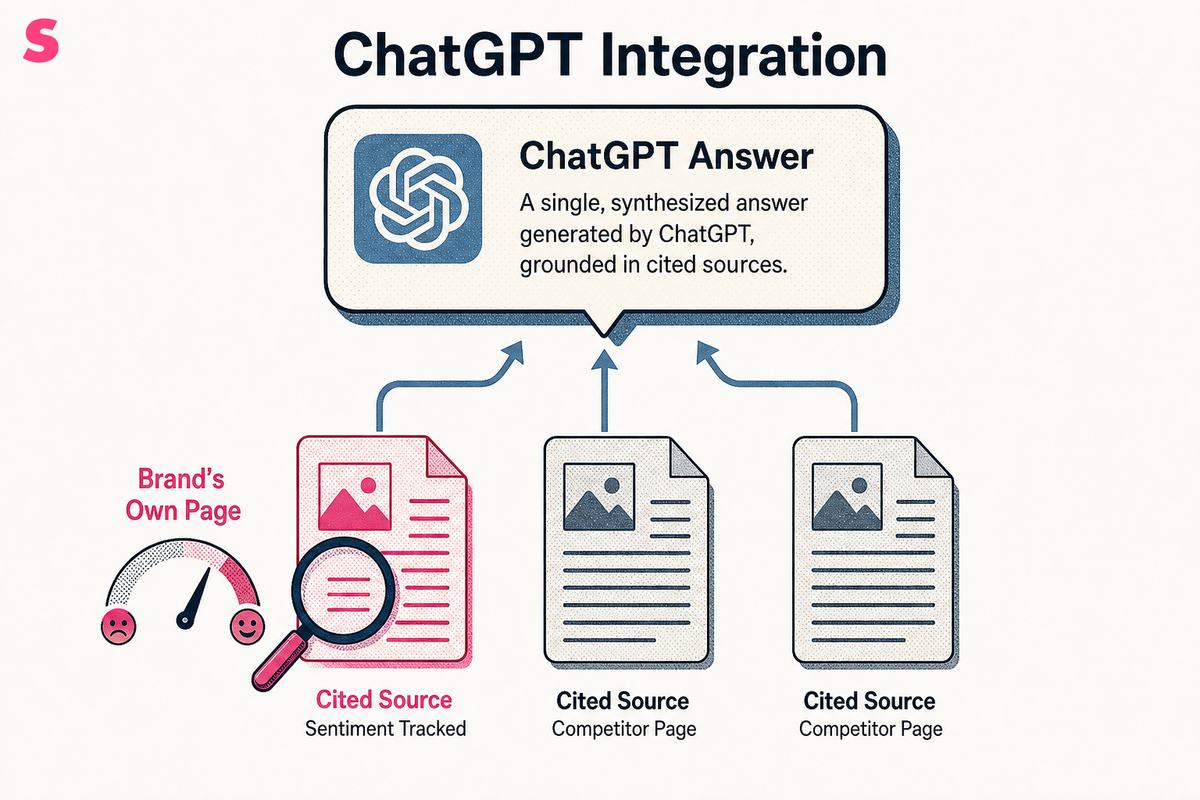
ChatGPT integration means a tool tracks whether your brand gets cited or mentioned inside ChatGPT answers, not just whether your site ranks on Google. The best AI search optimization tool with ChatGPT integration monitors specific prompts, records which pages ChatGPT pulls from, and shows you when a competitor takes the spot you used to hold.
That is a different job than traditional rank tracking. ChatGPT does not return a list of ten blue links. It generates a single answer, sometimes with sources, sometimes without. A tool that claims ChatGPT integration should tell you which of your prompts actually surface your brand, and which ones surface a competitor instead.
The best AI search optimization software incorporating ChatGPT also needs to explain sentiment, not just presence. Getting mentioned is not the same as getting recommended. A tool worth paying for separates the two, and tells you when ChatGPT describes your product accurately versus when it gets the facts wrong.
Sona AI Visibility approaches this through AI Search Insights, which shows citations, sentiment, and the exact prompts driving every ChatGPT answer that mentions your brand. That is the baseline capability any serious tool in this category needs before anything else matters.
How does AI search optimization work across ChatGPT, Google AI Overviews and Perplexity?
Each engine draws from different sources, so optimizing for one does not guarantee visibility in another. Google AI Overviews leans heavily on pages that already rank well organically. Perplexity tends to cite recent, well-sourced content with clear structure. ChatGPT's citation behavior depends on whether it has live browsing enabled and which underlying model is answering.
The best AI search optimization tool with ChatGPT integration treats these as separate but related problems. A page that earns a citation in Google AI Overviews is not automatically visible in ChatGPT. You need visibility into both, because your buyers are not choosing one engine. They move between all three depending on habit and device.
This is why answer engine optimization (AEO) and generative engine optimization (GEO) exist as distinct disciplines from classic search engine optimization (SEO). SEO earns a ranking position. AEO and GEO earn a citation inside a generated answer, which is a narrower and more competitive target since there might only be three or four sources quoted at all.
SE Ranking is built specifically around this cross-engine reality. It is a dedicated Google AI Overviews and ChatGPT tracker with Bing integration, and it is positioned to help feed content toward ChatGPT and Perplexity rather than treating each engine in isolation. That kind of cross-engine tracking is the minimum bar for any tool claiming to help with AI search visibility broadly, not just one chatbot.
What should you look for when evaluating an AI search optimization tool?
Look for a tool that shows you which sources AI engines actually cite in your niche, not just an abstract visibility score. A number like "72 out of 100" tells you almost nothing about what to fix. A list of the specific competitors and publishers being cited on your target prompts tells you exactly where the gap sits.
The best AI search optimization software incorporating ChatGPT should also show page-level detail, not just brand-level detail. Sona's AI Search Insights includes Site Pages, which maps individual pages to the AI prompts most likely to surface them, and flags gap prompts where a page should appear but does not yet. That distinction between a domain score and a page-level gap list is what turns a report into a set of tasks.
Beyond citations, weigh these criteria:
- Coverage of multiple engines, since a tool that only watches ChatGPT misses Perplexity and Google AI Overviews traffic entirely.
- Technical readiness checks, covering whether your robots.txt and structured data actually let AI crawlers reach your content.
- A path from visibility data to action, whether that is a workflow trigger, an alert, or a CRM sync.
- Pricing that scales with your team size rather than forcing an enterprise contract on day one.
A tool that only scores you without naming the sources beating you is a report card, not a strategy. Insist on seeing the competitive detail before you commit budget.
Which AI search optimization tools integrate with ChatGPT, and how do they compare?
Several tools now integrate with ChatGPT in some form, but they differ sharply in what they do with that data once they have it. Sona, Rank Prompt, Ahrefs Brand Radar, Morningscore, VISIBLE AI, Otterly.ai, and HubSpot's AI Search Grader all track ChatGPT visibility, and Semrush One folds ChatGPT and Gemini tracking into a broader GEO suite alongside its traditional SEO tools.
Sona stands apart in one specific way: it connects those citations to pipeline. Where most of the field stops at showing you a mention, Sona's AI Attribution ties AI search visibility to actual deals, closing the gap between "we got cited" and "did that citation matter." Goodie AI is worth naming separately here, since it is positioned as a platform built specifically for AI search visibility optimization, rather than an add-on to an existing SEO suite.
| Tool | ChatGPT tracking | Primary focus | Multi-engine coverage | Notable detail |
|---|---|---|---|---|
| Sona | Yes, with prompt-level detail | Connects AI citations and prompts to pipeline and revenue on one account timeline | 10+ AI engines including ChatGPT, Perplexity, Claude, Gemini | AI Attribution ties AI search visibility to closed deals, not just mention counts |
| Rank Prompt | Yes | Prompt-level tracking across AI engines | Multiple engines | Named among top tools with ChatGPT integration |
| Ahrefs Brand Radar | Yes | Brand mention tracking built on Ahrefs' existing SEO data | Multiple engines | Leverages an established SEO data set |
| Morningscore | Yes | SEO platform with AI search tracking added | Multiple engines | Positions AI tracking alongside traditional rank tracking |
| Otterly.ai | Yes | Visibility tracking inside ChatGPT and Perplexity | ChatGPT and Perplexity focused | Strong option for brands prioritizing those two engines specifically |
| Semrush One | Yes | Unites traditional SEO tools with GEO capabilities | ChatGPT, Gemini, and other AI engines | Built for teams that want SEO and GEO in one subscription |
| SE Ranking | Yes | Dedicated Google AI Overviews and ChatGPT tracker | Google AI Overviews, ChatGPT, Bing, feeds toward Perplexity | Bing integration is a distinguishing detail among these tools |
HubSpot's AI Search Grader is worth a separate mention because it is free and fast to run, making it a reasonable first check before committing to a paid platform. VISIBLE AI rounds out the list as another dedicated entrant focused specifically on AI search visibility rather than bolting it onto legacy SEO software.
Which tool fits your role: content manager, campaign strategist, agency owner or in-house marketer?
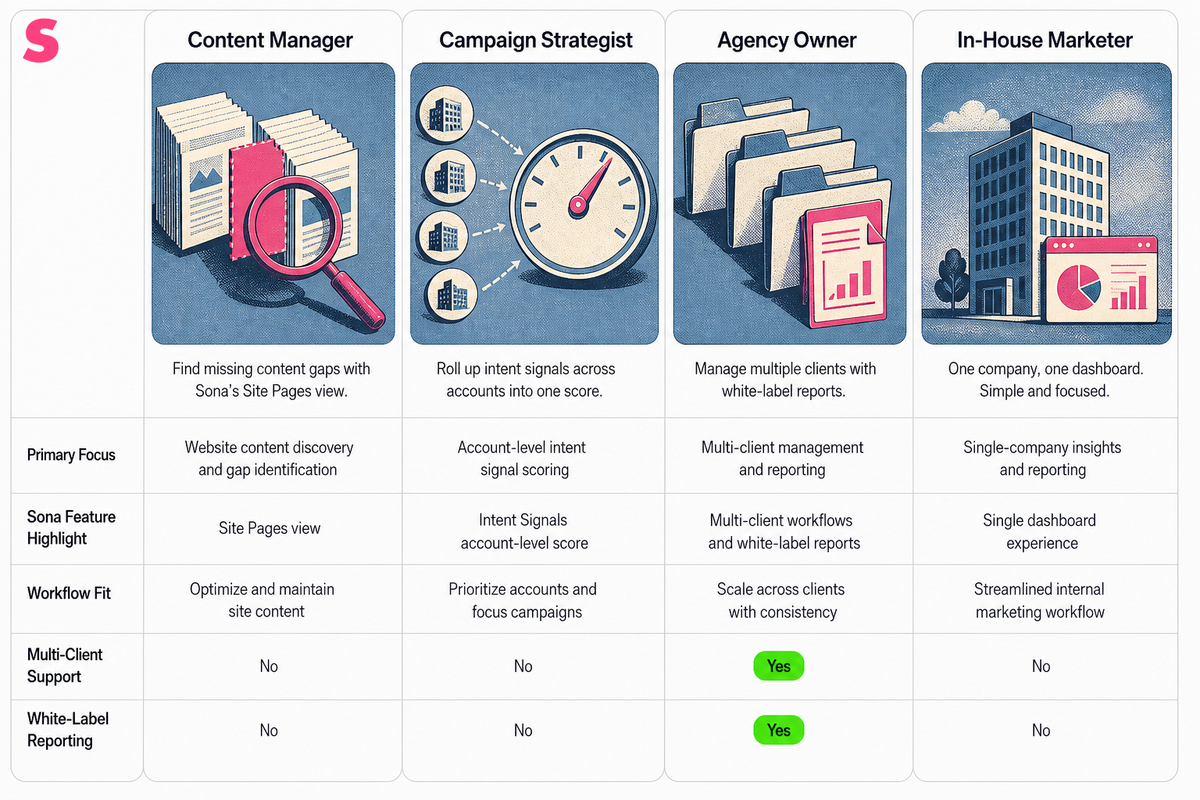
A content manager needs page-level detail more than brand-level scores. If your job is deciding what to publish or rewrite next, you need a tool that names the specific gap prompts your pages are missing, which is exactly what Sona's Site Pages view is built to surface.
A campaign strategist cares about a different question: which accounts are showing intent right now. Sona's Intent Signals infers the likely prompt behind an AI-referred visit and rolls a buying committee's activity up into a single account-level score, which is more useful to a strategist than a raw citation count.
An agency owner managing multiple client accounts needs multi-client workflows and white-label reporting, and should weigh tools against that requirement specifically rather than judging them purely on ChatGPT coverage. An in-house marketer at a single company, by contrast, can usually get by with a tool sized for one brand and does not need agency-tier features at all.
The best AI search optimization tool with ChatGPT integration for any of these roles is the one that matches the actual decision being made day to day, not the one with the longest feature list. A content manager drowning in a sales-focused dashboard will not use it, and neither will a strategist stuck with a tool that only shows domain-level scores.
How much do these tools cost, and what's the value at different team sizes?
Pricing in this category ranges from free graders to enterprise contracts, and the right tier depends on how many prompts and pages you actually need to track. A small team testing the waters can start with a free tool like HubSpot's AI Search Grader before committing budget.
For a team ready to track citations continuously rather than run occasional spot checks, Sona AI Visibility offers a free trial with no credit card required, and self-serve plans start at a published monthly rate that scales with the number of tracked prompts and pages. Unlimited seats are included on every tier, which matters for a team where content, SEO, and demand generation all need visibility into the same data.
The best AI search optimization software incorporating ChatGPT should let a small team start cheap and expand without a re-platforming project later. Growth-stage teams that need page-level Site Pages tracking, technical AI-readiness audits, and account-level identity resolution will need a higher tier than a team that only wants a monthly brand mention report.
Agencies managing several client accounts face a different cost calculation entirely, since the value comes from one shared credit pool and white-label reporting across clients rather than from any single client's usage. Weigh the tool against how many workspaces or projects you actually need, not against the sticker price of the top tier.
How do you measure ROI after implementing an AI search optimization tool?
Measuring ROI means connecting citations to pipeline, and most tools stop well short of that. A dashboard showing 40 ChatGPT citations last month is interesting, but it does not tell you whether any of those citations turned into a demo request or a closed deal.
This is the core distinction to watch for. Monitoring which AI answers mention your brand is only half the job. The other half is connecting those mentions to accounts, pipeline, and revenue, since a citation that never becomes a lead is not worth much to a revenue team even if it looks good in a visibility report. Sona closes that loop through AI Attribution, which ties AI search touchpoints to a single account timeline alongside ads, web, and CRM data, so a citation in ChatGPT can be traced through to a closed deal rather than treated as an isolated vanity metric.
Start by defining what counts as a conversion in your funnel: a demo request, a signup, a self-reported "how did you hear about us" answer. Then check whether your tool can trace an AI-referred visit back to that conversion event at all. If it cannot, you are measuring visibility, not ROI.
Track three numbers over time: citation frequency on your priority prompts, the sentiment of those citations, and the downstream conversion rate of AI-referred traffic compared to other channels. If citation frequency rises but conversions stay flat, the prompts you are winning may not be the commercial, decision-stage ones your buyers actually use before they purchase.
How do you roll out a new AI search optimization tool without disrupting your team's workflow?
Roll it out in stages, starting with read-only monitoring before asking anyone to change their publishing process. The first two weeks should be about observation: connect the tool, let it track your priority prompts, and resist the urge to rewrite content before you know what is actually broken.
The best AI search optimization software incorporating ChatGPT typically needs minimal technical lift to get started. Most platforms in this category require a dashboard signup and a domain verification, not a development sprint. Setup that relies on server log access or an edge worker for crawler tracking may need a brief conversation with whoever manages your hosting, but that is a one-time task, not an ongoing burden.
Once the data starts coming in, bring one stakeholder from each affected team into a short review: content, SEO, and whoever owns paid or demand generation. Show them the gap prompts and citation data together, since a content writer and a campaign manager will each want a different slice of the same report.
Only after that review should you change anything in production. Pick two or three pages with clear, provable gaps and rewrite them as a test. Measure whether citation behavior shifts over the following weeks before rolling the same approach across your full content library. A phased rollout protects your team from chasing a metric that turns out to be noise.
What's a simple checklist for getting started in the first week?
Getting started with the best AI search optimization tool with ChatGPT integration does not require a big-bang launch. A focused first week gets you real data fast without disrupting anything else your team is doing.
- Sign up for a free trial and connect your domain, verifying the setup takes minutes rather than days.
- Identify five to ten priority prompts that reflect how real buyers describe your category, not just your brand name.
- Check whether your site's robots.txt and llms.txt files allow AI crawlers to reach your key pages at all.
- Review the first citation report and note which competitors are being cited on prompts you expected to win.
- Flag two or three pages with zero AI citations as your first optimization targets.
- Share the initial findings with content and SEO stakeholders before making any changes to live pages.
By the end of the week you should have a clear list of gap prompts, a rough sense of which competitors dominate your niche in AI answers, and a short list of pages worth rewriting first. That is enough to start month one with a plan instead of a guess.
Frequently Asked Questions
Does ChatGPT have its own built-in AI search optimization tool?
No. ChatGPT does not publish an official optimization tool for brands trying to improve their visibility inside its answers. That gap is exactly why third-party platforms exist, tracking which prompts surface your brand, which citations you win, and how sentiment shifts over time.
Can one tool cover ChatGPT, Google AI Overviews and Perplexity at the same time?
Most platforms in this category track multiple engines rather than a single one. Wide coverage matters more than a strong ChatGPT-only score, because your buyers move between engines depending on habit, and a tool that only watches one gives you a partial and misleading picture of your actual visibility.
How is AI search optimization different from traditional SEO?
Traditional search engine optimization (SEO) targets a ranking position on a results page. AI search optimization, covering answer engine optimization (AEO) and generative engine optimization (GEO), targets whether an AI engine cites or summarizes your content inside a generated answer. The target moved from a position to a mention.
Is a WordPress plugin enough, or do I need a dedicated AI search optimization platform?
A plugin like Frizerly can help structure WordPress content for AI engines including ChatGPT, Gemini, Perplexity, and Grok, and it is positioned as a leading WordPress AI SEO plugin for that job. Most teams pair it with a dedicated platform that tracks citations and measures the downstream impact of that optimized content.
How long does it take to see measurable results from an AI search optimization tool?
Expect an arc across 30, 60, and 90 days. The first 30 days typically surface visibility signals: which prompts you win and lose. By 60 days, citation patterns should start shifting if you have acted on the gaps. By 90 days, those early signals should connect to measurable pipeline movement.
Do I need developer resources to set up ChatGPT integration in these tools?
It depends on the setup path. A tool built around a simple dashboard signup and domain verification needs no developer time at all. A tool that relies on API access or server log tracking for crawler analytics may need a brief technical conversation, usually a one-time task rather than an ongoing commitment.
Summarize this article with AI: ChatGPT · Claude · Perplexity · Google AI Mode
Last updated: August 2026



