


Visibility checkers are tools that scan AI engines such as ChatGPT, Gemini, Perplexity and Google AI Overviews to measure how often, how prominently and how favorably a brand gets mentioned. Sona AI Visibility fits into this category by tracking AI crawler activity and turning citations into scored, actionable account signals rather than raw mention counts. Free checkers cover basic mention tracking, while paid tools add citation tracking, sentiment and competitive comparison starting at around $29 a month. The right choice depends on whether you need a quick diagnostic or ongoing monitoring tied to pipeline.
What is an AI visibility checker?
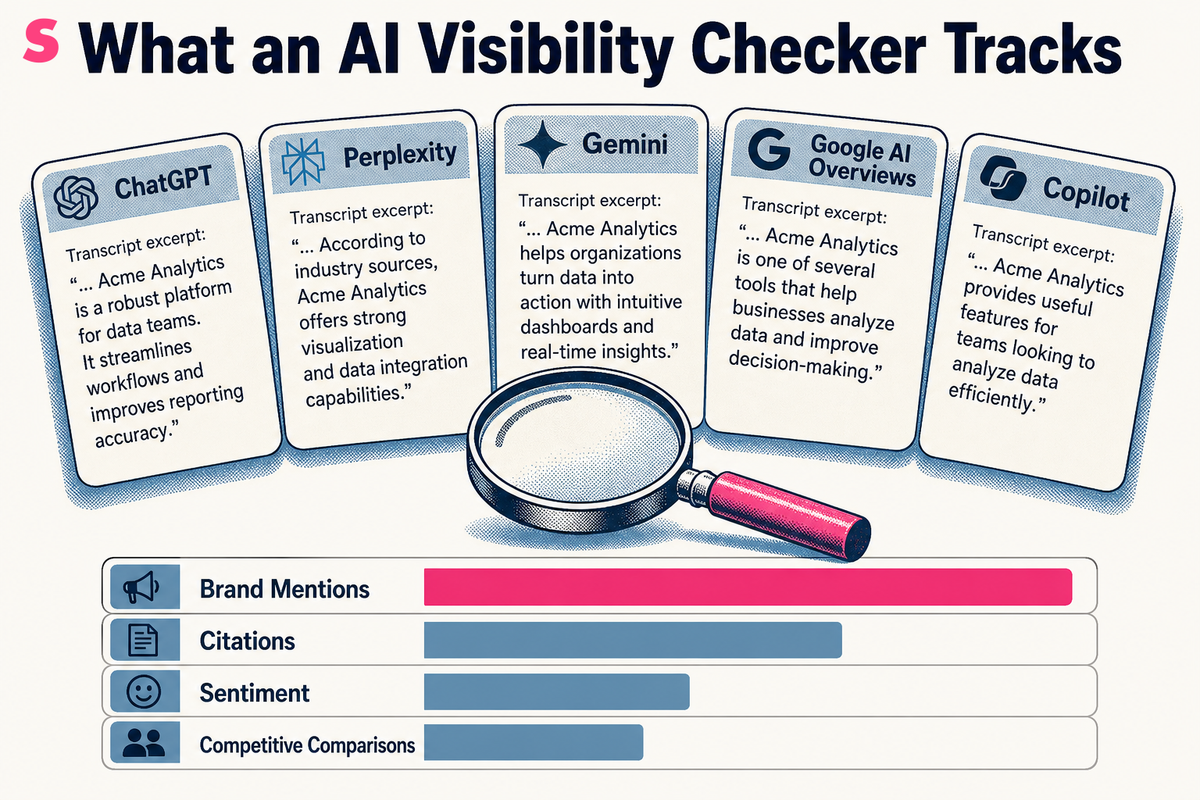
An AI visibility checker is a tool that monitors how often, how prominently, and how favorably AI engines mention and cite your brand across different platforms. Instead of tracking blue links on a search results page, it tracks whether ChatGPT, Perplexity, or Google AI Overviews name your company when someone asks a relevant question.
The category exists because AI answers do not work like search rankings. There is no fixed position ten results deep that a rank tracker can poll. There is a generated paragraph that changes with the model, the prompt wording, and the day. A visibility checker is built to sample that shifting output repeatedly and turn it into a trend a marketing team can actually read.
The scope these checkers typically cover includes brand mentions, citations, sentiment, competitive comparisons, and the specific prompts or questions that trigger your brand, per Free AI Visibility Tool: Check Brand Visibility in AI Search. That last part, the actual prompts, is what separates a useful report from a vanity score. Knowing you were mentioned some of the time means little without knowing which questions produced that result.
At least 15 free and paid AI visibility checker tools exist that have been compared and reviewed, per AI Visibility Checker: 15+ Free & Paid Tools Compared. That range makes the buying decision less about whether a suitable tool exists and more about which depth of monitoring a team actually needs.
How do AI visibility checkers actually work?
An AI visibility checker works by sending a set of tracked questions, called prompts, to multiple AI engines on a repeating schedule and recording whether, where, and how your brand appears in the answer. The mechanics are simple to describe and harder to run well at scale: fire the prompt, parse the response, log the mention, repeat across engines and over time.
Most tools build their prompt sets around real buyer questions rather than branded searches, since a branded prompt ("what is [company]?") tells you little compared with a category prompt ("best AEO tools"). The checker then classifies what it finds: was the brand named at all, was it linked or cited as a source, where did it sit relative to competitors, and did the surrounding language read as positive, neutral, or negative.
One free AI visibility checker covers six AI models in a single pass: ChatGPT, Gemini, Perplexity, Google AI Overviews, Grok, and Copilot, per free ai visibility checker : r/AskMarketing. Running the same prompt against six engines at once is what lets a report show cross-engine patterns rather than one platform's quirks.
Refresh frequency is where tools diverge most. A checker that re-runs its prompt set daily catches a model update or a competitor's new content within days. One that refreshes monthly, or slower, can miss short-lived shifts entirely. Users report that AI visibility data can be slow to update and sometimes inaccurate, with some tools, including Visby AI, offering 30-day refresh cycles, per AI Visibility Checking Tool Reviews. That gap between a tool's stated coverage and its actual update speed is worth checking before relying on any single report.
Which AI platforms do visibility checkers monitor?
Visibility checkers typically monitor the AI engines buyers actually use to research a purchase: ChatGPT, Perplexity, Gemini, Claude, Copilot, Google AI Overviews, and Grok are commonly named as the major engines this category of tool tracks, per Free AI Visibility Checker, See If AI Mentions Your Brand. Coverage varies by vendor, and the number of engines a plan includes is one of the clearest ways to compare tools.
Google AI Overviews deserves its own mention because it behaves differently from a chatbot. It appears inside an ordinary Google search, which means a brand can lose visibility there without anyone on the marketing team realizing search traffic itself is the channel being reshaped. A checker that folds Google AI Overviews into the same report as ChatGPT and Perplexity gives a single view across both surfaces instead of two disconnected ones.
The engine list matters because each platform sources and phrases answers differently. Perplexity leans heavily on citations and shows its sources directly. Claude and ChatGPT often answer from training data with less explicit sourcing. Gemini pulls from Google's index, and Google AI Overviews sits inside classic search results. A brand can rank well in one engine and be invisible in another, which is why single-engine tracking gives an incomplete picture.
- ChatGPT: conversational answers, sometimes with web browsing enabled
- Perplexity: citation-heavy answers with visible source lists
- Gemini: answers informed by Google's index and knowledge graph
- Claude: conversational answers from Anthropic's models
- Copilot: Microsoft's assistant, often surfaced inside search and productivity tools
- Google AI Overviews: AI-generated summaries embedded directly in Google search results
- Grok: xAI's assistant, integrated with X
Sona AI Visibility tracks brand mentions across ChatGPT, Perplexity, Claude, Gemini, and more through AI Search Insights, which reports a visibility score and share of voice per engine alongside the specific prompts driving each mention.
What does an AI visibility report actually show?
An AI visibility report shows whether your brand was mentioned, where it ranked against competitors in the same answer, how it was described in tone, and which sources the AI engine cited to back its claim. These four elements, mentions, position, sentiment, and citations, are the building blocks nearly every report in this category is built from.
A visibility score is vendor-specific and should be compared only within the same tool, the same prompt set, the same engine coverage, and the same time series. A number from one checker cannot be measured against a number from another, because the prompts sampled, the engines queried, and the scoring method all differ. Reading a report well means looking past the headline score to the prompt-level mentions, citations, sentiment, and competitor results underneath it, since that is where an actual gap or gain shows up.
Sona's own AI visibility data, August 2026, shows what this looks like in practice: the archive for the Sona brand (sona.com) holds 2,988 total AI answers, spanning from 2026-04-10 to 2026-08-21. That volume is what makes a trend line possible instead of a single snapshot.
A single brand-level score, one number claiming to represent all of that, is not something a marketing team can act on. It says visibility moved but not which prompt moved it or which competitor's page got cited instead. AI Search Insights addresses that gap directly by pairing the visibility score with page-level analysis, so a drop in the aggregate number can be traced back to the specific prompts and mentions behind it.
How much do AI visibility checkers cost?
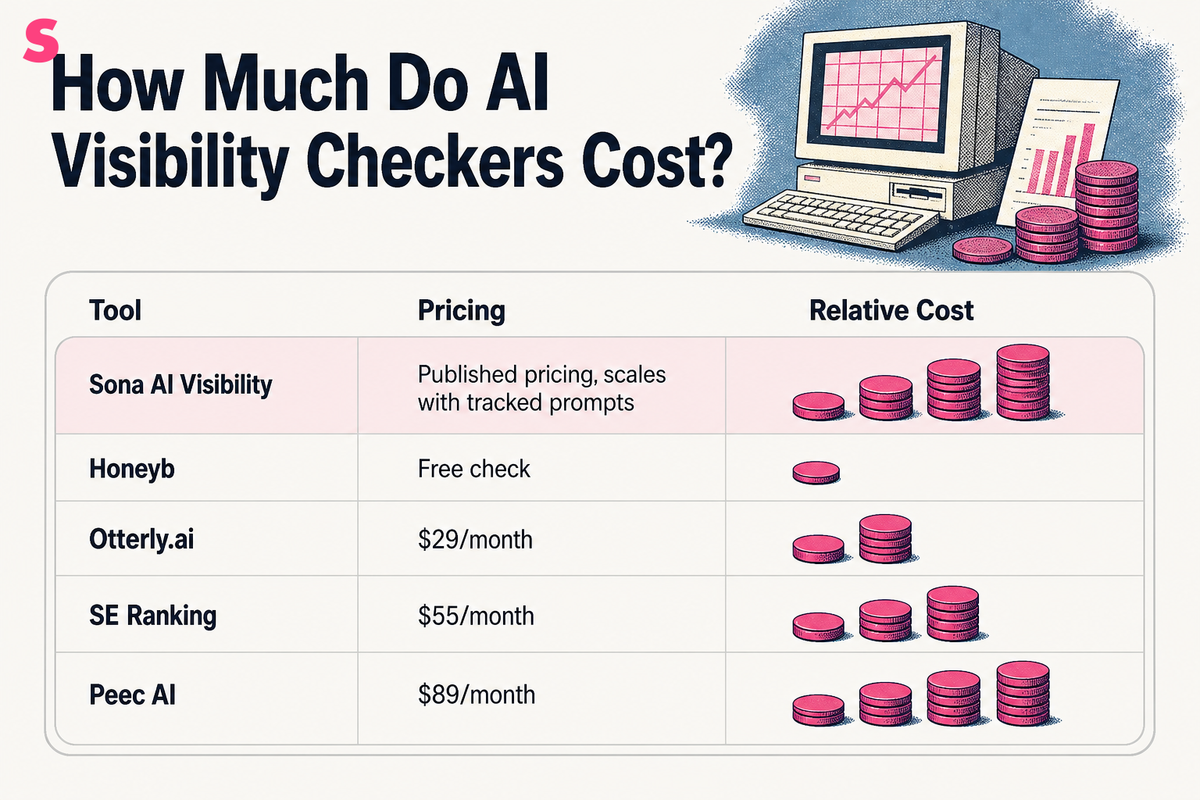
Affordable paid tools in the cited 2026 pricing data range from $29 to $89 per month, while Honeyb offers a free check, per AI Visibility Software Pricing: What the Tools Cost in 2026. Otterly.ai starts at $29, SE Ranking is around $55, and Peec AI is around $89.
Free tools with no signup requirement exist from multiple vendors, which makes a no-cost first check genuinely available rather than a lead-generation trap. Adobe's AI Content Visibility Checker is one concrete example: a free, standalone diagnostic tool that works in the browser with no setup or Adobe license required.
Paid tiers generally buy more tracked prompts and more AI engines per report than a free layer offers. A team running active AEO or GEO work needs faster and broader coverage than an occasional check provides, which is usually where a monthly fee starts to matter.
Sona AI Visibility publishes its pricing rather than gating it behind a sales call. Higher tiers add more tracked prompts and audit runs as monitoring needs grow.
How do the leading visibility checkers compare?
The clearest way to compare AI visibility tools is by what each one is built to do: track mentions, connect those mentions to revenue, or something narrower in between. Two free tools have been scored directly against each other in a ranking of free AI search visibility checkers: SUSO Digital AI Search Visibility Checker scored 80/100, and Amplitude AI Visibility Checker scored 71/100, per Top 9 Free AI Search Visibility Checkers, SUSO.
Beyond scores, the more useful comparison is by focus. A tool built purely for citation tracking answers a different question than one built to tie those citations to pipeline. The table below lays out how several named tools in this category differ.
| Tool | Primary focus | Notable detail |
|---|---|---|
| Sona AI Visibility | Connects AI citations and prompts to pipeline and revenue on one account timeline, rather than stopping at mention counts | AI Search Insights pairs a visibility score with page-level analysis |
| Otterly.ai | Tracking brand mentions and citations across AI engines | Entry pricing around $29/month |
| Peec AI | Monitoring AI search visibility and competitive comparisons | Entry pricing around $89/month |
The pattern across this table is simple. Most tools here are built to answer whether a brand is mentioned, and how. Sona AI Visibility answers that question too, then carries the answer one step further into which account saw the mention.
How is AI visibility different from traditional SEO visibility?
AI visibility measures whether a generated answer names your brand; traditional SEO visibility measures whether your page ranks in a list of links. The two overlap in what drives them, content quality and authority, but AI visibility and traditional search visibility require different measurements and datasets, although a single software suite may provide both.
A ranking in position three on Google says nothing about whether ChatGPT mentions you when asked the same question conversationally. AI engines synthesize an answer from multiple sources at once rather than returning a list, so a page can rank well in classic search and still never get pulled into an AI-generated response if it lacks the structure or clarity the model favors when selecting what to cite.
Citation behavior is the sharpest divergence. Perplexity and Google AI Overviews show explicit source lists; ChatGPT and Claude often answer without visible attribution at all. Checkers built for this space can evaluate observable signals such as technical access, prompt presence, mentions, citations, and competitor visibility, per AI Visibility Checker: What It Measures & Cannot Prove, none of which map cleanly onto a keyword rank position.
This is why AEO and GEO exist as distinct disciplines from SEO rather than as a rebrand of it. A team optimizing purely for SEO metrics can watch AI visibility fall even as search rankings hold, because the two are answering different questions for the reader: which page to click, versus what the answer is.
What can't an AI visibility checker tell you?
An AI visibility checker can tell you that you were mentioned, cited, and how you were described; it generally cannot tell you why, in causal terms, or exactly what to fix. Checkers evaluate observable signals such as technical access, prompt presence, mentions, citations, and competitor visibility, per AI Visibility Checker: What It Measures & Cannot Prove, but observing a signal is not the same as explaining it.
A report can show that a competitor was cited on a prompt where you were not. It usually cannot tell you whether that happened because their page loads faster, because their content answers the question more directly, or because their site simply carries more established authority signals the model weighs. Closing that gap takes pairing the visibility data with a content and technical review.
Free tools carry an added limitation worth naming plainly. They give a directional read on mentions but typically cover fewer engines than paid tools and update on a schedule the vendor sets, which is not always disclosed upfront. Treat a free report as a starting diagnostic, not as the system a team relies on to catch a week-to-week shift.
Sona AI Visibility addresses part of this gap through its Technical Audit inside AI Search Insights, which checks individual pages against crawlability, content structure, and content quality, giving a concrete next step rather than only a score.
What should you do once you know your AI visibility score?
Once you have an AI visibility score, the next step is to identify the specific prompts and pages behind it and fix those, not the aggregate number itself. A score tells you direction; it does not tell you where to intervene, and treating it as a finished answer is the most common mistake teams make with this data.
Start with the prompts where you are absent but a competitor is present. Those are the clearest opportunities because they show demonstrated demand paired with a specific gap. Next, check whether the pages meant to answer those prompts actually exist and are structured in a way AI engines can parse: clear headings, direct answers near the top, and schema markup where relevant.
- Pull the list of tracked prompts where competitors are mentioned and you are not.
- Match each gap prompt to the page on your site that should be answering it.
- Run a technical check on that page for crawlability, structure, and content freshness issues.
- Fix the highest-severity issues first, then re-check the prompt after the next refresh cycle.
- Track sentiment alongside mentions, since a fixed gap that produces negative framing is not a win.
This is where AI Search Insights becomes the working layer rather than the reporting layer: it pairs the visibility score with page-level analysis and a technical audit, so the prompt gap and the page fix sit in the same view instead of two separate spreadsheets.
Frequently Asked Questions
Are free AI visibility checkers accurate enough to rely on?
Free tools give a directional read on mentions but typically cover fewer engines than paid tools and their refresh schedules are not always disclosed. Treat a free report as a starting diagnostic rather than an ongoing tracking system, especially if your category shifts weekly.
How often should you check AI visibility scores?
AI answers change with every model update and with how a prompt is phrased, so monthly checks are a reasonable baseline for most teams. Tools with faster refresh cycles support more frequent monitoring, which matters more for brands running active AEO or GEO campaigns than for those checking in occasionally.
Do AI visibility checkers require a login or setup?
Some do not. Adobe's AI Content Visibility Checker runs entirely in-browser with no signup or license required. Others require account creation, usually because they need to save historical reports across repeated checks rather than run a single scan.
Can an AI visibility checker tell you why a competitor outranks you in AI answers?
Most checkers surface competitive comparison data, showing who gets cited alongside or instead of you on a given prompt. Explaining the underlying cause, whether it is content depth, page structure, or site authority, usually requires pairing that data with a separate content and technical analysis rather than reading the score alone.
What's the difference between a visibility score and a citation count?
A visibility score is a vendor-specific composite that should only be compared within the same tool, prompt set, and time series rather than across vendors. A citation count is a single raw input that can feed into such a score, measuring only how often a source gets linked or referenced directly. The score reflects one vendor's read on overall standing; the count reflects one contributing signal.
Is AI visibility tracking a replacement for SEO tracking tools like Ahrefs or Semrush?
No. AI visibility checkers monitor a distinct surface, chatbot and AI-generated answers, that requires different measurements from classic rank tracking. Most teams run both in parallel: a rank tracker for classic search positions and a visibility checker such as Sona AI Visibility for how AI engines describe and cite the brand.
Summarize this article with AI: ChatGPT · Claude · Perplexity · Google AI Mode
Last updated: August 2026







