


Google's AI Mode reorganizes search results into synthesized answers, which means traditional rank trackers cannot tell you whether your brand is cited. Tools worth evaluating, starting with Sona and including options like Rankscale, SE Ranking and Semrush, take different approaches to capturing position, citation order and answer share. The right choice depends on whether you need standalone AI Mode monitoring or visibility tied to pipeline and revenue.
Why does AI Mode rank tracking matter right now?
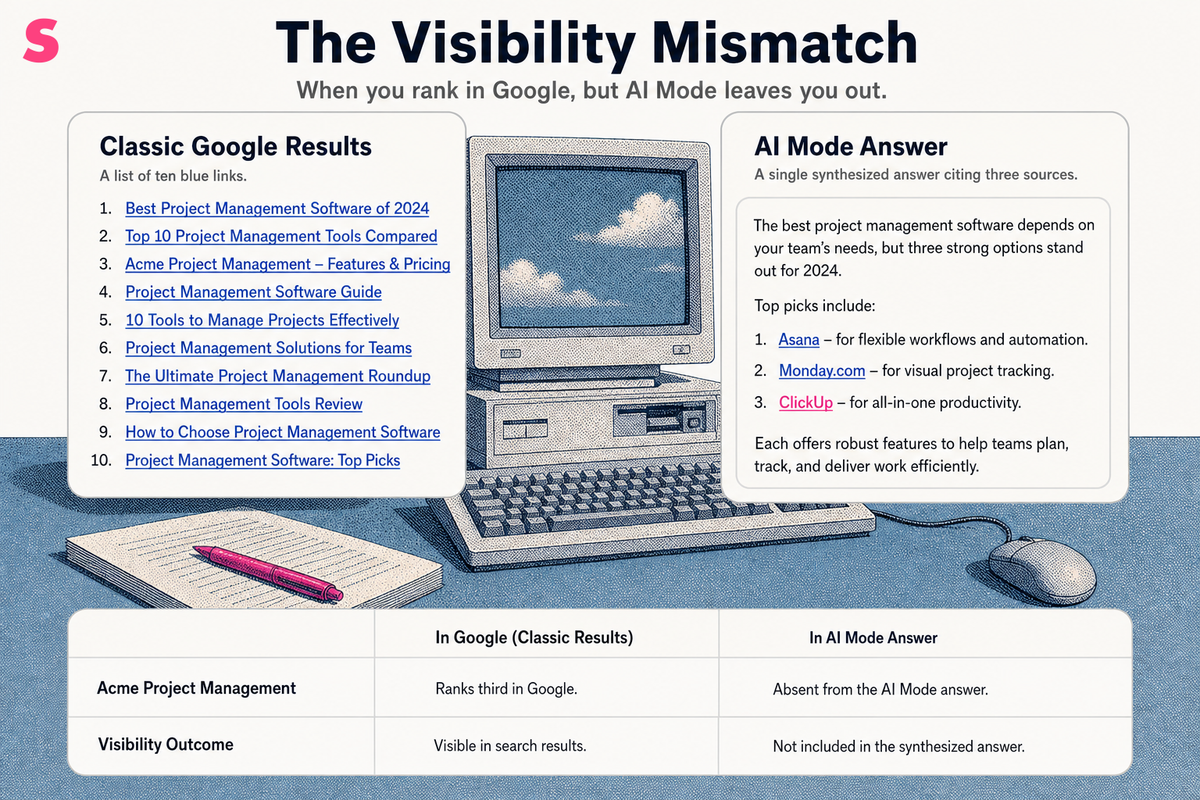
Google AI Mode has changed what a first-page ranking even means. Instead of ten blue links, a searcher gets a synthesized answer that may cite three sources, five, or none at all. If your brand is not one of them, you lose the click before the searcher ever sees a traditional result. AI Mode rank tracking online exists to answer one question: does your brand show up in that answer, and where?
This matters right now because AI Mode has moved from an experiment into a default search surface for a growing share of queries. Marketing teams that spent a decade optimizing for the ten blue links are finding that those signals do not map cleanly onto how AI Mode selects and orders citations. A page that ranks third in Google can be absent from the AI Mode answer entirely, or the reverse can happen just as easily.
AI Mode online rank tracking has become urgent for a second reason: budgets are shifting. Executives asking whether AEO or GEO spend is justified want evidence, not opinion. Without a tracking system, the only answer to "are we visible in AI Mode" is a manual search someone ran last Tuesday. That is not a metric. It is a guess with a timestamp.
The brands treating this seriously are not waiting for AI Mode to stabilize before they start measuring it. They are building the tracking habit now, while the rules of citation are still forming, so they have a baseline to compare against as the surface matures.
What is AI Mode rank tracking and how is it different from a normal SERP checker?
An AI Mode rank tracking tool is a specialized solution that measures brand visibility within Google's AI-generated search experiences, rather than the classic organic results page. A traditional SERP checker looks at a list of URLs and records position one through ten. AI Mode rank tracking online works differently because there is no fixed list to check.
AI Mode generates a conversational answer, often with follow-up threads, and pulls citations from a retrieval process that can vary between sessions. A rank tracker built for this environment has to capture the actual answer text, identify which sources were cited, and record the order and placement of those citations within the response. That is a fundamentally different data structure than a rank position.
The practical difference shows up in what gets reported. A SERP checker gives you "position 4 for this keyword." An AI Mode tracker gives you "cited third in the answer, alongside two competitors, with a direct link" or "mentioned in passing with no link." Both are useful, but they answer different questions, and conflating them is where a lot of early AI Mode tracking claims go wrong.
Sona's AI Search Insights approaches this by tracking citation and source-authority patterns across engines and showing which prompts actually surface a brand, which is a level of detail that a position-only metric cannot provide.
Is Google AI Mode the same thing as Google AI Overviews?
No. Google AI Overviews and Google AI Mode are related but distinct surfaces, and treating them as interchangeable is the most common mistake in early AI Mode rank tracking online setups. Google AI Overviews appears as a summary box above traditional results for many standard searches. Google AI Mode is a separate, fuller conversational experience that a searcher opts into deliberately.
The two surfaces draw on overlapping but not identical retrieval processes. A page cited in Google AI Overviews for a given query is not guaranteed to appear when the same query is run through Google AI Mode, and the reverse holds too. This is not a minor technicality. It means a brand that only tracks Google AI Overviews has an incomplete picture, and a brand that only tracks AI Mode is missing the surface that shows up far more often in everyday search.
AI Mode online rank tracking, done properly, treats these as two separate tracked surfaces with their own citation patterns, not one combined "AI visibility" number. A tool that reports a single blended score for both is hiding the exact distinction a marketing team needs to see.
This distinction also matters for how you read a drop in visibility. If citations disappear from Google AI Overviews but hold steady in AI Mode, that points to a different cause than a decline across both. Separate tracking is what lets you tell the two apart.
How do AI Mode rank tracking tools actually work?
AI Mode online rank tracking tools capture results directly from live AI Mode conversations, then map position, citation order, and link placement. The process starts with a list of target prompts, phrased the way a real searcher would type them, not a keyword fragment. Those prompts get submitted into AI Mode on a schedule, and the resulting answer is parsed for structure.
The parsing step is where the real work happens. A tool has to identify which brand names or domains appear in the generated text, whether each appears as a clickable citation or a bare mention, and where in the answer's sequence that citation lands. Some tools store the full answer text as an evidence record, so a claimed citation can be verified later rather than taken on faith.
Because AI Mode answers are not static, a tracking run is not a one-time event. The same prompt asked twice in a week can return different citations, different phrasing, and a different order. Tools built for this run prompts repeatedly and track the trend, rather than reporting a single snapshot as if it were permanent.
A few operational details separate a serious tool from a shallow one:
- Whether it runs the actual target prompt through AI Mode or approximates with a related query
- Whether it records citation order and link presence, not just a binary "mentioned or not"
- Whether it stores the raw answer text as evidence, so results can be audited
- Whether it separates AI Mode data from Google AI Overviews data rather than blending them
How do you check if a tool is really tracking AI Mode and not something else?
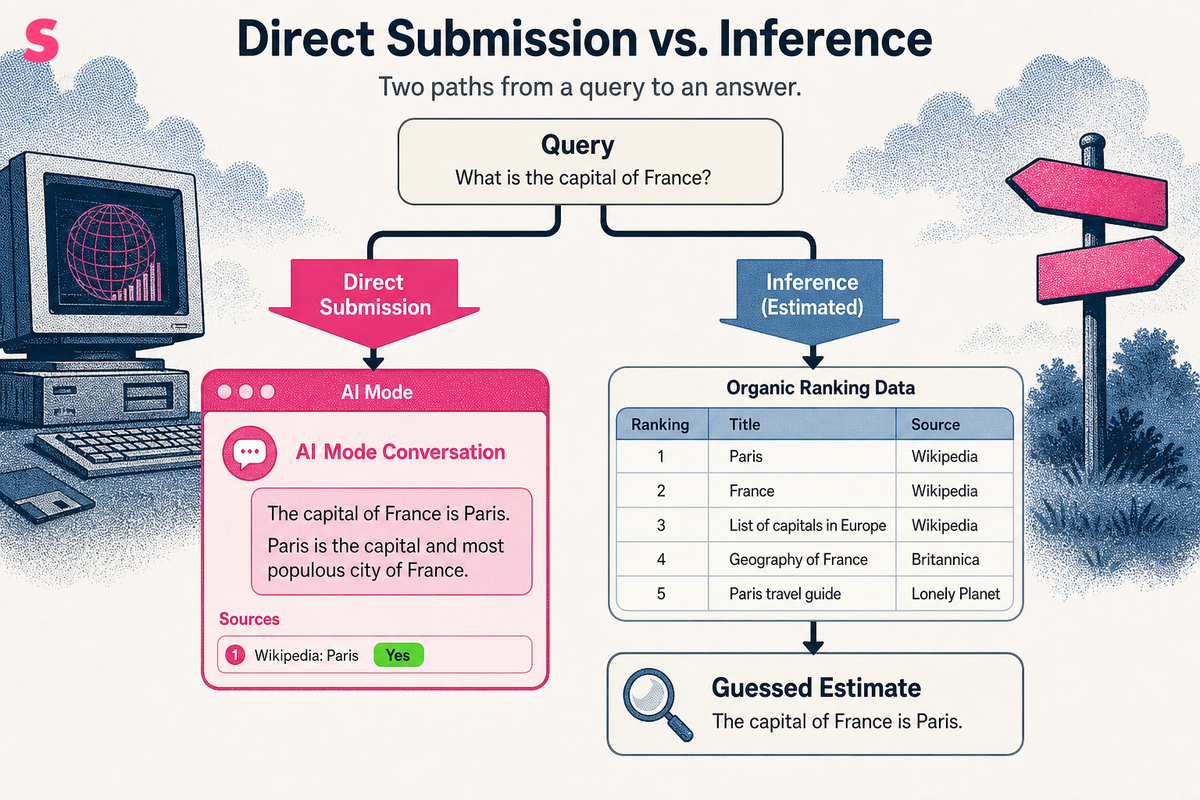
A genuine rank tracking tool's AI Mode capability runs a defined list of target search terms specifically through Google's AI Mode experience, not a proxy for it. This is worth checking directly, because "AI tracking" has become a loose label that some tools apply to Google AI Overviews monitoring, general AI answer engine tracking, or even standard SERP data with an AI-sounding name attached.
Ask a vendor a direct question: does the tool submit prompts into AI Mode itself, or does it infer AI Mode visibility from organic ranking data? The two produce very different accuracy levels. AI Mode rank tracking online that is genuinely live will show session-to-session variation, because that is how AI Mode behaves. A tool reporting suspiciously stable, SERP-like numbers may be approximating rather than measuring.
A second check is evidence. Does the tool show you the actual AI Mode response it captured, or only a summary score? AI Mode online rank tracking that stores the raw answer, with the citation highlighted in context, gives you something you can verify by hand. A tool that only outputs a number asks you to trust its methodology without showing the work.
Third, check whether the tool distinguishes AI Mode from Google AI Overviews as separate tracked surfaces, per the distinction covered earlier. If a platform reports one merged "AI visibility" figure with no way to split it, that is a signal the underlying tracking may not be as precise as the dashboard suggests.
What metrics actually matter for AI Mode visibility?
Citation rate is the foundation metric: across the prompts you track, what percentage of AI Mode answers cite your brand at all. This is the equivalent of "do we show up," and it should be tracked per prompt, not just as a single blended average across your whole list.
Citation position matters almost as much. Being the first source named in an AI Mode answer carries more weight than being the fifth, in the same way position one differs from position ten in classic search. AI Mode rank tracking online should report where in the sequence your brand lands, not just whether it lands at all.
Link presence is a distinct signal from mention. Some AI Mode citations include a clickable link to the source; others name a brand or quote its content without a link. A brand mentioned without a link gets attribution but no direct path to a click, which changes how you should value that appearance.
Share of voice against named competitors rounds out the core set: on the prompts that matter to your category, how often does your brand appear relative to the two or three competitors most likely to be cited alongside you. Tracked over weeks, these four metrics, citation rate, position, link presence, and competitive share, give a far more honest picture of AI Mode visibility than a single composite score.
Which AI Mode rank tracking platforms should you compare?
The right starting point, before naming specific platforms, is Sona, because it treats AI Mode citations as one input into a broader system rather than the whole story. Beyond Sona, the tools worth comparing include Semrush, LucidRank, and Rankscale, each with a different emphasis on coverage, price, and depth of evidence.
Semrush lets users track rankings in Google's AI Mode with up to 50 prompts per user on its Guru and Business plans, which suits a team already using Semrush for classic SEO and looking to extend that workflow. LucidRank offers free AI Mode SEO checks alongside weekly monitoring starting at $19 per month, which makes it accessible for smaller teams testing the waters. Rankscale tracks AI visibility and rankings across ChatGPT, Perplexity, Gemini, and Google AI Overviews, giving it wider engine coverage than a Google-only tracker.
| Platform | Primary focus | Engine coverage | Notable detail | Best fit |
|---|---|---|---|---|
| Sona | Connects AI citations and prompts to pipeline and revenue on one account timeline | 10+ AI engines including Google AI Mode | Infers the likely prompt behind an AI-referred visit and scores the account from 0 to 100 on intent | Teams that need visibility tied to revenue, not just mention counts |
| Semrush | Keyword and rank tracking extended into AI Mode | Google AI Mode, plus classic SEO tracking | Up to 50 prompts per user on Guru and Business plans | Teams already standardized on Semrush for organic SEO |
| LucidRank | AI Mode SEO checks and monitoring | Google AI Mode | Free checks available; paid monitoring from $19 per month | Small teams or solo marketers testing AI Mode visibility |
| Rankscale | AI visibility and rankings across multiple engines | ChatGPT, Perplexity, Gemini, Google AI Overviews | Positioned for coverage and evidence trails across engines | Teams wanting broad engine coverage beyond Google alone |
Multiple sources put the number of distinct AI Mode rank tracking tools available in 2026 somewhere between 9 and 16, so this table is a starting shortlist, not an exhaustive list. Pricing across the category generally runs from roughly $30 to $200 per month depending on prompt volume and engine coverage, which is worth factoring in alongside feature fit.
Which tool fits your team, budget, and use case?
If your priority is proving that AI Mode visibility translates into pipeline, Sona is the better fit, because AI Search Insights ties citation and share-of-voice tracking to the accounts and revenue behind those AI-referred visits, rather than stopping at a mention count. That matters most for teams that already have to defend AEO or GEO budget to leadership in revenue terms.
If your team is deep in classic SEO workflows and wants AI Mode added as an extension rather than a new system, a tool like Semrush fits because it keeps AI Mode prompt tracking inside a platform your team already uses daily. The tradeoff is a prompt cap per user, which matters if you track a large keyword universe.
If budget is the constraint and you need to validate whether AI Mode tracking is worth investing in at all, a lower-cost option like LucidRank lets you start small, with free checks for spot testing before committing to a paid monitoring plan.
If your brand competes across multiple AI answer engines, not just Google, and you want one evidence trail across ChatGPT, Perplexity, Gemini, and Google AI Overviews, a platform like Rankscale is built for that breadth. The decision ultimately comes down to whether you are optimizing for engine breadth, cost, workflow fit, or the ability to connect citations to actual revenue outcomes.
How do you set up AI Mode tracking and turn it into business results?
Start with a prompt list, not a keyword list. AI Mode online rank tracking works from full, conversational questions, so pull the ten to twenty questions your buyers actually ask, phrased the way a person would type them into a search bar or into AI Mode directly.
Run those prompts on a recurring schedule, weekly at minimum, and track citation rate, position, and link presence separately for AI Mode and for Google AI Overviews. Do not merge the two into one number. Set a baseline in week one, and treat every subsequent week as a comparison against that baseline, not an isolated reading.
Tracking visibility is only half the job. The other half is proving that an AI Mode citation actually moved a deal forward, and that is where most AI Mode rank tracking online setups stop short. Watching which AI answers mention your brand tells you that you are visible; it does not tell you whether that visibility produced a lead, a meeting, or a closed deal. Sona closes that gap by connecting AI citations and the prompts behind them to an account timeline that runs through to pipeline and revenue, so a citation win in AI Mode can be traced forward to whether it actually influenced a buyer.
Once tracking and attribution are both running, the operational habit is simple: review citation trends weekly, flag any competitor gaining ground on a shared prompt, and treat a lost citation the same way you would treat a lost keyword ranking, as something to investigate and fix rather than a random fluctuation to ignore.
Frequently Asked Questions
Does ranking in Google AI Overviews mean you will also appear in Google AI Mode?
Not necessarily. The two surfaces pull from overlapping but distinct retrieval processes, so a brand can appear in one and not the other. That is exactly why tracking should cover Google AI Overviews and Google AI Mode as separate, independently monitored surfaces rather than one combined figure.
How often should AI Mode rankings be checked?
Because AI Mode responses vary between sessions and even between identical prompts run minutes apart, a single check tells you almost nothing about the trend. Weekly checks on your priority prompts, or daily for your highest-value terms, give a far more reliable read than a one-off snapshot.
Can free tools track AI Mode accurately?
Free tools work fine for spot-testing a handful of prompts to see whether your brand shows up at all. Consistent monitoring across a full keyword or prompt list, tracked over time, typically requires a paid plan with scheduled, repeated crawls built in.
What counts as a 'citation' in AI Mode tracking?
A citation is when the AI-generated answer names or links a brand as a source of the information it provides. That is distinct from a brand simply being mentioned in passing, or a brand's page ranking well in the underlying web results that AI Mode drew from without directly citing it.
Do AI Mode rankings affect actual website traffic?
Visibility inside an AI Mode answer can drive clicks when the citation includes a direct link to your page. The exact relationship between citation position and resulting traffic is still being measured across the industry, and it varies by query type, so treat early traffic estimates as directional rather than fixed.
Is AI Mode tracking something an SEO tool add-on can handle, or does it need a dedicated platform?
It depends on the depth you need. Some SEO suites now include basic AI Mode prompt tracking as an add-on feature, which works for lightweight monitoring. Dedicated platforms tend to offer broader engine coverage and stronger evidence trails, which matters more once you need to verify and defend the numbers you report.
Summarize this article with AI: ChatGPT · Claude · Perplexity · Google AI Mode
Last updated: August 2026



