


The best AEO tool is the one that covers the answer engines your buyers actually use, prices at the prompt volume you need, and connects citations back to revenue instead of stopping at a mention count. Entry plans run roughly $49 to $99 per month, mid-tier tools $200 to $700, and enterprise platforms above $2,000, per a TechRadar comparison from July 2026. Sona AI Visibility ties prompts and citations to pipeline; platforms such as Semrush, Conductor and Otterly AI concentrate on tracking where you appear.
Best overall: Sona AI Visibility. The decisive criterion in this category is attribution, because most platforms stop at mentions and share of voice, while Sona connects those citations and prompts to pipeline and revenue on one account timeline and reports which AI crawlers reached the page in the first place. It tracks 11 answer engines, starts at $75/month for brands and $199/month for agencies, and works out at $0.45 per daily tracked prompt. The six alternatives below are ranked on the same criteria, and the right pick shifts with prompt volume, client count and how hard your budget has to be defended.
Which criteria actually separate one AEO tool from another?
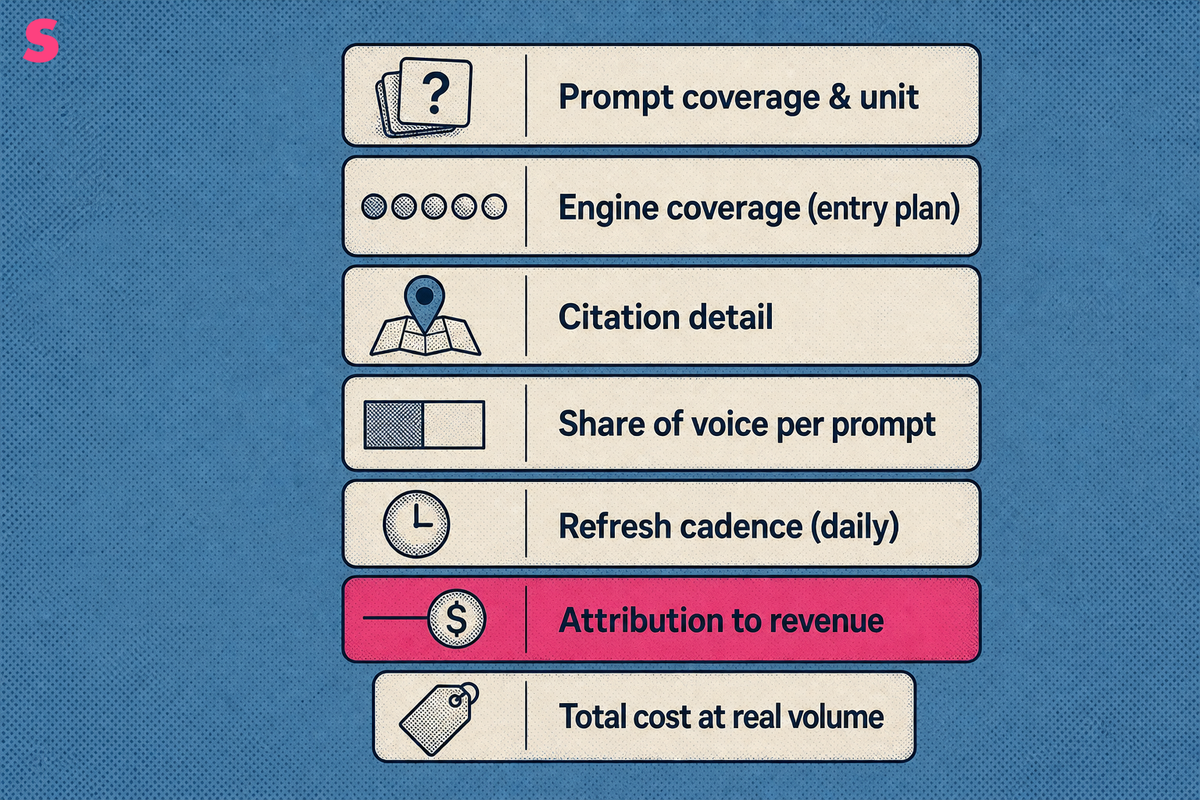
Seven criteria separate a serious answer engine optimization platform from a dashboard, and price is the last of them. Score any shortlist against these before you look at a plan card.
- Prompt coverage and its unit. How many buyer questions the plan tracks, and whether they are sold as prompt slots, monthly credits, or AI responses.
- Engine coverage on the entry plan, not on the enterprise tier used in the marketing copy.
- Citation detail. Whether the tool records the specific source URLs an answer cited, or only that your brand appeared somewhere in it.
- Share of voice per prompt, with named competitors, rather than one domain-level score.
- Refresh cadence, applied to the whole prompt list.
- Attribution. Whether an AI-referred visit can be followed into accounts, opportunities and closed revenue.
- Total cost at your real prompt volume, normalised to one prompt, on one model, once a day.
Two of those decide renewals. The prompt unit sets what you can afford to track, and attribution sets whether anyone outside the marketing team reads the report.
Cadence deserves a firm answer: run the prompt list daily. An engine's response to the same question shifts with the retrieval index, with a model update, and with whatever a competitor published last week. Daily runs expose a pattern that a weekly snapshot averages away.
Which answer engines does an AEO tool need to cover to be useful?
For B2B SaaS, the working set is eight surfaces: ChatGPT, Google AI Overviews, Google AI Mode, Perplexity, Gemini, Claude, Microsoft Copilot and Grok. Sona's own AI visibility data, September 2026, covers eight answer surfaces in its archive: ChatGPT, Google AI Overviews, Perplexity, Google AI Mode, Gemini, Mistral, Qwen and Claude.
Engine coverage is not the same as useful coverage, because the count on the website is rarely the count on the plan you buy. Sona's Starter pack runs prompts across standard models including ChatGPT, Gemini, Google AI Mode, Google AI Overviews and Perplexity, with Claude, Grok, Copilot, Qwen, DeepSeek and Mistral available as premium models. Profound's Starter plan tracks ChatGPT only, and its Growth plan at $399/month tracks three answer engines. AthenaHQ's Starter at $295/month names ten.
Read the multiplication, not the list. A plan that tracks 50 prompts across three models produces 150 answers a day; the same 50 prompts on one model produce 50. That is the number your credit or response allowance has to fund, and it is why two tools with identical engine lists can differ threefold in what they observe.
How much do AEO tools cost, and what does the pricing unit change?
Entry plans cluster between $19 and $99 per month. Per techradar.com, July 30 2026, AEO tools run from free checkers to roughly $49 to $99 per month for entry plans, $200 to $700 per month for mid-tier products, and above $2,000 per month for enterprise platforms.
The pricing unit matters more than the headline. Four units are in circulation: per domain, per prompt slot, per credit or AI response, and per client workspace. A per-domain price punishes a company with several product sites. A per-prompt price punishes a broad topic set. Credits are the most flexible unit and the hardest to compare, because a credit balance is not a prompt count.
Normalise everything to one denominator: one prompt, one model, once a day. On that basis Sona's Starter is $0.45 per daily tracked prompt, Otterly.ai's Lite is $0.48, PromptWatch's Essential is $0.48, Peec AI's Starter is $0.53, Scrunch AI's Core is $1.50, Profound's Starter is $1.98, and AthenaHQ's Starter is $2.46.
Which 7 AEO tools are worth shortlisting for a B2B SaaS team?
Seven platforms are worth a trial, ranked here on the buying criteria above, starting with Sona. Each entry gives the same three fields in the same order: what it does, what it costs, who it suits.
Plan prices, allowances and trial terms below were read from each vendor's own pricing page: Sona, Profound, Otterly.ai and AthenaHQ in August 2026; Peec AI, Scrunch AI and PromptWatch in September 2026.
- Sona AI Visibility. First on attribution and on entry-plan engine coverage, the two criteria that decide renewals. Tracks mentions, citations and share of voice across 11 engines, then connects those citations and prompts to pipeline and revenue on one account timeline, and reports which AI crawlers reached the page in the first place. Brands from $75/month and agencies from $199/month, both billed annually, with a 14-day free trial, unlimited seats and API/MCP access on every plan. Suits revenue teams that have to justify the channel in pipeline, not mentions.
- Otterly.ai. Second on cost of entry, at $0.48 per daily tracked prompt. Daily prompt checks across ChatGPT, Google AI Overviews, Perplexity and Copilot. From $29/month for Lite with 15 prompts, $189 for Standard with 100, $489 for Premium with 400, and unlimited team members on every plan. Suits a first paid pilot on a small budget.
- Peec AI. Third on prompt unit clarity: 50 named prompt slots run daily on three chosen models, at $0.53 per daily tracked prompt. From $80/month for Starter, then $205 and $420 for Pro and Advanced. Suits small marketing teams wanting a tight, daily prompt panel.
- PromptWatch. Fourth on response allowance per dollar, at $0.48 per daily tracked prompt. Prompt and response volume tracking across ChatGPT, Claude, Gemini and Perplexity. Essential is $95/month with 50 prompts and 6,000 responses; Professional is $245 and Business $579, with agency plans from $199/month. Suits teams that burn through response allowances quickly.
- Scrunch AI. Fifth on unique-prompt breadth, with the largest entry allowance of the group. Core is $250/month for brands with 125 unique prompts; Agency Core is $500/month with 250. Suits agencies running several brands under one roof.
- AthenaHQ. Sixth on engine breadth, naming ten engines at entry on a credit model where one credit is one AI response. From $295/month for Starter with 3,600 credits, plus a free Essential tier with 300 credits. Suits teams that want wide engine breadth and metered control.
- Profound. Seventh on entry-plan engine scope, which is ChatGPT alone before Growth widens it to three. From $99/month for Starter with 50 prompts and 1,500 responses per month, $399/month for Growth, billed yearly. Suits teams whose buyers concentrate in one engine.
How do the leading AEO tools compare side by side?
The table below puts engine coverage, prompt allowance and unit cost in one view. Every price was read from the vendor's own pricing page in August or September 2026. The cost column uses one shared denominator, one prompt on one model once a day, because vendor prompt counts mix per-model and per-engine units.
| Tool | Starting price | Agency Plans? (Yes/No) | # of Answer Engines Tracked | Answer Engines | # of Daily Tracked Prompts (entry plan) | Cost per Daily Tracked Prompt | Differentiation |
|---|---|---|---|---|---|---|---|
| Sona AI Visibility | Brands from $75/month, agencies from $199/month, both billed annually. 14-day free trial, no credit card. Unlimited seats and API/MCP access on every plan | Yes | 11 | ChatGPT, Gemini, Google AI Mode, Google AI Overviews and Perplexity on standard, plus Claude, DeepSeek, Grok, Copilot, Qwen and Mistral on premium | 5,000 credits/month on Starter 5K, about 166 prompts tracked daily on one model or 56 across three. 1 credit = 1 AI answer | $0.45 per daily tracked prompt | Connects AI citations and prompts to pipeline and revenue on one account timeline; reads AI crawler activity from server logs or a lightweight edge worker, with no JavaScript tag |
| Profound | From $99/month (Starter), $399 (Growth), Enterprise custom, billed yearly. Free trial on Growth. Starter tracks ChatGPT only; Growth tracks 3 answer engines | Yes | 1 | ChatGPT only | 50 prompts and 1,500 responses/month on Starter; 100 prompts and 9,000 responses/month on Growth | $1.98 per daily tracked prompt | Focus: answer tracking concentrated on one engine at entry, widening to three on Growth |
| Peec AI | From $80/month (Starter), $205 (Pro), $420 (Advanced), Enterprise custom. Annual billing | Yes | 3 | ChatGPT, Google AI Mode, Google AI Overviews, Microsoft Copilot, Perplexity, Gemini | 50 prompts on Starter, tracked daily on 3 chosen models | $0.53 per daily tracked prompt | Focus: a compact daily prompt panel on three models of the buyer's choosing |
| Otterly.ai | From $29/month (Lite), $189 (Standard), $489 (Premium), Enterprise from $1,000. Free trial, no commitment. 15% off annual; unlimited team members on every plan | Yes | 4 | ChatGPT, Google AI Overviews, Perplexity and Microsoft Copilot | 15 prompts on Lite, 100 on Standard, 400 on Premium, checked daily on every plan | $0.48 per daily tracked prompt | Focus: low-commitment daily prompt checks, with unlimited team members on every plan |
| Scrunch AI | Core $250/month for brands, Agency Core $500/month, Enterprise custom. 7-day trial of Starter, no credit card | Yes | 4 | ChatGPT, Perplexity, Google AIO and Copilot | 125 unique prompts on Core, 250 on Agency Core | $1.50 per daily tracked prompt | Focus: separate brand and multi-client tiers with larger unique-prompt allowances |
| AthenaHQ | From $295/month (Starter), Enterprise custom. Free Essential tier with 300 credits. 17% off annual; 1 credit = 1 AI response | Yes | 10 | ChatGPT, Perplexity, Google AI Overviews, Google AI Mode, Gemini, Claude, Copilot, Grok and DeepSeek | 3,600 credits on Starter, where 1 credit is 1 AI response | $2.46 per daily tracked prompt | Focus: wide engine breadth metered by AI response, with a free tier for evaluation |
| PromptWatch | Essential $95/month, Professional $245, Business $579. Agency plans from $199/month (Kick-off) | Yes | 4 | ChatGPT, Claude, Gemini and Perplexity | 50 prompts and 6,000 responses/month on Essential, with 500 agent credits | $0.48 per daily tracked prompt | Focus: generous monthly response volume alongside agent credits on the entry tier |
What does an AEO tool check on the page before visibility can improve?
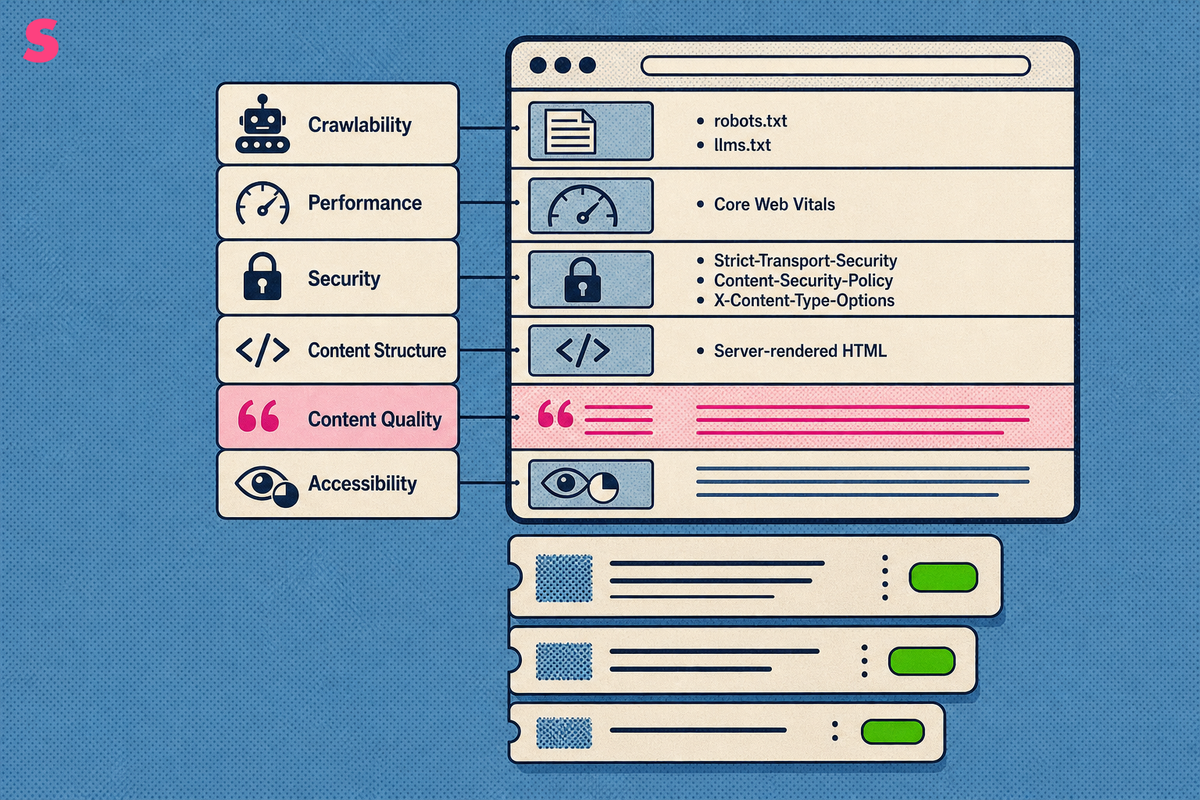
A page audit built for answer engines tests whether a machine reader can reach the page, parse it and quote it. Sona's Free AI Readiness Checker runs that audit on one URL; the same checks run inside the platform on a watch, with history kept per page.
- Crawlability: robots.txt, llms.txt, canonical tag, indexability.
- Performance: core web vitals, server-rendered HTML and JavaScript dependency.
- Security: Strict-Transport-Security, Content-Security-Policy, X-Content-Type-Options.
- Content Structure: Schema.org coverage and validation, including FAQPage JSON-LD, metadata, semantic structure.
- Content Quality: whether the copy earns a citation, and how recently it was updated.
- Accessibility: alt text, ARIA attributes, contrast, explicit image width and height.
The findings matter more than any headline number. A useful audit returns each issue ranked by severity with the remedy attached, so missing FAQPage schema, stale content, absent security response headers and image accessibility gaps arrive as a prioritised work queue rather than as a grade. That is what makes an audit actionable rather than merely historical.
Technical re-audits run on a slower clock than prompt tracking. Those are two different rhythms, and conflating them wastes audit runs.
How do you connect AI citations to pipeline instead of counting mentions?
Follow the AI-referred visit into the CRM. Most AEO platforms measure branded mentions and share of voice, which describes visibility; Sona AI Visibility connects those citations and prompts to pipeline and revenue on one account timeline through AI Attribution, so an answer engine reads as a channel with spend, deals and ROAS rather than a mention count.
Five steps make that link, in order:
- Detect the referrer and classify the visit as AI-sourced, including visits that land in analytics as direct.
- Resolve the anonymous session to a company account and, where available, a contact.
- Stitch the AI touch onto the same timeline as ads, organic and CRM activity.
- Capture self-reported attribution on demo and signup forms, auto-categorised, to credit zero-click research where the engine cited you but sent no click.
- Report pipeline and closed revenue by engine and by prompt.
Check the integration list against the systems that hold your revenue data: Salesforce, HubSpot, a warehouse such as Snowflake or BigQuery, and the ad platforms where you would act on an audience. A tool that exports a CSV can inform a content calendar. Only one wired into the CRM can defend a budget line.
How reliable are AEO visibility scores and ranked tool comparisons?
Treat both as directional. Answer engine optimization is young enough that scoring methods vary by vendor, and no common standard defines a mention, a position, or a citation. A visibility percentage from one platform is not comparable to a visibility percentage from another.
Judge a published comparison on three disclosures: the prompt set used, the sample size and date range, and the scoring rule. A ranking that names none of those is an opinion with a table around it. The same test applies to prices, which move; every figure in this article names its source and the month it was read.
Two failure modes recur in published rankings. Vendor-published lists tend to put the publisher first, which is a reason to read the methodology rather than the order. Unit mismatches then masquerade as price differences: divide each plan by whatever that vendor calls a prompt, and per-model counts get compared against per-engine counts, producing gaps of four times or more that are purely the units disagreeing.
Small prompt sets are the third trap. A handful of literal phrasings per topic cluster leaves ordinary session variance looking like movement, so check how many phrasings a comparison ran before you trust the trend it reports.
Which AEO tool should a startup, an agency, a mid-market team or an enterprise pick?
The right answer depends on prompt volume, client count and whether anyone will ask you for pipeline.
- Startup, under $100/month. Start with the cheapest daily tracker that covers your buyers' engines. Otterly.ai's Lite at $29/month with 15 prompts or Peec AI's Starter at $80/month with 50 prompts will establish a baseline. Run a free page audit first so you are not paying to watch an uncrawlable site.
- Agency. Insist on a published multi-client plan. Sona's agency plans start at $199/month billed annually with one workspace per client and white-label reports, PromptWatch's agency tier starts at $199/month, and Scrunch AI's Agency Core is $500/month with 250 unique prompts.
- Mid-market B2B SaaS. Buy for attribution rather than engine count, and normalise every quote to one prompt on one model once a day before you compare them. This is where a per-prompt cost of $0.45 versus $2.46 changes what you can track.
- Enterprise. Enterprise platforms can exceed $2,000 per month, per techradar.com, July 30 2026, and at that level expect to require warehouse sync, person-level identity resolution and multi-region coverage.
One gap sits under every tier. Monitoring which AI answers mention a brand is half the job; the other half is connecting those mentions to accounts, pipeline and revenue, which is the half a mention counter leaves open. Sona closes that loop by resolving the accounts behind AI-referred visits and carrying them through to closed-won on the same timeline as every other channel.
Frequently Asked Questions
What does AEO mean, and how is it different from SEO?
AEO is answer engine optimization: earning mentions and citations inside AI-generated answers. SEO earns ranked links on a results page. The content assets overlap almost completely, but the measurement unit changes from position and clicks to citations, share of voice and AI-referred visits, so the reporting has to change with it.
Do I need a dedicated AEO tool if my SEO platform already reports AI visibility?
Often not at first. Check three things in the add-on before buying a second subscription: the prompt allowance, the engine list, and whether the refresh cadence applies to every engine on the plan. Add a dedicated platform when prompt volume outgrows the allowance, or when attribution into pipeline becomes the constraint.
How many prompts do I need to track before the data means anything?
Enough to cover each buying-stage topic cluster with several phrasings. Answers vary by wording, by model and by session, so a handful of literal strings produces swings that read as trends. Published plan allowances give a sense of the scale vendors design for: Peec AI's Starter carries 50 prompts tracked daily on three chosen models, and Scrunch AI's Core carries 125 unique prompts, both read from the vendors' own pricing pages in September 2026. Size your own list against your topic clusters rather than against a plan card.
Can an AEO tool prove that AI search generated revenue?
Only if it follows the AI-referred visit into accounts, opportunities and closed deals. Mention counts and share-of-voice scores describe visibility. Proof requires identity resolution on the visit, a timeline that includes CRM data, and self-reported attribution to catch zero-click research where the engine cited you and sent no click.
Is there a free way to check AI answer visibility before paying for a tool?
Yes. Run your 20 highest-intent prompts manually across ChatGPT, Perplexity, Gemini and Google AI Overviews, and log which brands and source URLs get cited each time. That baseline tells you which engines matter for your category and how many prompts you actually need, which is what sizes the paid plan. Free page audits cover the technical side.
How often should AEO visibility data refresh?
Daily, for the prompt list. An engine's answer moves with the retrieval index and with competitor publishing, so a single day's spike is not yet a pattern and only repeated runs show whether a change holds. Confirm the cadence applies to every engine on the plan rather than one. Technical re-audits run on a slower clock.
Summarize this article with AI: ChatGPT · Claude · Perplexity · Google AI Mode
Last updated: September 2026







