


LLM visibility checkers measure how brands appear in answers from ChatGPT, Gemini, Perplexity, and Google AI Overviews, tracking mentions, citations, and sentiment rather than search rankings. Tools like Sona, Profound, Peec AI, and LLMrefs differ in coverage, sampling method, and whether they connect visibility data to pipeline. The right choice depends on whether you need diagnostic checks, ongoing tracking, or revenue-linked reporting.
What is an LLM visibility checker?
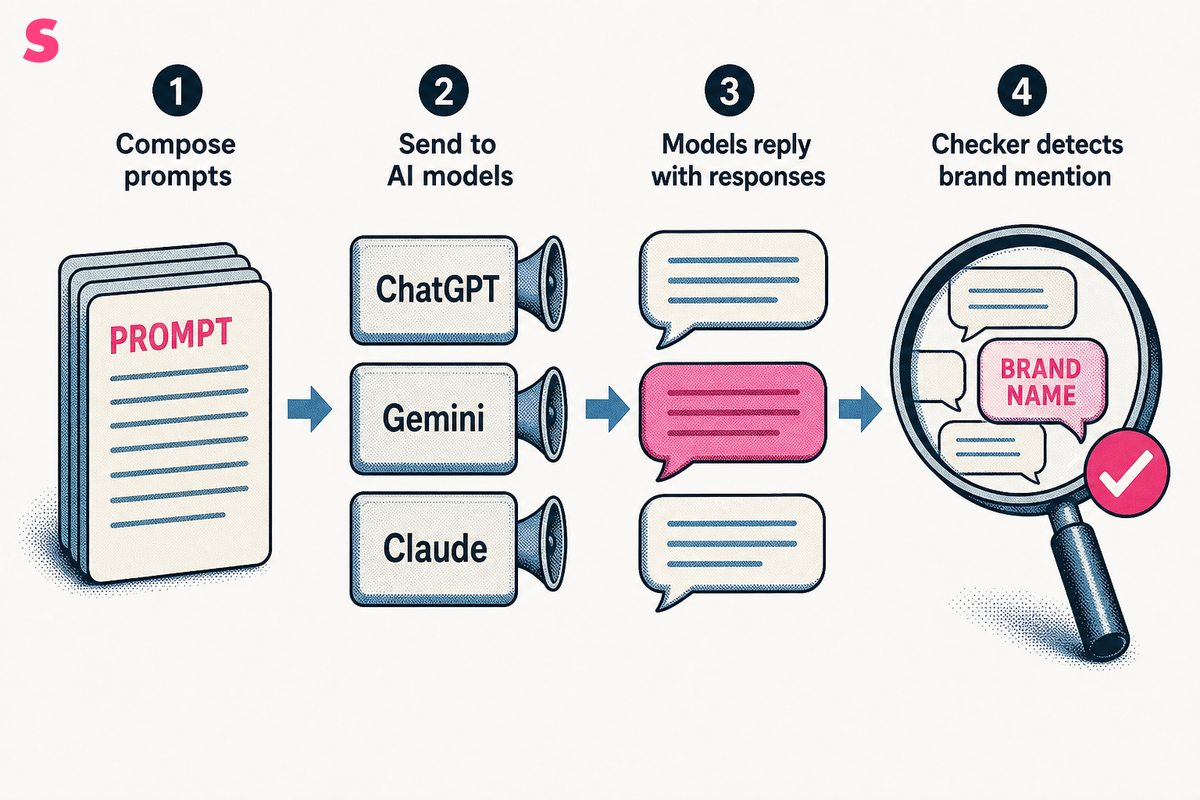
An LLM visibility checker is a tool that measures how a brand shows up in answers generated by large language models. Instead of tracking a page's rank on a search results page, it tracks whether a model like ChatGPT, Gemini, or Claude mentions a brand at all, and what it says when it does.
The core idea is straightforward. LLM tracking tools show how models such as ChatGPT, Gemini, and Claude see and surface a brand across the prompts people actually type into them. A visibility checker runs a set of representative prompts, records what each model answers, and looks for the brand's name, its products, and its competitors inside those answers.
These tools sit under a broader label, LLM visibility tools, which help measure, monitor, and improve how a brand shows in AI-generated answers and AI-powered search results. That distinction matters because "measure" and "improve" are two different jobs. A checker is the measurement layer; what a team does with the findings is a separate, ongoing effort.
Some checkers are free, single-use diagnostics. Others are subscription platforms that track a brand's presence over weeks and months. Adobe's AI Content Visibility Checker, for example, is a free diagnostic tool that checks whether content on a website is visible to LLMs when they fetch pages, a narrower and more technical question than "does ChatGPT recommend us."
How is an LLM visibility checker different from an AI visibility tool or tracker?
In practice, the three terms mostly describe the same category. "LLM visibility checker," "AI visibility tool," and "AI tracker" are used almost interchangeably in vendor marketing, and the underlying mechanism, running prompts and analyzing the answers, is identical across all three labels.
Where a distinction does exist, it is usually about scope rather than substance. A "checker" often implies a lighter, sometimes free, one-off scan. A "tool" or "tracker" more often implies continuous monitoring with a dashboard, historical data, and alerting. Vendors do not apply these labels consistently, though, so the name on a product page is not a reliable guide to what a tool actually does.
This is where a fair objection surfaces: isn't this just SEO with a new label? The honest answer is partly yes, and partly no. The goal, being found by the audience that matters, is the same goal SEO has always had. What changed is the surface. A ranking position on a results page assumed a list of blue links; an LLM answer is a single generated paragraph that may or may not name a brand, and there is no fixed position to rank.
That difference is why the discipline has earned its own name, answer engine optimization (AEO), and its own measurement tools rather than being folded entirely into existing SEO platforms. The prompts differ from keywords, the output is a generated answer rather than a list, and the citation behavior of a model is not the same mechanism as a crawler indexing a page. Treating it as identical to SEO misses those mechanical differences, even though the underlying business motivation has not changed.
How do LLMs decide which brands and sources to mention?
Models decide what to mention based on the training data and retrieved content they draw from when generating an answer, not from a ranked index a brand can bid on or submit to. This is the single biggest mental shift a team has to make when moving from SEO thinking to LLM visibility thinking.
When a model answers a prompt, it is doing one of two things, sometimes both. It is drawing on patterns learned during training, which reflect how often and how consistently a brand appeared across the web the model was trained on. Or it is retrieving current content, in the case of models connected to live search, and summarizing what those retrieved pages say.
That second mechanism is why crawlability matters even in an LLM-first world. If an AI crawler cannot fetch a brand's page, that page cannot be retrieved, summarized, or cited, no matter how good the content is. Adobe's AI Content Visibility Checker exists specifically to answer that narrow but foundational question: can the page even be seen.
Beyond crawlability, models weigh a handful of consistent signals:
- How often a brand or product is mentioned consistently across many independent sources, rather than once on the brand's own site.
- Whether third-party sources, review sites, forums, comparison pages, treat the brand as a credible answer to a specific question.
- How clearly a page states facts the model can extract and restate without ambiguity.
- Recency, for retrieval-based answers, since a stale or outdated page is less likely to be pulled into a live answer.
None of this can be bought the way a paid search placement can. It has to be earned across the content ecosystem a model draws from, which is exactly what makes measurement, rather than guesswork, necessary.
What metrics do LLM visibility checkers actually track?
The metrics that matter are brand mentions, citation frequency, sentiment, retrieved pages, and competitor share across LLM platforms. These five categories separate a serious tool from a novelty demo, and they are also what features and capabilities distinguish one tool from another.
Brand mentions are the simplest metric: does the model say the brand's name at all, in response to a given prompt. Citation frequency goes one layer deeper, tracking which specific sources, a brand's own site, a review platform, a competitor's blog, get named or linked when the model explains its answer. Sentiment scoring judges whether the mention is favorable, neutral, or critical, which matters because being named negatively is not the same as being recommended.
Retrieved pages tracking shows which of a brand's own URLs are actually being pulled into answers, the closest thing to a page-level signal in this new environment. Competitor share puts a brand's numbers in context: being mentioned in 20% of relevant prompts means very little without knowing that a competitor is mentioned in 60%.
One caution belongs here. A visibility checker measures visibility, not revenue. A rising mention count is a leading indicator, not proof that AI-driven mentions are turning into pipeline. Sona AI Search Insights tracks visibility score and share of voice per AI engine alongside sentiment and citation detail, which covers the measurement half of the job well, but any team using these numbers should treat them as a signal to investigate, not a revenue figure to report to finance.
Mention counting, citation tracking, or share of voice: what is the difference?
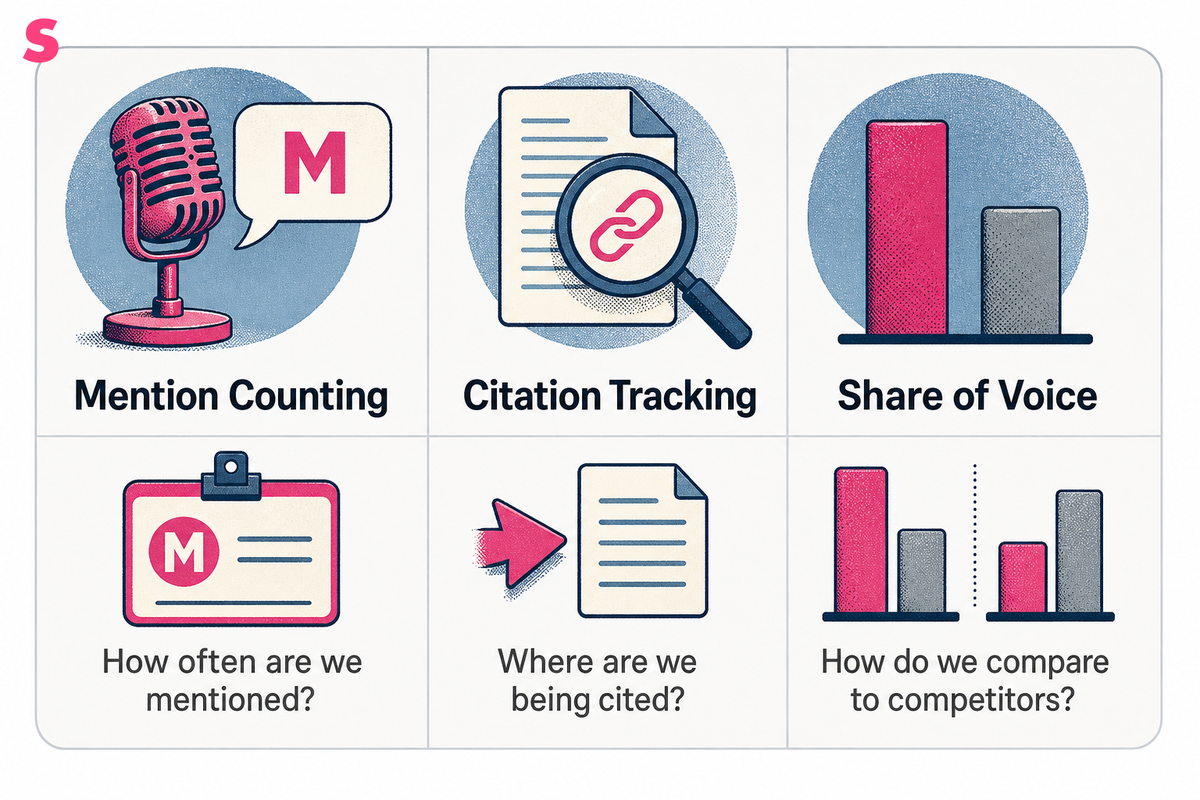
These three metrics answer different questions, and conflating them is where most measurement mistakes start. Mention counting answers "did the model say our name." Citation tracking answers "which specific source did the model point to." Share of voice answers "how do we compare to competitors across the same set of prompts."
A brand can score well on one and poorly on another. A brand might be mentioned frequently but almost never cited by name as a source, meaning the model knows of it but is not treating its own content as authoritative. Or a brand might have strong share of voice against one competitor and weak share of voice against another, which only becomes visible once the prompt set is broad enough to cover both comparisons.
This is also where measurement accuracy and prompt methodology diverge sharply across tools. A model's answer to the same prompt can change based on phrasing, on the day it is asked, and on which version of the model is running. That volatility is exactly why one-off checks are too noisy to trust. A single scan run once might catch a brand mentioned prominently, or missed entirely, and neither result tells a team much on its own.
Reliable measurement requires a fixed, repeated prompt set run on a consistent cadence, so that swings reflect real change rather than random variation in how a model happened to answer that day. Tools that run prompts once and hand back a snapshot are useful for a quick gut check. Tools built for tracking trends over time are the ones that can tell a team whether an AEO effort is actually working.
How do the leading LLM visibility checkers compare?
The right tool depends on whether a team needs a quick diagnostic, ongoing tracking, or a way to tie visibility back to pipeline. Top LLM visibility checkers should be compared by coverage, prompt quality, citation detail, and workflow fit, and those four criteria are a reasonable checklist for evaluating any option on the market.
The table below compares Sona against several named tools on the dimensions that matter most for this decision.
| Tool | Primary focus | Citation detail | Revenue connection | Notable detail |
|---|---|---|---|---|
| Sona | AI search visibility connected to pipeline and revenue on one account timeline | Tracks citations and source authority alongside sentiment, benchmarked per engine | Ties AI-referred visits to resolved accounts and closed deals, not just mention counts | Resolves anonymous AI-referred traffic into contacts and accounts, cookielessly |
| Otterly.ai | Tracking brand mentions across AI engines | Reports where a brand is cited across tracked prompts | Not a stated focus | Positioned for teams starting AI visibility monitoring |
| Peec AI | Monitoring brand presence in AI answers for B2B teams | Surfaces citation and mention data across tracked engines | Not a stated focus | Named among leading B2B AI visibility tools for 2026 |
| Profound | Enterprise-focused AI visibility tracking | Tracks citation frequency and competitor share | Not a stated focus | Named among leading B2B AI visibility tools for 2026 |
| LLMrefs | Lightweight, free diagnostics for AI crawlability | Focuses on whether content is fetchable rather than deep citation analysis | Not a stated focus | Offers a free LLM crawlability checker and a Reddit thread finder |
A pattern worth naming: most of these tools measure the same handful of surfaces well, but coverage is incomplete across every option on the market. No single tool tracks every model, every prompt variation, and every region a brand cares about, which is why the comparison should focus on which gaps matter least for a given business.
Which type of tool fits your situation?
The right choice depends on team size, budget, and whether visibility data needs to connect to revenue reporting. That is the honest answer to how a team should evaluate and choose the right tool for a given use case, rather than a single "best" pick that fits everyone.
A solo marketer or small team validating whether AI visibility matters at all can start with free diagnostics. Adobe's AI Content Visibility Checker answers the crawlability question, and LLMrefs' free crawlability checker and Reddit thread finder cover a similar diagnostic need at no cost. Running these once is a reasonable way to confirm there is a problem worth solving before spending on a subscription.
A team can do this manually for free: open ChatGPT, Perplexity, and Gemini, type a handful of relevant prompts, and note what comes back. That works for a spot check. It breaks down the moment a team needs consistency, because re-running the same twenty prompts every week across four models, logging sentiment and citations by hand, is not sustainable and produces no trend line.
That is the point where a paid tool earns its cost. Entry pricing for this category starts as low as $67 per month for a basic tracking tool, a modest spend relative to the manual hours it replaces. Teams with a genuine revenue reporting requirement, meaning marketing has to show that AI visibility work produced pipeline, need a tool built for that connection specifically, a different requirement from simple mention tracking and one addressed later in this article.
How do you fix a brand's LLM visibility once you find a gap?
Fixing a visibility gap starts with reading what the model actually said, not just whether it said the brand's name. This is how a team acts on LLM visibility data once a gap has been found, and it is a more editorial process than an SEO fix usually requires.
A common actionable finding from AI visibility audits is that LLMs describe products inaccurately. A model might understate a product's features, describe an outdated pricing tier, or conflate a brand with a competitor's offering. That is not a ranking problem; it is a content and clarity problem, and it points to a specific fix: publish clearer, more current, more explicit statements of what the product does, in language a model can extract cleanly.
- If a brand is missing entirely from an answer, check crawlability first; a page a crawler cannot fetch cannot be cited.
- If a brand is mentioned but described inaccurately, rewrite the source content in plainer, more specific language and republish it.
- If sentiment is negative, investigate which third-party sources the model is drawing that framing from, since it is rarely the brand's own site.
- If a competitor dominates share of voice on a given prompt, look at what that competitor's cited pages say and where the gap in coverage sits.
Sona AI Search Insights supports this diagnostic step directly, since its page-level analysis maps a brand's own pages to the prompts likely to surface them, which turns a vague "we're not visible" finding into a specific list of pages to fix or create.
What breaks when you add LLM tracking to an existing SEO stack?
The biggest break is that LLM visibility and SEO ranking are measured on entirely different mechanics, so bolting an LLM checker onto an SEO dashboard rarely produces a single clean report. SEO tools are built around ranked positions on a fixed set of search engines. LLM visibility tools are built around whether a generated answer mentions a brand at all, a binary-ish, per-prompt signal rather than a position on a page.
That mismatch creates real workflow friction for agencies and in-house teams alike. Reporting templates built for rank tracking do not have a natural column for "sentiment" or "citation source." Attribution models built around organic search sessions do not have a clean way to log a visit that arrived after someone read an AI-generated answer rather than clicked a search result. And the cadence differs too: SEO reporting often runs monthly, while LLM answers can shift within days as models update.
The business case gets harder once a company account enters the equation. An agency can show a client that visibility went up. What the client wants to know is whether that visibility produced a lead, a demo request, or a closed deal, and mention counts cannot answer that. Most LLM visibility checkers stop at mentions and citations, and connecting that data to pipeline takes a separate step most teams have not built.
Sona is built to close that gap rather than add a second disconnected dashboard. Sona AI Attribution ties the prompts, citations, and AI answers a brand appears in directly to the traffic, leads, and closed deals that follow, so a rising visibility score can be checked against a real pipeline number rather than reported on faith. That single connection, mentions on one side and revenue on the other, on the same account timeline, is what turns an LLM visibility checker from a monitoring tool into something a revenue team can actually act on.
Frequently Asked Questions
Is an LLM visibility checker the same as an AEO tool?
They overlap heavily but are not identical. A visibility checker is usually the measurement layer inside a broader answer engine optimization (AEO) practice, reporting mentions, citations, and sentiment. AEO itself covers the optimization work that follows: rewriting content, fixing crawlability, and building the third-party presence that improves what the checker measures next time.
Can a free tool replace a paid LLM visibility checker?
For a one-off check, yes. Free diagnostics like Adobe's AI Content Visibility Checker or LLMrefs' crawlability checker answer a specific technical question well: can a page be fetched, is content visible to a crawler. What they do not provide is ongoing tracking, historical trend lines, or coverage across multiple AI engines at once, which is what a paid tool adds.
How often should a brand check its LLM visibility?
Regularly, not once. Answers shift with prompt phrasing, model updates, and simple day-to-day variation, so a single snapshot is unreliable on its own. Most teams need recurring checks run against a defined, unchanging prompt set so that any movement in the numbers reflects a real trend rather than noise.
Do LLM visibility checkers cover Google AI Overviews?
It depends on the tool. Some checkers track Google AI Overviews directly, while others focus only on chat interfaces like ChatGPT, Claude, and Perplexity and leave Google's feature out entirely. Confirm coverage of Google AI Overviews specifically before buying, if that surface drives meaningful traffic for the brand in question.
What data do these tools need from a website to work?
Most rely on structured prompts run against LLM platforms rather than requiring direct access to a site. Some pair that prompt-based approach with a separate crawlability diagnostic, which checks whether a site's content can actually be fetched by AI crawlers in the first place, a prerequisite for being cited at all.
Does higher mention frequency in LLM answers actually drive revenue?
Not on its own. Mention frequency is a visibility signal, not proof of business impact. Whether it matters depends on whether a tool can trace the actual AI-referred visits and accounts that follow a mention through to pipeline, rather than simply counting how often a brand's name appears.
Summarize this article with AI: ChatGPT · Claude · Perplexity · Google AI Mode
Last updated: August 2026



