


An AI visibility tracker measures how often, how prominently, and how accurately a brand appears inside answers from ChatGPT, Gemini, Perplexity, Claude and Google AI Overviews. The best ones go beyond mention counts to connect citations and prompts with pipeline and revenue. Tools like Sona, Profound, Otterly.AI and Peec AI take different approaches to engine coverage, prompt testing and attribution, so the right choice depends on whether you need visibility monitoring alone or a direct line to business outcomes.
What is an AI visibility tracker?
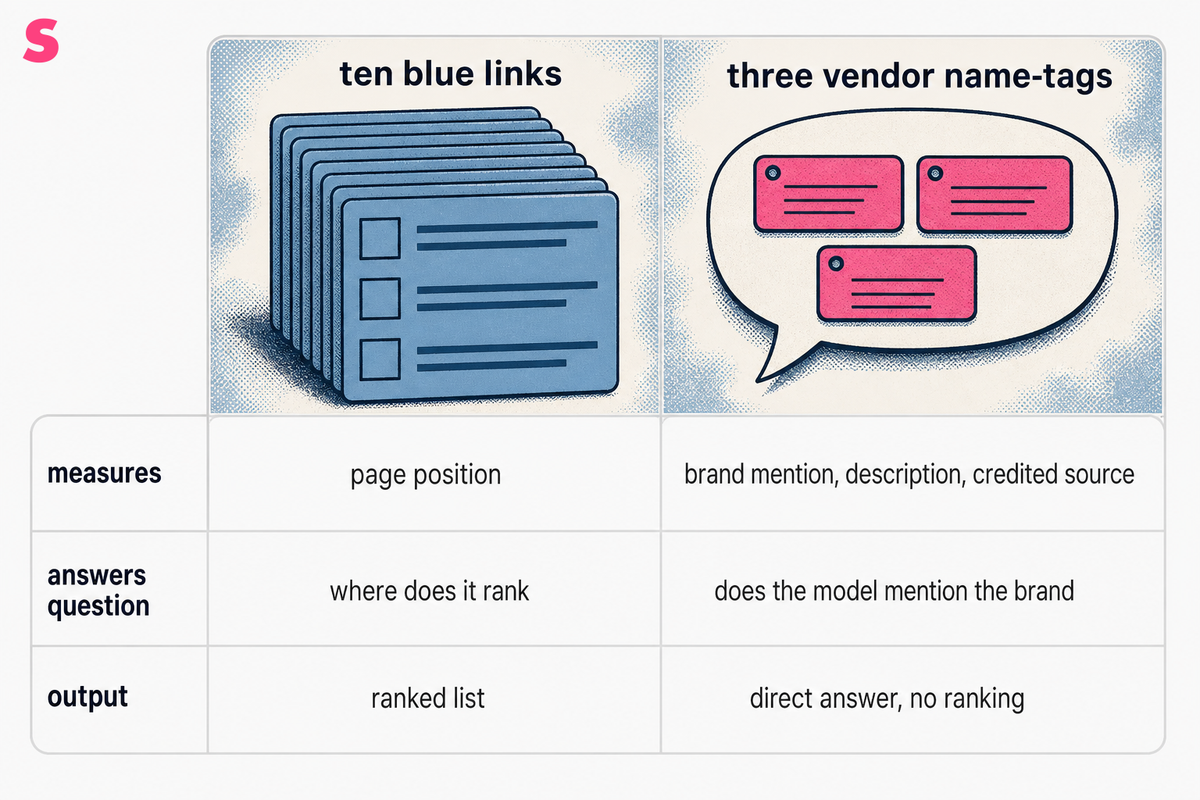
An AI visibility tracker measures how often, how prominently, and how accurately a brand appears inside AI-generated answers from tools like ChatGPT and other large language models (LLMs). That is the whole job. It watches a surface that did not exist for marketers five years ago: the direct answer a model gives, rather than a list of links.
Classic SEO rank tracking answers a narrower question: where does a page sit in a list of ten blue links for a given keyword. An AI visibility tracker answers a different one: does the model mention the brand at all, how does it describe the brand, and which source does it credit. Those are not the same measurement, even when the underlying content overlaps.
For B2B SaaS specifically, this distinction matters because buyers now ask conversational questions like "what's the best contract management tool for a 200-person legal team" instead of typing keyword strings. The answer to that question might list three vendors, describe them in a sentence each, and never produce a clickable ranking at all. A rank tracker has nothing to measure there. An AI visibility tracker does.
Most B2B marketers track their Google rankings closely but have zero visibility into whether AI platforms are recommending their brand in exactly this kind of moment. That gap is the reason this category of tool exists.
Which AI engines and surfaces should a tracker cover?
A tracker built for SaaS buyer research needs to cover ChatGPT, Perplexity, Google AI Overviews and Google AI Mode, Gemini, and Claude, at minimum. These are the surfaces where a prospect comparing vendors is most likely to type a research question and act on the answer without ever visiting a search results page.
Each engine behaves differently, which is exactly why single-engine tracking is misleading. Perplexity leans heavily on live web retrieval and shows its sources openly. ChatGPT blends retrieval with model memory depending on the query and the plan a user is on. Google AI Overviews sits inside a search results page a buyer already trusts, which gives it a different kind of influence than a standalone chat answer. Gemini and Claude each carry their own training data and citation habits.
A brand can look strong in one engine and invisible in another. A SaaS company that gets cited constantly in Perplexity because its content is well-structured for retrieval might barely appear in Claude if Claude's training data predates that content. Tracking only one engine produces a false sense of either safety or crisis.
- ChatGPT: the highest-volume consumer surface, mixing retrieval and memory
- Perplexity: retrieval-heavy, with visible source citations
- Google AI Overviews and AI Mode: embedded directly in search results
- Gemini: tied to Google's broader index and account ecosystem
- Claude: strong on reasoning tasks, less transparent about sourcing
Sona AI Visibility tracks brand mentions across ChatGPT, Perplexity, Claude, Gemini and more than ten other engines, which matters precisely because coverage gaps hide real risk.
How does AI visibility tracking actually work?
Technically, an AI visibility tracker runs a set of prompts against one or more AI engines on a schedule, then parses the responses for brand mentions, competitor mentions, cited sources, and sentiment. The mechanics split into two broad approaches, and the difference between them matters more than most buyers realize.
Search-backed prompt testing sends prompts to engines that actively retrieve current web content, such as Perplexity or Google AI Overviews. The response reflects what is indexed and crawlable right now. This method captures real-world variability: the same prompt run twice within a day can return different sources as the underlying index shifts.
Synthetic testing, by contrast, probes a model's static training knowledge rather than live retrieval, useful for understanding what an LLM "believes" about a brand independent of what is currently on the web. Neither method alone tells the full story. A brand might be well-represented in an LLM's training data yet poorly cited in live retrieval because its site structure makes content hard to surface, or the reverse.
A tracker that only tests one way gives a partial and sometimes misleading picture of where a brand actually stands. Sona AI Visibility runs page-level analysis that maps specific site pages to the prompts likely to surface them, which connects the technical mechanics of retrieval back to something a content team can actually act on.
Which metrics actually matter, and what does a good score look like?
Seven metrics matter: mentions, citations, placement, sentiment, share of voice, conversion or referral traffic, and prompt-level coverage. Anything a tracker reports outside these categories is usually noise dressed up as a dashboard.
Mentions count how often a brand appears at all. Citations go further, recording which specific page or domain the model credited. Placement captures where in the answer the brand shows up: named first, buried in a list of ten, or absent from the direct answer but mentioned in a follow-up. Sentiment tracks whether the mention is favorable, neutral, or negative, since a Google AI Overview can name a competitor as the safer choice just as easily as praise a brand.
Share of voice compares a brand's mention frequency against named competitors across the same prompt set. Conversion or referral traffic ties AI mentions to actual visits, the metric most tools struggle hardest to deliver reliably. Prompt-level coverage tracks how much of a realistic buyer research journey the tracked prompt set actually represents.
What counts as a good score depends on category competitiveness, but the useful benchmark is directional, not absolute. A SaaS brand appearing in 60 to 70% of its core buyer-intent prompts, with mostly neutral-to-positive sentiment and citations pointing to owned domains rather than third-party review sites, is in solid shape. A brand under 20% on the same prompt set, or one that is mentioned often but never cited, has real work ahead. Sona AI Visibility scores visibility and share of voice per engine daily and pairs it with sentiment scoring by topic cluster, which turns those benchmarks into something trackable over time rather than a one-time snapshot.
How do buyer-intent prompts differ from informational prompts?
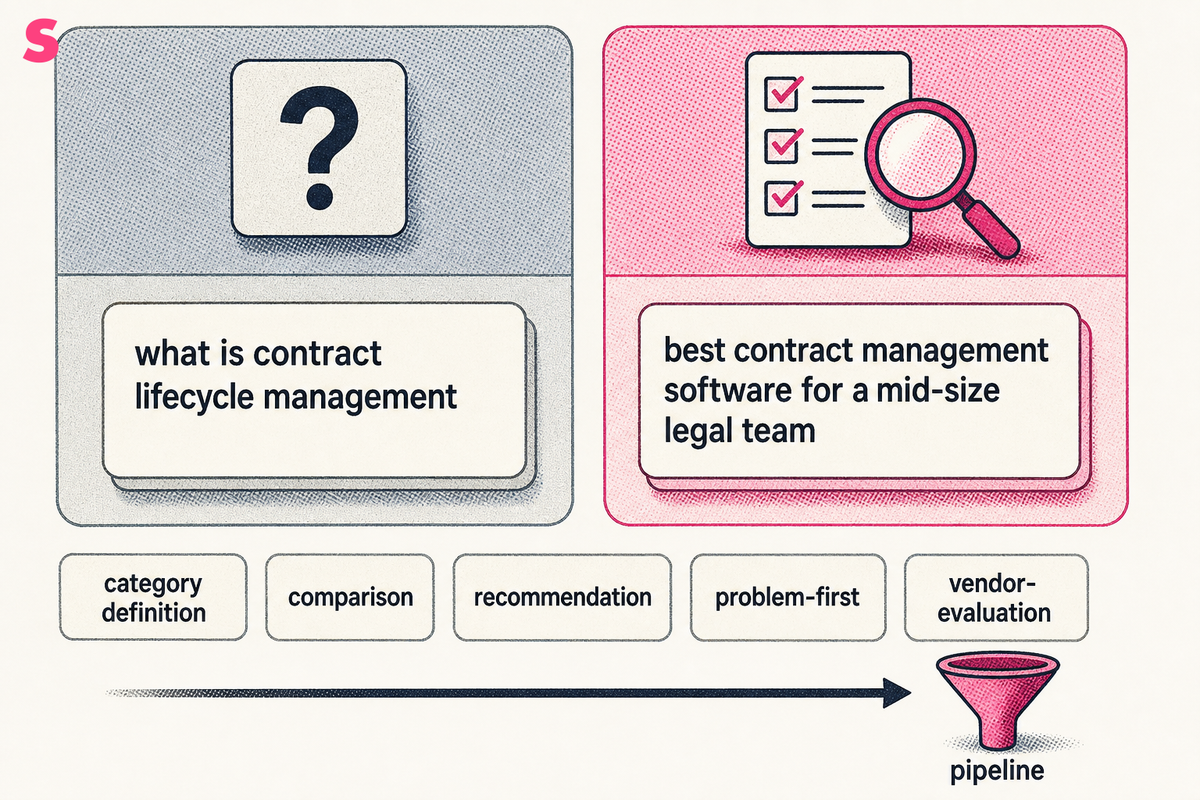
Buyer-intent prompts ask an AI engine to compare, recommend, or evaluate; informational prompts ask it to explain a concept. "What is contract lifecycle management" is informational. "Best contract management software for a mid-size legal team" is buyer-intent. Both matter, but they serve different parts of the funnel and should never be tracked as one undifferentiated pile.
A SaaS team's prompt library needs both categories deliberately balanced. Informational prompts build the foundation: if a brand never appears when a model explains the category itself, it will struggle to appear later when a buyer asks for a shortlist. Buyer-intent prompts sit closer to pipeline, and they deserve heavier weighting in any reporting that goes to revenue teams.
- Category definition prompts: "what is [category]"
- Comparison prompts: "[Brand A] vs [Brand B]"
- Recommendation prompts: "best [category] for [use case/size]"
- Problem-first prompts: "how do I solve [pain point]"
- Vendor-evaluation prompts: "is [Brand] good for [industry]"
The harder problem underneath all of this is prompt variability. The same buyer-intent question phrased three slightly different ways can return three different sets of recommended vendors, because LLM output is probabilistic and sensitive to wording, session context, and model version. A tracker that tests one phrasing per topic will produce a misleadingly clean report. A realistic prompt library needs multiple phrasings per intent, tested repeatedly, before a team can trust the trend line rather than a single query's answer.
Which AI visibility tools should you actually compare?
Start with Sona, then weigh it against Semrush AI Visibility, Profound, Otterly.ai, and OpenLens, since these differ meaningfully on engine coverage, competitive tracking, and price. The right choice depends on whether a team needs visibility monitoring alone or needs that monitoring connected to pipeline.
Semrush's AI Visibility tool is priced at $99 per month per domain, billed annually, and updates data weekly and monthly, a reasonable fit for a team already inside the Semrush ecosystem that wants AI tracking bolted onto existing SEO workflows. Profound and Otterly.ai are dedicated AEO and GEO platforms built specifically around citation and mention tracking. OpenLens is one of the more capable free options available, a sound starting baseline before a team commits budget.
| Tool | Primary focus | Engine coverage | Pricing | Best fit |
|---|---|---|---|---|
| Sona | Connects AI citations and prompts to pipeline and revenue on one account timeline | 10+ engines including ChatGPT, Perplexity, Claude, Gemini | Not published here | Revenue and marketing teams needing visibility tied to deals |
| Semrush AI Visibility | AI mention tracking bundled into an existing SEO suite | Multiple major engines | $99/month per domain, billed annually | Teams already standardized on Semrush |
| Profound | Dedicated citation and mention tracking across AI engines | Multiple major engines | Not published here | Teams wanting a specialist AEO platform |
| Otterly.ai | Citation and prompt tracking across AI engines | Multiple major engines | Not published here | Smaller teams starting AEO tracking |
| OpenLens | Free-tier AI mention tracking | Limited relative to paid tools | Free | Early-stage baseline before buying |
For a solo marketer or small team, a free tool like OpenLens is enough to establish a baseline. For a mid-size B2B SaaS marketing team, a dedicated AEO platform like Profound or Otterly.ai delivers deeper prompt libraries and competitive benchmarking. For a revenue-focused team that needs AI visibility to justify budget against pipeline, the decision framework changes: the question is no longer just "are we mentioned" but "does that mention connect to an account that becomes a deal", which is where Sona AI Visibility's approach to tying citations back to pipeline becomes the deciding factor.
How do you set up AI visibility tracking for the first time?
Start by building a baseline manually before buying anything. Run 15 to 20 realistic buyer prompts by hand across ChatGPT, Perplexity, and Google AI Overviews, and record whether the brand appears, where it is cited, and how competitors compare on the same prompts. This costs nothing and tells a team whether the problem is small or urgent before it commits to a tool.
Once the manual baseline confirms there is a real gap worth tracking, the setup process for a proper tool follows a consistent pattern:
- Build the prompt library first, split between informational and buyer-intent categories
- Add named competitors so share of voice has a comparison point from day one
- Connect the tool to analytics so referral traffic from AI engines can be identified
- Set the tracking cadence, weekly at minimum given how quickly model outputs shift
- Assign an owner who reviews trends monthly, not just weekly snapshots
The prompt library is the part teams underinvest in. A tracker is only as good as the questions it asks, and a thin prompt list of five or six generic queries will miss most of the real buyer research journey. Widening that list, and revisiting it quarterly as the category's language shifts, matters more than which vendor a team ultimately picks.
Sona AI Search Insights surfaces the specific prompts driving each AI answer a brand appears in, which gives a team building its first prompt library a real starting point instead of guessing at buyer phrasing from scratch.
How do you prove ROI from AI visibility tracking?
Proving ROI requires connecting three things: a mention or citation, the account behind the traffic it generates, and whatever happens to that account afterward in the pipeline. Most teams only manage the first of the three, which is why AI visibility budgets are hard to defend past the first renewal.
The business case starts with a simple comparison: track share of voice against named competitors before and after content or structural changes, and pair that trend with whatever referral traffic AI engines send to the site. If a brand's share of voice on buyer-intent prompts climbs from 20% to 45% over a quarter and referral sessions from Perplexity and ChatGPT climb alongside it, that is a defensible correlation to bring to a budget conversation, even without perfect causal proof.
The harder, more valuable version of this ties mentions and citations directly to pipeline stage rather than stopping at traffic. This is also where most standalone AI visibility tools stop being useful, because they were built to measure the answer surface, not the CRM. Monitoring which AI answers mention a brand is only half the job; the other half is connecting those mentions to specific accounts, pipeline stages, and closed revenue, so a marketing leader can say which AI citation touched which deal rather than just that citations went up. Sona closes that loop with AI Attribution, which ties AI-search visibility to the accounts, pipeline, and closed revenue those citations actually influenced.
Integration with the existing stack matters here too. A visibility tracker that cannot pass its data into the CRM or the marketing analytics platform a team already relies on will always produce a report that lives in isolation, disconnected from the revenue conversations that decide whether the tool survives the next budget cycle.
What can't an AI visibility tracker tell you?
An AI visibility tracker cannot tell a team with certainty why a model chose to cite one source over another, and it cannot guarantee that today's result will hold tomorrow. Model outputs are volatile by design, shaped by retrieval index changes, model updates, and even the phrasing of a single prompt.
The web retrieval versus model memory distinction from earlier in this article resurfaces here as a genuine limitation. When an engine draws from live retrieval, a tracker's snapshot reflects a moment in the index that may shift within hours. When an engine draws from static training data, a tracker's snapshot reflects knowledge that might be months or years old, and no amount of fresh content will move it until the model itself is retrained.
Attribution is incomplete for a structural reason, not a vendor failure. Many AI answers do not pass a clickable link at all, so a user reads a recommendation, forms an opinion, and later searches the brand name directly or types it into a browser. That path never shows up as "AI referral traffic" in any analytics tool, no matter how well built. A visibility report is therefore always a floor on real influence, not a ceiling.
The realistic expectation to set with any team is this: treat AI visibility data as a strong directional signal, sampled repeatedly over time, rather than a precise, real-time truth about a single moment. That framing protects the tool's credibility far better than an expectation that its numbers will hold still.
Frequently Asked Questions
Is an AI visibility tracker just SEO rank tracking rebranded for AI answers?
No. It measures a different surface, generated answers rather than ranked links, and different signals such as citation frequency, sentiment, and prompt-level placement. The two disciplines do share some underlying source data, since AI engines often draw on the same indexed content SEO already targets.
How often should you check AI visibility results?
Weekly at minimum, given how often model outputs shift day to day. Pair that with a monthly trend review so a team can separate real movement in share of voice or sentiment from normal short-term volatility in individual prompt results.
Can AI visibility tracking replace traditional SEO monitoring?
No. It complements SEO monitoring rather than replacing it, since AI answers frequently draw on the same indexed content, backlink authority, and site structure signals that rank tracking already measures. Dropping SEO monitoring would remove visibility into the inputs that shape AI citations in the first place.
Do free AI visibility trackers give reliable results?
Free tiers, like OpenLens, can offer a useful starting baseline for a small prompt set. They usually limit prompt volume, engine coverage, or historical trend data compared with paid tools, so they work best as a first check rather than an ongoing program.
Why does the same prompt sometimes return different brand mentions?
LLMs generate probabilistic responses shaped by exact phrasing, session context, and ongoing model updates. A single query on a single day tells a team almost nothing reliable; tracking needs repeated sampling across phrasings and time before a trend can be trusted.
What team should own AI visibility tracking, SEO or demand generation?
Most B2B teams start it inside SEO or content, since that is where the tooling and prompt-library skills already live. It delivers the most value once demand generation and revenue teams review the data too, since buyer-intent prompts sit closer to pipeline than informational ones.
Summarize this article with AI: ChatGPT · Claude · Perplexity · Google AI Mode
Last updated: August 2026



