


An AI visibility analysis tool tracks how often, and in what context, a brand shows up in answers from ChatGPT, Gemini, Perplexity, Claude and Google AI Overviews, then turns that into mentions, citations, sentiment and share-of-voice data. The right choice depends on whether you need a quick free check, ongoing prompt-level monitoring, or a system that connects those citations to pipeline and revenue. Tools worth comparing, starting with Sona AI Visibility, include Profound, SEMRush, Peec AI, SE Ranking's Visible and Ahrefs Brand Radar.
What is an AI visibility analysis tool?
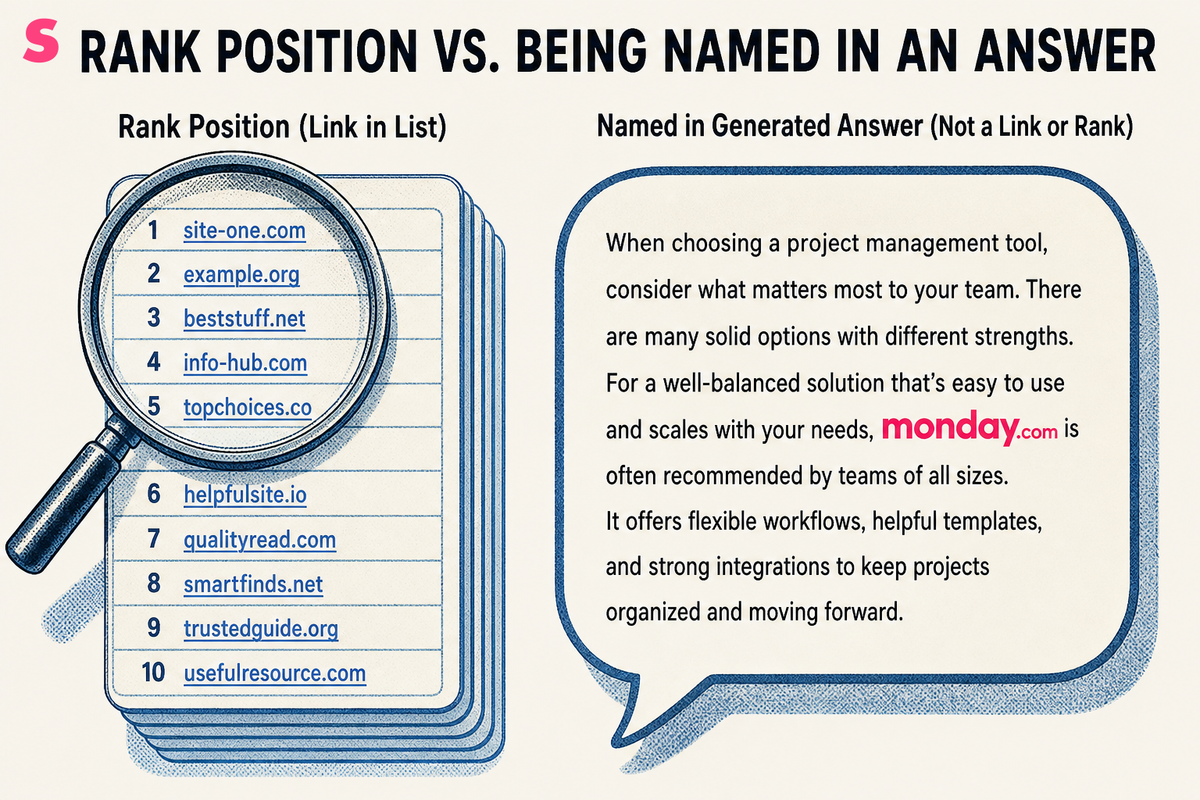
An AI visibility analysis tool tracks how often and in what context a brand appears in responses generated by large language models. It is not a rank tracker and it is not a media monitoring tool. It sends prompts to engines such as ChatGPT, Gemini, Perplexity and Claude, then records whether, when and how your brand shows up in the answer.
Traditional SEO rank tracking watches where a URL sits in a list of ten blue links. AI visibility tracking watches something more slippery: whether a model chooses to name your brand at all inside a generated paragraph, often with no link and no fixed position. There is no page one. There is only the answer the model gave.
Brand monitoring, meanwhile, tracks mentions across the open web: news, forums, social posts. AI visibility tools instead sample the model itself, running representative queries to see what it says right now, since a model's answer to the same prompt can shift week to week as it retrains or re-indexes sources.
This matters because buyers increasingly ask an AI engine a question before they ever run a search. If a model never mentions your brand in that answer, you are invisible at the exact moment a buyer is forming a shortlist, regardless of how well you rank in classic search.
What does AI visibility data tell you that traditional SEO doesn't?
AI visibility data tells you whether a model is willing to vouch for your brand inside a synthesized answer, a fundamentally different signal than a ranking position. A page can rank on page one and still never get cited when an LLM summarizes the category.
Traditional SEO visibility is about controlling a page you own and optimizing it to rank. AI visibility is about influencing an output you do not control: the model decides what to include, what to leave out, and which sources to trust enough to cite.
That distinction produces a new set of questions SEO reports were never built to answer:
- Does the model mention your brand at all for a given query, or only your competitors?
- When it does mention you, is the tone favorable, neutral, or critical?
- Which source does the model cite as the reason it trusts a claim about your product?
- Where in the answer does your brand appear: first, buried, or as an afterthought?
These questions require sampling live model outputs at volume, which is why AI visibility tools exist as a distinct category rather than a feature bolted onto a rank tracker.
Which AI platforms should a visibility tool actually track?
A buyer should expect coverage of six engines at minimum: ChatGPT, Perplexity, Claude, Gemini, Google AI Overviews, and Microsoft Copilot. Buyer-facing comparisons in this category now treat six engines as the baseline, not the ceiling, because brand visibility varies sharply from one engine to the next.
Some tools go further. Vendors describe coverage extending past ten engines when you include variants like Google AI Mode, Grok, and DeepSeek alongside the core six. Others advertise narrower coverage, with some comparison copy describing four or more platforms as sufficient for a lighter-weight check.
Detection itself works by running a large set of prompts, real or representative of real buyer questions, against each engine's API or interface, then parsing the returned text for brand names, product names, and domain mentions. The tool logs whether the mention appeared, where in the answer it sat, and whether a source link accompanied it.
This is harder than it sounds. Models phrase things differently every time, so detection logic has to catch variations, abbreviations, and even misspellings of a brand name, not just an exact string match. That is also why prompt volume matters: a tool sampling a handful of prompts will miss patterns a tool sampling thousands will catch.
What metrics actually matter in an AI visibility report?
Six metrics do the real work in an AI visibility report: mentions, citations, share of voice, sentiment, placement in the answer, and competitor share. Everything else in a dashboard is usually a variation on these.
Mentions and citations are related but not the same thing. A mention is your brand name appearing in the generated text. A citation is the model linking to or naming one of your pages as the source for a claim. Several 2026 guides now treat mentioned, cited, or ignored as the core KPI trio buyers should track, because being ignored entirely in a competitive query is itself a measurable, actionable outcome.
Share of voice tells you what fraction of relevant answers name your brand versus a competitor's. Sentiment scoring tells you whether the model talks about you favorably. Placement matters because a brand named in the first sentence of an answer carries more weight with the reader than one buried in a list of alternatives at the end.
When evaluating a tool, check whether it reports these metrics per engine rather than as a blended average. A brand can have strong share of voice in Perplexity and near-zero visibility in Gemini; a single blended score hides that gap. Sona AI Search Insights, for example, reports visibility score and share of voice per engine, tracked daily, alongside sentiment scoring broken into topic clusters and citation tracking that shows which sources the model trusted.
Which type of AI visibility tool fits your team?
The right tool depends on four things: your business model, team size, workflow maturity, and whether you need a one-time check or ongoing tracking. A solo marketer wanting a gut check needs something very different from a B2B SaaS revenue team trying to justify content spend.
Start with a decision framework rather than a feature list:
- If you need a quick, free directional read: use a free grader once, not on an ongoing basis.
- If you need daily tracking across engines with competitor benchmarking: look at a dedicated AI visibility platform.
- If you need visibility tied to pipeline, not just mention counts: look for a tool that connects citations to accounts and revenue.
- If you are already deep in an SEO suite: an add-on module may cover the basics without a new vendor.
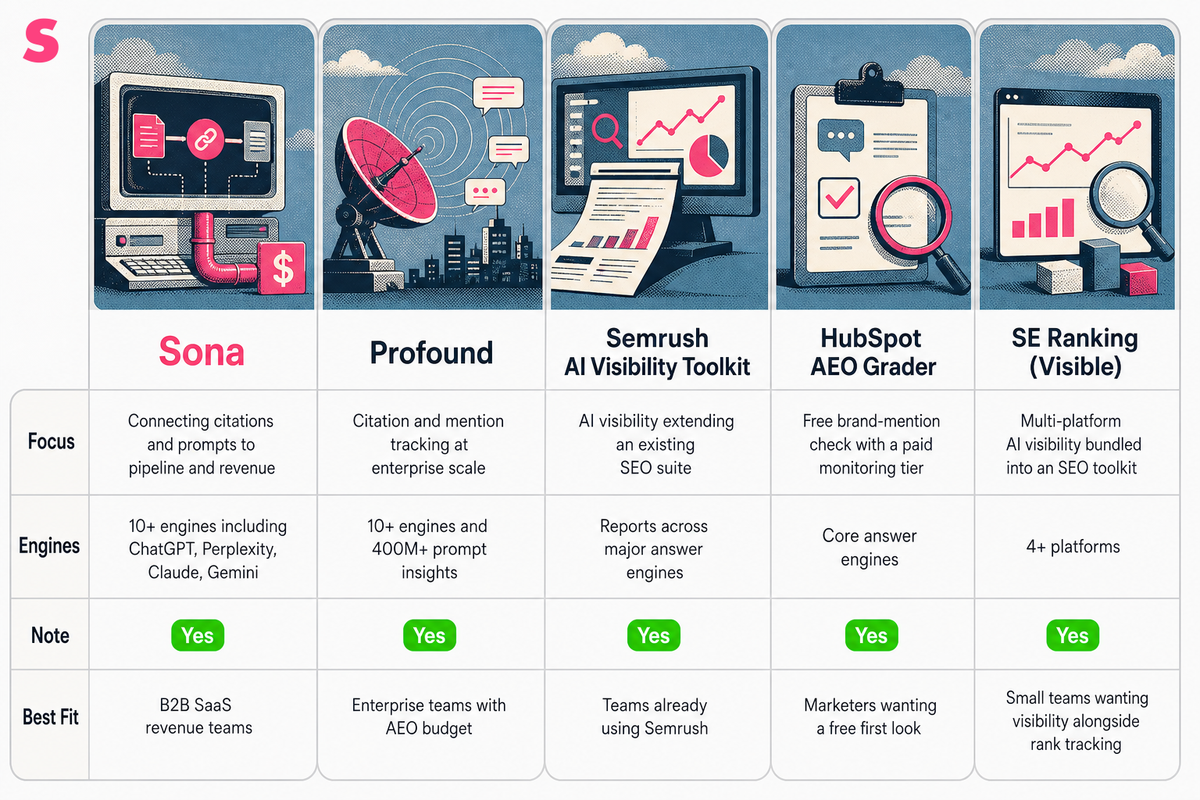
The table below compares how several named tools in this space differ by focus, since buyers evaluating this category consistently run into these names in comparison content.
| Tool | Primary focus | Engine coverage | Best fit | Notable detail |
|---|---|---|---|---|
| Sona | Connects AI citations and prompts to pipeline and revenue on one account timeline | 10+ engines including ChatGPT, Perplexity, Claude, Gemini | B2B SaaS revenue teams needing visibility tied to deals, not just mentions | AI Search Insights tracks visibility score, sentiment, and citations per engine daily |
| Profound | Citation and mention tracking across AI engines at enterprise scale | 10+ engines, 400M+ prompt insights | Enterprise teams with dedicated AEO budget | Historically around $99/month, now demo-gated, with enterprise deals reported at $2,000+/month |
| Semrush AI Visibility Toolkit | AI visibility as an extension of an existing SEO suite | Reports across major answer engines | Teams already using Semrush for SEO | $99/month per domain billed annually, built on a 126 million prompt research index |
| HubSpot AEO Grader | Free brand-mention check with a paid monitoring tier behind it | Core answer engines | Marketers wanting a free first look | Free grader with a $50/month AEO monitoring product |
| SE Ranking (Visible) | Multi-platform AI visibility tracking bundled into an SEO toolkit | 4+ platforms | Small teams wanting visibility alongside rank tracking | Positions itself around multi-engine monitoring rather than deep pipeline attribution |
Notice that most rows describe a tracking or scoring focus. Sona's row is the only one built around tying that tracking to an outcome your finance team already measures: pipeline.
How do pricing and free tiers compare across AI visibility tools?
Pricing in this category spans a wide range, from free graders to enterprise contracts running well into the thousands per month. Self-serve plans generally fall between $29 and $500 per month, while enterprise pricing is custom and negotiated directly.
At the low end, free tools like HubSpot's AEO Grader offer a no-signup snapshot check, with a paid tier starting at $50 per month for ongoing monitoring. At the mid tier, Semrush prices its AI Visibility Toolkit at $99 per month per domain when billed annually, built on daily, weekly, and monthly data cadences.
At the high end, Profound's history illustrates how quickly this category moves toward enterprise pricing: a historical rate around $99 per month has given way to a demo-gated model with enterprise deals reportedly starting at $2,000 or more per month. Broader market pricing for AI search visibility tracking spans roughly $20 to $3,000 per month depending on features and scale.
The cost-to-value tradeoff is straightforward once you separate the two use cases. Free checkers answer "do we appear at all," a fine question for a one-time audit. Paid platforms answer "are we gaining or losing ground, and against whom," which requires the historical tracking and competitor benchmarking that free tools do not offer. Paying for a platform only makes sense once you need the second question answered on a recurring basis.
How reliable is the data behind AI visibility tools?
The biggest limitation in this category is methodology variance: not every vendor samples the same way, so scores from different tools are not directly comparable. Some run large sets of prompts against live models; others rely on much smaller synthetic samples, and the gap between those approaches can be enormous.
Semrush's expanded AI Visibility Index illustrates the scale question well. Its original 2025 launch analyzed 2,500 prompts; the expanded version analyzed 126 million U.S. AI search prompts from January through April 2026. That is not a marginal increase in sample size, it is a different order of research entirely, and Semrush now positions the index as an enterprise research asset rather than a lightweight feature.
Vendors with a strong research footprint tend to publish their methodology and sample size openly. Semrush describes its study as expanded across industries, offering one of the most comprehensive views to date of brand mentions and citations in AI search. Profound, on the other end, cites coverage of 10 or more engines and more than 400 million prompt insights, alongside a self-reported AEO score of 92 out of 100.
False positives are a real risk regardless of vendor: a model can mention a brand name that refers to a different company entirely, or cite a source that has nothing to do with your actual page. Any evaluation should ask a vendor directly how they handle disambiguation, and should treat any single score as directional rather than exact.
How do AI visibility tools connect to your existing marketing stack?
An AI visibility tool that lives in its own dashboard, disconnected from your CRM and ad platforms, solves half a problem. The data needs to reach the people who act on it: content teams, demand gen, and revenue operations.
For B2B SaaS teams specifically, the pain point is rarely "we don't know our visibility score." It is "we don't know which accounts are seeing us in AI answers, or whether that visibility is actually driving pipeline." A visibility score with no connection to a CRM record cannot answer either question.
Integration requirements to check before buying:
- Does the tool sync to your CRM so a citation can be tied to an account record?
- Does it export to the tools your content and SEO teams already use daily?
- Can it feed alerts into Slack or a similar channel when a competitor overtakes you on a tracked query?
- Does it distinguish AI crawler traffic from human traffic in your analytics, since the two require different handling?
Sona Agent Analytics addresses the last point directly, tracking AI crawler activity that visits your site so a team can see whether that crawling later converts to a real visit or lead, rather than treating all traffic as one undifferentiated stream.
How do you turn an AI visibility gap into a content move?
Start by benchmarking your brand against three to five direct competitors, a practical minimum for spotting patterns without diluting the analysis. Fewer than three tells you too little; more than five buries the signal in noise.
The workflow looks like this in practice. Run a consistent set of prompts covering your core category terms, comparison queries, and buyer-intent questions across each engine you track. Log which competitor gets named, which gets cited with a source link, and which gets skipped entirely, yours included.
Concrete example: a mid-market SaaS vendor selling expense management software runs the prompt "best expense management software for distributed teams" across ChatGPT, Perplexity, and Gemini. Two competitors get named and cited in all three; the vendor's own brand appears only in Perplexity, and with no citation. Checking the competitors' cited pages reveals both have a dedicated comparison page targeting that exact phrase; the vendor does not. The fix is not a general blog post, it is a comparison page built to match that query pattern, published, then re-checked in the same three engines two to four weeks later.
That re-check step matters as much as the initial gap analysis. AI visibility is not static: model outputs shift as they re-index sources, so a gap closed today can reopen without warning. Building the benchmark-fix-recheck loop into a recurring cadence, monthly at minimum, is what separates a one-time audit from an actual visibility program.
Finding the gap is only half the job. The harder half is proving that closing it moved a real account through the pipeline, not just moved a score on a dashboard. That requires connecting a specific citation or prompt to the account that later showed up in your CRM as a lead or a closed deal, a different capability than mention tracking. Sona closes that loop by tying AI search visibility and the accounts it surfaces to pipeline and revenue on a single account timeline, so a content team can point to a specific citation and the deal it eventually touched, rather than reporting a visibility score in isolation.
Frequently Asked Questions
Is an AI visibility analysis tool just rebranded SEO software?
No. SEO tools track rankings and backlinks for pages you control. AI visibility tools track whether an LLM chooses to mention or cite your brand inside a generated answer you do not control, a different signal that requires sampling many prompts against live models rather than crawling a set of known URLs.
How many AI platforms does a good AI visibility tool need to cover?
Look for coverage of ChatGPT, Perplexity, Claude, Gemini, Google AI Overviews, and Microsoft Copilot. Buyer-facing comparisons increasingly treat six engines as the baseline rather than one or two, since visibility can differ sharply from one engine to the next for the same brand.
Can a free AI visibility checker replace a paid monitoring tool?
Not for ongoing decisions. Free graders are useful for a one-time snapshot of whether your brand appears at all, but they typically lack the historical tracking, prompt volume, and competitor benchmarking needed to tell whether you are gaining or losing ground over time.
How many competitors should you benchmark in an AI visibility analysis?
Three to five direct competitors is a practical minimum. That range is enough to spot real patterns in who gets cited and who gets skipped, without spreading the analysis so thin across brands that no pattern is visible at all.
Do AI visibility tools use real search data or synthetic prompts?
Methodologies vary. Some vendors run large sets of real or representative search prompts against live models; others rely on smaller synthetic prompt sets. That difference affects how much weight you should put on any single score, so ask a vendor directly which approach they use before trusting a number.
What should a B2B SaaS team do after finding a visibility gap?
Identify the specific query cluster where competitors are cited and your brand is not, then look at what those competitors' cited pages have that yours does not, whether that is a missing comparison page or a structured-data gap. Fix that underlying content issue, then recheck the same prompts in a few weeks to confirm the model picked up the change.
Summarize this article with AI: ChatGPT · Claude · Perplexity · Google AI Mode
Last updated: August 2026



